Pharm.D. NAPLEX Outcomes: What Rates Do and Do Not Show

Co-Founder and Chief Data Scientist
A high NAPLEX pass rate can make a pharmacy school look like a safe choice, but the number does not tell you everything about its students, teaching, or costs. For prospective Doctor of Pharmacy (Pharm.D.) students, the useful question is whether a program offers a credible route from admission through graduation and pharmacist licensure.
This guide explains how to read NAPLEX outcomes, which comparisons are fair, and what to check beyond the exam before committing your time and money.
Key Things You Should Know
- A published NAPLEX first-time pass rate describes exam results for candidates who tested in a reporting period, not the share of an entering class that graduated and became licensed.
- Compare the same reporting year, attempt category, and candidate count across schools, a rate without its denominator can be misleading.
- NAPLEX performance is one quality signal. Verify ACPE professional-program accreditation, graduation outcomes, total cost, experiential training, and state licensure eligibility before choosing a Pharm.D.
What do PharmD NAPLEX pass rates actually measure?
The North American Pharmacist Licensure Examination (NAPLEX) assesses knowledge and skills used in pharmacy practice. A school's first-time pass rate is the share of its reported first-time candidates who passed during the stated reporting period. The candidate count is the denominator: it tells you how many people produced that rate.
Read the label before comparing figures. A first-time rate and a rate that includes repeat attempts answer different questions. An annual testing cohort may also include graduates who finished in an earlier academic year, so it is not automatically the school's most recent graduating class. Neither measure shows how many students entered the program, left before graduation, or never sat for the exam.
NAPLEX reporting applies to pharmacist licensure candidates, not to every credential with "pharmacy" or "doctorate" in its name. That distinction matters when browsing shortest online doctoral programs: a faster doctorate outside an eligible professional pharmacy pathway is not a substitute for a Pharm.D. when pharmacist licensure is the goal.
How should students compare PharmD program NAPLEX outcomes?
Start with the National Association of Boards of Pharmacy (NABP) school-level results and each school's published outcomes. Match the reporting year and first-time attempt category, then read the candidate counts. A single year can be especially uninformative when few graduates tested; several consecutive years give a better view of consistency without guaranteeing what will happen to a future class.
This worksheet keeps the comparison focused on like-for-like evidence. Fill it with published figures and mark anything a school does not disclose rather than treating a missing figure as a favorable result.
| Comparison field | Program A | Program B |
| NAPLEX reporting year and first-time pass rate | - | - |
| Number of first-time candidates | - | - |
| Pattern across available recent years | - | - |
| Graduation or on-time completion outcome, with cohort definition | - | - |
| Published support for students preparing for licensure | - | - |
Ask schools to explain material swings, unusually small candidate groups, and how their graduation figures are defined. If you are considering accelerated Pharm.D. programs, compare their exam results alongside the pace and support available to students; a shorter schedule alone explains neither a high nor a low pass rate.
What do NAPLEX pass rates not reveal about PharmD programs?
A NAPLEX rate cannot establish teaching quality by itself. It does not show whether students received effective clinical supervision, could obtain suitable rotations, graduated on time, accumulated substantial debt, or felt prepared to practice. Admissions selectivity and the academic preparation of students who enroll can also affect results, making a pass-rate difference difficult to attribute to instruction alone.
Most importantly, a rate does not track the entire student journey. A program could report strong results among exam takers while giving a prospective student too little information about attrition or delayed graduation. Request outcomes for the same entering cohort where available, and ask how the school supports students who struggle before they reach the exam.
Be equally careful with alternatives advertised for speed. Lists of fast online pharmacy program choices may include credentials designed for roles other than licensed pharmacist. Their timelines and outcomes should not be compared with a professional Pharm.D.'s NAPLEX results as though the credentials led to the same job.
The Accreditation Council for Pharmacy Education (ACPE) accredits professional Pharm.D. programs. Its standards address the professional education and experiential training a program provides; accreditation is therefore a threshold check for a U.S. pharmacist pathway, not a prediction that every student will pass the NAPLEX. Look up the specific program and its current status in ACPE's official records rather than relying on a school-wide accreditation statement.
Do not confuse three separate checks. ACPE professional-program accreditation, an institution's accreditation, and state authorization to enroll a distance-education student. They answer different questions. None, by itself, grants a graduate a pharmacist license or confirms that a particular state will accept every proposed clinical placement.
Apply the same check to pharmacy transfer credit requirements: acceptance of previous coursework and the accreditation of the professional program are separate decisions. Before enrolling or transferring, confirm both with the receiving school and check licensure eligibility with the board in the state where you intend to practice.
A U.S.-educated applicant typically completes required undergraduate prerequisite coursework, earns a professional Pharm.D., and then meets the requirements of the state or jurisdiction issuing the license. Those requirements generally include the NAPLEX and may include a jurisprudence examination, practical experience, applications, and background checks. Boards set their own rules; some jurisdictions began transitioning from the Multistate Pharmacy Jurisprudence Examination (MPJE) to the Uniform Multistate Pharmacy Jurisprudence Examination (UMPJE) in 2026, so check the board's current instructions rather than assuming one exam applies everywhere.
Passing the NAPLEX is one step, not the license itself. The applicable board determines eligibility and issues the license. Internationally educated pharmacists have a distinct pathway that can include NABP's Foreign Pharmacy Graduate Examination Committee certification before state-specific licensing steps.
Entry into pharmacy school is a different decision from entry into practice. If pharmacy programs with flexible entry requirements appeal to you, still verify the professional program's accreditation and the licensing board's rules; an accessible admissions pathway does not waive licensure requirements.
The professional Pharm.D. builds on prerequisite sciences rather than repeating a pre-pharmacy major. Students study how medicines work, how to evaluate drug therapy and evidence, and how to communicate with patients and other clinicians. They also learn about medication safety, pharmacy law, and practice systems. Coursework and supervised assessment prepare students to make and explain pharmacy-related decisions within the scope of their training.
Experiential education connects that study to practice. Introductory pharmacy practice experiences (IPPEs) introduce students to supervised settings; advanced pharmacy practice experiences (APPEs) involve more sustained clinical and practice responsibilities later in the program. Schools differ in placement schedules and available sites, so ask who arranges rotations, whether travel is likely, and what intern registration or site clearances you must obtain.
For students transitioning into a Doctor of Pharmacy program, prior science coursework may satisfy some admissions prerequisites. The receiving school decides how those credits apply; they do not automatically replace professional coursework or supervised rotations.
An online or hybrid Pharm.D. can lead toward the same professional degree and licensing process when the specific program meets the applicable requirements. The delivery format alone says little about NAPLEX performance or educational quality. Compare the program's accreditation, student support, outcomes, clinical placements, and total cost using the same criteria you would apply to a campus program.
"Online" rarely means that every requirement happens at home. Programs may schedule live classes, campus visits, hands-on assessments, and in-person IPPEs and APPEs. Ask for an actual term and rotation schedule, who approves sites, whether placements can be near you, and whether your state permits the proposed enrollment and clinical activities. These details determine whether a format is workable alongside employment or caregiving.
When you compare online Doctor of Pharmacy programs, treat flexibility as a scheduling claim to verify - not as evidence that the curriculum is self-paced, rotations are remote, or a nearby site is guaranteed.
Schools set their own prerequisite courses, grades, academic thresholds, application materials, interviews, and deadlines. A completed bachelor's degree is not universally required, although some pathways require one. Confirm science laboratories, whether courses may be in progress when you apply, and how the school treats older or previously completed coursework. A stated minimum establishes eligibility to be considered, not a promise of admission.
Many schools use the Pharmacy College Application Service (PharmCAS), but not all do; school-specific instructions may also call for supplemental steps. The Pharmacy College Admission Test (PCAT) was retired in January 2024 and should not appear on a current application plan as an available exam.
Some programs that allow outstanding prerequisites let applicants apply while coursework is unfinished, subject to conditions before enrollment. Verify the exact completion deadline and obtain a written prerequisite evaluation before paying a deposit.
Time to the degree depends on what prerequisite work you have completed and on the professional program's sequence. Many professional curricula run across four academic years; accelerated pathways may compress that schedule but can leave less room for paid work or schedule changes. Compare the time from your current starting point, not just the advertised length of the professional curriculum.
For an affordability decision, request a full, current cost of attendance rather than comparing tuition alone. Include required fees and supplies, prerequisite courses you still need, travel or housing for campus sessions and rotations, and licensing-related expenses. Ask which costs can change with placement location or an extra term. A lower tuition quote may not be the lower-cost route for you.
Federal borrowing rules changed for many new graduate and professional borrowers beginning July 1, 2026. Before planning to cover a funding gap with loans, confirm your classification, eligibility, applicable limits, and any transitional rules with the school's financial aid office and Federal Student Aid. A comparison designed to reduce the cost of pharmacy school is useful only if it accounts for the expenses and aid rules that apply to your enrollment period.
What pharmacist careers, salaries, and job outlook follow a PharmD?
Licensed pharmacists work in settings including community pharmacies, hospitals, ambulatory care, and specialty pharmacy. Responsibilities and hiring preferences vary by role. A Pharm.D. does not ensure a job in a particular setting: some employers prefer postgraduate training or experience, while many pharmacist positions do not require a residency.
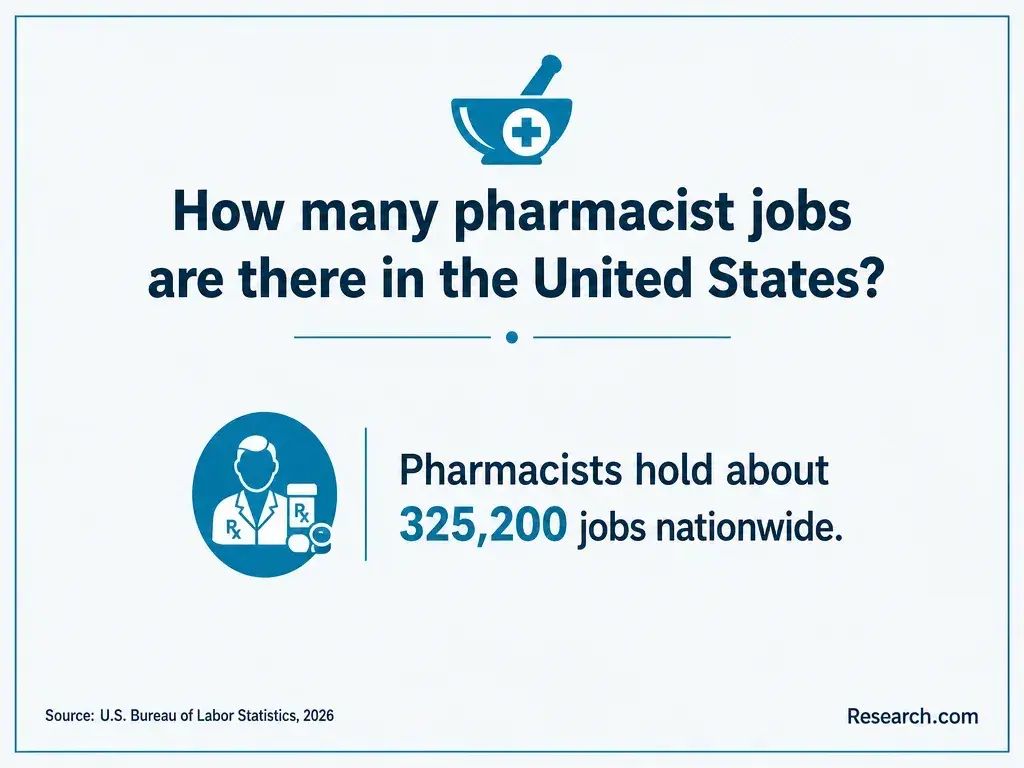
According to the Bureau of Labor Statistics, pharmacists' median annual pay was $140,910 in May 2025, with 5% projected job growth, 2025-2035 and about 12,500 openings per year projected. These occupation-wide figures are context for a career decision, not a forecast of an individual graduate's starting pay or local opportunities.
A residency provides structured postgraduate practice training; a fellowship generally focuses on a different, often research- or industry-oriented training objective. Optional specialty board certification is another credential, distinct from both training and state licensure. Decide whether any of these steps serves the roles you want before adding their time and opportunity cost to your plan.
If becoming a licensed pharmacist is not your goal, weigh less extensive routes before committing to a Pharm.D. Research on pharmacy degree programs with shorter timelines can help identify alternatives, but check the resulting occupation and credential carefully: a pharmacy technician is a separate role and does not ordinarily need a Pharm.D.
Other Things You Should Know About PharmD
Potentially, yes. NABP and the board where you seek licensure set the applicable retake, waiting-period, and eligibility rules. Check those rules before scheduling another attempt.
NAPLEX results are reported as pass or fail rather than a numerical score. Consult NABP's current candidate information for the result and performance details available to an unsuccessful candidate.
No. Score transfer sends an examination result to another participating jurisdiction as part of its licensing process. License transfer is a separate process for a pharmacist who already holds a license; the receiving board still sets its requirements.
Ask the program for its most recent graduation and attrition disclosures, the cohorts and dates behind them, and any publicly available student-outcomes report. If a figure is unavailable, note that gap when comparing schools rather than assuming a favorable result.
- accounting for retest effects on oral examinations | nih.gov https://pubmed.ncbi.nlm.nih.gov/20801978/
- Systematic Review of Predictors of Success for the North American Pharmacist Licensure Examination - PMC https://pmc.ncbi.nlm.nih.gov/articles/PMC8715967/
- Association Between NAPLEX Preparation Program Characteristics and First-Time Pass Rates - Nova Southeastern University https://scholars.nova.edu/en/publications/association-between-naplex-preparation-program-characteristics-an/
- What Do We Mean When We Say "Pass Rate"? | wiley.com https://onlinelibrary.wiley.com/doi/10.1111/emip.12297
- Key Outcomes | The Ohio State University College of Pharmacy https://pharmacy.osu.edu/education/doctor-pharmacy/key-outcomes
- School of Pharmacy Graduation Outcome Measures | Lake Erie College of Osteopathic Medicine https://lecom.edu/about/accreditation/pharmacy-graduation-outcome-measures/
- Accreditation & Licensure | UAMS College of Pharmacy https://pharmacy.uams.edu/about-us/accreditation/
- Pharmacy School NAPLEX Pass Rates (2019-Present) | ClinCalc.com https://clincalc.com/Pharmacy/NAPLEX.aspx
- Pharmacy Residency Programs | NAPLEX Pass Rate https://nabp.pharmacy/news/blog/preceptors-and-residency-directors-can-help-pharmacy-students-pass-the-naplex/
- NAPLEX Pass Rate Trends: What the Data Means | TrueLearn https://truelearn.com/resource-library/naplex-pass-rate-trends-2026/