How to compare PharmD programs by transfer credit policy

Co-Founder and Chief Data Scientist
A pharmacy school may accept your previous courses yet give you no advanced standing in its Doctor of Pharmacy (Pharm.D.) program. That distinction can change your graduation date and total cost. Whether you have undergraduate prerequisites, professional pharmacy coursework, or both, this guide shows how to compare transfer policies, identify credits that actually shorten the degree, and get the decisions you need in writing before committing to a school.
Key Things You Should Know
- Acceptance of undergraduate prerequisites does not mean transfer into the professional Pharm.D. curriculum; ask for separate decisions on each.
- A transferred professional course saves time only if it satisfies a required course and fits the receiving program's sequence, clinical training, and residency requirements.
- Compare the cost of completing the degree, not just credits accepted: federal borrowing rules changed for many new professional students beginning July 1, 2026.
How does PharmD transfer credit policy vary by program?
Pharm.D. programs set their own rules for accepting prior coursework. Many evaluate undergraduate courses against admission prerequisites, while transfer into the professional curriculum may be limited, reviewed course by course, or unavailable. A school may also require a transfer student to enter with a particular cohort rather than at the point their total credits suggest.
The distinctions below prevent an accepted transcript from being mistaken for a shorter Pharm.D. program. The receiving school decides both whether credit is accepted and which requirement it fulfills.
| Previous work | What acceptance usually means | Potential effect on graduation |
| Undergraduate pre-pharmacy coursework | Satisfies specified admission prerequisites | May make the applicant eligible to enter; usually does not replace professional courses |
| Professional Pharm.D. coursework | May substitute for specific required courses after review | Can reduce remaining coursework, but may not advance cohort placement |
| Introductory or advanced clinical experiences | Subject to separate review of hours, objectives, sites, and supervision | May need to be repeated if equivalency or program requirements are not met |
If you still need undergraduate courses, investigate how schools let you transfer coursework toward pharmacy prerequisites. If you are already enrolled in a Pharm.D. program, ask specifically about professional-course equivalency and placement; prerequisite policies will not answer that question.
Which PharmD programs accept transfer students?
There is no dependable nationwide list of Pharm.D. programs that will accept every type of transfer applicant. A school may welcome applicants with transferred undergraduate prerequisites but have no available seats for students transferring from another professional pharmacy program. Professional transfers can also depend on academic standing, available cohort space, and how closely the curricula align.
Applicants whose previous degree is in a science field may find pharmacy school for biology and chemistry graduates useful for identifying possible starting points. Even extensive science coursework should be evaluated against each school's current prerequisites, not assumed to replace professional Pharm.D. courses.
What accreditation should a PharmD program have?
Check the receiving program's current professional accreditation status with the Accreditation Council for Pharmacy Education (ACPE). ACPE accredits professional pharmacy education programs; it does not accredit individual pharmacists or issue licenses. Also check the institution's recognized institutional accreditation. The two reviews address different things.
For a distance-learning option, verify state authorization to enroll you where you live and any separate rules affecting clinical placements. Authorization to deliver education, ACPE professional-program accreditation, and eligibility for pharmacist licensure are distinct questions. Confirm the licensing implications with the pharmacy board in the state where you intend to practice.
A listing among shortest online doctoral programs is not evidence that a credential is an ACPE-accredited Pharm.D. Treat accreditation and the exact degree awarded as threshold checks before comparing transfer credits or speed.
The receiving program generally reviews official transcripts and, for professional courses, detailed syllabi showing content, contact hours, laboratory work, assessments, and learning outcomes. It may compare course level, grades, the age of coursework, and whether a course was completed at an acceptable institution. A credit-hour match alone does not establish equivalence.
Ask for the result in writing. A useful evaluation identifies each accepted course, the specific requirement it satisfies, any conditions still outstanding, and the earliest realistic entry point in the curriculum. If you have courses in progress, ask when final transcripts are due and whether admission or placement depends on the final grade.
That review differs from meeting pharmacy degree entry requirements. A school might allow an applicant to apply with unfinished prerequisites while still requiring them to be completed before matriculation. Do not treat permission to apply as credit awarded.
Schools often consider undergraduate science, mathematics, writing, and other general education courses for prerequisite equivalency. Whether a particular course qualifies depends on that school's subject, laboratory, grade, and recency rules. Advanced Placement, community-college, online-lab, and international coursework can receive different treatment across programs.
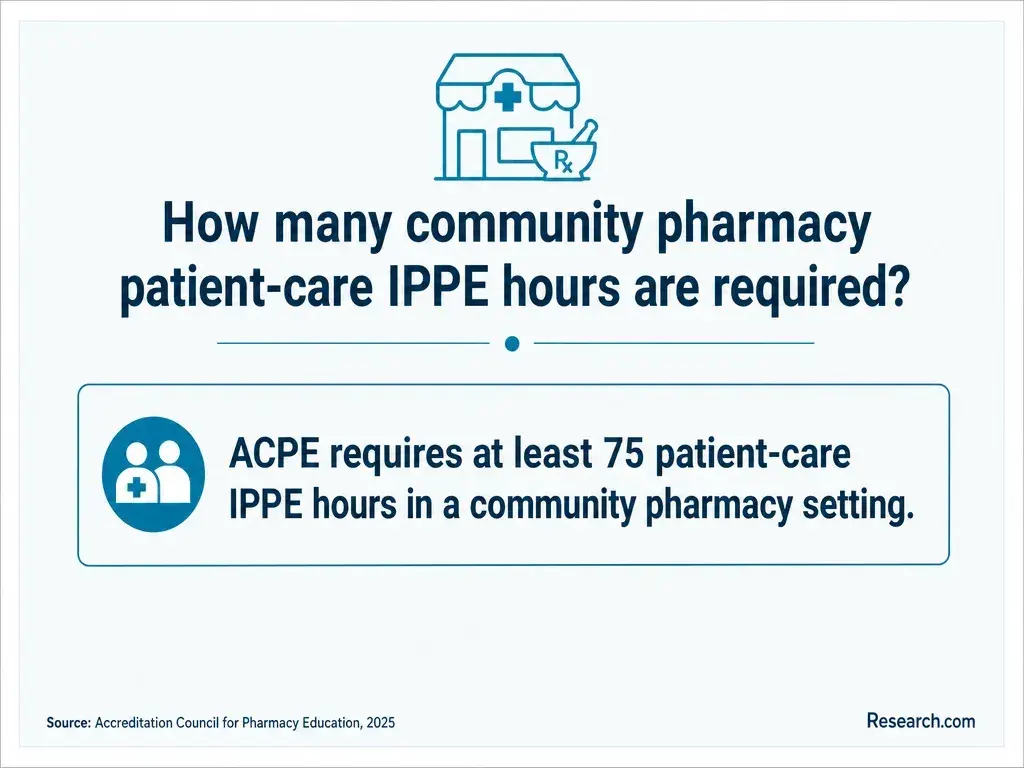
Professional pharmacy courses are harder to generalize. A receiving school may compare pharmacotherapy, pharmaceutics, patient-care skills, or other completed courses with its own integrated sequence. Introductory pharmacy practice experiences (IPPEs) and advanced pharmacy practice experiences (APPEs) require particular care because their objectives, supervision, and placement requirements may differ. Never assume work experience can replace a required rotation.
Credits from fast online pharmacy program choices may serve a different educational goal. A pharmacy technician or other short-program credential is not a Pharm.D.; ask whether its individual courses meet a stated prerequisite rather than assuming the credential transfers into professional training.
Requirements vary by school and by whether you are transferring undergraduate prerequisites or seeking entry after starting a professional Pharm.D. program. Schools may review prerequisite completion, laboratory courses, grades, GPA, academic standing, recommendations, an interview, and explanations for leaving a previous program. Some request a letter of good standing from the current pharmacy school.
Before applying, get answers to these questions so you can separate a firm requirement from a preference:
- Must I complete a bachelor's degree, or will the specified prerequisites suffice?
- Which courses, labs, minimum grades, and course-age limits apply to my entry term?
- Does the school accept professional transfers, and is a seat available in the relevant cohort?
- Which application system, supplemental materials, transcripts, and deadlines apply to transfer applicants?
Reviewing pharmacy schools with accessible admissions can help build an initial list, but an apparently accessible first-year pathway says little about professional-transfer seats or credit awards. The Pharmacy College Admission Test (PCAT) was retired in 2024; do not plan around taking it as a current admissions exam.
Delivery format does not determine whether credits transfer. Both online or hybrid and campus programs can require close matching of professional courses, cohort sequences, and hands-on skills. An online course in the receiving curriculum may still have scheduled live sessions, in-person assessments, or campus labs.
Compare the actual schedule after credit evaluation, not the format label. IPPEs and APPEs involve supervised practice at approved sites; ask who coordinates placements, whether a site near you is possible, and whether travel or time away from work may be required. Intern registration, immunizations, background checks, and site approvals can vary by state and placement.
When exploring pharmacy doctorate programs with distance learning, request the transfer decision and the complete in-person calendar together. A flexible lecture schedule has limited value if remaining labs or rotations conflict with your obligations.
The number of accepted credits is not the same as the number of terms saved. A required course offered only in sequence, an unavailable cohort seat, or rotations scheduled later can keep the graduation date unchanged. Conversely, accepted prerequisites may prevent you from paying to repeat undergraduate coursework even if the professional program takes its usual length.
Request a term-by-term plan and a cost estimate based on that plan. Compare remaining tuition and mandatory fees alongside books and clinical resources, lab supplies, background checks, immunizations, campus visits, rotation travel or housing, and possible time away from work. A lower price per credit is not necessarily a lower cost to completion.
These estimates also matter if you intend to reduce the cost of pharmacy school through borrowing. Federal loan rules changed for many new graduate and professional borrowers beginning July 1, 2026. Have each school's financial aid office confirm your classification, eligibility, applicable limits, and any transitional provisions for your enrollment history rather than relying on an older borrowing example.
Graduating from a Pharm.D. program does not itself make you a licensed pharmacist. U.S.-educated graduates generally must meet their state board's requirements, including examination, internship or practical-experience requirements where applicable, and an application for licensure. The North American Pharmacist Licensure Examination (NAPLEX) assesses pharmacy practice knowledge; the applicable law examination or other jurisprudence requirement depends on the jurisdiction. Some jurisdictions began transitioning from the MPJE to the UMPJE in 2026, so check the current board and National Association of Boards of Pharmacy instructions rather than assuming either exam applies everywhere.
Before transferring, ask whether the new program can document your completed experiential education and what intern-registration rules apply to your future placements and intended licensing state. This is particularly important if the transfer crosses state lines. Residency, fellowship, and specialty board certification are separate postgraduate or professional credentials, not substitutes for a pharmacist license.
Be cautious when comparing pharmacy degree programs with shorter timelines: a faster pharmacy-related credential may suit another career goal, but it does not by itself establish eligibility for pharmacist licensure.
How can you choose a reputable PharmD program for transfer?
Choose among programs that pass the accreditation and licensure checks, then compare their written evaluations rather than their advertised willingness to accept credits. The strongest offer is the one that makes your remaining curriculum, schedule, clinical placements, and cost clear - not necessarily the one that accepts the most credits.
Use the same final checks for each school before paying a deposit:
- Confirm current ACPE professional-program status, the degree awarded, and relevant state authorization and licensure considerations.
- Obtain a course-by-course decision distinguishing accepted prerequisites from professional credits and identifying any clinical experiences that must be repeated.
- Request a term-by-term graduation plan, including cohort entry, campus attendance, and IPPE and APPE placement expectations.
- Compare estimated cost to completion and ask financial aid staff to assess your individual eligibility.
- Review published NAPLEX outcomes with their reporting years and cohort sizes, and ask how the school supports students entering from another curriculum.
If speed is your priority, compare any offer with Pharm.D. programs with an accelerated format. An accelerated program is not automatically transfer-friendly: its tightly sequenced courses may leave less room for advanced standing. If a school cannot explain how accepted credits change your actual graduation plan, keep that uncertainty in your decision.
Other Things You Should Know About PharmD
Some schools offer a reconsideration process. Ask for the policy and deadline, then supply the requested syllabus or documentation showing the disputed course's content and assessments. A review does not guarantee a different result.
Policies vary. A receiving school may award credit without including transferred grades in its institutional GPA, while still considering all transcripts for admission or academic review. Ask how each GPA is calculated.
That depends on the receiving school's eligibility rules and the reason for dismissal. Disclose your full academic history and ask whether you may apply before spending money on an application.
Wait until you understand the receiving school's admission decision, credit award, and start date. Withdrawing early could leave a gap if admission or advanced standing does not materialize; ask both schools about their withdrawal and enrollment deadlines.
- NYS Pharmacy: License Requirements - Office of the Professions https://www.op.nysed.gov/professions/pharmacist/license-requirements
- Impact of Advanced Pharmacy Practice Experience Placement Changes in Colleges and Schools of Pharmacy - PMC https://pmc.ncbi.nlm.nih.gov/articles/PMC3327247/
- Transfer Student Applicants | umaryland.edu https://www.pharmacy.umaryland.edu/academics/pharmd/transfer-student-applicants/
- IPPE & APPE | UTHSC https://www.uthsc.edu/pharmacy/current-students/oel/ippe-appe.php
- Pharmacy | South University https://catalog.southuniversity.edu/pharmacy/doctor-of-pharmacy-pharmd/pharmacy
- Transfer student policy - Doctor of Pharmacy | Physician Assistant Studies https://applebaum.wayne.edu/pharmd/transfer-policy
- FAQ | OSU College of Pharmacy - Oregon State University https://pharmacy.oregonstate.edu/programs-admissions/pharm-d/faq
- Pharm.D. Curriculum - College of Pharmacy https://pharmacy.utexas.edu/programs/pharmd/curriculum
- Transfer Policy | Howard University College of Pharmacy https://pharmacy.howard.edu/academic-programs/four-year-entry-level-pharm-d-program/transfer-policy
- Graduating Early - AS&E Students - Tufts University https://students.tufts.edu/academic-advising-and-undergraduate-studies/advising/graduating-early