
2027 MSN Programs Transition to DNP: What Future Nurse Practitioners Need to Know

Co-Founder and Chief Data Scientist
The education path for nurse practitioners is shifting, with many schools phasing out Master of Science in Nursing (MSN) programs in favor of the Doctor of Nursing Practice (DNP). The American Association of Colleges of Nursing (AACN) has long supported this move to the doctoral level to better prepare advanced practice nurses for today’s complex healthcare system.
According to the most recent data, 439 nursing schools in the U.S. now offer DNP programs, reflecting steady growth in this trend. For aspiring nurse practitioners, this shift brings new considerations around career opportunities and education costs. This guide will break down the differences between MSN and DNP programs, discuss MSN to DNP programs, and outline career prospects to help you make an informed decision about your nursing path.
Key things you should know about MSN transition programs to DNP
- Most MSN-to-DNP programs take two to three years to complete, depending on whether you enroll full-time or part-time.
- Students complete advanced coursework in leadership, healthcare policy, and evidence-based practice beyond their MSN training.
- These programs focus on advanced leadership, healthcare policy, and evidence-based practice beyond the MSN.
- What is driving the move from MSN to DNP programs for nurse practitioners? What is driving the move from MSN to DNP programs for nurse practitioners?
- How long does it usually take to complete an MSN to DNP transition program? Completion Time
- Why are some nurses against the MSN to DNP change? Why are some nurses against the MSN to DNP change?
- What is the difference between MSN and DNP nurse practitioner programs? MSN vs. DNP
- How much do nurse practitioners earn in the U.S. (MSN vs. DNP)? Average Salary
- What are the core competencies emphasized by DNP training? Core Competencies
- What are the main benefits of a DNP compared to an MSN? DNP Benefits
- What jobs can you get with a DNP degree? Potential Jobs
- Can you still get licensed as a nurse practitioner with just an MSN? Can you still get licensed as a nurse practitioner with just an MSN?
- What is the job outlook for nursing graduates who have a DNP degree? Job Outlook
MSN to DNP Programs for Nurse Practitioners: What the Shift Means in 2026
Nurse practitioners who already hold or are considering a Master of Science in Nursing are facing an important education decision: is the MSN still enough, or is it smarter to move into a Doctor of Nursing Practice pathway? The answer depends on your career goals, state licensing rules, employer expectations, cost tolerance, and whether you want to stay primarily in patient care or move into leadership, policy, education, or systems improvement.
The MSN remains a valid route to nurse practitioner licensure, but the profession has been moving toward doctoral preparation for advanced practice. The Doctor of Nursing Practice is designed to prepare nurses not only to diagnose, treat, prescribe, and manage complex care, but also to lead quality improvement, apply evidence in clinical systems, use healthcare data, and influence policy.
This guide explains why MSN-to-DNP programs are growing, how long they take, how they compare with MSN programs, what nurses gain and give up by pursuing the DNP, and how to decide whether the transition is worth it for your situation.
Quick Answer: Is an MSN to DNP Program Worth It for Nurse Practitioners?
An MSN-to-DNP program can be worth it if you want stronger preparation for leadership, healthcare systems improvement, academic roles, policy work, or higher-responsibility advanced practice. It may be less compelling if your goal is only to enter NP practice quickly, minimize debt, or remain in a clinical role where employers do not pay more for a DNP.
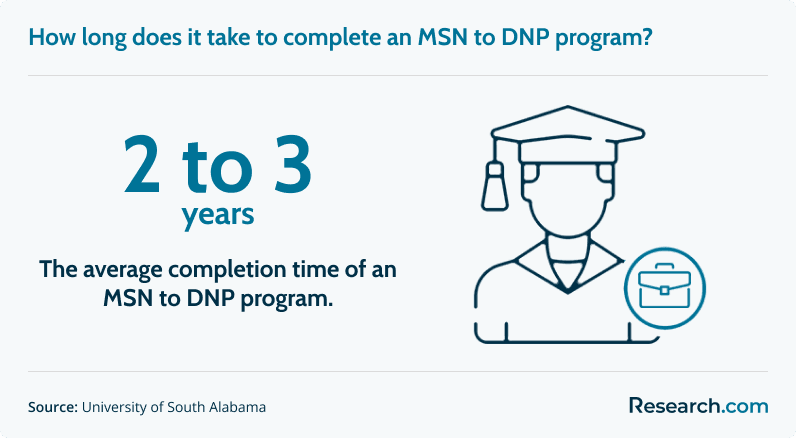
Most MSN-to-DNP programs take about two to three years, depending on full-time or part-time enrollment, transfer credits, required clinical practice hours, and whether the school offers continuous terms. At present, nurse practitioners can still become licensed with an MSN, but the DNP is increasingly viewed as the preferred future standard for advanced practice preparation.
| Decision Point | MSN Pathway | MSN-to-DNP Pathway |
| Best fit | Nurses who want the fastest qualifying route into NP practice | MSN-prepared nurses who want doctoral-level clinical, leadership, policy, or systems training |
| Typical time commitment | Often shorter for entry into practice | Usually about two to three years after the MSN |
| Licensure status | Still accepted for NP licensure | Also accepted and aligned with the profession’s doctoral-preparation trend |
| Career emphasis | Direct patient care and specialty practice | Advanced practice plus leadership, quality improvement, informatics, education, and policy |
| Main trade-off | Less time and lower educational burden | More time and cost, but broader long-term career flexibility |
What is driving the move from MSN to DNP programs for nurse practitioners?
The movement from MSN to DNP preparation is tied to the changing demands placed on nurse practitioners. Advanced practice nurses now manage more complex patients, coordinate care across settings, use digital health tools, interpret data, and participate in systemwide quality and safety initiatives. The DNP was created to strengthen preparation for that broader role.
The American Association of Colleges of Nursing has recommended that the Doctor of Nursing Practice serve as the entry-level degree for nurse practitioners. The AACN’s position is that doctoral-level education better reflects the expanded clinical, leadership, technology, and evidence-based practice responsibilities expected of advanced practice nurses.
Several forces are shaping this transition:
- More complicated care delivery: Nurse practitioners increasingly treat patients with multiple chronic conditions, coordinate with interdisciplinary teams, and work within data-driven clinical systems.
- Professional education standards: The AACN has promoted the DNP as a way to create more consistent advanced practice preparation across nursing programs.
- Comparison with other health professions: Pharmacy and physical therapy have already moved toward doctoral entry-level education, and nursing leaders have argued that advanced nursing practice should follow a similar professional trajectory.
- Demand for leadership-ready clinicians: DNP programs prepare nurses to lead quality improvement, manage teams, evaluate outcomes, and participate in administrative or executive decision-making.
- Stronger emphasis on applied evidence: DNP education focuses on using research findings to change practice, improve care processes, and measure real-world patient outcomes.
How long does it usually take to complete an MSN to DNP transition program?
Most MSN-to-DNP programs take about two to three years to complete. Full-time students often finish closer to two years, while working nurses who enroll part time commonly need closer to three years. Some programs may allow three to four years for part-time completion, especially when students balance clinical practice, family responsibilities, and doctoral project requirements.
The exact timeline depends on the number of post-MSN credits required, whether previous coursework transfers, how many clinical practice hours you still need, and whether the program runs during summer terms. Many programs require around 30–40 additional credits beyond the MSN, along with a scholarly project or clinical immersion experience.
Program length should be considered alongside career and financial planning. For example, comparing the time investment with expected earnings is just as important as researching role-specific outcomes such as nurse care coordinator salary data. The degree may create stronger long-term options, but it also delays the time before you can fully use the credential.
Many MSN-to-DNP pathways are online or hybrid because they are designed for licensed, working nurses. This flexibility resembles other advancement routes, such as a medical assistant to RN bridge online program, where the structure helps healthcare workers continue progressing without leaving the workforce entirely.
| Enrollment Format | Typical Completion Time | Who It Fits Best | Main Consideration |
| Full-time | Closer to two years | Nurses who can reduce work hours or prioritize school | Faster completion, but heavier weekly workload |
| Part-time | Closer to three years | Working NPs balancing employment and family obligations | More manageable pace, but longer time to credential completion |
| Extended part-time | Often within three to four years | Nurses who need maximum scheduling flexibility | Lower course load, but prolonged tuition and project timeline |
Why are some nurses against the MSN to DNP change?
Some nurses oppose the MSN-to-DNP shift because they see it as an added barrier rather than a necessary improvement. Their main concern is practical: the DNP requires more tuition, more time, more clinical or project work, and more delayed earning potential, while the salary difference may not be large in every employer setting.
For many practicing NPs, the MSN has already provided the clinical preparation needed for safe and effective advanced practice. They question whether doctoral preparation should become mandatory when many communities need more primary care providers, not fewer. The concern is especially strong among nurses who would need to take on new debt or reduce work hours to complete the DNP.
The debate is similar to how nurses evaluate other advanced or specialized roles, including whether additional credentials are justified by outcomes such as legal nurse consultant salary potential. More education can create opportunity, but it does not always produce a proportional pay increase.
Common objections include:
- Higher education cost: DNP programs are more expensive than MSN programs, and a pay raise is not guaranteed simply because a nurse holds a doctoral credential.
- Longer preparation time: Additional years in school can postpone career advancement, income growth, or specialty practice.
- Uncertain salary premium: Some clinical employers pay NPs based on role, specialty, location, or productivity rather than degree level alone.
- Potential workforce effects: If doctoral preparation becomes required, some nurses worry fewer candidates may pursue NP roles during a period of rising patient demand.
- Confidence in MSN training: Many MSN-prepared NPs believe their graduate education already equips them for competent advanced practice.
What is the difference between MSN and DNP nurse practitioner programs?
MSN and DNP nurse practitioner programs can both prepare nurses for advanced practice, but they are not built around the same level of preparation. MSN programs generally focus on clinical knowledge, assessment, diagnosis, treatment, prescribing, and specialty practice. DNP programs add doctoral-level coursework in leadership, health systems, quality improvement, policy, informatics, and translation of evidence into practice.
Nurses considering broader specialty preparation, such as dual FNP ACNP programs, should compare not only specialty tracks but also degree level. A dual-track MSN may provide wider clinical eligibility, while a DNP may add stronger preparation for systems leadership and advanced organizational roles.
| Feature | MSN Nurse Practitioner Program | DNP Nurse Practitioner Program |
| Program length | MSN programs usually take two years to complete | DNP programs often require three to four years, with post-MSN options commonly shorter than BSN-to-DNP routes |
| Primary focus | Clinical preparation for advanced patient care | Advanced clinical practice plus leadership, policy, systems improvement, and evidence translation |
| Clinical hours | Typically around 500–700 clinical hours | Can exceed 1,000 hours, depending on prior preparation and program requirements |
| Final requirement | May include a thesis, capstone, or clinical project | Requires a scholarly project focused on applying evidence to a real healthcare problem |
| Career direction | Primarily direct patient care and specialty clinical practice | Clinical practice plus leadership, academic, executive, quality improvement, and policy-related pathways |
The longer DNP route can be compared with other extended graduate pathways, such as online MSN to PhD programs. The key difference is that the DNP is a practice doctorate focused on improving care delivery, while the PhD is a research doctorate focused on generating new knowledge.
How much do nurse practitioners earn in the U.S. with an MSN vs. a DNP?
Salary should be part of the MSN-to-DNP decision, but it should not be the only factor. In the U.S., MSN-prepared nurse practitioners have an average annual salary of around $108,000. DNP-prepared nurse practitioners generally average about $116,000 per year. These figures provide a useful comparison point, but actual earnings vary by specialty, location, employer type, years of experience, productivity model, and leadership responsibilities.
As with choosing MPCAC accredited master’s programs in psychology, the credential itself is only one part of the value equation. Nurses should also consider accreditation, licensure alignment, career mobility, specialty demand, and whether the program helps them qualify for the work they actually want.
The DNP may lead to higher compensation when it helps a nurse move into roles with greater responsibility, such as leadership, education, policy, quality improvement, or specialized practice. However, not every employer pays more for the degree alone. Nurses comparing earnings should look closely at role-specific outcomes, including DNP FNP salary information, rather than assuming the doctorate automatically produces a large raise.
| Credential | Average Annual Salary | How to Interpret the Number |
| MSN-prepared nurse practitioner | Around $108,000 | Reflects a baseline for many NPs working in clinical roles across specialties and settings |
| DNP-prepared nurse practitioner | About $116,000 | May reflect access to higher-responsibility roles, but pay varies by employer, specialty, and location |
The salary gap can matter over a long career, but the DNP’s return on investment depends on tuition, lost work hours, employer tuition support, debt, and whether the degree helps you enter better-paid roles.
What are the core competencies emphasized by DNP training?
DNP education is built around advanced practice plus system-level improvement. Instead of focusing only on individual patient encounters, MSN-to-DNP programs train nurses to evaluate care delivery, lead change, use evidence, and improve outcomes across populations and organizations.
Advanced Clinical Judgment
DNP students deepen their ability to assess complex cases, manage advanced treatment plans, and apply current evidence to patient care. This preparation is especially useful for NPs working with high-risk, medically complex, or underserved populations.
Leadership and Organizational Change
Doctoral nursing practice programs emphasize team leadership, resource management, workflow improvement, and organizational strategy. Graduates are expected to understand how clinical decisions connect to staffing, budgets, quality metrics, and patient safety.
Health Policy and Advocacy
DNP-prepared nurses learn how policy decisions affect access, reimbursement, scope of practice, population health, and care quality. This training supports nurses who want to advocate within healthcare organizations, state systems, or national policy discussions.
Quality Improvement and Patient Safety
Quality improvement is central to DNP training. Students learn to identify performance gaps, design interventions, measure outcomes, and refine processes to reduce errors and improve care delivery.
Informatics and Healthcare Technology
DNP programs increasingly emphasize digital health, electronic health records, telehealth, analytics, and data-informed decision-making. Competence in nursing informatics helps advanced practice nurses use technology to improve care coordination and clinical outcomes.
What are the main benefits of a DNP compared to an MSN?
The DNP’s main advantage is not simply that it is a higher degree. Its value comes from the wider set of roles and responsibilities it can prepare nurses to handle. For some NPs, that broader preparation is essential. For others, the MSN may be enough.
| Benefit | Why It Matters | Best Fit |
| Broader career options | DNP graduates may pursue clinical leadership, executive, academic, policy, or quality improvement roles in addition to practice | Nurses who want flexibility beyond direct care |
| Higher earning potential | Average salaries are higher for DNP-prepared NPs, though the difference depends on role and employer | Nurses targeting leadership or specialized positions |
| Stronger systems training | Programs teach healthcare finance, policy, safety, outcomes, and organizational change | Nurses who want to lead programs or departments |
| More clinical and practice hours | DNP students typically complete over 1,000 clinical hours, compared to 500–700 in many MSN programs | Nurses seeking deeper applied preparation |
| Evidence-based practice expertise | DNP projects require students to translate research into measurable practice improvements | Nurses interested in quality improvement or clinical innovation |
| Technology and informatics skills | Training includes data use, electronic records, telehealth, and decision-support tools | Nurses working in digital or data-heavy care environments |
| Policy and advocacy preparation | Graduates learn to analyze regulations and advocate for better systems of care | Nurses interested in population-level impact |
| Academic readiness | DNP graduates may be competitive for faculty and clinical education roles | Nurses who want to teach while maintaining a practice orientation |
What jobs can you get with a DNP degree?
A DNP can support several advanced nursing career paths. Some DNP graduates continue as nurse practitioners in direct care, while others move into leadership, education, public health, health policy, or specialized clinical improvement roles.
| Role | Average Annual Salary | What the Role Involves |
| Nurse Practitioner | $131,500 | Diagnoses conditions, prescribes treatment, manages patient care, and may take on specialized or leadership responsibilities |
| Clinical Nurse Specialist | $146,844 | Improves care in a specialty area such as oncology, pediatrics, or critical care through expert practice, staff mentoring, and protocol development |
| Nurse Executive | $144,103 | Leads departments or healthcare organizations, overseeing staffing, budgets, strategy, and clinical operations |
| Nurse Educator | $104,996 | Teaches nursing students or practicing nurses and develops clinical education programs |
| Health Policy Specialist | $115,123 | Uses evidence and data to shape healthcare policy, regulation, advocacy, and system improvement |
| Public Health Program Director | $118,642 | Designs, manages, evaluates, and funds community or population health programs |
Specialty choice strongly affects how a DNP is used. For instance, nurses researching what you can do with a pediatric care nurse practitioner DNP may find opportunities in pediatric primary care, specialty clinics, quality improvement, children’s hospitals, or academic settings.
The DNP is most useful when it connects directly to a defined career plan. If your goal is advanced clinical practice, leadership, education, policy influence, or healthcare system improvement, the degree may expand your options beyond what the MSN alone typically supports.
Can you still get licensed as a nurse practitioner with just an MSN?
Yes. Nurse practitioners can still become licensed with an MSN. State boards of nursing and national certification bodies currently continue to accept the MSN as the minimum educational preparation for NP licensure. An MSN graduate can complete the required certification process and apply for NP licensure, just as a DNP graduate can.
This matters for nurses building upward from earlier credentials. Someone who began with an associate degree and researched careers with an associate degree in nursing can still progress through RN, BSN, MSN, certification, and NP licensure without being required to complete a DNP under current rules.
However, the professional direction is changing. The AACN has recommended the DNP as the entry-level degree for advanced nursing practice, and many schools have adjusted or expanded doctoral pathways in response. No states currently require the DNP for NP licensure, but future program availability and employer preferences may continue shifting toward doctoral preparation.
| Question | Current Answer |
| Is an MSN still enough for NP licensure? | Yes, MSN-prepared graduates can still pursue certification and licensure as nurse practitioners |
| Do all states require a DNP? | No states currently require the DNP for NP licensure |
| Could requirements change later? | The profession is moving toward doctoral preparation, but nurses should verify current rules with their state board and certification body |
| Should current MSN-prepared NPs be worried? | Practicing NPs should monitor policy changes, but the MSN remains valid for licensure under current standards |
What is the job outlook for nursing graduates who have a DNP degree?
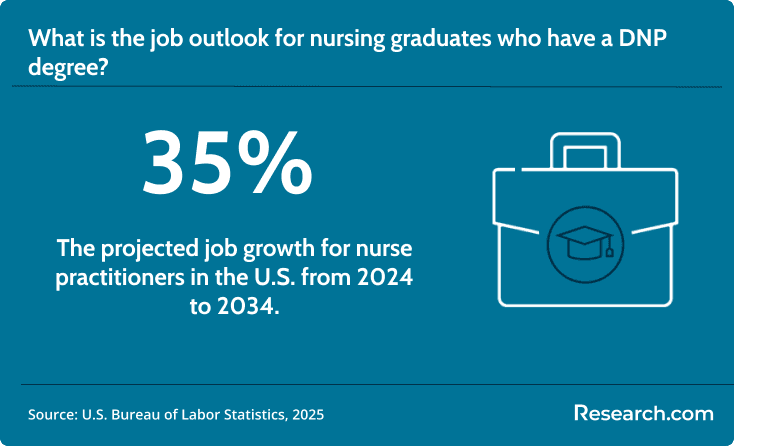
The outlook is strong for DNP graduates, especially those working as nurse practitioners. According to the U.S. Bureau of Labor Statistics, employment of nurse practitioners is projected to grow by 35% from 2024 to 2034, which is much faster than the average for all occupations.
This demand is connected to several healthcare needs: more access to primary and specialty care, stronger emphasis on prevention, wider use of advanced practice providers, and the need for clinicians who can help improve care quality and efficiency.
DNP graduates may also be competitive for leadership, administrative, teaching, and policy roles. Their mix of advanced clinical expertise and systems-focused training can be valuable in hospitals, outpatient practices, universities, public health organizations, and government agencies.
Still, job outlook should be interpreted carefully. A DNP does not guarantee a specific position or salary. Location, specialty, state scope-of-practice rules, experience, certification, and employer demand all affect opportunities.
Is an MSN to DNP program the right choice for you?
The MSN-to-DNP decision should start with your end goal, not with the credential itself. The DNP makes the most sense when the doctoral curriculum helps you reach a role that requires or strongly values advanced practice leadership, systems thinking, data use, policy knowledge, or quality improvement expertise.
| Choose an MSN-to-DNP Program If... | Consider Staying With the MSN If... |
| You want leadership, executive, policy, faculty, or quality improvement responsibilities | You want to enter or continue clinical NP practice with the least additional schooling |
| Your employer rewards doctoral preparation through promotion, pay, or role eligibility | Your current employer does not differentiate between MSN and DNP preparation |
| You want to lead evidence-based practice projects or systemwide care improvements | You prefer direct patient care and do not want broader administrative responsibilities |
| You can manage the tuition, time, and workload without excessive financial strain | The cost would require heavy debt without a clear career return |
| You want to prepare for future shifts in advanced practice education expectations | You already meet licensure requirements and have no need for doctoral-level roles |
How to compare MSN-to-DNP programs before enrolling
Not all MSN-to-DNP programs are equally useful for every nurse. A strong program should match your specialty, licensure needs, schedule, budget, and long-term career plan.
- Confirm accreditation. Make sure the nursing program is properly accredited and recognized for your intended credential and practice pathway.
- Check state licensure alignment. If you plan to practice as an NP, verify that the program supports certification and licensure requirements in your state.
- Compare total cost, not only tuition. Include fees, books, travel for campus intensives, clinical placement expenses, reduced work hours, and loan interest.
- Ask how clinical hours are handled. Find out whether the school helps arrange placements or expects students to secure their own sites and preceptors.
- Review the DNP project model. A strong project should connect to real practice improvement, measurable outcomes, and your professional interests.
- Evaluate schedule flexibility. Online and hybrid formats can help working nurses, but they still require consistent time for coursework, clinical hours, and project work.
- Ask about employer outcomes. Look for evidence that graduates move into the roles you want, such as NP leadership, faculty work, executive practice, or policy positions.
- Clarify transfer credit policies. Your MSN coursework and completed clinical hours may affect how long the program takes and how many credits you need.
Common mistakes to avoid when choosing an MSN-to-DNP program
| Mistake | Why It Can Hurt You | Better Approach |
| Choosing based only on tuition | The cheapest program may not offer strong clinical support, licensure alignment, or relevant specialization | Compare total cost, accreditation, outcomes, and clinical placement structure |
| Assuming online means easy | Online DNP programs still require advanced coursework, clinical hours, and a major scholarly project | Ask for a realistic weekly time estimate before enrolling |
| Ignoring state requirements | Licensure and certification rules can vary by state and specialty | Confirm requirements with your state board and certifying organization |
| Expecting an automatic salary jump | Some employers pay by role, specialty, productivity, or experience rather than degree level alone | Research salary policies for your target employers before taking on debt |
| Starting without a career goal | A DNP is a major investment and may not pay off if it does not connect to a defined role | Identify whether you want clinical advancement, leadership, teaching, policy, or quality improvement work |
| Overlooking clinical placement logistics | Finding preceptors can be one of the hardest parts of graduate nursing education | Ask whether the school provides placement support and what happens if a site falls through |
Questions to ask before applying to an MSN-to-DNP program
- Is the program accredited and appropriate for my intended NP specialty or advanced nursing role?
- Will the program meet certification and licensure requirements in the state where I plan to practice?
- How many credits and clinical hours will I need after my MSN coursework is reviewed?
- Can I complete the program while working full time, or will I need to reduce my hours?
- Does the school help arrange clinical placements and DNP project sites?
- What is the total expected cost, including fees, travel, books, and lost work time?
- Do graduates move into roles similar to the ones I want?
- Will my employer provide tuition reimbursement, promotion opportunities, or salary recognition for the DNP?
- How is the scholarly project structured, supervised, and evaluated?
- What student support is available for online learners, working nurses, and part-time students?
Here’s what graduates have to say about their MSN to DNP degrees:
- Isabella: "Moving from an MSN into an online DNP program let me keep working while building stronger leadership skills. The coursework challenged how I viewed practice change, and I now feel better prepared to guide improvements in my clinic."
- Shania: "The online MSN-to-DNP format gave me enough flexibility to continue caring for my family while advancing professionally. The clinical work and evidence-based project were demanding, but they helped me become a more capable practitioner."
- Christoff: "Completing the DNP after my MSN became a major turning point in my career. I appreciated learning with nurses from different regions, and the program helped me apply research in practical ways that improved patient care."
Key Insights
- The MSN is still accepted for nurse practitioner licensure, and no states currently require the DNP for NP licensure.
- The DNP is gaining momentum because advanced practice nurses are expected to manage complex care, use data, lead improvement projects, and influence healthcare systems.
- Most MSN-to-DNP programs take about two to three years, with part-time students often taking longer than full-time students.
- MSN-prepared NPs average around $108,000 annually, while DNP-prepared NPs average about $116,000, but salary gains depend heavily on role, employer, specialty, and location.
- The DNP is most valuable for nurses who want leadership, education, policy, quality improvement, informatics, or advanced clinical responsibility.
- The degree may not be worth the cost if your employer does not value doctoral preparation and your goal is only to continue standard clinical NP practice.
- Before enrolling, verify accreditation, state licensure alignment, clinical placement support, total cost, transfer credit policies, and graduate outcomes.
- A strong MSN-to-DNP decision is based on career fit and return on investment, not on the assumption that a higher credential automatically leads to better pay or better jobs.
References:
- American Association of Colleges of Nursing. About the Doctor of Nursing Practice. AACN
- Glassdoor. (2025). Salary: Nurse Executive in the United States 2025. Glassdoor
- Indeed. (2025). Nurse practitioner salary in the United States. Indeed
- National Library of Medicine. Nursing informatics resource. Nursing informatics
- Payscale. (2025). Doctor of Nursing Practice (DNP) Salary. Payscale
- U.S. Bureau of Labor Statistics. (2025). Occupational Outlook Handbook: Nurse Anesthetists, Nurse Midwives, and Nurse Practitioners. U.S. BLS
- University of South Alabama. (2025). Online MSN to DNP for Advanced Nursing Practice Roles. USA
Other Things You Should Know About MSN Programs Transition to DNP
A DNP program should be accredited by the Commission on Collegiate Nursing Education (CCNE) or the Accreditation Commission for Education in Nursing (ACEN). Accreditation matters because it affects eligibility for federal aid, certification, and employer recognition after graduation.
By 2027, MSN to DNP programs will incorporate enhanced clinical hours, leadership training modules, and evidence-based practice research projects, aligning with AACN standards. These updates aim to prepare nurse practitioners for comprehensive roles in advanced practice settings.


