PharmD Application Without Pharmacy Experience

Co-Founder and Chief Data Scientist
Not having worked in a pharmacy can make a Doctor of Pharmacy (Pharm.D.) application feel incomplete. But pharmacy experience is not a universal admission requirement, and work history cannot substitute for required coursework.
If you are considering pharmacy school from a science, healthcare, or unrelated background, this guide explains how to check your eligibility, show that you understand the profession, and compare the time and cost of becoming a licensed pharmacist. You can then decide whether to apply now, gain exposure first, or pursue a different route.
Key Things You Should Know
- You can apply without pharmacy experience if the programs you choose do not require it; prerequisites and admission policies are school-specific.
- Experience can strengthen an application by giving you concrete examples of patient service and a tested reason for choosing pharmacy, but it does not replace required courses.
- Plan beyond admission: a typical professional Pharm.D. takes about four years after prerequisites, and graduation alone does not grant a pharmacist license.
Can you apply to a PharmD program without pharmacy experience?
Many Pharm.D. programs consider applicants who have never worked as a pharmacy technician or intern. The deciding question is whether each school requires experience, recommends it, or simply considers it alongside other evidence of readiness. Do not interpret "preferred" as "required," or assume that one school's policy applies elsewhere.
Without pharmacy employment, your application needs a credible explanation of why you want to practice pharmacy rather than another health profession. Relevant evidence might come from patient-facing work, volunteering, research, caregiving, or an informational conversation with a pharmacist. Explain what you observed and learned; do not describe brief exposure as though it were professional practice.
Start with each school's current admissions page and PharmCAS directory entry, if it uses PharmCAS. Pharmacy programs with varied admission routes can help you build a search list, but the school's published requirements control your application.
What are the admission requirements for PharmD programs?
Programs commonly evaluate prerequisite coursework, grades, transcripts, recommendations, an application essay, and an interview. Exact course, minimum-grade, GPA, degree, and deadline rules differ. A bachelor's degree is not universally required: some schools admit applicants who complete specified undergraduate prerequisites without finishing one. Meeting a published minimum does not guarantee admission.
PharmCAS is a centralized application service used by participating schools, not a substitute for checking each school's policies. A school may also require a supplemental application, separate fee, or interview, and not every school uses PharmCAS. The Pharmacy College Admission Test (PCAT) was retired in January 2024; do not plan to take it as a current admissions step.
Before paying an application fee, compare your transcript with the current requirements and ask admissions staff about any uncertain course or deadline. Resources on pharmacy program preparation requirements can help you organize that review, but only the receiving program can confirm whether your courses qualify.
How do you become a pharmacist without prior pharmacy experience?
Prior employment is not the starting credential. The route is to complete a program's undergraduate prerequisites, earn an accredited professional Pharm.D., and satisfy the licensing requirements of the state or jurisdiction where you intend to practice. The professional program supplies supervised practice experiences; you are not expected to arrive already qualified to practice pharmacy.
Use this sequence to identify your next step, rather than treating admission as the end of the plan:
- Choose a target licensing jurisdiction and compare its requirements with those of prospective Pharm.D. programs.
- Complete missing prerequisites and confirm how each school will evaluate your transcripts.
- Seek enough exposure to explain your interest in pharmacists' work, then submit applications under each school's rules.
- Complete the professional curriculum and required supervised experiences, including any applicable student intern registration or site clearances.
- After graduation, meet your jurisdiction's examination and other licensing requirements before practicing independently.
If you mainly want a quicker entry into pharmacy-related work, compare that goal with low-cost and shorter pharmacy degree programs. A shorter credential may serve another role, but it cannot replace the professional degree and licensure required to work as a pharmacist.
Most programs expect undergraduate science preparation - often chemistry, biology, and related laboratory work - alongside mathematics and general education. These are pre-professional prerequisites, not courses in the professional Pharm.D. curriculum. There is no nationwide course list or universal credit-hour minimum: schools decide which courses, labs, grades, and substitutions they accept.
A biology or chemistry major may already have much of the preparation, while an applicant from another field may need additional terms of coursework. Even a familiar course title may not establish equivalency. Programs can differ on community-college credits, online labs, AP or IB credit, older courses, and whether prerequisites may be in progress when you apply. The receiving school decides how previous work counts.
For applicants with substantial science coursework, Pharm.D. programs for students with a pre-pharmacy background provide a starting point for comparison. Send prospective schools course titles, descriptions, lab details, and completion dates when requesting an evaluation; do not assume that having a science degree clears every prerequisite.
It can help, but its value depends on the program and on what you learned. Pharmacy work may give you informed examples for an essay or interview and show sustained interest. It is not an automatic advantage over an applicant with strong academics, service experience, and a thoughtful understanding of patient care. A school's required academic thresholds still apply.
If you have limited time, distinguish two gaps: academic eligibility and professional exposure. Address missing prerequisites first if they prevent admission. For exposure, seek a realistic view of pharmacists' responsibilities through permitted shadowing, volunteering, or conversations; follow site privacy and access rules. If you already have college credits, investigate transfer credits for pharmacy school separately. Work experience does not itself award prerequisite or professional-program credit, and the receiving institution determines what academic credit applies.
The professional Pharm.D. builds on prerequisites through coursework in pharmacology, pharmacotherapy, medication safety, drug information, patient assessment, and communication. Students learn to evaluate medication use and explain recommendations within their level of training and supervision. Coursework alone is not permission to practice independently.
Supervised experiential education begins with introductory pharmacy practice experiences (IPPEs) and progresses to advanced pharmacy practice experiences (APPEs), generally in later stages of the program. Sites, schedules, travel, required clearances, and any intern-registration rules vary. Ask a program who arranges placements and what happens if a student cannot use a nearby site.
Some accelerated Pharm.D. programs compress the academic calendar, not the need to master coursework and complete required practice experiences. Compare their actual breaks, rotation schedule, and work-hour demands before treating a shorter calendar as a better fit.
A traditional professional Pharm.D. commonly takes about four years after required undergraduate prerequisites; some accelerated formats take less time on a more intensive schedule. Your total timeline depends on courses you still need, whether a program admits students without a bachelor's degree, and the program's calendar. Do not confuse a short prerequisite pathway with a shortened professional degree.
Without a named school and aid year, a single tuition figure would be misleading. This table separates the principal cost categories so you can compare schools on the same basis, including expenses that advertised tuition may omit.
| Cost category | What it may include |
| Before enrollment | Missing prerequisites, applications, transcript services, and interviews |
| During the program | Tuition, mandatory fees, books, technology, lab supplies, and required screenings |
| Experiential education | Transportation, possible temporary housing, and time away from paid work |
| After graduation | Licensing applications and required examination fees |
Compare each school's current cost-of-attendance estimate and ask which expenses it includes. Doctor of Pharmacy programs with manageable tuition may be worth reviewing, but lower advertised tuition does not establish a lower total cost. Federal borrowing rules changed for many new graduate and professional borrowers beginning July 1, 2026; have each school's financial aid office explain your eligibility under the applicable rules before relying on loans to cover a budget gap.
Some programs deliver portions of Pharm.D. instruction online or in a hybrid format and may consider applicants without pharmacy employment. "Online" does not mean fully remote or self-paced: hands-on activities, campus visits, assessments, IPPEs, and APPEs can require in-person attendance and scheduled availability.
When comparing best online Doctor of Pharmacy programs, confirm the current format directly with each school. Ask whether classes meet live, how often you must travel, who secures rotation sites, whether placements can be near home, and whether your state permits enrollment and the proposed clinical placements. State authorization for distance education and eligibility for pharmacist licensure are separate questions.
An online pathway may reduce relocation for classes while still requiring travel or reduced work hours during rotations. Treat any promise that you can complete all clinical training remotely - or automatically use your current workplace - as a claim to verify before enrolling.
The Accreditation Council for Pharmacy Education (ACPE) accredits professional pharmacy education programs; it does not certify or license individual pharmacists. Check a program's current status in ACPE's official directory, including any status conditions. Also distinguish professional-program accreditation from an institution's accreditation and its authorization to enroll distance-learning students in your state.
For U.S.-educated applicants, graduation is followed by a jurisdiction's licensing process. This generally includes the North American Pharmacist Licensure Examination (NAPLEX), plus any applicable jurisprudence examination and other board requirements. Do not assume every jurisdiction uses the Multistate Pharmacy Jurisprudence Examination (MPJE): requirements differ, and some jurisdictions began transitioning to the Uniform Multistate Pharmacy Jurisprudence Examination (UMPJE) in 2026. Passing an examination alone does not issue a license. Internationally educated pharmacists have a distinct eligibility pathway that must also be checked with the relevant board and the National Association of Boards of Pharmacy.
Be especially careful when a listing emphasizes online pharmacy program length under two years. Verify the exact credential and ACPE professional-program status; a shorter pharmacy-related program is not necessarily an entry-level Pharm.D. Before committing, confirm that the program's education and placement arrangements align with the licensing board where you plan to practice.
What careers, salaries, and job outlook follow a PharmD degree?
Licensed pharmacists work in community pharmacies, hospitals, ambulatory care, and other medication-focused settings. Duties and hiring preferences vary. A Pharm.D. is the professional education route, but employers may value particular experience or postgraduate training for some positions. A residency provides structured postgraduate practice training; a fellowship generally focuses on a different training objective, often in research or industry. Neither is universally required for pharmacist employment, and specialty board certification is distinct from state licensure.
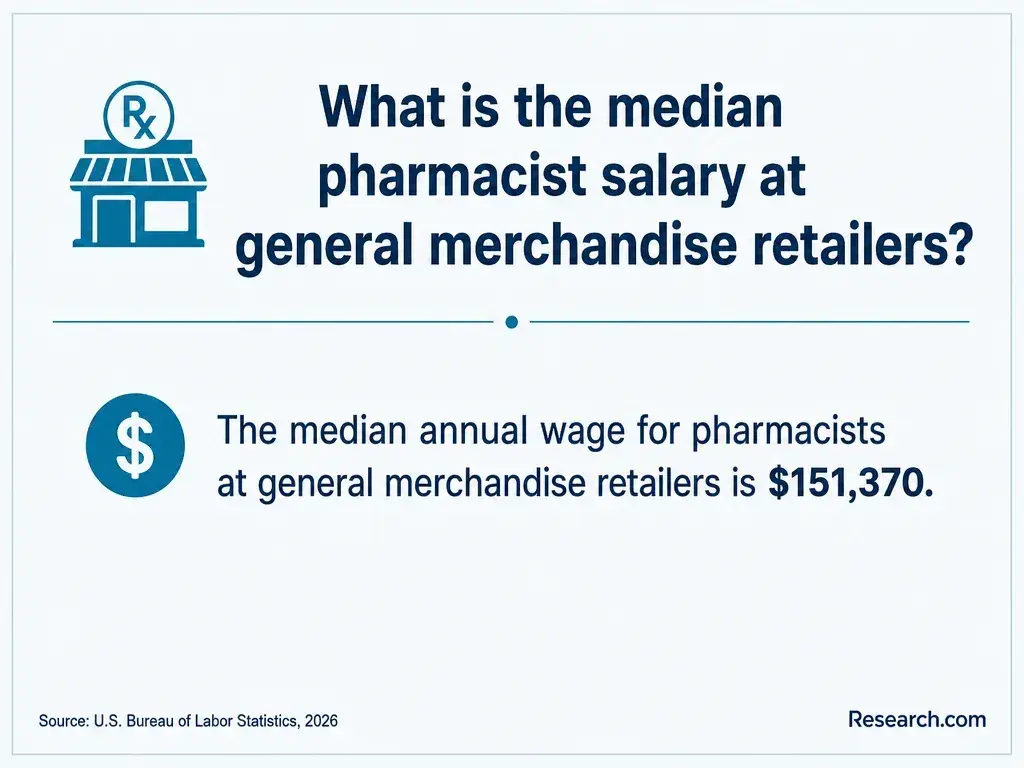
The U.S. Bureau of Labor Statistics reports median annual pay of $140,910 in May 2025 for pharmacists, with 5% projected job growth, 2025-2035 and about 12,500 openings per year. These occupation-wide figures are useful context, not a prediction of an individual graduate's pay or local job prospects.
If you want pharmacy exposure without committing to the Pharm.D., pharmacy technician work is a separate occupation that does not ordinarily require that degree. Its median annual pay was $45,750 in May 2025, according to the Bureau of Labor Statistics. That difference helps frame the education-and-earnings trade-off, but it does not mean either path guarantees a particular income. Likewise, short online doctorate programs may serve other career goals; they are not substitutes for the professional Pharm.D. and pharmacist licensure.
Other Things You Should Know About PharmD
Connect a specific experience from your previous work or studies to pharmacists' responsibilities, then identify what you still need to learn. Avoid claiming that transferable skills alone prepare you to practice pharmacy.
Ask prospective schools what forms of career exploration they value. Informational conversations, approved volunteering, and relevant patient-facing work may give you material to discuss, even when shadowing access is limited.
It may affect admission, experiential placements, intern registration, or licensing, depending on the facts and jurisdiction. Review disclosure rules and contact the relevant school and state board early rather than assuming admission resolves future eligibility.
Reapply when you can show a meaningful change, such as stronger prerequisite performance, better-informed career motivation, or a wider school list. Where available, request feedback and check the new application cycle's requirements before submitting again.
- A brief history of pharmacy admissions in North America - PMC https://pmc.ncbi.nlm.nih.gov/articles/PMC6851653/
- Virginia Board of Pharmacy - FAQ https://www.dhp.virginia.gov/Boards/Pharmacy/PractitionerResources/FAQ/
- PharmD FAQs - UNC Eshelman School of Pharmacy https://pharmacy.unc.edu/education/pharmd/pharmd-admissions-faqs/
- Questions About Clinical Experience - Princeton's HPA https://hpa.princeton.edu/faqs/activities-faq/clinical-experience-faq
- PharmD Application Process and Requirements | umich.edu https://pharmacy.umich.edu/pharmacy-programs/pharmd-program/application-process-requirements/
- Pharmacy | Pre-Health Advising https://prehealth.ucmerced.edu/health-careers/pharmacy
- Prospective Student FAQ " Pharm.D. Admissions " | ufl.edu https://admissions.pharmacy.ufl.edu/admission-requirements/faq/
- Admissions Frequently Asked Questions and Tips | ucsf.edu https://pharmd.ucsf.edu/admissions/faq-tips
- Pharmacist | University of Texas at Rio Grande Valley https://www.utrgv.edu/studentsuccess/for-students/pre-professional/pharmacist/index.htm
- UConn PharmD Applicants | Pharmacy Advising Center https://advising.pharmacy.uconn.edu/faq/uconn-pharmd-applicants/