PharmD tuition and aid comparison worksheet

Co-Founder and Chief Data Scientist
A pharmacy school's tuition quote is not the same as the amount you will need to pay - or borrow - to earn a Doctor of Pharmacy (Pharm.D.) degree. Fees, prerequisite courses, living expenses, and clinical rotations can change which offer costs less. This worksheet is for applicants comparing U.S. Pharm.D. programs, including campus and hybrid options. It shows what to request from each school, how to calculate a comparable net cost, and which accreditation, scheduling, and licensing details to check before accepting an offer.
Key Things You Should Know
- Compare the full cost through graduation, not just annual tuition: include required fees, living expenses, rotation travel, and any prerequisite courses.
- Subtract grants and scholarships from costs, but not loans. Federal borrowing rules changed for many new graduate and professional borrowers beginning July 1, 2026, so confirm your aid-year eligibility with each school.
- Verify the specific Pharm.D. program's ACPE status and clinical-training arrangements before treating a lower-priced offer as a better value.
What does a PharmD tuition and financial aid comparison worksheet include?
A useful worksheet puts every offer on the same time frame: from any remaining undergraduate prerequisites through Pharm.D. graduation. Copy the table for each pair of schools and enter figures from written tuition schedules, financial aid offers, and the schools' published cost-of-attendance budgets. Use the same living arrangement and expense assumptions for both columns.
For each column, add estimated costs, then subtract only confirmed gift aid and tuition benefits to find net cost. Keep loans on a separate line: they finance a cost rather than reduce it, and interest increases repayment expense. Ask whether a quoted award renews automatically or depends on academic progress, enrollment, or available funding.
Earlier coursework can also change the comparison. Check pharmacy degree transfer credit policies, but obtain a written evaluation from each receiving school; accepted undergraduate credit does not necessarily replace professional Pharm.D. courses.
How much does a PharmD program cost in tuition and total expenses?
There is no reliable single price for every Pharm.D. student. Schools may charge by term, credit, or program year; residency classification and annual price changes can also matter. Request a term-by-term tuition and mandatory-fee estimate through your expected graduation date rather than multiplying one advertised term's price without checking the curriculum sequence.
Then account for expenses the tuition figure excludes: prerequisite courses, textbooks and drug-information resources, devices, laboratory supplies, background checks, immunizations, insurance, and living costs. Introductory and advanced clinical rotations may require commuting, temporary housing, or time away from paid work. Licensure applications and exams generally come after graduation, so budget for them separately rather than assuming they appear in the school's educational cost estimate.
An affordable route to a Pharm.D. is the one with a manageable total cost and a workable route through required training - not simply the lowest published tuition. If one school is cheaper only because its budget omits rotation travel, request a comparable estimate before deciding.
What financial aid options are available for PharmD students?
Potential resources include school scholarships, outside scholarships, employer benefits, eligible federal aid, and private loans. The mix depends on the student, program classification, enrollment, aid year, and award conditions. Complete the Free Application for Federal Student Aid (FAFSA) and obtain a program-specific aid estimate; do not assume that aid available during undergraduate prerequisites continues unchanged in the professional program.
Federal rules changed for many new graduate and professional borrowers beginning July 1, 2026. In particular, do not build a budget around assumed access to Graduate PLUS loans or an old borrowing limit. Ask each financial aid office which rules apply to your entry term, whether any transition provision applies to you, and how its cost-of-attendance budget treats rotation expenses. Compare the resulting borrowing gap with savings or other funding you can actually use.
If unfinished prerequisites delay entry, include their tuition and the extra time in your calculation. Guidance on pharmacy degree options without every prerequisite completed can help frame questions, but each school decides which courses may remain in progress when you apply and which must be finished before enrollment.
Online or hybrid instruction may reduce routine commuting or relocation costs, but a professional Pharm.D. still includes supervised in-person experiences. Some programs also require scheduled live classes, campus labs, or immersions. A campus program may cost more for housing yet offer clinical placements that require less travel for a particular student. Neither format is automatically cheaper.
Use the same expense categories for both formats, then ask how often you must travel, who arranges clinical sites, whether placements can be near home, and whether your work schedule can accommodate rotations. Compare online pharmacy education duration claims carefully: a short pharmacy-related degree is not necessarily a Pharm.D. or a route to pharmacist licensure.
Verify the specific professional Pharm.D. program's current status in the Accreditation Council for Pharmacy Education (ACPE) program directory, including any conditions or status changes. Also check the institution's recognized institutional accreditation. These are different reviews: institutional accreditation alone does not establish that a Pharm.D. program holds the professional accreditation relevant to the usual U.S. pharmacist-licensure pathway.
For a distance-learning option, separately confirm whether the school may enroll you in your state and whether it can arrange or approve the required in-person training there. State authorization to provide education is not a promise of clinical placement or pharmacist-licensure eligibility. Apply these checks to any advertised online pharmacy school programs before comparing their prices.
Applicants generally complete specified undergraduate pre-pharmacy coursework before entering the professional Pharm.D. curriculum, but required courses, labs, grades, credit rules, and bachelor's-degree expectations vary by school. The retired Pharmacy College Admission Test (PCAT) is not a current exam to budget for. Check each school's current admissions page and, where applicable, its PharmCAS directory listing rather than assuming every school uses the same application process.
For a fair cost comparison, ask for an evaluation of outstanding prerequisites and whether accepted prior coursework satisfies them. Review pharmacy school prerequisites and eligibility as a starting point, then confirm the requirements and deadlines directly with the programs. A school's minimum GPA or credit threshold establishes eligibility for consideration, not admission.
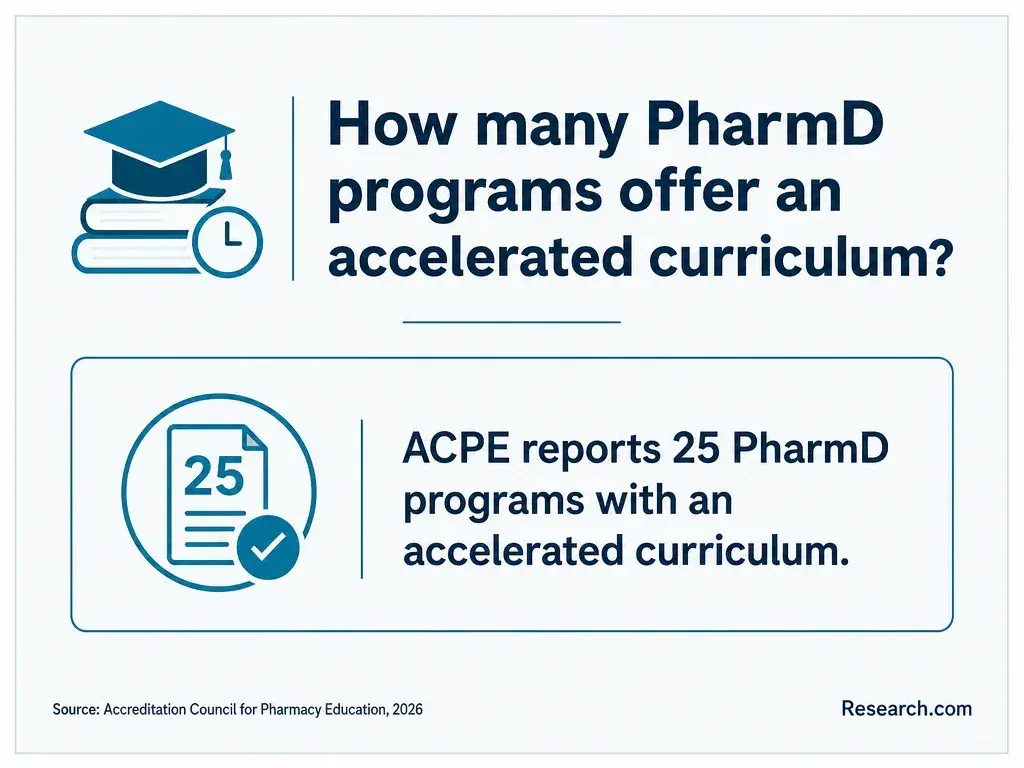
Many professional Pharm.D. curricula span four academic years after prerequisites, while some use an accelerated calendar. Your actual timeline also depends on unfinished undergraduate courses, the program's start term, required rotations, and whether courses follow a fixed sequence. Enter your expected graduation term in the worksheet, not just the number of years shown in marketing materials.
Pharm.D. programs with an accelerated format may reduce time away from full-time earnings, but a tighter schedule can limit paid work or increase summer living and travel expenses. Ask for the complete academic calendar and total tuition through graduation before assigning a financial advantage to the shorter route.
The professional curriculum develops medication-related scientific knowledge, patient assessment and counseling skills, therapeutics, and safe pharmacy practice. It also includes introductory pharmacy practice experiences (IPPEs) and later advanced pharmacy practice experiences (APPEs) in supervised practice settings. These experiences are distinct from undergraduate science prerequisites and may create transportation, housing, and scheduling costs.
Ask who identifies and approves rotation sites, what travel students have historically needed, and what responsibilities fall to students for intern registration, screenings, immunizations, or site onboarding. Prior science coursework may help with preparation, but online pharmacy programs for science-background students still require the professional curriculum and in-person experiential training; a biology or chemistry degree does not substitute for them.
A Pharm.D. degree does not itself authorize pharmacy practice. Graduates seeking U.S. pharmacist licensure must meet the relevant state board's requirements, typically including the North American Pharmacist Licensure Examination (NAPLEX), applicable pharmacy-law assessment requirements, and any state-specific application or training conditions. Jurisprudence requirements differ by jurisdiction; do not assume your state requires the Multistate Pharmacy Jurisprudence Examination (MPJE), particularly as some jurisdictions began moving to the Uniform MPJE (UMPJE) in 2026.
Budget for exam and application fees and allow time between graduation and a possible license. Comparisons of how long online doctoral programs take describe degree completion, not the full licensing process. Confirm current eligibility, exams, and fees with the board where you intend to practice. Internationally educated applicants may face a different pathway.
What careers, salaries, and job outlook follow a PharmD degree?
Licensed pharmacists work in settings such as community pharmacies, hospitals, ambulatory care, and other medication-focused services. The Bureau of Labor Statistics reports median annual pay of $140,910 in May 2025 for pharmacists and projects 5% growth during 2025-2035, with about 12,500 openings per year. These national figures describe an occupation, not a salary offer or return on investment for a particular graduate. Location, setting, hours, and available positions matter when judging whether projected borrowing is manageable.
A residency may support entry into some clinical roles, and fellowships or optional specialty board certification serve different purposes; none replaces state licensure, and none is required for every pharmacist job. If your goal does not require practicing as a pharmacist, compare low-cost and shorter pharmacy degree programs against the actual qualifications for the work you want. Pharmacy technician roles, for example, are a separate occupation and do not ordinarily require a Pharm.D.
Before committing, favor the offer whose verified net cost you can fund and whose accreditation, timetable, and rotation arrangements support your intended licensing state. If one estimate relies on unconfirmed aid, unspecified clinical travel, or borrowing you may not qualify for, request written clarification before paying a deposit.
Other Things You Should Know About PharmD
Yes. Ask whether it is refundable and whether it is credited toward tuition. A credited deposit affects when you pay, but should not be counted as an extra program cost.
Not safely. Confirm how long each award lasts, its renewal conditions, and whether the amount changes when tuition or enrollment changes.
Request the benefit's annual terms and any repayment obligation if you leave your job. Count only the assistance you expect to remain eligible for while meeting the program's class and rotation schedule.
Check both deposit deadlines, request a written extension if needed, and ask the other school when its aid offer will be available. Do not treat an estimated scholarship as confirmed funding.
- Cost of Attendance (Budget) | 2026-2027 Federal Student Aid Handbook https://fsapartners.ed.gov/knowledge-center/fsa-handbook/2026-2027/vol3/ch2-cost-attendance-budget
- What Financial Aid Offers Don't Tell You About the Cost of College | U.S. GAO https://www.gao.gov/blog/what-financial-aid-offers-dont-tell-you-about-cost-college
- Fast Facts: Tuition costs of colleges and universities (76) | ed.gov https://nces.ed.gov/fastfacts/display.asp
- Types of Financial Aid: Grants, Work-Study, and Loans | studentaid.gov https://studentaid.gov/understand-aid/types
- Cost of Attendance " Pharm.D. Admissions " | ufl.edu https://admissions.pharmacy.ufl.edu/financial-aid/anticipated-expenses/
- How Enrollment Affects Your Federal Student Loans | The University of Iowa https://financialaid.uiowa.edu/types-aid/loans/how-enrollment-affects-your-federal-student-loans
- Tuition & Financial Aid - Doctor of Pharmacy (PharmD) https://pharmsci.uci.edu/degrees-programs/doctoral-programs/pharmd/tuition-financial-aid/
- Changes to 2026-2027 Federal Student Loans | columbia.edu https://sfs.columbia.edu/content/changes-2026-2027-federal-student-loans
- Understanding cost of attendance - Student Financial Services | Virginia Commonwealth University https://sfs.vcu.edu/financial-aid/how-aid-works/understanding-cost-of-attendance/
- Program Fees | About the University of Cincinnati https://www.uc.edu/about/bursar/tuition-fees/program-fees.html