
How to prepare for the first PharmD clinical rotation

Co-Founder and Chief Data Scientist
Your first Pharm.D. clinical rotation can feel like a test of everything you learned in class, but preparation is more manageable when you separate required clearances from the skills you need on-site. This guide is for pharmacy students approaching their first supervised placement, whether it is an introductory or advanced experience. You will learn what to confirm with your school and preceptor, what to review and bring, and how to use feedback. The goal is to arrive ready to learn safely—not to act like an independent pharmacist.
Key Things You Should Know
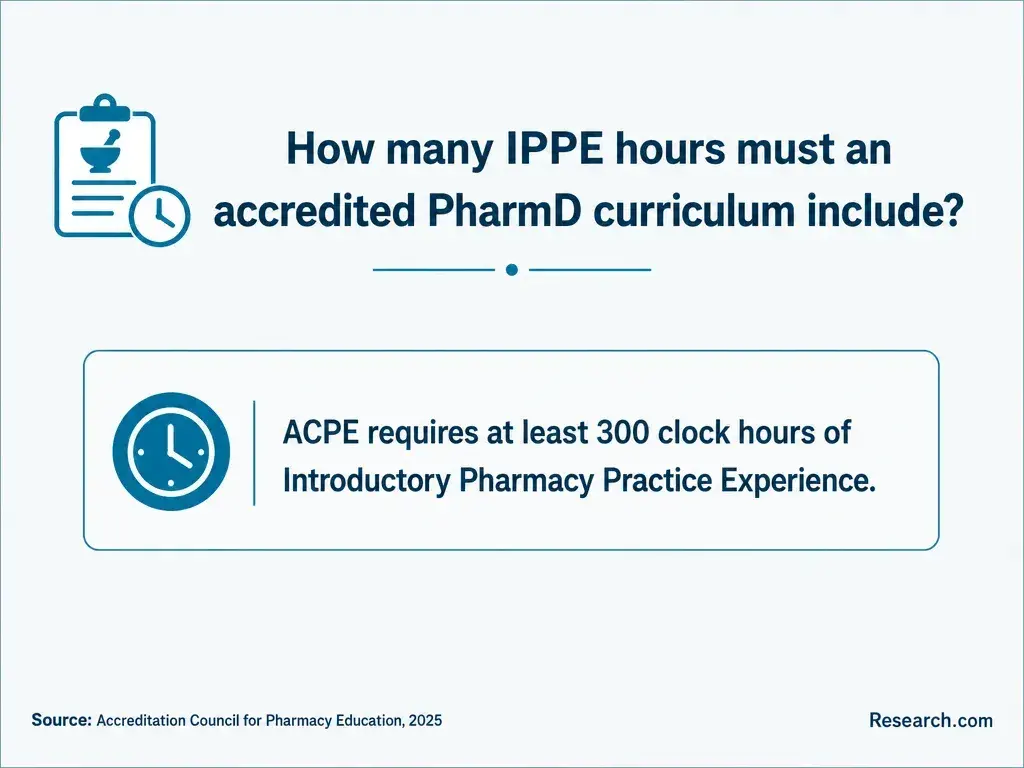
- First, confirm whether your placement is an introductory pharmacy practice experience (IPPE) or an advanced pharmacy practice experience (APPE); expectations and assigned responsibilities differ.
- Get written confirmation of site approval, required clearances, intern registration if applicable, schedule, dress code, and evaluation criteria before your start date.
- ACPE standards require at least 1,440 hours of APPEs across the professional program; your first rotation is one supervised part of that training, not a pharmacist license.
What Is a PharmD Clinical Rotation?
A Pharm.D. clinical rotation is a supervised learning experience in a pharmacy practice setting. IPPEs introduce students to practice during the professional curriculum; APPEs provide more advanced, sustained responsibilities later in the program. Your school assigns or approves the site and evaluates your work with input from a qualified preceptor. Timing, placement procedures, and duties vary by program and site.
Rotations are part of the professional Doctor of Pharmacy curriculum, not undergraduate pre-pharmacy coursework. They also cannot generally be replaced by a shorter pharmacy-related credential. If you are comparing online pharmacy degree time to completion, check which credential each timeline describes before assuming it includes Pharm.D. clinical training.
What Should You Do Before Your First PharmD Rotation?
Start with the documents your experiential education office and site actually use. A focused plan is more valuable than trying to reread every course note.
- Confirm the assignment: Verify the site, dates, daily schedule, reporting location, parking or transit arrangements, and the person to contact if you are delayed.
- Read the objectives: Identify required activities, assignments, attendance rules, and how your preceptor will assess progress.
- Review the setting: Refresh the medication classes, calculations, counseling topics, and documentation skills most likely to arise there.
- Set up approved resources: Test access to your school's drug-information tools and learn the site's rules before using personal devices or AI tools with patient information.
- Plan for disruptions: Arrange reliable transportation and ask whom to notify about illness, weather, or a schedule change.
Contact the preceptor at the time and by the method your school requests; some schools handle the introduction themselves. A shorter online doctoral study duration does not change a rotation's site-specific attendance and preparation requirements.
What Requirements Must You Meet Before Clinical Rotations?
Requirements depend on the school, site, and state. Your experiential education office should provide the controlling checklist and deadline; a site may impose additional conditions. Do not assume that having completed coursework means you are cleared to start.
Check for current immunization and health documentation, background checks or drug screening, privacy and safety training, site onboarding, and any required pharmacist-intern registration. Ask whether liability coverage is provided through the school or must be documented separately. State rules may restrict what an intern can do, even when a preceptor is willing to teach a task.
Admission eligibility is a different decision from rotation clearance. Students exploring pharmacy degree eligibility options should confirm both the conditions for entering a program and the separate conditions for entering its practice sites. Missing a site deadline can delay a placement even if you remain in good academic standing.
Students learn to apply classroom knowledge to real workflows: gathering relevant patient information, checking medication orders, identifying potential medication-related problems, communicating recommendations, counseling under supervision, documenting work, and recognizing when to ask for help. The mix depends on whether the experience is an IPPE or APPE and on the practice setting.
Prior biology, chemistry, or pre-pharmacy courses provide a foundation, but they do not substitute for supervised patient-care judgment. If you are planning your transition from pre-pharmacy to a Pharm.D., expect rotations to emphasize how you use scientific knowledge, explain your reasoning, and respond to feedback—not simply how many facts you recall.
Prepare for the work patients and staff actually do at your assigned site. These setting-specific review priorities can help you choose what to study first:
- Community pharmacy: Review prescription processing, common counseling points, medication access issues, and when a question needs pharmacist escalation.
- Hospital or health-system pharmacy: Review medication-order workflows, formulary concepts, sterile-product safety if relevant, and how the team communicates changes.
- Ambulatory care: Review chronic-disease follow-up, patient interviewing, monitoring measures, and documentation expectations.
- Specialty or other sites: Ask which patient population, therapies, and workflow will be central rather than assuming every rotation has the same objectives.
Even when a program offers Doctor of Pharmacy programs with online coursework, clinical placements ordinarily require scheduled, hands-on participation at approved sites. Confirm travel and work-schedule implications before accepting a placement.
Ask the site about its dress code, prohibited items, and permitted technology before packing. Bring only what you need to participate and document your learning without compromising patient privacy.
- Required identification, badge, onboarding confirmation, and any documents the site specifically requests.
- A small notebook or approved electronic note-taking method for learning points - not identifiable patient information unless the site expressly authorizes its secure system.
- Access to approved clinical references, plus a charged device if personal devices are allowed.
- Site-appropriate clothing and footwear, water or food if permitted, and a plan for breaks.
Budget for commuting, parking, meals, or temporary housing where needed; these costs can matter even if tuition is already covered. When comparing cost-conscious online Pharm.D. choices, ask about likely placement locations and related expenses rather than comparing advertised tuition alone.
Begin by agreeing on expectations: ask when to arrive, how to present a question, what work needs approval, and when feedback will occur. Be dependable, protect confidential information, and acknowledge uncertainty instead of guessing. If you identify a possible safety issue, promptly bring it to the preceptor rather than acting beyond your assigned role.
After feedback, summarize the change you will make and demonstrate it on the next appropriate task. This matters in any curriculum, including Pharm.D. programs for a faster path: a compressed schedule can leave less time to recover from unclear expectations. If supervision or an assigned task raises a concern, follow the school's escalation process.
Your school sets the grading policy, while the preceptor typically assesses your performance against published objectives. Common areas include preparation, professionalism, communication, clinical reasoning, patient safety, and progress after feedback. Some programs use pass/fail grades; others use additional rating scales or assignments. Ask for the rubric before the rotation begins and request a progress check early enough to improve.
Keep a record of required activities and feedback in the school's approved system. Pharmacy prerequisite credit evaluation addresses whether earlier coursework applies to admission or a degree; it is not a substitute for demonstrating rotation competencies. If a grade or evaluation seems inconsistent with the rubric, use the school's stated review procedure rather than waiting until the term ends.
IPPEs and APPEs help students meet the experiential requirements of an accredited professional Pharm.D. program and develop skills relevant to pharmacist practice. They do not issue a license. After degree completion, an applicant must meet the relevant state board's requirements, which generally include the North American Pharmacist Licensure Examination (NAPLEX) and may include a jurisdiction-specific law examination and other conditions. Do not assume every jurisdiction uses the MPJE; examination requirements can change.
When considering pharmacy program value and duration, separate the time to earn a degree from the steps required for licensure. Confirm the board's current intern-hour, examination, and application rules in the state where you intend to practice.
How Should You Choose a PharmD Program for Clinical Training?
Choose a program whose experiential model you can complete—not one whose placement descriptions merely sound appealing. Verify its current Accreditation Council for Pharmacy Education (ACPE) professional-program status, then ask how the school approves sites, assigns preceptors, handles distant placements, supports students when a site changes, and evaluates IPPEs and APPEs. Institutional accreditation and authorization for online enrollment are separate questions; neither replaces ACPE program accreditation or guarantees a placement near home.
Use the same questions when comparing pharmacy schools that may be easier to enter with other options. An admissions advantage matters less if required rotations, travel, or time away from work are impractical. Request written details on placement responsibilities and full expected costs before committing.
Clinical training should also support your intended practice direction without promising a particular job. The Bureau of Labor Statistics reports median annual pay for pharmacists of $140,910 in May 2025. That occupation-wide figure is useful career context, not a forecast of what a new graduate—or a graduate of any particular program—will earn.
Other Things You Should Know About PharmD
Tell your preceptor promptly and follow the site's safety and reporting procedures. Concealing a potential error can prevent the team from protecting a patient and addressing its cause.
Possibly. Schools set their own reassignment policies, and approved sites may have limited capacity. Contact the experiential education office immediately if a placement creates a documented safety, accessibility, or serious logistical concern.
Not automatically. The school must approve the site, preceptor, objectives, and assessment. Ask its experiential education office whether a placement at your employer is permitted and how student duties would be distinguished from paid work.
No residency is universally required for pharmacist licensure. A residency is postgraduate training that may be preferred for some positions; its value depends on the role you want and the employer's requirements.
- Immunizations by Pharmacists and Pharmacy Interns | ohio.gov https://www.pharmacy.ohio.gov/covidvaccine
- Medication Dispensing Errors and Prevention - NCBI - NIH https://www.ncbi.nlm.nih.gov/books/NBK519065/
- Medication Safety and Your Health | cdc.gov https://www.cdc.gov/medication-safety/about/index.html
- Preceptor Development: Providing Effective Feedback, Part 2 | nih.gov https://pmc.ncbi.nlm.nih.gov/articles/PMC4062731/
- PharmD Student Voices: A Clinical Training Explainer | Doctor of Pharmacy https://pharmacy.wisc.edu/2025/08/13/pharmd-student-voices-a-clinical-training-explainer/
- Pharmacy students' medication history taking competency | sciencedirect.com https://www.sciencedirect.com/science/article/abs/pii/S1877129718304696
- School of Pharmacy Health Policy | Pharmacy Students https://students.pharmacy.wisc.edu/pharmd-handbook/sop-health-policy/
- Online Student Resources | CU School of Pharmacy https://pharmacy.cuanschutz.edu/current-students/distance-degree-and-programs/student-resources
- Matriculation and Continued Enrollment Policies | University of Illinois Chicago https://students.pharmacy.uic.edu/student-resources/policies-guidelines/matriculation-and-continued-enrollment-policies/
- KU Pharmacy Student Handbook https://pharmacy.ku.edu/student-handbook


