
PharmD versus Pharmacy Technician Training

Co-Founder and Chief Data Scientist
Pharmacists and pharmacy technicians often work side by side, but their training leads to different responsibilities - and very different commitments of time and money. If you are choosing between entering the pharmacy workforce soon and preparing to provide patient care as a licensed pharmacist, the distinction matters. This guide compares the education, admissions, licensing, costs, schedules, and career prospects of both routes. It also identifies what to verify before enrolling, so you can choose a path that matches the work you want to do rather than paying for a credential you do not need.
Key Things You Should Know
- A Doctor of Pharmacy (Pharm.D.) is the U.S. professional degree route toward pharmacist licensure; pharmacy technician training prepares students for a different, supervised role and does not substitute for a Pharm.D.
- Technician training generally offers a faster entry route. A Pharm.D. typically follows undergraduate prerequisite coursework and includes a multiyear professional curriculum; neither credential alone grants permission to practice.
- Median annual pay was $140,910 for pharmacists and $45,750 for pharmacy technicians in May 2025, according to the Bureau of Labor Statistics. Those occupational medians are not promises of individual earnings.
What is the difference between a PharmD and pharmacy technician training?
A Pharm.D. prepares a student to seek pharmacist licensure and take responsibility for clinical and professional decisions about medications. Pharmacy technician training prepares a student to support dispensing and pharmacy operations under the supervision required by state law.
The deciding question is whether you want to become the licensed professional accountable for medication therapy or enter pharmacy work in a support role. This comparison separates the credentials from the jobs they can lead to. Duties vary by state and workplace, but technician training is not an abbreviated Pharm.D.
| Decision factor | Pharm.D. route | Pharmacy technician route |
| Starting point | College-level prerequisites set by the pharmacy school | Entry requirements set by the program, employer, and state |
| Education | Professional pharmacy coursework and supervised clinical experiences | Job training or a certificate or degree program focused on technical pharmacy work |
| Work goal | Eligibility to pursue pharmacist licensure | Eligibility to pursue technician registration or certification where applicable |
| Main limitation | Graduation does not itself confer a license | Technician training does not qualify someone for pharmacist licensure |
Choose technician training if you want to test your interest in pharmacy or start working sooner without committing to professional school. Choose the Pharm.D. route if your goal requires pharmacist licensure. Even online doctorate programs with shorter timelines should not be mistaken for a shortcut to pharmacist licensure: the credential must be an appropriate professional pharmacy degree, followed by state licensing requirements.
What education and licensing are required to become a pharmacist or pharmacy technician?
For the usual U.S.-educated pharmacist pathway, students complete a school's undergraduate prerequisites, graduate from an Accreditation Council for Pharmacy Education (ACPE)-accredited professional Pharm.D. program, and meet their state board's licensing requirements.
Those requirements generally include the North American Pharmacist Licensure Examination (NAPLEX), applicable law testing, and any required supervised experience and background checks.
A passing exam score does not issue a license by itself. Depending on the jurisdiction, law testing may involve the Multistate Pharmacy Jurisprudence Examination (MPJE), the Uniform Multistate Pharmacy Jurisprudence Examination (UMPJE), another process, or no separate jurisprudence exam.
Technician requirements are more state-dependent. A state may require registration or licensure, approved training, an examination, or a combination; employers may set additional hiring standards.
Check the board of pharmacy in the state where you intend to work before choosing a program. If you already have college credit, ask the receiving Pharm.D. school whether you can apply prior college credits to pharmacy programs. A school - not the previous institution - decides which courses satisfy its prerequisites or professional curriculum.
How long do PharmD and pharmacy technician programs take to complete?
The professional Pharm.D. curriculum commonly takes about four academic years after prerequisite coursework, although program structures differ. Your total timeline depends on which prerequisites you have completed and how the school sequences courses and rotations. Some faster Doctor of Pharmacy routes compress the professional calendar, but they do not eliminate required education or licensure steps; a denser schedule may also limit paid work.
Technicians may enter through employer-provided training or a formal program, so preparation can range from months to longer degree pathways. Confirm how long it takes to finish the specific program and satisfy your state's technician rules. For either route, distinguish the advertised class schedule from the time needed for labs, practical training, examinations, and registration.
Pharm.D. students study the science and use of medications, including pharmacology, therapeutics, calculations, medication safety, patient assessment, and communication. They also complete supervised introductory pharmacy practice experiences (IPPEs) and advanced pharmacy practice experiences (APPEs), where they apply their learning in practice settings.
Undergraduate pre-pharmacy courses such as biology or chemistry prepare students for this professional curriculum; they are not the curriculum itself. Pharm.D. programs for students with a pre-pharmacy background can provide a starting point for comparing how schools build on prior study.
Technician training emphasizes tasks such as prescription processing, pharmacy calculations, inventory, medication names, safety procedures, and the technology used in dispensing. Depending on the program, students may also practice compounding or prepare for work in a hospital or community pharmacy. These skills support pharmacists; they do not authorize independent clinical decisions or patient counseling beyond what state law permits.
Pharm.D. admissions requirements are school-specific. Compare each school's required undergraduate courses and labs, minimum grades, credit policies, application materials, and deadlines. Some schools accept applicants without a completed bachelor's degree if their prerequisites are met; others have different expectations.
Many use the Pharmacy College Application Service (PharmCAS), but applicants must confirm each school's application process. The Pharmacy College Admission Test (PCAT) was retired in January 2024 and is not a current exam to schedule.
Technician programs often have fewer academic prerequisites, but admission to a program is separate from eligibility for state registration and clinical placement. Ask about background checks and other conditions before paying a deposit.
If you still need Pharm.D. prerequisites, pharmacy programs with flexible entry requirements may be worth investigating - but obtain written confirmation of what must be completed before enrollment or progression. A low admissions threshold is not a promise of admission or licensure.
A Pharm.D. generally creates a larger financial commitment because it involves prerequisite study and a multiyear professional program. Technician training can cost less, especially when an employer provides it, but prices differ substantially among certificate, degree, and workplace routes. Compare each option's total cost to reach your intended job, not just advertised tuition.
For a Pharm.D., request a current estimate that includes mandatory fees, supplies, clinical requirements, rotation travel, and licensing expenses. For technician training, check tuition or training charges alongside books, examination fees, and state registration costs.
Pharmacy program tuition options are useful only when the figures cover comparable periods and required costs. Ask financial aid staff which aid rules apply to your classification and start date: federal borrowing rules changed for many new graduate and professional borrowers beginning July 1, 2026, so older loan examples may not describe your options.
Some Pharm.D. programs deliver academic coursework online or in hybrid formats, and some technician programs offer online classes. Neither format automatically makes hands-on training remote. Pharm.D. students must plan for required practical experiences and any campus labs or immersions; technician students should check whether their program requires in-person practice or an externship.
Ask who approves placements, whether travel is likely, and which sessions occur at fixed times. Doctor of Pharmacy programs with online coursework should be compared on these commitments, not on the word "online" alone.
Verify a Pharm.D. program's professional accreditation through ACPE. Separately check the institution's accreditation, its authorization to enroll you in your state, and whether the program's placements and degree support licensure where you intend to practice.
For technician programs, check state board rules and any accreditation or program approval relevant to your certification goal. These are distinct checks; one does not replace the others.
National technician certification may be required by a state or preferred by an employer; it is not uniformly mandatory across the United States. The Pharmacy Technician Certification Board offers the Certified Pharmacy Technician (CPhT) credential, and the National Healthcareer Association offers the ExCPT examination leading to its technician certification.
Confirm which credential your state and prospective employers accept, as well as the certifier's current eligibility rules. A short program marketed among accelerated online pharmacy degree pathways should be checked against those rules: a quick credential is not necessarily a technician certification pathway and cannot replace a Pharm.D.
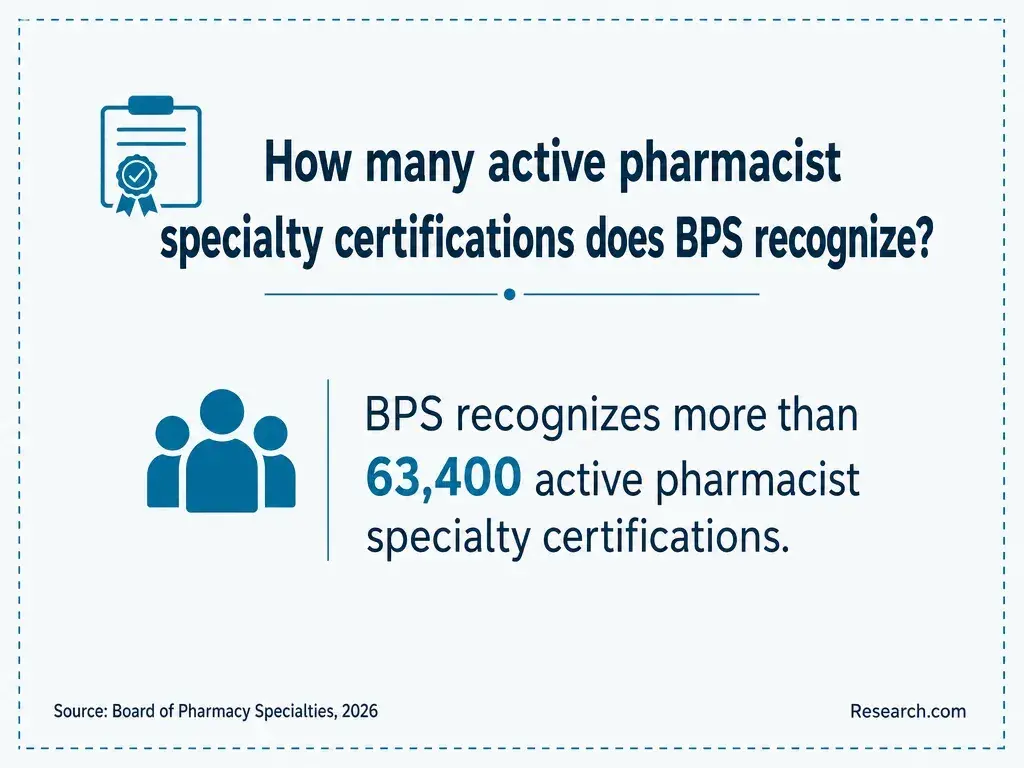
Pharmacists need a state license, not a national certification in place of one. After licensure, some pursue specialty credentials from the Board of Pharmacy Specialties; eligibility depends on the specialty. Residency, fellowship, and board certification are different forms of postgraduate training or recognition, and none substitutes for pharmacist licensure.
Once licensed, Pharm.D. graduates may work as pharmacists in community, hospital, ambulatory care, or other settings. Some positions favor or require postgraduate training: a postgraduate year one (PGY1) residency provides broad practice training, while a postgraduate year two (PGY2) residency develops specialty practice.
Fellowships commonly emphasize research or industry work. These are possible next steps, not universal requirements for pharmacist jobs.
Technicians work in settings including community and hospital pharmacies, supporting dispensing, inventory, and other permitted operations under applicable supervision. Experience may lead to specialized duties where state law and employers allow them, but advancement does not convert a technician credential into a pharmacist license.
If technician work confirms your interest in becoming a pharmacist, revisit pharmacy degree entry options and compare their actual prerequisites. Pharmacy experience can inform your decision, but it does not automatically replace required college courses.
How do pharmacist and pharmacy technician salaries and job outlooks compare?
According to the Bureau of Labor Statistics, median annual pay was $140,910 for pharmacists and $45,750 for pharmacy technicians in May 2025. The gap reflects different occupations and responsibilities, not a guaranteed return on Pharm.D. tuition. Earnings vary by employer, location, experience, and schedule.
BLS projects 5% growth for pharmacists and 6% growth for pharmacy technicians from 2025-2035, with about 12,500 and 44,700 openings per year, respectively. Those openings include replacement needs; they do not measure an individual applicant's chances.
When weighing earnings against education costs, use an online pharmacy degree cost comparison only after confirming that each program leads toward the same kind of job. A technician program can be the better value for someone who wants technician work, while a Pharm.D. is the relevant route for someone committed to pharmacist practice.
Before committing, confirm the credential your intended job requires, your state's rules, the program's practical schedule, and your full cost after available aid. The most consequential mistake is choosing on projected salary or speed alone without checking whether the training qualifies you for the role you want.
Other Things You Should Know About PharmD
Often, yes, if you meet your state's technician requirements and an employer can accommodate your schedule. Pharm.D. classes and rotations may make regular work hours difficult.
Not necessarily, but it can affect program placement, certification, registration, or licensure. Review the relevant board's disclosure rules and ask about available eligibility guidance before enrolling.
Potentially. An internationally educated pharmacist may have a separate pathway involving National Association of Boards of Pharmacy foreign graduate certification and state licensing requirements. Eligibility depends on the applicant's education and jurisdiction.
Not automatically. Each state controls its own pharmacist licensing and technician requirements. Check the destination board's application or transfer process before accepting a position.
- Are Prerequisite Courses Barriers to Pharmacy Admission or the Keys to Student Success? - PMC https://pmc.ncbi.nlm.nih.gov/articles/PMC10159397/
- Pharmacy Technicians | ct.gov https://www.cga.ct.gov/2000/rpt/2000-R-0605.htm
- Cost of Attendance (Budget) | 2025-2026 Federal Student Aid Handbook https://fsapartners.ed.gov/knowledge-center/fsa-handbook/2025-2026/vol3/ch2-cost-attendance-budget
- Apply - Reciprocity - Texas State Board of Pharmacy https://www.pharmacy.texas.gov/applicants/apply-reciprocity.asp
- Registered Pharmacy Technicians - Office of the Professions https://www.op.nysed.gov/professions/registered-pharmacy-technicians/faqs
- Continuing Education (CE) Information | California State Board of Pharmacy https://www.pharmacy.ca.gov/licensees/personal/ce.shtml
- FAQ | OSU College of Pharmacy - Oregon State University https://pharmacy.oregonstate.edu/programs-admissions/pharm-d/faq
- Pharmacy Technician Career Overview | Mayo Clinic College of Medicine and Science https://college.mayo.edu/academics/explore-health-care-careers/careers-a-z/pharmacy-technician/
- Pharmacy Technician vs. Pharmacist | American Career College https://americancareercollege.edu/blog/pharmacy-technician-vs-pharmacist
- Pharmacist vs. Pharmacy Technician: 6 Key Differences | Marshall University https://www.marshall.edu/blog/pharmacist-vs-pharmacy-technician/


