St. John Fisher Online PharmD Admission Requirements

Co-Founder and Chief Data Scientist
Applying to St. John Fisher University's online Doctor of Pharmacy (Pharm.D.) pathway takes more than finding an application deadline. You need to know whether your college courses meet the prerequisites, how the program handles hands-on training, and what the degree will cost beyond tuition.
This guide separates admission requirements from professional coursework and pharmacist licensure, so you can identify gaps before applying and decide whether Fisher's online pathway fits your schedule and goals.
Key Things You Should Know
- Fisher's online Pharm.D. pathway calls for at least 62 semester credits of prerequisite college coursework; those credits precede, rather than replace, the professional curriculum.
- A 2.75 cumulative GPA is a stated admissions minimum, not a promise of admission. Confirm current science-GPA and course-grade rules before applying.
- "Online" does not mean fully remote: expect scheduled instruction, in-person skills requirements, and supervised pharmacy practice experiences. Budget for those commitments before accepting an offer.
What are St. John Fisher online Pharm.D. admission requirements?
St. John Fisher University's Wegmans School of Pharmacy offers an online pathway to its professional Pharm.D. degree. Applicants need qualifying undergraduate prerequisite coursework, an acceptable academic record, and the materials required for the applicable admissions cycle. Prerequisites are pre-professional courses taken before entry; they are not credits earned in the Pharm.D. curriculum.
Start by matching your transcript against Fisher's current course-by-course prerequisite list, including laboratory components and minimum grades. Do not assume that a bachelor's degree is required simply because the Pharm.D. is a doctorate, or that a course with a similar title will automatically satisfy a requirement. Fisher makes the final determination about equivalencies and admission. If you are missing a course, distinguish a class you may finish before enrollment from one that must be complete when you apply. A broader guide to pharmacy degree entry requirements can help frame that conversation, but Fisher's current policy controls.
Is St. John Fisher's online Pharm.D. program ACPE accredited?
Fisher's Wegmans School of Pharmacy holds professional Pharm.D. accreditation from the Accreditation Council for Pharmacy Education (ACPE). The online pathway leads to Fisher's Pharm.D.; it is not a separate pharmacy credential merely because some instruction is delivered online. Before enrolling, check the current ACPE program record and ask Fisher to confirm that your intended pathway is covered by the accredited professional program.
ACPE professional-program accreditation is distinct from Fisher's institutional accreditation and from authorization to enroll a distance-learning student in a particular state. It also does not guarantee that a clinical placement is available near your home or that your state will issue you a pharmacist license. Those are separate checks when comparing top online pharmacy doctorate programs.
How many prerequisite credits are required for Fisher's online Pharm.D.?
Fisher identifies at least 62 semester credits of prerequisite coursework for Pharm.D. entry. Reaching the credit total alone is insufficient: the required subjects, labs, and applicable grades must also be satisfied. These are college credits completed before the professional program, not the length of the Pharm.D. curriculum.
If you have credits from another institution, request a course-level review before paying for additional classes. Send syllabi when course titles do not clearly establish equivalence, and ask specifically about laboratory format, repeated courses, and any time limits on older science coursework. The receiving school decides how prior work applies; advice about how to apply prior college credits to pharmacy programs cannot substitute for Fisher's evaluation.
Fisher's stated minimum cumulative GPA is 2.75. A minimum establishes eligibility for consideration, not a competitive target or an admission guarantee. Before applying, confirm how Fisher calculates cumulative GPA and whether the current cycle also sets a separate science or prerequisite GPA, minimum course grades, or rules for repeated classes.
If your record is near the threshold, ask admissions to review the actual transcript rather than averaging grades yourself. A strong recent science record may help demonstrate readiness, but it does not override a published requirement. Guides to pharmacy program applicant requirements are useful for comparing options, not for predicting Fisher's decision from GPA alone.
Prepare for a program-specific application process involving your academic history, transcripts, recommendations, and an admissions review that may include an interview. Check Fisher's current cycle instructions for the application platform, exact recommendation requirements, deadlines, and any supplemental steps; do not assume that submitting a centralized application completes every school requirement.
The most useful preparation is to assemble a transcript-to-prerequisite checklist and identify recommenders who can speak to your academic readiness or professional conduct. Applicants changing fields should explain why their earlier coursework and experience prepare them for patient-facing pharmacy training, while addressing any missing prerequisites directly. Doctor of Pharmacy pathways for career transitions offer context, but Fisher's application instructions determine what to submit.
No current applicant should plan to take the Pharmacy College Admission Test (PCAT): the exam was retired in January 2024. Confirm Fisher's current application checklist rather than following older pages that discuss PCAT scores or waivers. Admission still depends on the program's academic and application requirements.
The absence of a PCAT hurdle does not shorten the professional degree or make it equivalent to affordable short pharmacy programs. Shorter programs may prepare students for pharmacy-adjacent or technician work, but they do not replace an accredited Pharm.D. as the educational route to U.S. pharmacist licensure.
Both pathways lead to Fisher's professional Pharm.D. The decision is primarily about where and how you can attend required instruction and training - not whether online students can avoid hands-on pharmacy education. The comparison below highlights the commitments to verify with Fisher for your cohort.
| Decision factor | Online pathway | Campus pathway |
| Class participation | Online instruction may include scheduled live activities; confirm the current timetable. | Instruction is organized around campus attendance; confirm the current timetable. |
| Hands-on skills | Required in-person activities and any campus visits still need to fit your schedule. | Hands-on activities are generally organized through the campus schedule. |
| Clinical training | Supervised practice occurs in person at approved sites; nearby placement should not be assumed. | Supervised practice also occurs in person at approved sites. |
| Likely logistical pressure | Travel for campus requirements or rotations, alongside online class times. | Regular campus attendance, alongside rotation travel. |
Ask Fisher for the current live-session schedule, required campus dates, and placement process for introductory and advanced pharmacy practice experiences - often called IPPEs and APPEs. Also ask what you must arrange yourself, including intern registration, health documentation, background checks, transportation, or housing. Comparing online doctorate program length without comparing these in-person obligations can produce an unrealistic work plan.
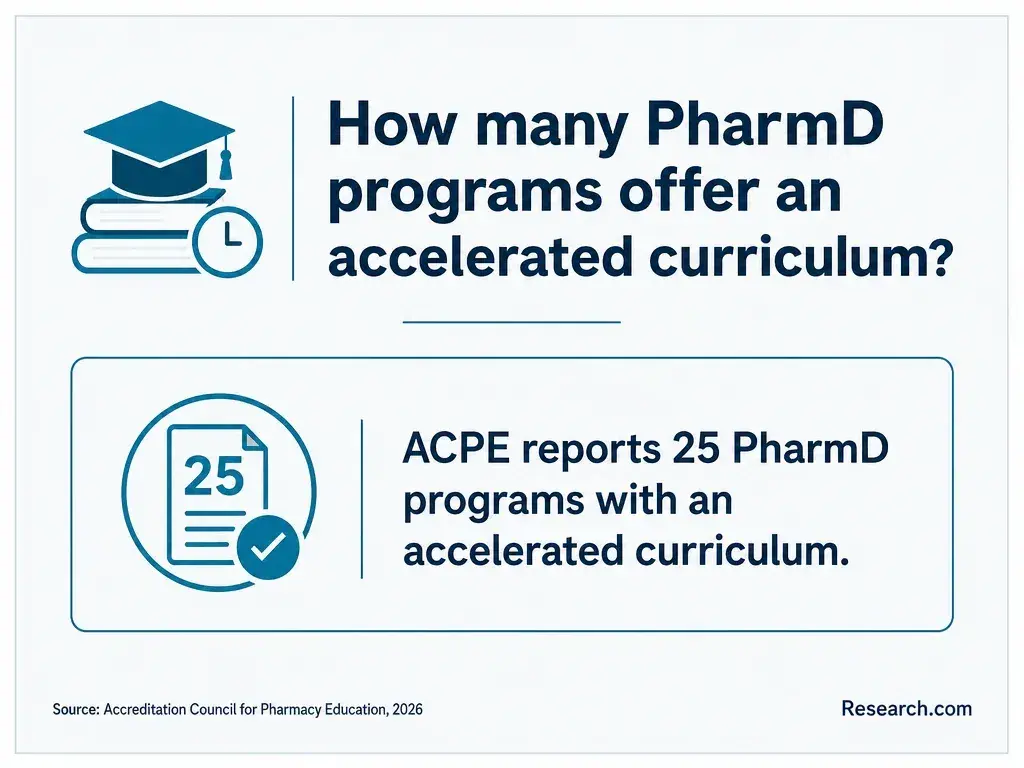
Fisher's online Pharm.D. follows a four-year professional pathway after prerequisite coursework. That timeline is not the time needed to finish missing prerequisites. Required course sequencing and in-person experiential training also limit how much a student can accelerate the program independently.
If finishing sooner is essential, compare published curricula and admissions eligibility for fast-track Doctor of Pharmacy programs rather than assuming Fisher's online delivery reduces the degree length. Ask Fisher whether any previous professional pharmacy coursework can be evaluated for advanced standing; ordinary prerequisite credits should not be counted twice as Pharm.D. curriculum credits.
There is no responsible single-price answer without Fisher's current tuition schedule, your entering cohort, and your expected expenses. Request a written cost-of-attendance estimate for the online Pharm.D. that separates tuition from mandatory fees and accounts for the full professional program. A per-credit price alone is not a total-program quote.
Build your budget around the costs most likely to differ by location: prerequisite classes, technology and required resources, travel for campus activities, clinical-site transportation or temporary housing, and screening or immunization requirements. Include future licensure application and examination costs, which vary by jurisdiction. When comparing a low-cost online pharmacy doctorate, use the same cost categories and degree length for each school.
Ask Fisher's financial aid office which federal borrowing rules apply to your start date and student classification. Federal rules changed for many new graduate and professional borrowers beginning July 1, 2026; do not build a plan around an older assumption about Grad PLUS access or borrowing limits. The practical test is whether your expected financing covers both billed charges and unavoidable travel and living costs.
Can Fisher's online Pharm.D. graduates become licensed pharmacists?
Yes, graduates of an ACPE-accredited Pharm.D. pathway can pursue U.S. pharmacist licensure, subject to the requirements of the state or other jurisdiction where they apply. Graduation does not itself issue a license. Jurisdictions set their own eligibility, supervised-experience, background-check, examination, and application rules.
The North American Pharmacist Licensure Examination (NAPLEX) assesses pharmacy knowledge for licensure. A jurisdiction may also require a law examination, but applicants should check that board's current rules rather than assume it uses the Multistate Pharmacy Jurisprudence Examination (MPJE); some jurisdictions began moving to the Uniform MPJE (UMPJE) in 2026. Confirm your intended board's rules and Fisher's state-specific enrollment and placement arrangements before committing. Quickest online pharmacy study routes are not substitutes for the professional degree and licensing process if your goal is to practice as a pharmacist.
Other Things You Should Know About PharmD
Possibly. Ask Fisher which courses may be in progress when you apply and the deadline for completing them before enrollment. A conditional offer does not waive unfinished prerequisites.
Only if Fisher accepts that credit for the specific requirement. Ask for a course-level decision, especially for science subjects with laboratories, before relying on exam credit.
Do not assume so. Technician work can provide useful exposure to pharmacy practice, but academic prerequisite waivers require Fisher's explicit approval.
Not for every pharmacist position or as a universal condition of licensure. A residency provides postgraduate clinical training and may be required or preferred for particular jobs; it is separate from state licensure and optional specialty board certification.
- Earn an Online Pharm.D. Degree at St. John Fisher University https://onlinepharmd.sjf.edu/
- Doctor of Pharmacy (PharmD) - Prospective Students https://www.pharmacy.umaryland.edu/academics/pharmd/prospective-students/
- PharmD Application Deadlines | University of the Pacific https://www.pacific.edu/pharmacy/pharmd/deadlines
- How to Apply to the PharmD Program | Texas A&M University Irma Lerma Rangel College of Pharmacy https://pharmacy.tamu.edu/pharmd/apply.html
- PharmD Admissions - R. Ken Coit College of Pharmacy https://www.pharmacy.arizona.edu/academics/pharmd/admissions
- Graduate Programs | Doctor of Pharmacy (Pharm.D.) | St. John Fisher University https://www.sjf.edu/graduate-programs/doctor-of-pharmacy-pharmd/
- Prerequisites - College of Pharmacy - University of Minnesota https://www.pharmacy.umn.edu/doctor-pharmacy/admissions/how-apply/prerequisites