
How to Compare PharmD Programs by Rotation Placement

Co-Founder and Chief Data Scientist
A Pharm.D. program's rotation network can shape where you train, how far you travel, and which kinds of pharmacy practice you experience. Yet a long list of affiliated sites does not tell you where students actually go. This guide is for prospective Doctor of Pharmacy students comparing programs, including online and hybrid options. You'll learn how to check required hours, placement policies, preceptor support, and costs - and how to distinguish a promising opportunity from a placement the school can document.
Key Things You Should Know
- Start with the program's actual placement record, not its site list: ask where recent students completed rotations, which placements required travel, and how assignments were made.
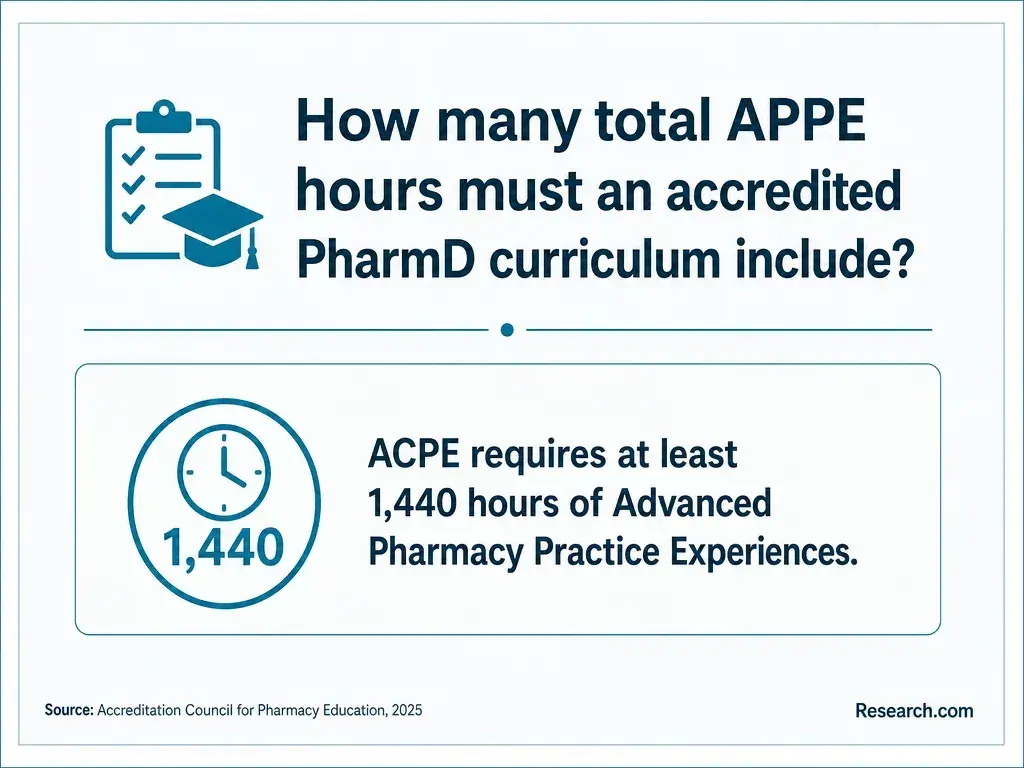
- ACPE-accredited Pharm.D. programs must provide at least 300 introductory pharmacy practice experience hours and 1,440 advanced pharmacy practice experience hours; hours alone do not establish site quality.
- Compare guaranteed requirements separately from competitive electives, and budget for possible rotation housing, transportation, and time away from paid work.
What is PharmD rotation placement, and why does it matter?
Rotation placement is the process of assigning a Pharm.D. student to a supervised practice site and preceptor, the pharmacist or other qualified professional responsible for guiding and evaluating the experience.
Introductory pharmacy practice experiences (IPPEs) build early practice skills; advanced pharmacy practice experiences (APPEs) provide more substantial patient-care and practice responsibilities later in the professional curriculum.
Placement matters because access to a site is different from access to a useful learning experience. Two students might both rotate through a hospital, but encounter different patient populations, responsibilities, feedback, and mentorship. A strong comparison asks what students actually do and how reliably the school places them - not just whether a hospital appears on an affiliation list.
These experiences are part of the professional degree, not a replacement for undergraduate prerequisites. If you are still planning your route into pharmacy school, compare Doctor of Pharmacy pathways after pre-pharmacy study separately from each program's rotation arrangements.
How many IPPE and APPE rotation hours should a PharmD program provide?
ACPE standards require at least 300 IPPE hours and 1,440 APPE hours in an accredited Pharm.D. program. IPPEs introduce students to supervised pharmacy practice during the professional curriculum. APPEs come later and include required experiences across major practice settings, alongside opportunities for electives.
Use those minimums as a baseline, not a ranking. Ask each school how its hours are scheduled, whether rotations run during academic breaks, and what happens if a site cancels. A program offering more hours is not necessarily stronger if students have limited responsibilities or inconsistent supervision.
Compressed calendars require particular scrutiny. When comparing accelerated pharmacy school options, request a term-by-term experiential schedule and identify when full-time rotations would limit paid work, relocation flexibility, or other commitments.
How do you compare PharmD programs by rotation quality and variety?
Compare programs using the same evidence for each one. The table separates a claim that sounds appealing from the information that helps you judge whether it will benefit you.
| Comparison point | Stronger evidence to request | Important limitation |
| Site access | Recent student placements by setting and region | An affiliated site may not take students every year. |
| Specialty variety | Electives students actually obtained | Popular electives may be competitive or distant. |
| Learning quality | Typical student duties, feedback frequency, and site review process | A prestigious site name does not establish a good learning experience. |
| Placement reliability | School policy for cancellations and reassignment | Students may still face schedule or location changes. |
Give more weight to documented outcomes and clear policies than to a large site count. Request information from the same recent period at every school, and distinguish required placements available to all students from selective electives.
Compare the full cost of attendance, too: a lower tuition figure can lose its advantage if rotations regularly require additional housing or travel. That distinction is especially useful when researching lower-cost online Pharm.D. pathways.
Look for substantive experience in community pharmacy, hospital or health-system pharmacy, ambulatory care, and inpatient general medicine. These core settings expose students to different medication-use systems and patient-care responsibilities. Ask how the program meets its required APPE setting requirements and what work students perform at each site.
Then evaluate electives against your interests. A student considering residency may value access to inpatient specialties and longitudinal mentorship; someone interested in outpatient practice may prioritize ambulatory clinics, transitions of care, or community-based services. Specialty pharmacy, managed care, industry, and other electives can add perspective, but availability and student selection rules vary.
Choose breadth before a narrow specialty promise: interests can change, and a strong required rotation foundation remains useful. If your goal does not require pharmacist licensure, consider whether shorter pharmacy programs with career potential meet it instead. Pharmacy technician preparation, for example, is a different educational route and does not qualify someone for pharmacist licensure.
Schools generally coordinate or approve sites and preceptors, but assignment methods differ. A program may collect student preferences, use a matching process, assign required rotations centrally, or allow students to propose sites for approval. A preference is not a placement guarantee.
Before accepting an offer, establish your responsibilities as well as the school's. These steps reveal whether the placement process is workable for your location and finances:
- Ask who secures and approves each IPPE and APPE site, including any site you propose yourself.
- Request the preference and assignment timeline, location rules, and policy for site cancellations.
- Confirm who arranges intern registration when required, background checks, immunizations, and site onboarding.
- Estimate travel, temporary housing, and lost work time under both a preferred and a less convenient assignment.
Prior coursework or pharmacy employment may help you prepare, but neither should be assumed to secure a placement or replace a required rotation. If you are entering with existing coursework, review pharmacy admissions for students with prior credits as a separate question from experiential placement.
A preceptor supervises students, sets learning activities, gives feedback, and evaluates performance under the school's experiential education policies. Ask how the school qualifies and prepares preceptors, how often students receive feedback, and whom students contact if supervision or site conditions fall short.
Good mentorship depends on more than a preceptor's job title. Find out whether students can participate in patient-care discussions, practice documentation and communication, and receive a midpoint evaluation that leaves time to improve. Ask how the program reviews student evaluations of sites and handles concerns without jeopardizing a student's progression.
Preceptors help students apply what they have learned; they do not replace foundational coursework. If you are still deciding where to apply, confirm each school's pharmacy school prerequisites separately from its promises about clinical mentorship.
Online coursework does not make required practice experiences remote. Online and hybrid Pharm.D. programs still need approved, supervised IPPE and APPE sites, and they may also require campus visits or in-person skills work. A nearby rotation may be possible, but do not assume the school can place you near home for every required setting.
When you review online pharmacy doctorate programs, request the written placement policy for your state and ask which nearby sites have taken students recently.
Confirm who finds preceptors, whether out-of-state placements are permitted, and what happens if a local site becomes unavailable. Also check scheduled classes and rotation hours before assuming you can retain a full-time job.
Distance-education state authorization, permission to conduct a clinical placement in a state, and eligibility for that state's pharmacist license are separate matters. Verify each with the school and the relevant state authorities before enrolling.
The Accreditation Council for Pharmacy Education (ACPE) accredits professional Pharm.D. programs and sets standards that include supervised experiential education.
Check the program's current status in ACPE's official program directory, then examine its placement policies and student outcomes yourself. Accreditation establishes a professional-program standard; it does not guarantee a particular city, specialty rotation, preceptor, or job.
Do not confuse ACPE professional-program accreditation with a university's institutional accreditation or its authorization to offer distance education in your state. These address different questions. Likewise, when you compare online doctorate lengths, do not treat a short completion time or the word "doctorate" as evidence that a program is an ACPE-accredited Pharm.D. pathway.
Rotations develop supervised practice skills and can help students identify settings for employment or postgraduate training. They do not issue a pharmacist license. After earning the Pharm.D., graduates must meet the requirements of the jurisdiction where they seek licensure, which can include intern-hour rules and examinations.
The NAPLEX is a pharmacist licensure examination; a jurisdiction may also require the MPJE, UMPJE, or another assessment of pharmacy law. Check the current state board's rules rather than assuming one process applies everywhere.
For career context, the Bureau of Labor Statistics reports pharmacist median annual pay of $140,910 in May 2025. That occupational median is not an expected starting salary or a return on a particular program's tuition. Rotation location and mentorship may help you explore opportunities, but neither guarantees employment.
A PGY1 residency builds broad postgraduate practice experience, while a PGY2 residency provides more specialized training; fellowships serve different training goals. Board certification is a separate credential, not a substitute for state licensure.
These paths are not required for every pharmacist job. Similarly, fast-track online pharmacy education should not be mistaken for a shortcut around an accredited Pharm.D. and jurisdiction-specific licensing requirements.
What questions should you ask before choosing a PharmD program?
Send the same questions to each experiential education office and ask for written policies or recent placement summaries. The answers should let you compare realistic assignments, not ideal examples:
- Where did recent students complete required rotations, and how many needed to travel or obtain temporary housing?
- Which sites and electives were available to students generally, and which required competitive selection?
- Who finds, approves, and replaces sites and preceptors, and when are assignments finalized?
- What are the required rotation schedules, onboarding costs, and consequences of a delayed or cancelled placement?
- How are preceptors evaluated, and how can students report concerns or request support?
- For my intended state of practice, what must I verify about placement permission, intern registration, and later licensure?
Favor a program that can substantiate dependable core placements, explain its assignment process, and give you a manageable cost and travel plan. Treat an unqualified promise of a local or specialty placement as a red flag.
If you have previous college credit, ask admissions to evaluate credits for pharmacy prerequisites; only the receiving school can determine how they apply, and that decision is separate from rotation placement.
Other Things You Should Know About PharmD
Do not assume they are. Ask the program whether any rotation offers compensation and whether site policies restrict outside employment during scheduled hours. Build your budget without relying on rotation pay.
Students can contact the school's accessibility or disability services office to discuss the applicable process. Raise the issue early so the school can coordinate with a site when appropriate; an accommodation request does not guarantee a specific site.
The school's handbook controls remediation, repeat rotations, appeals, and potential graduation delays. Read that policy before enrollment, especially if an additional rotation would create travel or tuition costs.
Yes, when it is relevant to the position. Describe the setting, supervised responsibilities, and concrete projects accurately; do not present student activities as independent pharmacist practice.
- Factors That Influence Students' Selection of Advanced... - PMC https://pmc.ncbi.nlm.nih.gov/articles/PMC7092785/
- Cost of Attendance (Budget) | 2025-2026 Federal Student Aid Handbook https://fsapartners.ed.gov/knowledge-center/fsa-handbook/2025-2026/vol3/ch2-cost-attendance-budget
- Advanced Pharmacy Practice Experiences (APPE) | Veterans Affairs https://www.va.gov/loma-linda-health-care/work-with-us/internships-and-fellowships/advanced-pharmacy-practice-experiences-appe/
- Introductory Practice (IPPE) and Advanced Practice (APPE) | utexas.edu https://pharmacy.utexas.edu/programs/pharmd/experiential/ippe-appe
- IV. Preceptors - E. Evaluation of Rotations | Southwestern Oklahoma State University https://swosu.edu/pharmacy/current-students/experiential-program/preceptors/evaluation.php
- Rotation Information | University of Kentucky https://ciche.uky.edu/rotation-information
- Experiential Education Program - College of Pharmacy https://www.pharmacy.umn.edu/doctor-pharmacy/experiential-education/experiential-education-program
- Experiential Education | Washington State University https://pharmacy.wsu.edu/pharmd/experiential-services/
- Experiential Education Site Selection Policy | ucsf.edu https://pharmd.ucsf.edu/policies/site-selection
- How to Develop a Managed Care Pharmacy IPPE/APPE https://www.amcp.org/resource/how-develop-managed-care-pharmacy-ippeappe


