Online Pharm.D. Attendance Expectations and Live Sessions

Co-Founder and Chief Data Scientist
An online Doctor of Pharmacy (Pharm.D.) program may let you study from home, but it may not let you choose when, or where, you complete every requirement. Live classes, campus labs, and clinical rotations can determine whether the program works alongside your job or caregiving commitments.
This guide explains which attendance rules to check, how online and campus schedules differ, and what to confirm before paying a deposit. It is for prospective U.S. pharmacy students who need a realistic schedule, not just a convenient course-delivery label.
Key Things You Should Know
- "Online" does not mean self-paced: a program may require live classes, timed assessments, campus visits, and attendance at in-person clinical sites.
- Ask for the current term-by-term calendar and attendance policy; a recording may help you review a class without excusing an absence.
- The U.S. Bureau of Labor Statistics projects 5% growth for pharmacists from 2025-2035, but career prospects do not remove the need to budget for required time away from work.
What attendance is required in an online PharmD program?
Attendance depends on the specific program and course. Online lectures might be available on demand, while discussions, skills assessments, examinations, and group work can have fixed times. Hands-on training may require travel to campus or another approved location. When you choose an online Pharm.D. program, evaluate its required calendar rather than its "online" label.
Request written answers to these scheduling questions before accepting an offer:
- Which activities require real-time attendance, and in what time zone are they scheduled?
- How often are campus visits required, how long do they last, and are dates announced in advance?
- What counts as an excused absence, and can missed labs or assessments be made up?
- Does the schedule change during clinical rotations, including evenings or weekends?
A workable first-year timetable is not enough. Ask for a term-by-term view through graduation so later in-person requirements do not come as a surprise.
Are live sessions mandatory in online PharmD programs?
They can be. A synchronous session is a class or activity attended live at a scheduled time; an asynchronous activity can generally be completed within a deadline. Programs may combine both formats, and a recording does not necessarily satisfy a live-participation requirement.
Ask the program to separate mandatory live lectures from optional office hours and recorded content. Confirm whether attendance is taken, whether cameras or participation are required, and how students in different time zones are accommodated. Even accelerated Pharm.D. degree options should be judged by their actual weekly meeting and assessment schedule, not just their shorter calendar.
How do online PharmD programs compare with campus-based programs?
The professional degree goal is the same, but the location of instruction changes how students plan their weeks. This comparison identifies scheduling differences to verify at individual schools; neither format has a universal attendance policy.
| Commitment | Online or hybrid Pharm.D. | Campus-based Pharm.D. |
| Class meetings | May mix recordings with required live online sessions | Typically includes scheduled on-campus classes |
| Practical skills | May require concentrated campus visits or other in-person sessions | Often distributed across scheduled campus labs |
| Clinical rotations | In-person site attendance remains a substantial commitment | In-person site attendance remains a substantial commitment |
| Travel and housing | May involve immersion trips and rotation-related moves | May involve a campus commute and rotation-related travel |
Online delivery may reduce routine commuting, but it can replace that expense with travel or temporary housing. When comparing budget-friendly pharmacy education options, price the required in-person schedule as well as tuition.
For a U.S. professional Pharm.D. pathway, check the program's current status with the Accreditation Council for Pharmacy Education (ACPE). ACPE professional-program accreditation is distinct from the university's institutional accreditation. It is also distinct from state authorization, which concerns whether a distance-education program may enroll a student in a particular state. Confirm all three separately, along with any restrictions on clinical placements where you live.
Do not mistake a shorter online pharmacy-related credential for a professional Pharm.D. degree. Listings about fast-track online pharmacy education can describe different credentials, verify the exact award and ACPE status before assuming it supports a U.S. pharmacist-licensure application.
The professional curriculum builds from pharmaceutical sciences and medication knowledge toward patient assessment, pharmacotherapy, medication safety, communication, and supervised practice. Online cases and discussions can support that learning, but practical skills must still be demonstrated under the program's requirements. Prerequisite undergraduate science courses are preparation for admission, not a substitute for the professional curriculum.
Students transitioning into a Doctor of Pharmacy program should compare course sequencing and skills-assessment dates, especially if they plan to keep working. Ask whether required group activities, proctored exams, and lab weeks appear on a published calendar or are scheduled closer to the term.
Requirements vary by school. Applicants generally need specified undergraduate prerequisite coursework, but a completed bachelor's degree is not universally required. Schools set their own policies for courses and labs, grades, interviews, references, and whether coursework may be in progress when an application is submitted. Check the current school admissions page and, if the school uses it, its PharmCAS listing for the applicable cycle. The Pharmacy College Admission Test (PCAT) was retired in January 2024, it is not a current exam to schedule.
Review pharmacy school prerequisites and eligibility against your own transcripts, then obtain the school's assessment of any uncertain course equivalencies. Meeting a published minimum does not guarantee admission or resolve a missing lab requirement.
Completion time depends on the school's professional curriculum, its sequence, and any approved advanced standing; prerequisite coursework may add time before enrollment. Online delivery alone does not shorten the degree. Ask for the published completion plan, including when full-time clinical rotations replace regular classes.
Compare lower-cost online Pharm.D. pathways using the total cost of attendance - not tuition alone. Include required fees, technology, books, campus travel, rotation housing or commuting, and time away from paid work. Ask financial aid staff for an estimate for your entry term and borrower status. Federal borrowing rules changed for many new graduate and professional borrowers beginning July 1, 2026, so older descriptions of loan limits or Grad PLUS access may not apply to you.
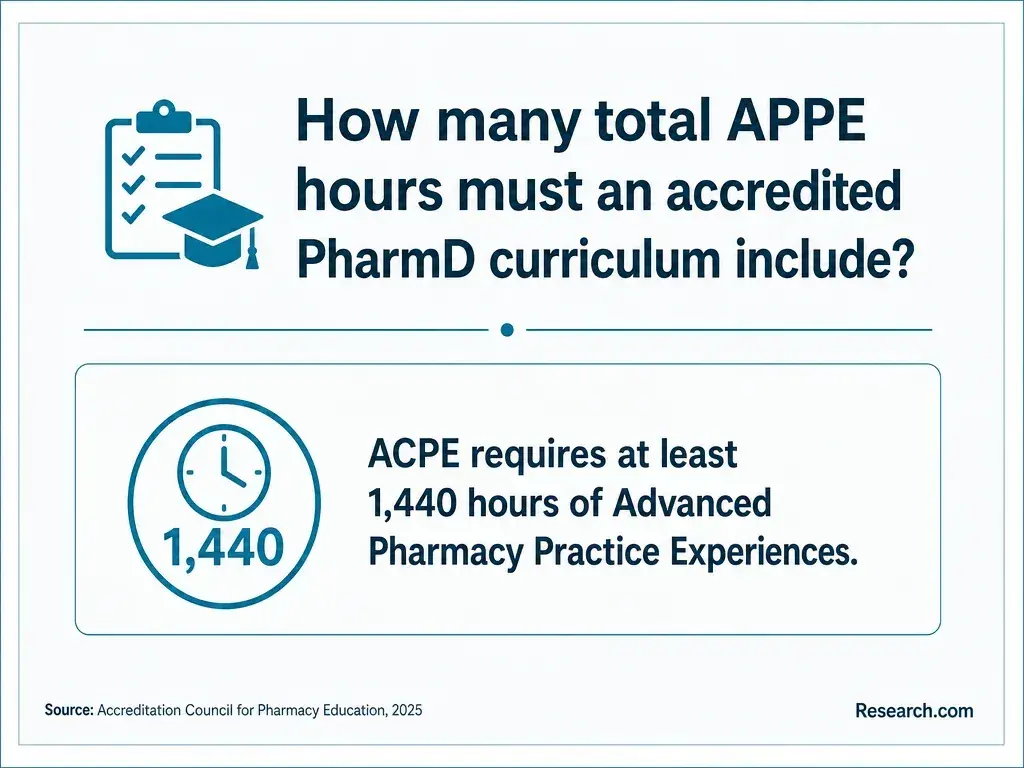
Pharm.D. students complete supervised introductory pharmacy practice experiences (IPPEs) and advanced pharmacy practice experiences (APPEs). These are clinical placements, not online lectures. APPE blocks can make a normal full-time work schedule impractical even when earlier coursework was flexible.
Ask who identifies and approves sites and preceptors, whether placements near your home are possible, and how far you might have to travel. Confirm your responsibilities for intern registration where required, background checks, immunizations, and transportation. A current employer's pharmacy is not automatically an acceptable rotation site. Likewise, pharmacy programs with transfer pathways do not necessarily accept prior work or another school's clinical experience in place of required rotations.
A Pharm.D. degree does not itself grant permission to practice as a pharmacist. Graduates seeking U.S. licensure must meet the requirements of the board of pharmacy in their intended jurisdiction. These generally include an application, required examinations, and any applicable intern-hour or background-check requirements.
The North American Pharmacist Licensure Examination (NAPLEX) assesses pharmacy practice knowledge. Jurisprudence testing varies: a jurisdiction may use the Multistate Pharmacy Jurisprudence Examination (MPJE), the Uniform Multistate Pharmacy Jurisprudence Examination (UMPJE), another process, or different requirements. Passing an exam does not itself issue a license.
Build time for licensing steps into your plans after graduation. General estimates of online doctoral study duration describe degree study, not the additional time a particular state board may take to establish licensure eligibility.
What careers, salaries, and job outlook follow an online PharmD?
After meeting state licensure requirements, pharmacists may work in community, hospital, ambulatory care, or other settings; hiring requirements and schedules differ. The U.S. Bureau of Labor Statistics reports median annual pay of $140,910 in May 2025 for pharmacists and projects 5% job growth from 2025-2035. These occupation-wide figures are context, not a prediction of an online graduate's starting pay or job prospects.
Some roles favor postgraduate residency or fellowship training, but neither is universally required for pharmacist employment; specialty board certification is also separate from state licensure. If you cannot yet meet admissions prerequisites, investigate pharmacy school requirements and exceptions before changing career plans. A pharmacy technician role may offer another way to enter the field, but it is a different occupation and does not confer pharmacist eligibility.
Other Things You Should Know About PharmD
Possibly during some terms, but do not assume you can maintain the same hours throughout. Ask your employer about flexibility before rotation blocks and required in-person activities begin.
Not necessarily. Still, admission does not guarantee that every required visit or clinical placement will be close enough to commute from home.
Not always. A course may use timed exam windows or scheduled assessments. Request the testing policy, including time-zone and make-up rules.
Ask each program for its current calendar and written policies. Mark every required live session, in-person visit, and rotation block against your work, caregiving, and travel constraints before paying a deposit.
- The impact of synchronous hybrid instruction on students' engagement in a pharmacotherapy course | nih.gov https://pmc.ncbi.nlm.nih.gov/articles/PMC9014902/
- PharmD FAQs - UNC Eshelman School of Pharmacy https://pharmacy.unc.edu/education/pharmd/pharmd-admissions-faqs/
- Doctor of Pharmacy | University of Missouri-Kansas City Academic Catalog https://catalog.umkc.edu/colleges-schools/pharmacy-home-page/doctor-of-pharmacy/
- PharmD Admissions - R. Ken Coit College of Pharmacy https://www.pharmacy.arizona.edu/academics/pharmd/admissions
- Can You Really Earn a Pharm.D. Online? Here's What to Expect - Lake Erie College of Osteopathic Medicine https://lecom.edu/can-you-really-earn-a-pharm-d-online-heres-what-to-expect/
- Online Doctor of Pharmacy (PharmD) Program | Butler University https://www.butler.edu/health-professions/doctor-of-pharmacy/online/
- PharmD Remote Pathway | CU School of Pharmacy https://pharmacy.cuanschutz.edu/degreesandprograms/pharmd/remote-pharmd
- Pharm.D. (Online or On-Campus) | Lipscomb University https://lipscomb.edu/academics/programs/pharmacy
- PharmD Prerequisites - Doctor of Pharmacy https://pharmacy.wisc.edu/pharmd/prerequisites/
- FAQ - Fisher Pharm.D. Online | SJF-PHA https://onlinepharmd.sjf.edu/admissions/faq/