2027 BS in Business Administration and Human Resources Management: Comparing Degree Plans After an AAS
Audited and Verified:
Our Editorial and Data Verification Process
Research.com uses government datasets, official education statistics and primary institutional information to support its career and degree guides. Our review process checks factual accuracy, occupational definitions, source dates and the requirements associated with the credentials discussed.
How This Article Was Fact-Checked
Our editorial team verifies salary estimates, employment projections, education requirements and program information against original data providers and official organizations. Salary figures are checked against the relevant occupational definitions and reporting periods. Information about licensure, accreditation and required in-person training is reviewed separately.
Fact-checked and verified on:

Co-Founder and Chief Data Scientist
An associate of applied science (AAS) can be a starting point for a bachelor's degree, but its career-focused courses may fit a business administration plan differently from a human resources management plan. If you are deciding between the two, the useful comparison is not just which title sounds better. It is which program applies more of your existing credits to graduation requirements and prepares you for the work you want. This guide shows you how to compare degree audits, coursework, scheduling, costs, and career paths before you enroll.
Key Things You Should Know
- Choose broad business administration if you want flexibility across functions; choose a formal HR major or concentration if you want deeper preparation for recruiting, employee relations, or HR operations.
- Do not equate credits a school accepts with requirements it fulfills. Request an official, plan-specific evaluation of your AAS before estimating completion time or cost.
- The U.S. Bureau of Labor Statistics reports a $75,940 median annual wage for human resources specialists in May 2025, but that occupation-wide figure is not a starting-salary estimate for AAS transfer students.
What Is the Difference Between Business Administration and Human Resources Management Degrees?
A BS in Business Administration generally combines accounting, finance, marketing, operations, management, and business analysis. Human resources management puts more emphasis on how organizations recruit, support, develop, and manage employees. Schools may offer HR as a separate bachelor's degree, a formal business administration concentration, or a smaller set of electives. Those are different credentials, even when some classes overlap.
The choice depends partly on your AAS and partly on your target work. Someone with an AAS in office administration who wants options in operations and HR may benefit from the broader BS. Someone already handling hiring paperwork or training coordination may value additional HR coursework. If your goal is supervising teams rather than practicing HR, compare the actual management curriculum with accelerated organizational leadership college programs; leadership coursework is not a substitute for employment-law and HR-operations preparation.
The table separates the plans by what you would study and where that preparation is most useful. Confirm the requirements at each school rather than assuming all degrees with the same name are alike.
| Comparison point | Business administration BS | HR management degree or formal concentration |
| Academic focus | Multiple business functions and organizational decisions | Workforce practices within an organizational and business context |
| Likely fit | Students considering operations, administrative, sales-support, or other business paths | Students seeking recruiting, HR operations, training, or employee-relations work |
| Main limitation | May offer too little HR depth without suitable electives or experience | May leave less elective space for other business functions |
How Does an AAS Transfer Into a Bachelor's Degree Program?
An AAS is usually designed around applied occupational study. A receiving university decides which courses it accepts and, separately, which accepted courses satisfy general education, business-core, HR, elective, or residency requirements. A course counted only as a free elective may add to your credit total without replacing a required accounting or HR class.
Compare two degree audits at the same institution - one for each proposed plan - using the same AAS transcript and catalog term. Pay particular attention to writing, mathematics, statistics, accounting, and lower-division business prerequisites. Also ask whether a transfer agreement covers your exact AAS program, not merely your community college. Applied work, military learning, and prior-learning assessments require separate evaluation where offered.
The following sequence turns a preliminary credit estimate into a usable comparison:
- Send official transcripts and course descriptions or syllabi for classes whose equivalency is unclear.
- Ask the transfer office for a written evaluation and a business adviser to map accepted courses to each degree's requirements.
- Check upper-division and residency rules, prerequisite order, and how often remaining courses run.
- Request a review or appeal for a course that appears equivalent but was classified only as an elective; obtain the approved decision in writing.
If the AAS was in a different applied field, compare relevant alternatives as well. For example, project management bachelor's completion using existing credits may deserve consideration when the intended work is project coordination rather than HR. Only the receiving school can determine which route actually preserves more useful credit.
Which Degree Plan Offers Better Career Opportunities After an AAS?
Neither plan is universally better. Start with the responsibilities you want in your next job and the evidence you already have from work, internships, or your AAS. Business administration can preserve options when you are still deciding among operations, administrative, customer-facing, and other business functions. HR study is a more direct academic match when you want to handle recruiting processes, personnel records, training coordination, or employee-support work.
An AAS in a technical or service field can also be an advantage if you want to work for employers in that sector: you may understand the workplace before learning its business processes. But a bachelor's degree does not turn that familiarity into specialist or management experience. If logistics work is the goal, compare the curriculum and transfer fit of a specialized program; supply chain degree duration and salary considerations are more relevant than HR electives to that decision.
A useful tie-breaker: if both plans apply similar AAS credits, favor the one with coursework and supervised experience closest to your target role. If one plan requires substantially more unmet prerequisites, weigh that extra time and cost against the value of its specialization. A broad degree plus an HR internship may be more useful than an HR-labeled plan without access to practical experience; the reverse can also be true.
Both plans commonly build on communication, quantitative reasoning, accounting, economics, and organizational behavior. A business administration plan then tends to spread advanced work across functions such as finance, marketing, operations, and strategy. An HR plan may devote more of that space to staffing, compensation, training and development, employee relations, HR information systems, and employment-law concepts. Course names do not establish depth: compare required credits, prerequisites, assignments, and available electives in the current catalog.
For an AAS transfer student, sequencing matters as much as the course list. A missing introductory statistics or accounting requirement may delay an upper-division course even when many applied credits transfer. Ask whether HR courses teach practical tasks - such as evaluating a recruitment process using appropriately protected data - and whether an internship or capstone is required, optional, or available. Existing employment does not automatically satisfy an academic project requirement.
If faster completion is important, examine shorter pathways to an online business degree against your audit. Shorter terms change the calendar, not necessarily the number of requirements or the hours of work per course.
Delivery mode should make the remaining degree plan feasible without sacrificing the courses and experience you need. Online study can reduce commuting, while campus study may make in-person advising, recruiting events, and local internships easier to access. Neither format guarantees a particular level of support or flexibility.
Ask for sample schedules for the specific remaining courses, not just a description of the overall program. Online classes can still have live sessions, fixed deadlines, group presentations, proctored exams, or required visits. Campus courses may meet at times that conflict with work, and a required HR internship may have daytime hours in either format. Compare internship access and career services as well as delivery mode; a list to compare leading American online business degree schools is a starting point, not a substitute for checking your own course schedule and audit.
An AAS does not automatically guarantee admission to a university or its business major. Schools may review college transcripts, academic standing, minimum grades in prerequisite courses, and separate major-entry requirements. A program may admit you to the institution while requiring additional math, accounting, or economics work before you can enter or progress through the business curriculum.
Ask admissions which requirements apply to AAS holders, then ask the business department which courses must be completed before upper-division enrollment. Submit official transcripts from every college attended. If you need a prerequisite, confirm whether you may take it at a lower-cost institution and obtain written approval of its equivalency before registering. Short-term classes toward a bachelor's degree may help with scheduling, but a faster class is useful only if the receiving school will apply it to the needed requirement.
The answer depends on remaining required courses, not the number of AAS credits printed on your transcript. Two students with similar accepted-credit totals can have different graduation dates if one still needs sequenced prerequisites or a course offered infrequently. Full-time study can shorten calendar time, while part-time study may be more workable alongside employment; neither choice changes a school's graduation requirements.
For each plan, request an audit and a term-by-term schedule, then price the courses that remain. Include tuition, mandatory fees, books, technology or proctoring charges, travel, and any income lost by changing work hours. Ask financial aid how enrollment intensity, transfer credits, and satisfactory academic progress affect your eligibility. Use business administration college costs and potential career outcomes for context, but do not treat an advertised program price or salary as your personal return.
The most informative comparison is the amount you would pay and the time you would spend from this point forward under each approved degree plan. Do not count projected savings from AAS credits until the school confirms how they apply.
First, identify the institution awarding the degree and verify its current institutional accreditation through the accreditor or the U.S. Department of Education's accreditation database. Then check whether the business school or the specific program has additional accreditation from AACSB, ACBSP, or IACBE. These are different questions: institutional accreditation does not mean an HR concentration has separate business accreditation, and a school-level accreditation claim may not cover every degree.
Ask the program to identify its accreditor, the programs covered, and the status applicable to your planned enrollment. Confirm the details with the accreditor and ask the school's financial-aid office about aid eligibility. When considering budget-conscious online business administration education, check accreditation and exact program scope before comparing advertised tuition. Accreditation is an important verification step, not proof that credits will transfer elsewhere or that graduates will obtain jobs.
Relevant starting targets may include HR assistant or recruiting coordinator, administrative specialist, operations coordinator, or training coordinator, depending on prior experience and local openings. An HR specialist may recruit, help administer personnel processes, or support employee relations; employers can require experience beyond coursework. Management positions generally involve a different level of responsibility and should not be treated as automatic outcomes of either bachelor's plan.
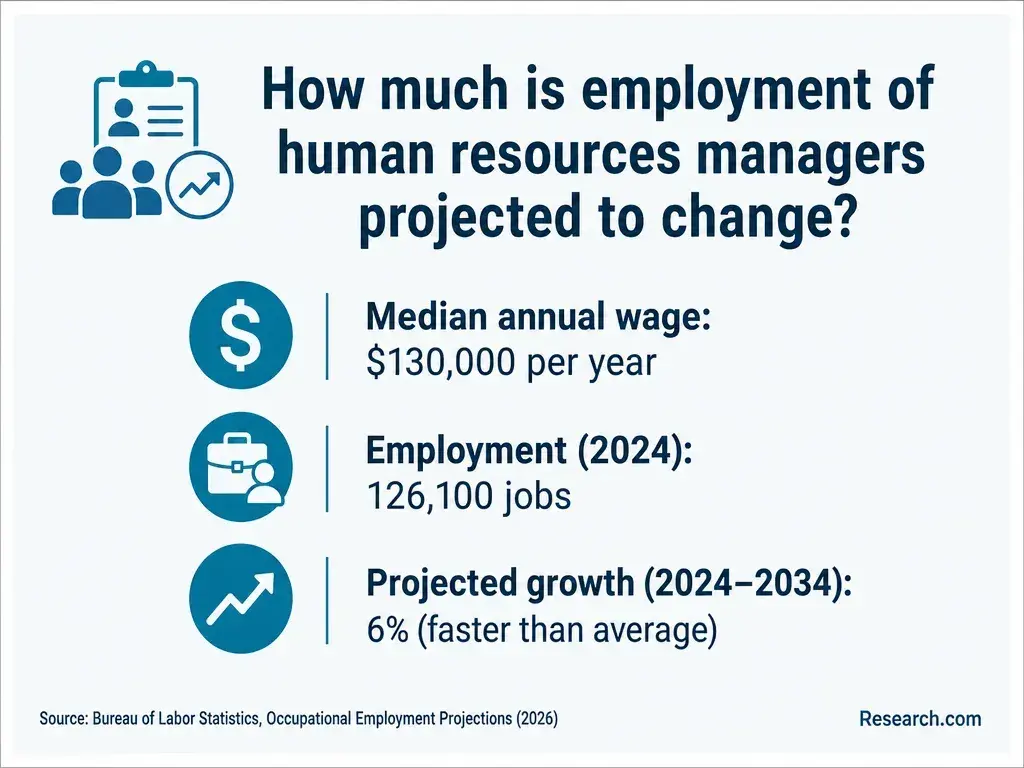
The table gives U.S. occupation-wide context, not salaries promised to graduates. Figures are Bureau of Labor Statistics median annual wages for May 2025 and projected employment changes for 2025-2035; individual offers vary by location, employer, and experience.
| Occupation | Median annual wage | Projected employment growth | Relevance to the comparison |
| Human resources specialist | $75,940 | 6% | Direct HR target, though duties and experience requirements vary |
| Training and development specialist | $69,280 | 11% | Potential fit for students interested in employee learning |
| Project management specialist | $102,320 | 7% | Alternative business pathway that typically calls for relevant project skills |
The specialist medians include experienced workers, so use them to compare occupations - not to forecast your first offer. For a project-focused goal, compare required experience and budgeting for online project management college study before assuming the broader business plan is the least costly route. Whichever plan you choose, look for ways to document spreadsheet work, professional communication, process improvement, and role-specific projects without disclosing private employer or employee information.
Which Certifications Improve Career Prospects in Human Resources?
Voluntary HR certifications can help demonstrate knowledge, but they are separate from an HR major or concentration. SHRM-CP and HRCI's aPHR or PHR are examples to investigate; their eligibility rules, exam content, fees, and renewal requirements differ and can change. Check the certifying organization's current rules before paying for preparation. Neither an AAS nor a bachelor's degree should be assumed to confer a certification automatically.
Choose a credential for a specific purpose. An early-career applicant might compare entry-oriented options against the skills requested in local HR postings; an experienced HR employee might consider a credential matched to their responsibilities. If employers require a bachelor's degree, certification alone may not fill that gap. Conversely, if you already have the education required for your target roles and need a narrow HR skill, a full second degree may be unnecessary.
Funding can affect that choice. Ask whether an employer pays for an exam or continuing education, and check whether a degree program participates in federal student aid; business administration college affordability and FAFSA participation is relevant to the degree side of that comparison. Do not assume a standalone certification course has the same aid eligibility as a bachelor's program.
Other Things You Should Know About Business Administration
Possibly, if faculty approve the project and your employer permits the work and data use. A job itself is not automatic capstone credit; ask for the learning objectives, supervision rules, and confidentiality requirements.
Not necessarily. The diploma may show only the awarded degree, while the concentration appears on the transcript. Ask the registrar how your school records both.
Either may satisfy the degree-level requirement for MBA consideration. Graduate programs set their own admissions standards, and relevant work experience can matter; an MBA is not required for every business or HR career.
General HR roles do not typically require a state HR license. Particular duties or jobs may carry other legal or credential requirements, so check the position and jurisdiction rather than assuming an HR degree or voluntary certification grants professional authority.
- Cost of Attendance (Budget) | 2025-2026 Federal Student Aid Handbook https://fsapartners.ed.gov/knowledge-center/fsa-handbook/2025-2026/vol3/ch2-cost-attendance-budget
- Accreditation in the U.S. | ed.gov http://www.ed.gov/laws-and-policy/higher-education-laws-and-policy/college-accreditation/accreditation-in-the-us
- HRCI vs. SHRM Certification - What's the Difference? | UTSA PaCE https://www.utsa.edu/pace/news/hrci-vs-shrm-certification-what-is-the-difference.html
- How Do Transfer Credits Work When You Go Back to School? | Whitworth Online https://online.whitworth.edu/news-articles/how-do-transfer-credits-work-when-you-go-back-to-school/
- Bachelor's in Human Resource Management (BS) Degree | The University of Alabama at Birmingham https://www.uab.edu/business/home/programs/undergraduate-degrees/human-resource-management
- 11 Types of Business Degrees You Can Pursue in 2026 | University of North Dakota https://und.edu/blog/types-of-business-degrees.html
- How Long Does It Take to Get an Associate Degree? | snhu.edu https://www.snhu.edu/about-us/newsroom/education/how-long-is-an-associate-degree
- Program: Business Administration, AAS | solacc.edu https://catalog.solacc.edu/preview_program.php
- Everything you need to know before choosing an undergraduate business degree - Penn State World Campus https://www.worldcampus.psu.edu/about-us/news-and-features/choosing-a-business-degree-program
- Transfer credit policies - Office of Admissions https://admit.washington.edu/apply/transfer/policies/