
PharmD Admission Requirements Without a Bachelor's Degree

Co-Founder and Chief Data Scientist
A bachelor's degree is not always necessary to apply to a Doctor of Pharmacy (Pharm.D.) program, but skipping the degree does not mean skipping college coursework. For prospective pharmacists, the decision is whether to complete a school's prerequisites and apply directly or finish a bachelor's degree first.
This guide explains how requirements differ, what to check before paying for courses, and how admission connects to the professional degree and eventual pharmacist licensure.
Key Things You Should Know
- Many U.S. Pharm.D. programs admit applicants without a bachelor's degree, provided they complete that school's required undergraduate courses and other admission conditions.
- Pre-pharmacy coursework often takes about two years of full-time study; the professional Pharm.D. commonly takes four more years, although program structures vary.
- The PCAT was retired in January 2024. Admission requirements now depend on the school, while pharmacist licensure remains a separate process after graduation.
Can you enter a PharmD program without a bachelor's degree?
Yes. Some schools admit students after they complete specified pre-professional coursework - undergraduate classes taken before the professional Pharm.D. curriculum - even if they have not earned a bachelor's degree. Other schools require a bachelor's degree or offer multiple entry pathways. A school's minimum number of credits is its own rule, not a national admission standard.
The no-bachelor's route may save time and undergraduate tuition if you can finish the required courses efficiently. Completing a bachelor's degree first may make more sense if you want a separate credential, need time to strengthen your application, or want career options if pharmacy school does not work out. Compare each school's published pharmacy school prerequisites and eligibility before choosing either route; meeting a minimum makes you eligible to apply, not certain to be admitted.
What are the admission requirements for a PharmD without a bachelor's degree?
Without a bachelor's degree, you still need to satisfy the receiving school's academic and application rules. Requirements may include prerequisite courses and labs, minimum grades or GPA, transcripts, recommendations, an interview, and proof that remaining courses will be finished before enrollment. Schools can also set course-age limits or rules for repeated classes.
Check the current admissions page and application-cycle instructions for each program on your shortlist. These are the points most likely to change whether you can apply this cycle:
- Confirm that applicants without a bachelor's degree are eligible and identify the exact courses, labs, grades, and credits required.
- Ask whether unfinished prerequisites are allowed at application and when final grades must be submitted.
- Check whether the school uses the Pharmacy College Application Service (PharmCAS), requires a supplemental application, and has separate deadlines or deposits.
- Request a written evaluation of any unusual coursework before enrolling in another class.
Policies on advanced-placement credit, online labs, international courses, and repeated courses are especially important to verify. A guide to pharmacy degree entry requirements can help frame your questions, but the school's current written policy controls your application.
Which prerequisite courses are required for PharmD admission?
Common pre-pharmacy subjects include general and organic chemistry, biology, mathematics, and writing. Programs may also require anatomy and physiology, microbiology, physics, statistics, social sciences, or humanities. Science-lab requirements differ, so a lecture course alone may not satisfy a school that specifies a lab.
Build your course plan from the requirements of the programs where you intend to apply, not from a generic "pre-pharmacy" major. This matters particularly for students comparing pharmacy programs for students with science credits: an existing biology or chemistry course may fit one school's prerequisite and miss another's required sequence. Ask each school whether substitutions, community-college courses, and online or in-person labs are accepted.
There is no nationwide undergraduate-credit minimum for Pharm.D. admission. Schools specify their own prerequisite credits and courses; some also require general-education credits beyond the sciences. The credit total on your transcript matters less than whether the receiving school accepts each course toward its requirements.
The distinction below helps prevent a costly planning error: credits earned before admission and credits earned in the professional program serve different purposes.
| Credit category | What it means for admission |
| Undergraduate prerequisite credits | Courses the school requires before entering its Pharm.D. program; a bachelor's degree may not be required. |
| Additional undergraduate credits | May count toward a school's stated total only if its policy allows them; they do not replace specified courses. |
| Professional Pharm.D. credits | Earned after admission under the program's curriculum; earlier college credits do not automatically transfer into it. |
When comparing schools, send transcripts for a pharmacy prerequisite credit evaluation. Ask the receiving school to identify both missing courses and credits it will accept; another institution's acceptance decision is not binding on it.
The Pharmacy College Admission Test (PCAT) was retired in January 2024, so it is not a current exam you can schedule as a routine Pharm.D. admissions step. Do not rely on an older admissions checklist that still tells applicants to take it.
A school may instead use interviews, written responses, or other program-specific assessments. Review its current instructions rather than assuming that "no PCAT" means "no evaluation beyond grades." If avoiding a lengthy admission and licensing route is central to your choice, compare pharmacy education with shorter completion time carefully: a shorter pharmacy-related credential does not substitute for a Pharm.D. and pharmacist licensure.
A common route is roughly two years of full-time prerequisite study followed by a four-year professional Pharm.D. curriculum. The first phase is not part of the professional degree merely because it is called "pre-pharmacy." Actual time depends on course availability, your prior credits, the school's sequence, and whether you study full time.
Some schools offer accelerated professional curricula. Compare how accelerated Pharm.D. programs work against your capacity for compressed coursework, scheduled clinical experiences, and potentially less time for paid work. Before choosing the apparently fastest option, map the semesters needed for missing prerequisites and the program's actual start date; a missed course sequence can erase the expected time savings.
Some Pharm.D. programs offer online or hybrid instruction and may consider applicants who meet prerequisites without holding a bachelor's degree. "Online" does not necessarily mean self-paced or fully remote. Scheduled classes, campus visits, hands-on activities, and in-person clinical experiences may still be required.
Pharmacy practice experiences include introductory pharmacy practice experiences (IPPEs) and more advanced rotations called advanced pharmacy practice experiences (APPEs). Ask who arranges or approves sites, whether placements can be near you, and what travel, intern registration, health screening, or time away from work may be necessary. Published claims about online pharmacy degree time to completion may concern credentials other than an entry-to-practice Pharm.D.; verify the credential before comparing timelines.
Start by checking the program's current standing with the Accreditation Council for Pharmacy Education (ACPE), which accredits professional pharmacy programs. Then separately verify the institution's accreditation and, for online study, whether it is authorized to enroll you in your state. These are different checks; none alone confirms that a particular clinical placement is available or that you meet your state's licensing rules.
Use the same criteria when comparing campus and online pharmacy school programs: your prerequisite eligibility, full tuition and required fees, schedule, campus travel, clinical-placement arrangements, and published graduate licensing-exam outcomes. Ask how the school supports students who need placements outside its home area, but do not treat placement near home as guaranteed unless the school explicitly commits to it.
Budget for more than advertised tuition. Prerequisite courses, required technology or materials, background checks, immunizations, rotation travel, and licensing expenses may affect the total. Federal borrowing rules changed for many new graduate and professional borrowers beginning July 1, 2026; confirm your student classification and current aid eligibility with the school's financial aid office rather than assuming previous loan options remain available.
Graduating from an ACPE-accredited Pharm.D. program does not itself authorize you to practice as a pharmacist. You must apply to the relevant state board of pharmacy and meet that jurisdiction's requirements, which can include supervised experience, background checks, the North American Pharmacist Licensure Examination (NAPLEX), and a jurisprudence requirement. A jurisdiction may use the Multistate Pharmacy Jurisprudence Examination (MPJE), the Uniform Multistate Pharmacy Jurisprudence Examination (UMPJE), another process, or no separate jurisprudence exam; check the board's current rules.
Licensure is also distinct from optional postgraduate training. A residency or fellowship provides additional training for particular career goals, while specialty board certification is a separate credential with its own eligibility rules. None replaces a state pharmacist license. If you want doctoral study but do not intend to become a licensed pharmacist, consider whether doctoral study with a shorter time commitment better matches your goal; it is not a shortcut to pharmacist licensure.
What salary and job outlook can PharmD graduates expect?
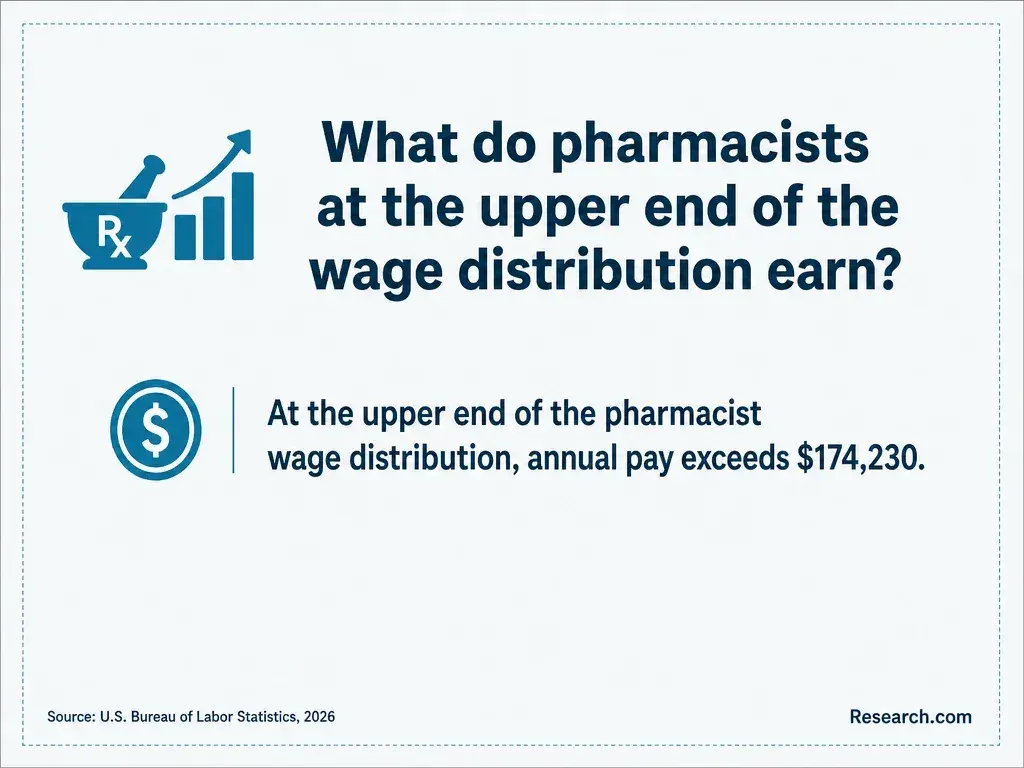
The U.S. Bureau of Labor Statistics reports median annual pay of $140,910 in May 2025 for pharmacists and projects 5% job growth from 2025 to 2035, with about 12,500 openings per year. Those occupation-wide figures are context for a career decision, not a salary forecast for a new graduate or a promise of a position.
Weigh that potential against the full cost and time required to become licensed. Compare Doctor of Pharmacy programs with manageable tuition using total required expenses, not tuition alone, and consider income you may forgo during study and rotations. A lower-cost option is only useful if you can meet its prerequisites, complete its required in-person work, and pursue licensure where you plan to practice.
Other Things You Should Know About PharmD
Usually, the relevant question is whether your courses satisfy the program's prerequisites, not what major appears on your transcript. Check the school's policy if your coursework comes from an unusual program.
Generally, work experience does not substitute for a required college course unless a school explicitly allows it. It can still help you assess whether pharmacy practice interests you.
Not automatically. Some pathways may award a bachelor's degree along the way, but others award only the professional degree. Ask the school which credentials your specific pathway confers.
Deferral policies vary by school and may require approval. Request the policy in writing before assuming an offer can be moved to a later entering class.
- State Licensure Requirements for Students Seeking Postgraduate Residency Training May Limit Options - PMC https://pmc.ncbi.nlm.nih.gov/articles/PMC5135425/
- Selection Criteria - College of Pharmacy https://www.pharmacy.umn.edu/doctor-pharmacy/admissions/how-apply/selection-criteria
- FAQ | OSU College of Pharmacy - Oregon State University https://pharmacy.oregonstate.edu/programs-admissions/pharm-d/faq
- PharmD Program Prerequisites - Temple School of Pharmacy https://pharmacy.temple.edu/pharmdprereqs
- Application Process | College of Pharmacy | UUH https://pharmacy.utah.edu/admissions/admissions-info/application-process
- PharmD Early Assurance - Doctor of Pharmacy https://pharmacy.wisc.edu/pharmd/early-assurance/
- PharmD Application Process and Requirements | umich.edu https://pharmacy.umich.edu/pharmacy-programs/pharmd-program/application-process-requirements/
- Pharmacy (BS to PharmD) - Philadelphia | Saint Joseph's University https://www.sju.edu/degree-programs/bs-doctor-pharmacy-pharmd
- PharmD Pharmacy Admissions Process | Pharmacy & Health Sciences https://cphs.campbell.edu/academic-programs/pharmacy/doctor-of-pharmacy/requirements/
- PharmD FAQs - UNC Eshelman School of Pharmacy https://pharmacy.unc.edu/education/pharmd/pharmd-admissions-faqs/


