2027 BS in Business Administration: Business School Admission After General University Admission
Audited and Verified:
Our Editorial and Data Verification Process
Research.com uses government datasets, official education statistics and primary institutional information to support its career and degree guides. Our review process checks factual accuracy, occupational definitions, source dates and the requirements associated with the credentials discussed.
How This Article Was Fact-Checked
Our editorial team verifies salary estimates, employment projections, education requirements and program information against original data providers and official organizations. Salary figures are checked against the relevant occupational definitions and reporting periods. Information about licensure, accreditation and required in-person training is reviewed separately.
Fact-checked and verified on:

Co-Founder and Chief Data Scientist
University admission does not always mean you have a place in its business school. Some universities admit students directly to a BS in Business Administration; others require a second application after prerequisite courses or a period of undergraduate study. If you are already enrolled, the distinction affects which courses to take next, when you can enter the major, and whether a delay could extend your degree.
This guide explains how to identify your admission status, prepare a business-school application, and compare programs without mistaking accepted credits or general university eligibility for progress toward graduation.
Key Things You Should Know
- Check whether your university uses direct admission, a pre-business track, or a separate application to the BS in Business Administration; university admission alone may not grant access to the major.
- Ask the business school to confirm prerequisite grades, GPA rules, application timing, and seat availability for your intended entry term.
- Request an official degree audit before committing to a schedule: accepted credits may count as electives rather than satisfy business-core requirements. For career planning, the May 2025 median wage for human resources specialists was $75,940, an occupation-wide figure—not an expected starting salary for business graduates.
What is a BS in Business Administration?
A BS in Business Administration is an undergraduate degree combining general education with study of how organizations manage money, people, customers, information, and operations. It may offer a broad business curriculum or an official concentration. A BS, BBA, and BA in Business can cover similar subjects, but their required courses, quantitative emphasis, and admission rules depend on the university—not the degree abbreviation alone.
For an already-admitted student, the important distinction is where you have been admitted. Your university may list you as a business major, a pre-business student, an undeclared student, or a student in another college. Only the applicable catalog and your student record can establish whether you have entered the business school. If program length is also part of your decision, you can compare accelerated business programs, then verify whether their admission and course-sequencing rules would actually shorten your path.
What are the admission requirements for a business school after university admission?
There is no universal second-stage admission rule. At one university, declaring the major may be enough; at another, students must apply to the business school after completing specified courses. A third may admit students to pre-business status but limit entry to the BS major by GPA, prerequisite grades, available seats, or application term. Eligibility to apply is not the same as admission, and admission is not the same as satisfying degree requirements.
The stages below show what each decision establishes. Use the distinction when reading an acceptance letter or speaking with an adviser.
| Stage | What it establishes | What it does not establish |
| University admission | Permission to enroll at the institution | A place in a separately admitting business school |
| Pre-business or prerequisite eligibility | Permission to pursue preparatory coursework or apply later | Guaranteed admission to the BS major |
| Business-school admission | Entry to the specified business program under its rules | Completion of every major or graduation requirement |
| Transfer-credit acceptance | Recognition of prior college-level work | Application of each credit to a particular business requirement |
Before applying, build a written record rather than relying on an informal assurance. The following sequence helps you find a missing requirement while there is still time to address it:
- Check your admission letter, student record, and current catalog for your declared major and the business school's application route.
- Obtain the requirements for your intended entry term, including prerequisite courses, minimum grades, GPA calculation, deadlines, and any required application materials.
- Ask an academic adviser which courses you can take before business school admission and whether later courses depend on admission to the major.
- If you studied elsewhere, submit official transcripts to the transfer office and request a degree audit showing where each accepted course applies; seek written review of disputed equivalencies.
- Confirm the decision timeline and make a course plan for both admission and non-admission outcomes before registering for the next term.
Requirements can differ for transfer, returning, and second-degree students. A previous business course may satisfy an elective but not the school's accounting or statistics prerequisite; a university may also have rules for repeated or pass-fail courses. If your actual goal is a separate HR major, investigate how to apply prior credits to an HR bachelor's degree rather than assuming its admission and credit rules match the business administration program.
How do accredited BS in Business Administration programs differ?
First, verify the university's institutional accreditation. Then check whether any advertised business accreditation—such as AACSB, ACBSP, or IACBE—actually covers the school or program you intend to enter. Institutional accreditation and business-specific accreditation have different scopes; neither tells you whether you personally meet a separate business-school admission threshold.
Among accredited options, compare the features that affect an already-enrolled student's route: direct versus secondary admission, prerequisite sequencing, transfer-course equivalencies, required credits taken at that institution, access to upper-division classes, and the catalog rules that will govern your degree. Ask for the relevant policy and an official audit, not just a general program description. If financing is a deciding factor, a comparison of affordable accredited business administration programs accepting FAFSA can help identify options to investigate; confirm each school's accreditation scope, aid eligibility, and your remaining requirements directly.
Business administration programs commonly combine general education with introductory and upper-division work in accounting, economics, finance, marketing, management, operations, statistics, and business law. Some include information systems, a capstone, or electives in a formal concentration. The exact list matters most when the business school requires certain courses before admission but restricts others until after admission.
Look for prerequisite chains in the catalog. For example, a later finance course may depend on accounting, while an analytics course may require statistics. Even if you have enough total credits to be a junior, a missing prerequisite or an upper-division course offered infrequently can delay graduation. Students seeking project-management-focused study should compare the business core with online project management degrees for transfer applicants; similar electives do not make the two degrees interchangeable, and each school decides how prior courses apply.
Choose the format in which you can complete the required courses in sequence, not simply the one with the most convenient label. An online program may still require scheduled discussions, group presentations, proctored exams, or fixed deadlines. A campus program may provide easier access to in-person recruiting or advising but require travel and classes during working hours. For an already-admitted student, also confirm whether changing formats means changing campuses, colleges, or admission status.
Ask for sample upper-division schedules, assessment rules, and any internship or campus-visit requirements before making the switch. US online business education program comparisons can help you identify programs, but the deciding evidence is whether their actual course availability and business-school admission policies fit your circumstances.
A full-time bachelor's path is commonly planned across four academic years, but a student applying to the business school after university admission needs a more specific estimate: the terms required to finish prerequisites, receive an admission decision, and take the remaining business courses in order. Part-time enrollment, transferred courses, repeated prerequisites, and courses offered only in certain terms can change that timeline.
Compare costs using the courses you still need—not a school's advertised tuition alone. Include tuition and mandatory fees, books or software, commuting or technology expenses, and the financial effect of an extra term. Ask the financial-aid office how a change of major, enrollment intensity, or delayed entry to required courses could affect your aid. Online undergraduate business rankings for shorter study paths are a starting point, but a shorter advertised calendar does not establish a shorter or cheaper path for your approved degree audit.
The degree can support applications for roles such as operations coordinator, HR assistant or specialist, marketing coordinator, procurement associate, and project coordinator. These jobs involve different work: tracking processes, supporting hiring, preparing campaign materials, handling purchasing, or monitoring schedules. Match electives and experience to the function you want rather than assuming a broad business degree qualifies you for every one of them.
Relevant employment, an internship, or a supervised project can help demonstrate spreadsheet skills, professional communication, and sound judgment. Graduating does not automatically make someone a manager; supervisory roles generally call for demonstrated responsibility and results. If you are already employed, consider whether you can balance employment and business administration college study while building evidence of skills for your next role.
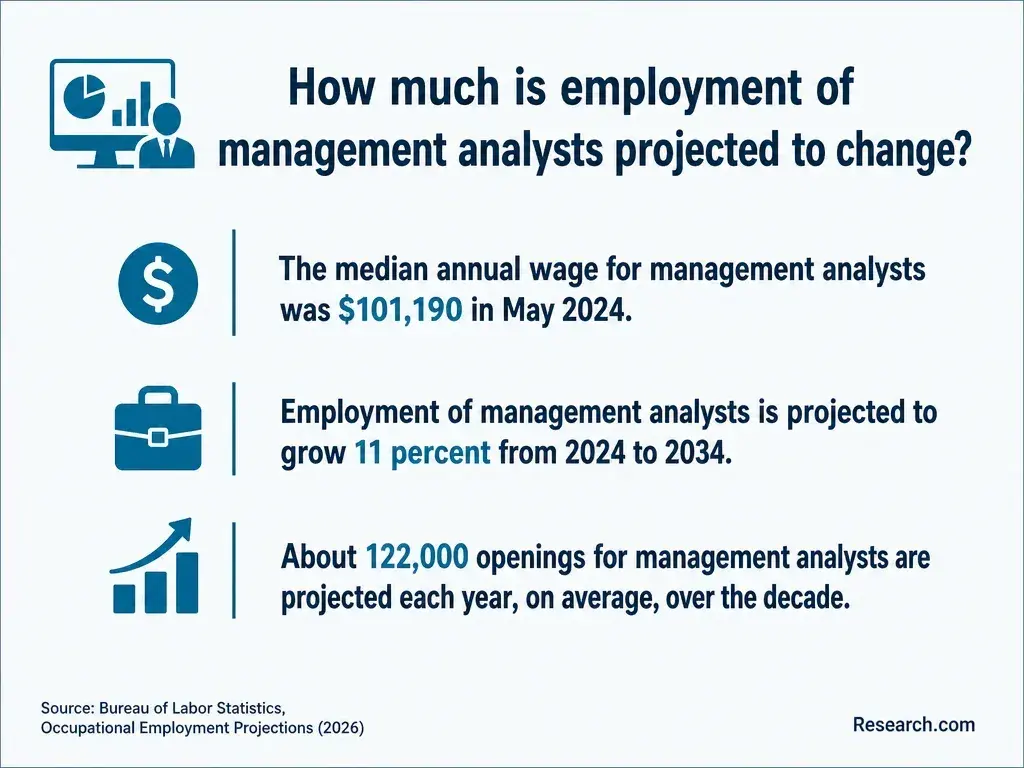
There is no single salary for this degree. Pay depends on the occupation, location, industry, and experience. The U.S. Bureau of Labor Statistics reports a May 2025 median annual wage of $75,940 for human resources specialists. That is the midpoint for workers across the occupation, not a starting salary or a wage earned by everyone with a BS in Business Administration. Use occupation-specific pay information for the roles you intend to pursue, and compare it with local job postings and your likely entry point.
Salary potential should not justify borrowing without a completion cost estimate. If expense could affect whether you finish, explore cheaper business administration college programs while comparing the credits each would apply to your degree and the time you would need to complete it.
Outlook is measured for occupations, not for everyone holding a particular degree. The U.S. Bureau of Labor Statistics projects 6% employment growth for human resources specialists from 2025 to 2035. That projection indicates change in a defined occupation; it does not predict whether a new graduate will be hired or whether a business-school application will pay off. Assess the requirements and opportunities for your target role rather than treating general business demand as a placement forecast.
If several programs could prepare you for that role, the stronger choice is the one you can enter, complete, and afford while gaining relevant experience. Resources on online business education on a smaller budget can inform a cost comparison, but projected job growth does not erase the risk of unnecessary credits or debt.
Which certifications or licenses benefit business administration graduates?
A certification is useful when it matches a specific job function and you meet the issuing organization's eligibility rules. HR, project management, and accounting all have separate credentials or licensing pathways; a BS in Business Administration does not award them automatically. In particular, accounting licensure has requirements set by the relevant state board, so business-school admission is not evidence of future CPA eligibility.
Before paying for credential preparation, examine job postings for your target role and confirm the credential's education, experience, and examination rules with its issuer. If your goal calls for substantial project-management coursework rather than an add-on credential, compare that separate bachelor's path and investigate paying for project management bachelor's study with grants. Neither a grant nor admission to a different major should be assumed until the responsible school confirms eligibility.
Other Things You Should Know About Business Administration
Possibly. Ask whether reapplication is permitted, which future terms are open, and whether retaking a prerequisite or improving your academic record would change your eligibility. Keep a workable alternate major or transfer plan.
That depends on the school. Some admit students to the general major before they select a concentration; others have separate capacity or application rules. Check when and how the choice becomes official.
Not necessarily. Some schools use specific entry terms or application windows. Confirm the deadline for the term you want rather than assuming you can apply as soon as your grades post.
Often, but membership rules vary by organization and campus. An adviser or organization officer can clarify eligibility; participation itself does not confer admission to the business school.
- Ohio Guaranteed Admission (OGA) https://highered.ohio.gov/initiatives/access-acceleration/guaranteed-admission
- School-Determined Requirements | 2024-2025 Federal Student Aid Handbook https://fsapartners.ed.gov/knowledge-center/fsa-handbook/2024-2025/vol1/ch1-school-determined-requirements
- Academic Policies and Information | Northern Virginia Community College Academic Catalog https://catalog.nvcc.edu/academic-policies-information/
- As a pre-business student, pursue standard admission to Kelley | Kelley School of Business https://kelley.iu.edu/undergraduate/admissions/current-iu/index.html
- Accelerated Business to MBA Pathway | psu.edu https://greaterallegheny.psu.edu/academics/baccalaureate/business/master-business-administration
- College of Business Administration - University of Pittsburgh https://catalog.upp.pitt.edu/content.php
- Admission to Business Majors | Undergraduate Programs | UConn School of Business https://undergrad.business.uconn.edu/prospective/current-students/
- Admission to the College of Business | University of Louisville Academic Catalogs https://catalog.louisville.edu/undergraduate/admission/college-business/
- Grades and Grade Point Average (GPA) Calculation | University of Arizona Office of the Registrar https://registrar.arizona.edu/records-enrollment/enrollment/grades/grades-and-grade-point-average-gpa-calculation
- Ten Ways to Avoid Financial Aid Delays | JCTC https://jefferson.kctcs.edu/affording-college/financial-aid-information/avoid-delays.aspx