Pharmd Rolling Admission: When to Apply?

Co-Founder and Chief Data Scientist
With rolling admission, waiting for a Pharm.D. program's final deadline can put you at a disadvantage, but applying before your materials are ready can, too. If you are planning pharmacy school, this guide will help you choose a submission window, account for PharmCAS processing and school-specific requirements, and decide whether your application is ready. It also covers the costs and commitments worth checking before you accept an offer.
Key Things You Should Know
- For a rolling-admission Pharm.D. program, aim to submit a complete, strong application early in that school's cycle, not merely before its final deadline.
- Allow time for transcripts, recommendations, PharmCAS processing, and any supplemental application, an early submission is not necessarily an early review.
- Applying earlier may improve access to available interview dates and seats, but it never guarantees admission. Confirm each school's review process and deadlines.
What is rolling admission for PharmD programs?
Rolling admission means a school reviews applications or makes decisions during an extended period rather than waiting until one final deadline has passed. The details vary: a program might interview applicants in batches, release decisions periodically, or continue reviewing until its class is filled. A published deadline can therefore remain open even as available seats become fewer.
Rolling review does not mean every applicant receives an immediate decision or that applications are considered strictly in submission order. Schools may wait for required materials, compare candidates within an interview group, or hold some decisions for later. If you are still finishing prerequisite coursework, ask whether the school permits courses to be in progress when you apply and when they must be completed. Pharmacy programs for students with varied academic backgrounds can help you frame that conversation, but the school's current policy controls.
When should you apply to a rolling-admission PharmD program?
Apply as early as you can submit a complete, competitive application for your chosen schools. Do not rush a weak application to be first, and do not use the final deadline as your planning date. Start by checking each program's opening date, priority deadline if it has one, final deadline, and whether it reviews files before verification or only after every required item arrives.
Use this sequence to set a realistic submission target:
- Choose schools and check their current PharmCAS directory entries and admissions pages for prerequisites, deadlines, interviews, and supplemental requirements.
- Request transcripts and recommendations early enough to allow for delivery and processing; draft your application while those materials are pending.
- Identify the date by which your file can actually be complete, then submit with room for corrections or school follow-up before the relevant deadline.
- If you are close to a deadline, ask admissions whether seats and interviews remain and whether late-arriving materials can still be considered.
Apply sooner if your application already meets the requirements and you would attend if admitted. Consider waiting to strengthen a material weakness - such as a missing required course or an unfinished recommendation - if the school confirms that waiting remains viable. Published minimums are eligibility thresholds, not promises of admission; pharmacy schools and entry standards should be assessed against each program's current rules.
How does PharmCAS work for PharmD applications?
The Pharmacy College Application Service (PharmCAS) is a centralized application used by many, but not all, U.S. Pharm.D. programs. Applicants generally enter academic and experience information, arrange for official transcripts and requested evaluations, and select programs. PharmCAS then processes submitted materials according to its current cycle instructions. Each school decides how it evaluates applicants.
A PharmCAS submission is not necessarily a complete school application. A program may also require a supplemental form or fee, an interview, updated grades, or other materials by its own deadline. Check whether a school's deadline refers to submitting PharmCAS, receiving all materials, or another stage. If prior coursework matters to your eligibility, apply prior college credits to pharmacy programs only after the receiving school confirms how it evaluates them; entry prerequisites are different from credit transferred into the professional curriculum.
Requirements commonly include specified undergraduate prerequisite courses, transcripts, recommendations, and an interview, but the courses, laboratory expectations, minimum grades, GPA rules, and required materials differ by school. Some programs admit students after prerequisite study without a completed bachelor's degree; others offer different entry pathways. Pre-pharmacy courses prepare you to enter the professional Pharm.D. curriculum - they are not the curriculum itself.
Before choosing an application date, confirm how each school treats courses in progress, repeated or older coursework, community-college credit, and online labs. Applicants changing fields can use pharmacy doctorate options after chemistry as a starting point, then obtain a school-specific prerequisite review. The Pharmacy College Admission Test (PCAT) was retired in January 2024; do not plan around taking it.
A traditional professional Pharm.D. curriculum commonly takes four academic years after the required pre-professional coursework. The time before entry depends on which prerequisites you have completed; some schools offer accelerated or other structured pathways with different calendars. How accelerated Pharm.D. programs work is worth examining if time matters, but compare actual start dates, breaks, workload, and graduation dates - not just the advertised number of years.
For a rolling-admission applicant, missing a prerequisite or a cycle deadline can affect the start date more than a program's nominal length. Ask whether unfinished courses can be completed before matriculation and what happens to an offer if they are not.
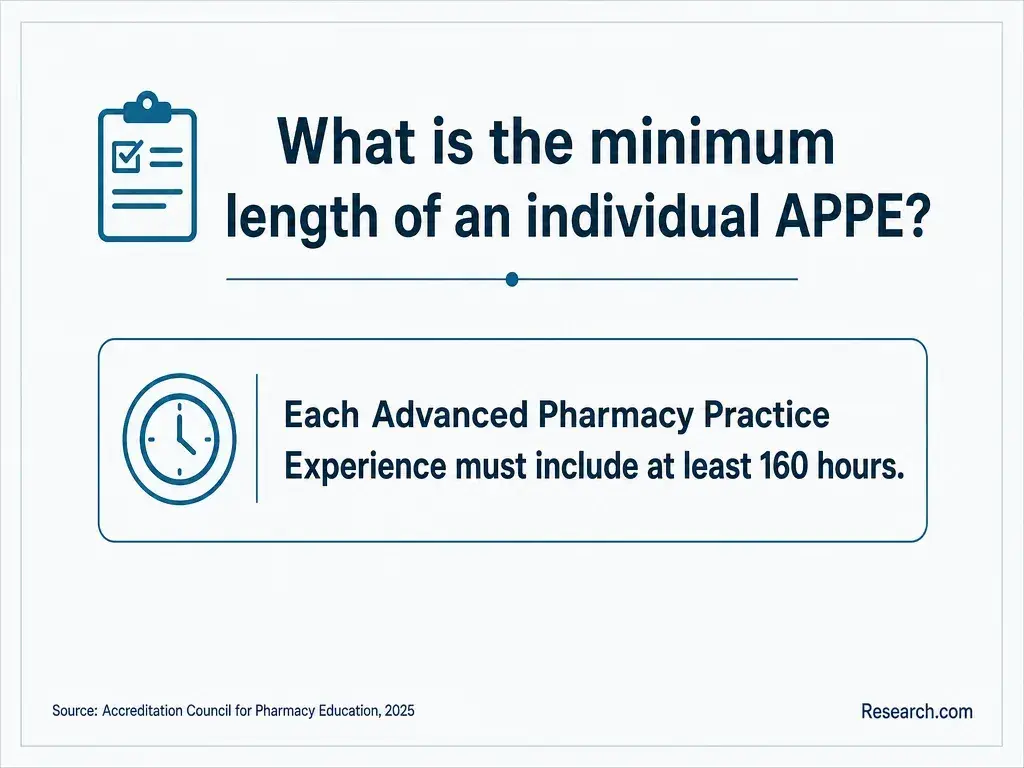
The professional curriculum develops knowledge of medicines and the skills to assess medication use, communicate with patients and care teams, and make decisions within a pharmacist's legal scope of practice. It combines classroom and skills-based learning with supervised introductory pharmacy practice experiences (IPPEs) and later advanced pharmacy practice experiences (APPEs). Rotation scheduling can constrain work hours and require travel, depending on the school and sites.
That commitment is relevant before you accept a rolling offer: ask when experiential work begins, who arranges placements, and what travel or intern-registration obligations students face. If your goal is a pharmacy-adjacent job rather than pharmacist licensure, pharmacy degree options with shorter study periods may be worth comparing. A shorter credential does not replace a qualifying Pharm.D. for the usual U.S.-educated pharmacist licensing pathway.
Some Pharm.D. pathways deliver part of their instruction online, but "online" does not establish that classes are self-paced or that the degree can be completed remotely. Programs may require scheduled live sessions, campus visits and hands-on labs, as well as in-person IPPEs and APPEs. If flexibility affects where you apply, compare online Pharm.D. pathways for future pharmacists against each school's current attendance and placement requirements.
Check the Accreditation Council for Pharmacy Education (ACPE) status of the professional Pharm.D. program, not just the institution's accreditation. Separately verify that the school can enroll you from your state and support any required clinical placements there. State authorization for distance education is not the same as eligibility for pharmacist licensure.
There is no reliable single price for a Pharm.D.: tuition varies by school, residency classification, enrollment pattern, and aid year. An early offer is useful only if you can assess the full financial commitment before a deposit deadline. When you compare online Pharm.D. costs, include expenses that an advertised tuition figure may exclude.
These cost categories show what to request from each school so you can compare offers on the same basis.
| Cost category | What may affect the total |
| School charges | Tuition classification, mandatory fees, and annual increases |
| Learning and placement | Required materials, technology, background checks, immunizations, and rotation travel or housing |
| Entry and licensing | Unfinished prerequisites, application costs, and eventual examination and licensing fees |
Ask for the current cost of attendance and a financial-aid estimate for your circumstances. Federal borrowing rules changed for many new graduate and professional borrowers beginning July 1, 2026; do not assume a previous student's loan limits or Grad PLUS access will apply to you. Confirm eligibility and current terms with the school's aid office before paying a nonrefundable deposit.
For the standard U.S.-educated route, choose a Pharm.D. program with the appropriate ACPE professional-program accreditation status and confirm your intended state board's education, supervised-experience, examination, and application requirements. Graduation does not issue a pharmacist license. The North American Pharmacist Licensure Examination (NAPLEX) is part of the licensing process; jurisprudence testing varies by jurisdiction, including whether the board uses the MPJE, the UMPJE, or another approach. The state board determines when all conditions for licensure are met.
Speed alone is a poor licensing criterion. Online doctorate programs with shorter timelines may award other types of doctorates, but a doctorate in another subject is not a substitute for a qualifying Pharm.D. Internationally educated pharmacists should check the applicable foreign-graduate and state-board pathway rather than assume these U.S.-educated steps apply unchanged.
What careers, salaries, and job outlook follow a PharmD?
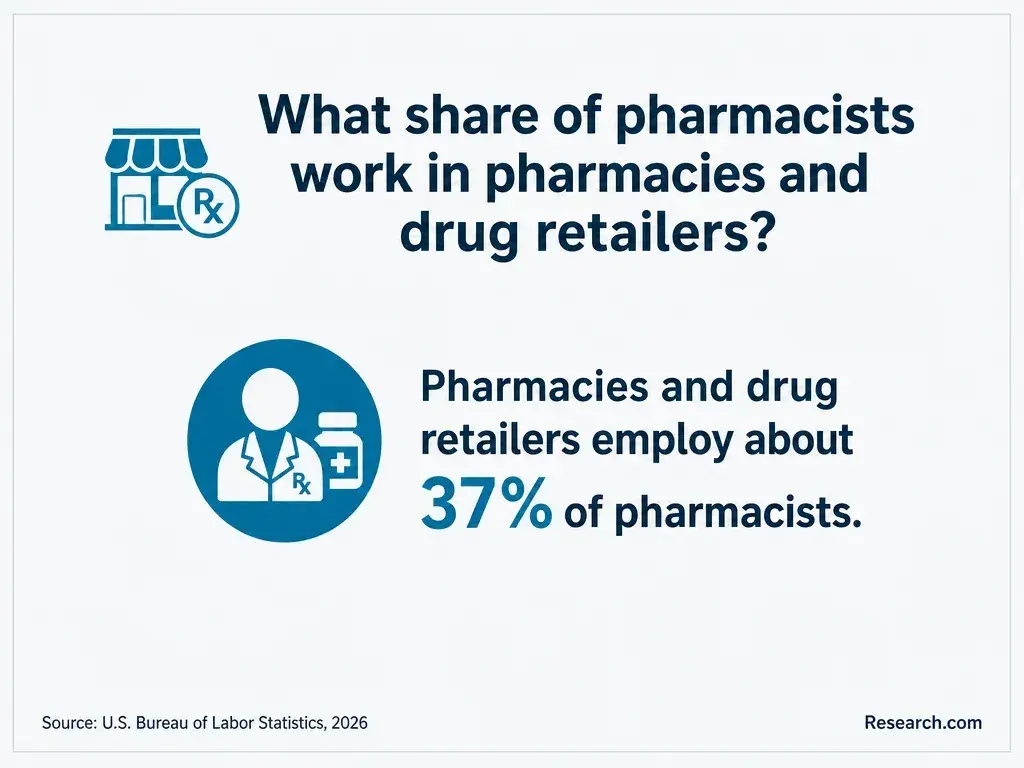
Licensed pharmacists work in settings including community pharmacies, hospitals, and other patient-care environments; particular roles may have additional employer requirements. The Bureau of Labor Statistics reports median annual pay of $140,910 in May 2025 for pharmacists and projects 5% growth, 2025-2035, with about 12,500 openings per year. Those occupation-wide figures are context for a career decision, not a starting-salary or job offer for a new graduate.
A residency can provide postgraduate practice training, while a fellowship commonly emphasizes a different specialized training path; neither is universally required to work as a pharmacist. Board certification is a separate credential, not a state license. If you mainly want to enter the pharmacy workplace sooner, consider whether budget-friendly pharmacy education options serve your goal. Pharmacy technician is a separate occupation and does not ordinarily require a Pharm.D. That distinction can prevent you from committing to the cost and timeline of pharmacist training for a job that does not require it.
Other Things You Should Know About PharmD
You can ask, but deferral policies vary. Get written confirmation of whether the offer, deposit, scholarship, and prerequisite conditions would carry into the next entering class.
Some information can be updated under the current PharmCAS cycle rules, while other changes must go directly to a school or cannot replace the original submission. Check both PharmCAS instructions and the program's update policy before relying on a later grade or experience.
Do not assume it is. Check the offer's written payment, refund, and acceptance terms before submitting a deposit, especially if you are awaiting decisions elsewhere.
Follow its instructions to confirm your interest and provide only the updates it accepts. Ask when the list is reviewed and keep a workable alternative plan; a waitlist position is not an admission offer.
- FAQ | OSU College of Pharmacy - Oregon State University https://pharmacy.oregonstate.edu/programs-admissions/pharm-d/faq
- Admissions Frequently Asked Questions and Tips | ucsf.edu https://pharmd.ucsf.edu/admissions/faq-tips
- PharmD Admissions Selection Criteria | Doctor of Pharmacy https://pharmacy.wisc.edu/pharmd/selection-criteria/
- PharmD Admissions - R. Ken Coit College of Pharmacy https://www.pharmacy.arizona.edu/academics/pharmd/admissions
- Academic Requirements | ucsd.edu https://pharmacy.ucsd.edu/degree-programs/academic-requirements
- How to Apply to the PharmD Program | Texas A&M University Irma Lerma Rangel College of Pharmacy https://pharmacy.tamu.edu/pharmd/apply.html
- PharmD Pharmacy Admissions Process | Pharmacy & Health Sciences https://cphs.campbell.edu/academic-programs/pharmacy/doctor-of-pharmacy/requirements/
- PharmD FAQs - UNC Eshelman School of Pharmacy https://pharmacy.unc.edu/education/pharmd/pharmd-admissions-faqs/
- Pharmacy Early Assurance Program | ufl.edu https://admissions.pharmacy.ufl.edu/steps-to-apply/early-assurance-program/
- PharmD Apply Now - UW School of Pharmacy https://sop.washington.edu/pharmd/admissions/application-procedures/