2027 Paying for an Online BS in Business Administration: A Temporary Layoff During Business School
Audited and Verified:
Our Editorial and Data Verification Process
Research.com uses government datasets, official education statistics and primary institutional information to support its career and degree guides. Our review process checks factual accuracy, occupational definitions, source dates and the requirements associated with the credentials discussed.
How This Article Was Fact-Checked
Our editorial team verifies salary estimates, employment projections, education requirements and program information against original data providers and official organizations. Salary figures are checked against the relevant occupational definitions and reporting periods. Information about licensure, accreditation and required in-person training is reviewed separately.
Fact-checked and verified on:

Co-Founder and Chief Data Scientist
A temporary layoff can make business school both more appealing and harder to pay for. You may have time to study now, but less cash for tuition - and no certainty about when work will resume. This guide is for US students considering or completing an online BS in Business Administration during that gap. It explains how to compare aid and payment options, check whether enrollment affects unemployment benefits, and choose a course load you can sustain if you are recalled.
Key Things You Should Know
- File the FAFSA even if it reflects income earned before your layoff; ask your school's financial aid office whether a documented income change qualifies for a professional judgment review.
- Check your state's unemployment rules before enrolling. Collecting benefits while studying may be possible, but availability-for-work and reporting requirements vary.
- Budget for a return to work, not just the layoff. Federal Direct Loans generally require at least half-time enrollment, while course deadlines and aid eligibility can change if you reduce your load.
What Is an Online Bachelor's Degree in Business Administration?
An online BS in Business Administration is an undergraduate degree covering how organizations manage money, people, operations, and customers. "Online" describes delivery, not necessarily the schedule: courses may have fixed deadlines, live meetings, group work, or proctored exams. A BS, BBA, and other business bachelor's degrees can differ in curriculum, so compare actual requirements rather than assuming the titles are interchangeable.
For someone on temporary layoff, the degree is most useful when it fills a documented gap - such as a bachelor's requirement for a target role or missing accounting and analytical skills. If you already have a degree and need one specific skill, a shorter course or employer training may cost less. Undergraduate programs with faster pacing are worth considering only if their deadlines will still be manageable after a recall.
How Can You Pay for an Online Business Administration Degree During a Layoff?
Start with the amount you must pay before aid is disbursed or employment resumes. A low advertised tuition rate does not show your remaining degree cost: required credits, fees, books, software, and the time needed to finish also matter.
The payment sources below have different timing and risks. Compare them against your school's bill due date and your household's essential expenses.
| Payment source | What to verify | Main cash-flow risk |
| Federal grants and student loans | FAFSA results, school eligibility, enrollment requirements, and award notice | Aid may arrive after charges are due; loans must be repaid |
| School grants, scholarships, or payment plans | Eligibility, renewal rules, installment dates, and fees | An award or plan may not cover the full term |
| Employer education assistance | Whether benefits continue during layoff, approval rules, and reimbursement timing | You may need to pay first or lose eligibility |
| Workforce training funds | Eligibility and approved-program rules through a local American Job Center | Funding is not automatic and may not cover this degree |
Before committing, follow this sequence so a temporary income gap does not become an unaffordable long-term obligation:
- Request an official transfer-credit evaluation and degree audit, then ask for the cost of the remaining required courses - not just the per-credit price.
- File the FAFSA, review the school's award notice, and ask about layoff-related aid adjustments and institutional emergency assistance.
- Confirm the tuition due date, refund deadline, and what happens to aid if you drop a course or withdraw.
- Keep an emergency reserve for living expenses and a possible return-to-work transition; borrow only after comparing the remaining gap with your repayment capacity.
Use lower-priced accredited business administration study options to identify candidates, then obtain each school's individualized cost and aid figures. An inexpensive program can still cost more overall if few of your previous credits apply.
Can You Receive Financial Aid While Collecting Unemployment Benefits?
Potentially, yes. Receiving unemployment benefits does not by itself bar you from filing the FAFSA or receiving federal student aid. Financial aid eligibility depends on federal and school rules; unemployment eligibility is decided separately under your state's rules. Do not assume approval from one office answers the other office's question.
The FAFSA may use income from before your layoff. Tell the school's financial aid office about the change and ask whether it can review documented circumstances through professional judgment. The school decides whether an adjustment is warranted; a layoff does not guarantee more aid. Ask what evidence it needs, such as a layoff notice, recent pay information, or unemployment documentation. For a starting point, compare federal aid options at accredited business administration colleges, then confirm eligibility directly with the institution.
Before enrolling, ask your state unemployment agency whether your proposed course schedule affects job-search, availability-for-work, training-approval, or weekly reporting requirements. Explain any mandatory daytime sessions. Keep its answer with your records, and report schooling and any earnings as your state requires.
First, verify that the institution has recognized institutional accreditation and that the specific online program is eligible for the aid you plan to use. Business-specific accreditation from AACSB, ACBSP, or IACBE is a separate consideration; check whether its stated scope covers the school or program rather than treating a logo as proof of coverage or career outcomes.
Next, test the program against two schedules: your current layoff and a normal workweek after recall. Ask for sample course calendars, live-attendance and exam rules, group-project expectations, required visits, course rotation, and policies for changing pace or taking leave. Compare written answers alongside an official transfer evaluation, aid offer, and remaining-cost estimate. You can use explore online business degree school rankings in America as a discovery step, not a substitute for checking policies that apply to your enrollment term.
Programs commonly combine general education with accounting, economics, finance, marketing, management, operations, business law, and quantitative coursework. Requirements and sequencing vary. If your goal is to move from a laid-off operations job into procurement, for example, check whether the curriculum includes supply chain or purchasing courses and an applied assignment - not merely a general management elective.
Ask an adviser which required courses are offered each term and which prerequisites must come first. A concentration can add useful depth, but it may also add credits or delay graduation; an elective alone is not an official concentration. If supply chain is the target, an affordable supply chain degree planning guide can help frame the comparison with a specialized degree. Choose based on the work you want to do and the credits you still need.
Schools typically request prior academic transcripts and proof that you meet their undergraduate admission standards. Transfer applicants may face separate requirements for entry to the business major. A layoff does not usually change academic eligibility, but it makes application costs and the timing of credit evaluation more consequential.
Submit transcripts from every prior college and ask which accepted credits satisfy general education, business-core, and elective requirements. Check whether mathematics, statistics, accounting, or other prerequisites remain and whether residency rules require credits at the new school. If application fees are a barrier, accredited online colleges without application fees may broaden your shortlist; confirm the fee policy and program availability before applying.
Completion time depends on credits that apply to the degree, remaining prerequisites, course availability, and how many courses you can take per term. An accelerated calendar can shorten elapsed time without reducing required work. During a layoff, the decisive question is whether you can finish courses already in progress if your employer recalls you.
Ask an adviser to map a part-time and a faster-paced schedule from your official degree audit. Check add/drop dates, aid requirements, and whether a required course is offered again soon if you must pause. US rankings for accelerated business bachelor's degrees can suggest programs to investigate, but advertised completion times are not a personalized graduation date.
The degree can support applications for roles such as operations coordinator, marketing coordinator, HR specialist, or project coordinator, depending on your experience and skills. If you expect to return to your former employer, compare its advancement requirements with outside job postings before paying for a degree. Graduation alone does not establish supervisory experience or qualify you for every specialist position.
Use the layoff to gather evidence you can show an employer: a permitted, nonconfidential process analysis, a spreadsheet model based on public or hypothetical data, or examples of responsibilities from previous work. If project coordination is your goal and you already have college credit, compare the broad business route with transfer credit evaluations for project management majors. The better route depends on credit applicability and the skills requested in your target jobs, not the degree title alone.
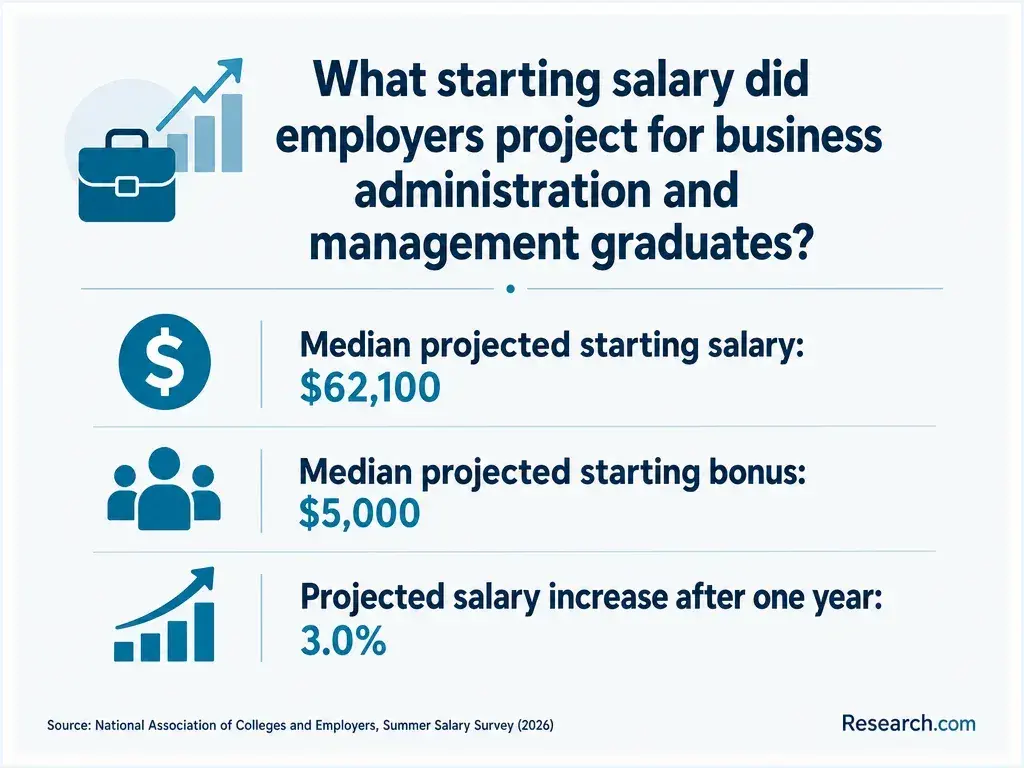
There is no single salary for a BS in Business Administration. Pay depends on the occupation, location, industry, and prior experience. The US Bureau of Labor Statistics reports a May 2025 median annual wage of $75,940 for human resources specialists. That occupation-wide midpoint includes experienced workers; it is not a starting salary or a predicted return from enrolling during a layoff.
For a personal return-on-investment estimate, compare pay ranges in local postings for roles you could realistically enter with your current experience against the school's net remaining cost and any borrowing. Do not count a promotion or salary increase until you have evidence that the degree is required or valued for that specific move. Lower-priced college options for business majors can help build a comparison set, but your transfer evaluation and aid offer determine the more useful cost figure.
Do Business Administration Careers Require Licenses or Certifications?
Many general business roles have no universal occupational license, though employers may request particular software skills or voluntary certifications. Regulated work is different: a business administration degree alone does not grant CPA licensure or a financial-services license. Check the relevant state board, regulator, or certifying organization before choosing courses for a credential goal.
If your immediate goal is a nonregulated operations or coordination role, compare the cost and timing of a full degree with targeted training and your existing work experience. Faster-paced business degree study options may make sense when a bachelor's requirement is holding you back, but speed does not replace a separate license or the experience an employer expects.
Other Things You Should Know About Business Administration
Yes, but reserve enough for essential expenses and review how severance affects unemployment benefits under your state's rules. Do not commit money needed before your next likely paycheck.
Not necessarily. In-school deferment for federal student loans generally depends on at least half-time enrollment at an eligible school. Ask your loan servicer and registrar how your planned enrollment will be reported.
Only with appropriate permission and within confidentiality and data-use rules. Public or hypothetical data is safer when access to company information has ended.
Recheck work hours against required class sessions and deadlines before the school's refund date. Ask whether a lighter course load changes your aid or whether deferring admission is the safer financial choice.
- What should I do if I have special financial circumstances? | studentaid.gov https://studentaid.gov/help/reporting-special-financial-circumstances
- Individuals FAQs - Unemployment Insurance | Georgia Department of Labor https://dol.georgia.gov/faqs-individuals/individuals-faqs-unemployment-insurance
- School-Determined Requirements - FSA Partner Connect https://fsapartners.ed.gov/knowledge-center/fsa-handbook/2026-2027/vol1/ch1-school-determined-requirements
- Types of student financial aid | usa.gov https://www.usa.gov/student-aid
- Employer-offered educational assistance programs can help pay for college | Internal Revenue Service https://www.irs.gov/newsroom/employer-offered-educational-assistance-programs-can-help-pay-for-college
- Situations That May Impact Your Financial Aid | hacc.edu https://www.hacc.edu/Paying/AidSituationChanges/index.cfm
- What happens to my financial aid if I enroll part-time or reduce my course load? - Student Financial Aid https://www.washington.edu/financialaid/2026/09/14/what-happens-to-my-financial-aid-if-i-enroll-part-time-or-reduce-my-course-load/
- Understand Your Loan's Grace Period | Financial Education, https://loans.ucla.edu/loan-grace