
PharmD Application With Repeated Prerequisite Courses

Co-Founder and Chief Data Scientist
A repeated chemistry or biology course does not automatically end your chance of entering pharmacy school. But a higher grade may not erase the first attempt, and each Doctor of Pharmacy (Pharm.D.) program can decide differently whether the retake satisfies its prerequisites.
This guide is for applicants weighing another course against applying now. It explains how to report repeats, compare school policies and calculate the likely GPA effect so you can spend your time and money on a retake that actually helps.
Key Things You Should Know
- You can generally apply with repeated prerequisite courses, but the receiving Pharm.D. program decides whether a retake meets its grade, laboratory and course-age rules.
- Report every attempt required by PharmCAS; a school's grade-replacement policy does not mean the earlier grade disappears from your application.
- Before paying for another course, ask each target school how it calculates prerequisite GPA and counts attempts. For illustration, equally weighted grades of C and A average 3.0 rather than replacing the C with a 4.0.
Can you apply to PharmD programs with repeated prerequisite courses?
Yes. A repeated undergraduate prerequisite is not, by itself, a universal barrier to Pharm.D. admission. Eligibility depends on the program's current rules and the outcome of your retake. A school may accept the latest passing grade for a required course while still considering your full academic record during admission review.
Separate permission to apply from readiness to enroll. Some programs review applications with prerequisites in progress, but require satisfactory completion before matriculation. Others have earlier completion deadlines. If you are deciding where to apply after a difficult term, compare pharmacy programs with varied admission routes, then confirm each school's actual repeat and prerequisite policies. An advertised minimum is not a promise of admission.
How do pharmacy schools evaluate repeated prerequisite course grades?
Schools may use a retake for different purposes: establishing that you passed a required subject, calculating a prerequisite GPA, or evaluating your academic trend. Those decisions need not use the same grade. The table shows why you should request the program's rule rather than assume your college's transcript-replacement policy carries over.
| Possible school policy | What it means for an applicant |
| Most recent grade meets the prerequisite | The retake may satisfy the course requirement; the earlier attempt can still remain in GPA or holistic review. |
| Highest grade meets the prerequisite | A stronger earlier or later attempt may establish eligibility, subject to the school's other rules. |
| All attempts count in a GPA | A higher retake improves the average but does not erase the lower grade. |
| Attempts or grades receive separate review | The school may consider how many times the subject was attempted alongside the final result. |
If your college marks an earlier grade as "replaced," do not assume another institution will disregard it. Ask the admissions office which attempt meets the minimum grade and whether its prerequisite GPA uses all attempts. For broader context on how receiving schools assess prior classes, see pharmacy prerequisite credit evaluation. Acceptance of undergraduate prerequisite credit is distinct from transfer into the professional Pharm.D. curriculum.
What PharmD admission requirements apply to applicants with repeated courses?
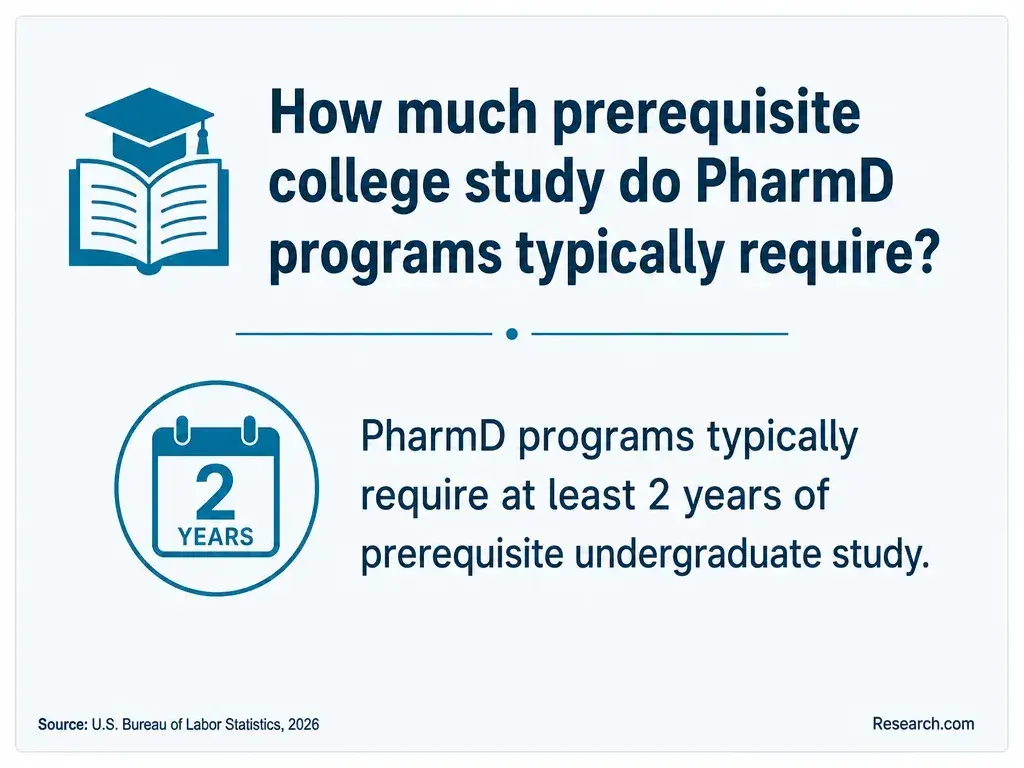
A retake must still match the receiving school's required subject, credit level and, when specified, laboratory component. Programs may also set a minimum course grade, prerequisite or cumulative GPA, and a deadline for finishing outstanding courses. A bachelor's degree is not universally required; required pre-professional credits and courses vary by program.
Check the current school directory and each program's admissions page for the application cycle you intend to enter. Then ask about any ambiguous equivalency - particularly if the retake is at a different college or its lab is separate. Some pharmacy programs before all requirements are complete may consider an application with coursework in progress, but that does not waive the conditions for enrollment. Also confirm supplemental applications, recommendations, interviews and deadlines; those are separate from whether the repeat counts.
PharmCAS is the centralized application service used by many, but not all, Pharm.D. programs. If your target school uses it, follow the instructions for your application cycle and enter coursework from every required transcript, including earlier and repeated attempts. A college's academic-renewal or grade-replacement notation is not permission to omit an attempt. PharmCAS application processing and a school's own GPA policy are separate matters.
Use this sequence to reduce transcript and verification problems:
- List every institution attended and request the transcripts required by the current PharmCAS instructions.
- Enter each attempt under the term and institution where it appears, matching course details and grades to the transcript.
- Identify planned or in-progress retakes as the application instructions direct; do not enter a hoped-for final grade.
- Check the cycle's academic-update rules and each school's deadline for receiving the completed grade.
If your earlier Doctor of Pharmacy pathways after pre-pharmacy study included similar courses at multiple colleges, do not silently choose which one "counts." Report the record accurately and let each program determine equivalency. Schools that do not use PharmCAS may have different application instructions.
There is no single national repeat limit for Pharm.D. prerequisites. A program may impose an attempt limit, require permission after multiple attempts, or have no published numerical cap while still reviewing the pattern. Ask whether withdrawals count as attempts under its policy and whether a third enrollment changes eligibility.
Repeated coursework has a time cost as well as a tuition cost. If your planned retake delays entry, compare that delay with the benefit of meeting a firm grade requirement or demonstrating stronger preparation. Be especially careful when researching pharmacy degree programs with accelerated schedules: a short pharmacy-related credential is not necessarily a Pharm.D. or a route to pharmacist licensure.
Often, but first establish that the course has actually expired under your target school's rules. Some programs apply recency limits only to particular sciences; others may assess older coursework individually. A qualifying retake can refresh the prerequisite, but the school must confirm that its credits, content and lab satisfy the current requirement.
Before enrolling, send admissions staff the old course date and the proposed retake's catalog description, credits and lab information. Ask whether an approved upper-level course could satisfy the requirement instead. A late retake can affect your application and start date, so compare the school's deadlines with realistic online Pharm.D. program timelines. Online coursework does not imply that required labs or later clinical rotations can be completed remotely.
First identify which GPA you are looking at. A cumulative GPA covers a broader academic record; a prerequisite GPA covers courses the program designates as prerequisites. A school may calculate its own version of either, and application-service calculations may differ from the GPA printed by your college.
Here is an illustration, not a universal PharmCAS or school formula: for two equally weighted, three-credit attempts, a C valued at 2.0 and an A valued at 4.0 average to 3.0 if both grades count. If only the A counts, the result for that course is 4.0. Other courses, credit weights and grading systems change the actual GPA. Ask each school which attempts it includes before estimating whether another retake will clear a threshold.
Budget for the course as well as the possible improvement. When comparing affordable Doctor of Pharmacy options, include retake tuition, lab fees and any delayed entry alongside professional-program costs. For the 2026-27 aid year, verify your own eligibility and current federal borrowing rules with the school's financial aid office; new professional borrowers should not assume access to Grad PLUS loans.
Yes. The Accreditation Council for Pharmacy Education (ACPE) accredits professional pharmacy education programs, not individual pharmacists. Check the program's current status in ACPE's official records and ask how that status relates to licensure eligibility in the state where you intend to practice. Institutional accreditation is a separate question; for a distance pathway, state authorization to enroll you is separate again.
These distinctions matter even if a program readily accepts your retakes. When considering online pharmacy school programs, verify required campus visits, in-person labs, introductory and advanced pharmacy practice experiences, and any restrictions on arranging rotations in your state. Admission to a program does not guarantee a nearby placement or a pharmacist license.
Start with the decision your retake was meant to solve: which programs will accept the course, and at what grade? Then compare the full path to graduation. A faster start may be less attractive if another required course remains, while waiting for a retake may be worthwhile if it resolves a firm eligibility barrier.
Use these questions when contacting each admissions office; keep its written answer with your application plan:
- Which attempt satisfies the prerequisite, and how will every attempt affect the GPAs you evaluate?
- Do the proposed course and lab meet your equivalency and recency rules, and when must the final grade arrive?
- What are the total tuition and required fees, and what additional travel, lab or rotation costs should I expect?
- Who coordinates clinical placements, and what campus attendance or out-of-area travel may be required?
- What is the program's current ACPE status, and where are its published licensure-exam outcomes?
If pharmacy education with shorter completion time is appealing, verify the credential and the actual Pharm.D. schedule before comparing prices. A lower advertised price or shorter pharmacy-related course does not establish a lower total cost or pharmacist-licensure eligibility.
How do PharmD graduation and licensure requirements affect career options?
Prerequisites are undergraduate preparation; they are not the professional Pharm.D. curriculum. Completing an ACPE-accredited Pharm.D. is an important step toward U.S. pharmacist licensure, but graduation does not itself issue a license. The relevant state board sets additional requirements, which may include supervised experience, the North American Pharmacist Licensure Examination (NAPLEX), and a jurisdiction-specific law assessment. Do not assume every jurisdiction uses the same jurisprudence exam: some use the MPJE, some have transitioned to the UMPJE, and requirements can change.
The U.S. Bureau of Labor Statistics reports pharmacist median annual pay of $140,910 in May 2025 and projected employment growth of 5%, 2025-2035. Those national figures describe an occupation, not the return on a particular retake or Pharm.D. program. Residency or fellowship training may matter for some roles, while Board of Pharmacy Specialties certification is a separate credential; none replaces state licensure. Include exams, possible postgraduate training and time away from work when considering doctoral degree timeline options.
Other Things You Should Know About PharmD
If asked, briefly identify what changed - such as your study approach - and point to evidence of improvement. Take responsibility without turning the answer into an excuse or assuming one strong retake settles every concern.
Only if the receiving program permits it for that course and term. Ask before registering, because a pass may not demonstrate that you met a required letter-grade minimum.
No. The Pharmacy College Admission Test was retired in January 2024 and is not a current exam you can take to strengthen an application. Focus on the program's current criteria instead.
Experience can help show your understanding of the profession, but it generally does not waive a stated prerequisite grade requirement. Confirm eligibility first, then use your experience to add context to the rest of your application.
- Are Prerequisite Courses Barriers to Pharmacy Admission or the Keys to Student Success? - PMC https://pmc.ncbi.nlm.nih.gov/articles/PMC10159397/
- Academic Performance Standards - Doctor of Pharmacy https://www.utoledo.edu/pharmacy/current/pharmd-aps.html
- How to Apply to the PharmD Program | Texas A&M University Irma Lerma Rangel College of Pharmacy https://pharmacy.tamu.edu/pharmd/apply.html
- Prerequisite Coursework | School of Pharmacy https://www.pharmacy.pitt.edu/academics/doctor-pharmacy/apply-pharmd-program/prerequisite-coursework
- PharmD Apply Now - UW School of Pharmacy https://sop.washington.edu/pharmd/admissions/application-procedures/
- PharmD Admissions Selection Criteria | Doctor of Pharmacy https://pharmacy.wisc.edu/pharmd/selection-criteria/
- Prerequisite Course Requirements at the College of Pharmacy | UNT Health Fort Worth https://www.unthealth.edu/college-of-pharmacy/faqs/prerequisite-course-requirements.html
- PharmD FAQs - UNC Eshelman School of Pharmacy https://pharmacy.unc.edu/education/pharmd/pharmd-admissions-faqs/
- FAQ | OSU College of Pharmacy - Oregon State University https://pharmacy.oregonstate.edu/programs-admissions/pharm-d/faq


