How to Compare Pharm.D. Offers Before Depositing

Co-Founder and Chief Data Scientist
A Pharm.D. deposit can secure your seat before you know which offer will cost less or better support your path to licensure. If you have multiple pharmacy school acceptances, compare more than scholarships and campus impressions.
This guide gives you a side-by-side scorecard and shows how to check total cost, accreditation, clinical placements, exam outcomes, and career opportunities. You'll finish with a way to choose an offer, or identify the questions you need answered before the deposit deadline.
Key Things You Should Know
- Compare the full cost to graduate, not the first-year scholarship; federal borrowing rules changed for many new graduate and professional borrowers beginning July 1, 2026.
- Confirm each professional Pharm.D. program's ACPE status and your intended state's licensure rules before paying a deposit, admission and degree completion do not confer a pharmacist license.
- Use NAPLEX results, graduation rates, and rotation support as evidence - not guarantees, and weigh them against cost and the work you hope to do.
What should you compare when evaluating PharmD offers?
Compare offers using the same assumptions: your expected start term, residency classification, prerequisite work, and intended licensing state. Keep the offer letters, aid notices, catalogs, and written answers from both schools beside this scorecard. The fields below capture the differences most likely to change your decision.
| Comparison field | Offer A | Offer B |
| Deposit amount, deadline, and refund policy | _____ | _____ |
| Estimated total cost to graduate, less renewable gift aid | _____ | _____ |
| Prerequisites still needed and whether prior credits count | _____ | _____ |
| Professional-program accreditation status | _____ | _____ |
| Program length and required in-person attendance | _____ | _____ |
| Rotation placement, travel, and housing obligations | _____ | _____ |
| Published NAPLEX and graduation outcomes | _____ | _____ |
| Support for intended practice setting | _____ | _____ |
Start by ruling out an offer with an unresolved licensure or attendance problem. Then compare the remaining offers on cost and evidence of student support. If prior coursework affects your starting point, request a written evaluation rather than assuming the pharmacy degree transfer credit policies described elsewhere apply to your offers.
How much will each PharmD program cost after scholarships and financial aid?
Calculate a separate cost to graduate for each offer: tuition and mandatory fees across every required term, plus living costs, books and clinical resources, equipment, prerequisite courses, campus visits, rotations, and expected licensing expenses. Subtract scholarships and grants only for terms in which you meet their renewal conditions. Do not subtract loans: they finance a cost rather than reduce it.
Ask each financial aid office for a term-by-term estimate and written scholarship conditions. Check whether tuition can increase, whether summer terms cost extra, and whether a rotation may require travel or temporary housing. You can use budget-friendly pharmacy degree programs to find comparison candidates, but verify current charges directly with each school.
For an aid package beginning on or after July 1, 2026, ask how current federal loan rules apply to your student classification and borrowing history. Rules for many new graduate and professional borrowers changed, and a prior student's Grad PLUS experience may not describe your options. Compare the amount you would actually need to borrow, not just the aid listed in an award letter.
Is each PharmD program accredited and aligned with state licensure requirements?
Check each offer in the Accreditation Council for Pharmacy Education (ACPE) professional-program directory, including its current status and any conditions. ACPE accreditation of the Pharm.D. program is distinct from the university's institutional accreditation. For a distance pathway, the school's authorization to enroll you in your state is another separate question.
Ask your intended state board of pharmacy whether the education pathway meets its licensing requirements and what it requires for intern registration, supervised experience, the North American Pharmacist Licensure Examination (NAPLEX), and any jurisprudence assessment. Requirements vary; do not assume every jurisdiction uses the MPJE, as some began transitioning to the UMPJE in 2026. A Pharm.D. graduate must still satisfy the applicable board's requirements and receive a license.
Resolve eligibility questions before comparing attractive admission offers. A school may consider applicants through pharmacy degree eligibility options that allow coursework to remain in progress, but a conditional admission offer does not waive prerequisites or establish licensure eligibility.
Compare the schedule you must follow, not the delivery label. An online or hybrid Pharm.D. may include live classes, in-person skills assessments, campus immersions, and supervised clinical rotations. A campus-based program may reduce immersion travel but still send students away for rotations. Neither format is automatically compatible with full-time employment.
Get written details on required campus dates, live-session attendance, lab locations, and who finds and approves clinical sites near you. Ask what happens if a local placement is unavailable, whether your state permits the proposed arrangement, and whether employment can conflict with rotation hours. Listings of Doctor of Pharmacy distance learning programs can help you identify formats to investigate; the school must confirm your actual attendance and placement obligations.
Recheck each acceptance for outstanding conditions. Pharm.D. prerequisites are undergraduate pre-professional coursework, not the professional curriculum you enter after admission. Schools differ on required subjects and labs, minimum grades, course age, GPA, and whether a bachelor's degree is required. A minimum threshold is not a promise of admission or continued eligibility.
Confirm the final transcript deadline, treatment of courses in progress, background-check or immunization conditions, and any supplemental steps. If you applied through PharmCAS, distinguish its application requirements from the school's own enrollment conditions; not every program uses PharmCAS. The PCAT was retired in January 2024 and should not be treated as a current routine entrance exam. Comparisons of pharmacy schools and entry standards cannot replace your offer's written conditions.
Compare the time from your expected start date to graduation, including unfinished prerequisites, required summer study, and any delay before the first professional term. Ask whether courses run in a fixed cohort sequence and when a student who fails or postpones a course can take it again. A nominally shorter program can take longer for you if prerequisites or scheduling block entry.
Also account for lost earnings and reduced work hours during intensive terms and advanced rotations. When researching online doctoral study duration, check that a listing describes a professional Pharm.D., rather than another doctorate.
Review how each curriculum develops medication knowledge, patient assessment, communication, and safe decision-making - not just its elective titles. Ask when students practice in labs and simulations and how much choice they have in electives or practice settings. Someone coming from chemistry may find pharmacy doctorate options after chemistry useful for framing questions about the transition from prerequisite science to patient care.
Distinguish introductory pharmacy practice experiences (IPPEs) from advanced pharmacy practice experiences (APPEs), which occur later in the professional program. Compare the settings available, who coordinates placements, how preferences are handled, and what travel students may need. Clinical sites can require intern registration, background checks, immunizations, and schedule changes. A published list of sites does not mean you can choose one or complete every rotation near home.
Request each school's most recent published NAPLEX first-time pass results and graduation rates, with the reporting year, cohort definition, and number of students included. The NAPLEX is part of the licensing process, not a license by itself. Ask whether the pass-rate denominator represents all graduates, only first-time test takers, or another group, and how the school supports students who need additional preparation.
Read outcomes alongside student progression and total cost. A strong pass rate does not reveal how many students left before graduation, and a single small cohort may not represent your likely experience. If an accelerated option appeals to you, compare its outcomes and support with those of longer programs rather than assuming accelerated online pharmacy degree pathways have comparable credentials or exam results; some listings describe degrees other than an entry-to-practice Pharm.D.
Match each school's placements, electives, advising, and employer connections to the settings you may pursue, such as community, hospital, ambulatory care, or specialty pharmacy. Ask for evidence of graduates' destinations and distinguish direct employment from postgraduate training. Residency and fellowship are training routes; optional board certification is a separate credential. Neither replaces state pharmacist licensure, and neither is required for every pharmacist job.
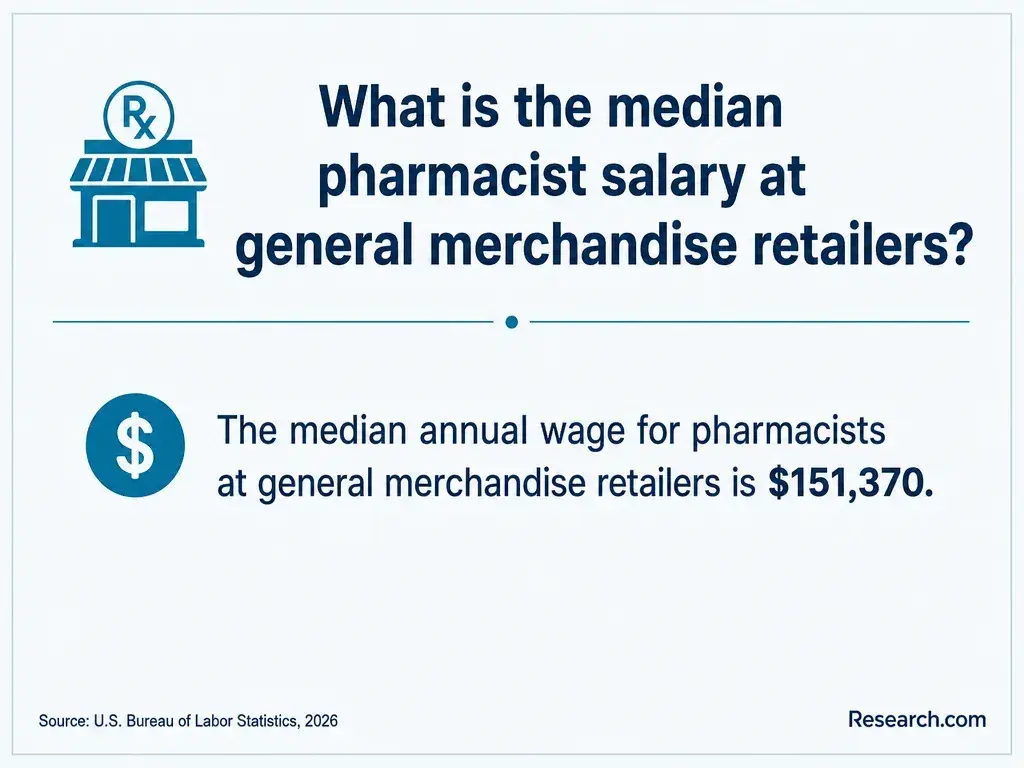
The Bureau of Labor Statistics reports median annual pay for U.S. pharmacists of $140,910 in May 2025, with 5% projected employment growth, 2025-2035. That occupation-wide median is useful for judging borrowing risk, but it cannot predict your starting pay, practice setting, or local job prospects. If your goal is a pharmacy-adjacent role rather than licensed pharmacist practice, compare that goal with pharmacy degree affordability and completion time before committing to a professional doctorate.
Which PharmD offer provides the strongest return on investment?
The strongest offer is the one that clears your accreditation, licensure, and scheduling requirements while giving you a defensible path to graduation at a borrowing level you can manage. Compare estimated debt at graduation and time away from paid work against realistic career possibilities, not a promised salary. A larger scholarship may lose its advantage if it cannot be renewed or if required travel is substantial.
Before depositing, make a final decision in this order:
- Eliminate any offer with unresolved accreditation, state eligibility, prerequisite, or mandatory-attendance questions.
- Get written cost, scholarship-renewal, and rotation-placement answers; update the scorecard using the same assumptions for every offer.
- Compare outcomes and career support for the settings you would actually consider, then choose the offer whose remaining risks you can accept.
- Read the deposit terms and deadline, save the documents, and decline other offers according to each school's instructions once your decision is final.
If two offers remain close, ask which one still makes sense if you need an extra term, travel for a rotation, or pursue a job outside your preferred specialty. That stress test is more useful than declaring the lowest advertised tuition or highest reported pass rate the automatic winner. The same caution applies to pharmacy programs with faster completion options: verify that their pace, required attendance, and rotation schedule are workable for you.
Other Things You Should Know About PharmD
Policies vary by school. Check the offer letter for the refund deadline and conditions, and get clarification in writing before paying.
Yes, you can ask, but an extension is not guaranteed. Contact admissions before the deadline, explain what information you need, and keep the original deadline unless the school confirms a new one in writing.
Check each school's acceptance terms before doing so. Multiple deposits can be costly and may conflict with a school's stated policies; withdraw promptly from offers you will not use.
Only if the school permits it. Ask whether deferral requires a new application, whether your scholarship carries forward, and what happens to your deposit.
- Accepting Financial Aid | studentaid.gov https://studentaid.gov/complete-aid-process/accept-aid
- General Requirements for Withdrawals and the Return of Title IV Funds | 2025-2026 Federal Student Aid Handbook https://fsapartners.ed.gov/knowledge-center/fsa-handbook/2025-2026/vol5/ch1-general-requirements-withdrawals-and-return-title-iv-funds
- Immunization requirements for entry into college and university | Colorado Department of Public Health and Environment https://cdphe.colorado.gov/immunization/immunization-requirements-entry-college-university
- Frequently Asked Questions | Colorado Department of Higher Education Home https://cdhe.colorado.gov/residency-requiremenets-frequently-asked-questions
- DAPIP | Homepage - Office of Postsecondary Education (OPE) https://ope.ed.gov/dapip/
- Immunization Requirements for Colleges and Universities | ncdhhs.gov https://www.dph.ncdhhs.gov/programs/epidemiology/immunization/schools/college
- Requirements | Texas DSHS https://www.dshs.texas.gov/immunizations/school/requirements
- Impact of Pharmacy School Characteristics on NAPLEX First-time Pass Rates - PMC https://pmc.ncbi.nlm.nih.gov/articles/PMC6718508/
- CPE Program Accreditation - ACPE https://acpe.edu/programs/accreditation
- Student Costs & Budgeting | Washington State University https://pharmacy.wsu.edu/pharmd/resources/costs-budgeting/