Online PharmD Application Readiness Checklist

Co-Founder and Chief Data Scientist
An online Doctor of Pharmacy (Pharm.D.) program may let you study away from campus, but applying successfully requires more than finding online classes. You need to know whether your coursework qualifies, whether you can attend required in-person activities, and whether the degree supports licensure where you intend to practice.
This checklist helps prospective U.S. pharmacy students identify application gaps, compare programs on the same terms, and decide what to verify before paying an application fee or accepting an offer.
Key Things You Should Know
- Confirm the specific Pharm.D. program's Accreditation Council for Pharmacy Education (ACPE) status, your state's distance-education authorization rules, and pharmacist licensure eligibility separately.
- Check prerequisite acceptance and deadlines before applying; an online pathway can still require campus labs and in-person clinical rotations that conflict with work or travel plans.
- Compare total costs and scheduling obligations, not tuition alone. A Pharm.D. does not itself grant a pharmacist license; graduates must satisfy their jurisdiction's examination and other licensing requirements.
What is an online PharmD program, and how does it prepare you for pharmacy practice?
An online Pharm.D. program delivers some professional-degree instruction remotely. "Online" does not necessarily mean fully remote, self-paced, or available around a full-time job. Programs may require live classes, scheduled assessments, campus skills sessions, and supervised practice at physical pharmacy or healthcare sites.
The professional Pharm.D. curriculum builds on pre-professional prerequisites - undergraduate courses completed before admission. It develops medication knowledge, patient assessment, communication, clinical decision-making, and supervised practice skills. Before applying, request a term-by-term calendar showing when you must be online at a set time and when you must attend in person.
Be especially cautious when comparing accelerated online pharmacy degree pathways. A short pharmacy-related degree or certificate is not automatically a professional Pharm.D. pathway to pharmacist licensure.
How can you verify an online PharmD program's accreditation and licensure eligibility?
Check three distinct issues: ACPE accreditation of the professional Pharm.D. program, the institution's recognized accreditation, and permission to enroll or place distance-learning students in your state. None of these alone confirms that a particular graduate will receive a pharmacist license.
Use this verification sequence before treating a program as an application option:
- Look up the exact institution and professional program in ACPE's current program records; note its accreditation status and any relevant conditions.
- Confirm institutional accreditation through the institution and its recognized accreditor.
- Ask the school whether it may enroll you in your state and arrange any required clinical placements there.
- Contact the pharmacy board in the state where you intend to seek licensure about education, intern registration, examinations, and any state-specific conditions.
Save the written responses and the date you checked them. When you compare pharmacy doctorate options, do not substitute an institution-wide accreditation claim for confirmation of the specific professional program's status.
What are the admission requirements for online PharmD programs?
Requirements vary by school. Applicants commonly need specified undergraduate science and general education prerequisites, transcripts, recommendations, and an interview, but a bachelor's degree is not universally required. Minimum grades, GPA thresholds, laboratory formats, course-age rules, and deadlines also differ. The Pharmacy College Admission Test (PCAT) was retired in January 2024; do not plan to take it as a current application step.
Build a school-specific application file with the following checks so an unfinished requirement does not derail matriculation:
- Match every completed and planned prerequisite to the school's current course list, including required labs and minimum grades.
- Request a written review of uncertain credits, such as community-college, AP/IB, online-lab, repeated, or international coursework.
- Record whether prerequisites may be in progress when you apply and the deadline for finishing them.
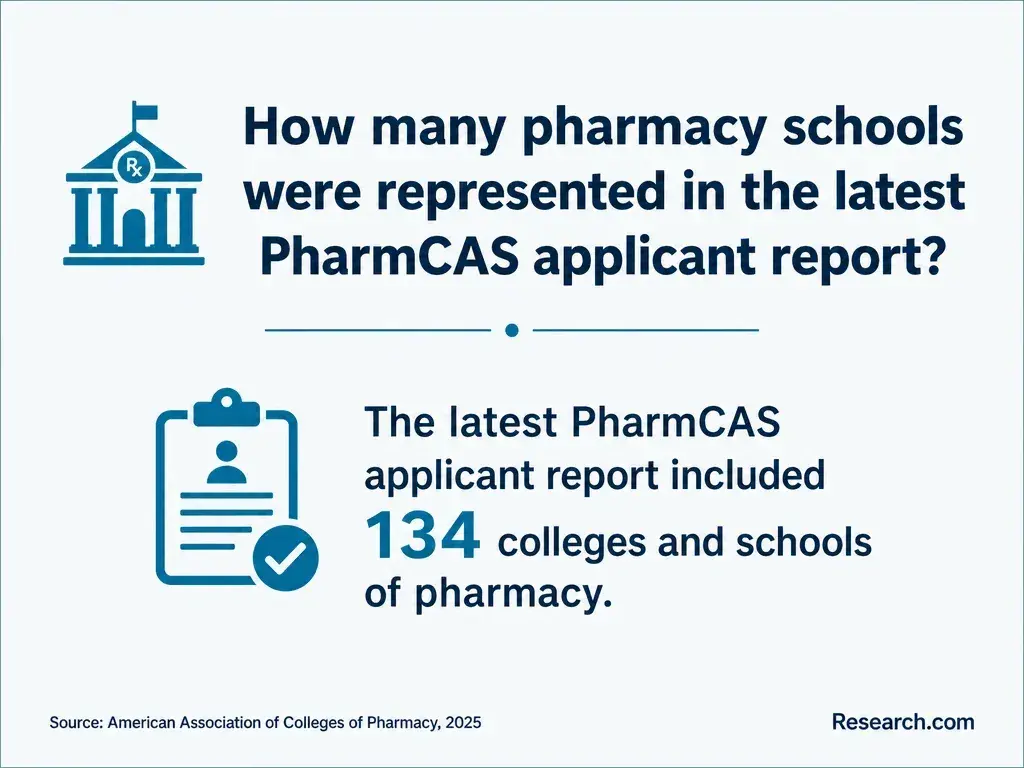
- Confirm whether the school uses PharmCAS, its own application, or both; record transcript, recommendation, interview, and deposit deadlines separately.
Some pharmacy programs before all requirements are complete may consider applicants with courses in progress. That is different from waiving requirements, so obtain the school's conditions in writing.
Both formats must provide the professional education and supervised experience required by their programs. The practical difference is where instruction occurs and how often you must travel - not whether hands-on training matters. An online format may reduce routine commuting while adding travel for campus sessions or rotations; a campus program may make scheduled in-person work simpler but require relocation or a regular commute.
Use the same fields for every school you are considering. Fill in each program's published requirements rather than assuming that its delivery label describes your actual schedule.
| Decision field | Online or hybrid option | Campus-based option |
| Live class times and attendance | __________ | __________ |
| Required campus visits and travel | __________ | __________ |
| Clinical placement location and support | __________ | __________ |
| Ability to maintain paid work | __________ | __________ |
| Total estimated educational cost | __________ | __________ |
For applicants with completed science coursework, Pharm.D. programs for students with a pre-pharmacy background are worth comparing by prerequisite acceptance as well as format. Prior coursework may satisfy admission requirements without shortening the professional curriculum.
Typical professional coursework covers medicinal chemistry, pharmacology, pharmacotherapy, patient assessment, pharmacy law, medication safety, and communication. Pharmacotherapy connects disease states with medication selection and monitoring; skills labs and simulated patient cases let students practice applying that knowledge before supervised patient-care experiences. Exact courses, sequencing, and in-person lab requirements depend on the school.
Request the current curriculum map and mark courses that require scheduled attendance, equipment, or travel. If you have prior college credit, ask separately whether it meets admission prerequisites and whether any credit can transfer into the professional curriculum. The receiving school decides both questions under its own policies; pharmacy degree programs for transfer students should be compared using a written credit evaluation, not a general transfer-friendly claim.
A traditional professional Pharm.D. curriculum commonly takes four academic years after prerequisites, although program calendars and accelerated options vary. Online delivery does not remove required coursework or clinical experiences. Ask for the expected graduation date based on your completed prerequisites and the program's actual course sequence.
For each offer, request a cost-of-attendance estimate that separates tuition and mandatory fees from books, technology, campus travel, clinical-rotation travel or housing, background checks, immunizations, and eventual licensing expenses. Compare costs over the same period. A lower tuition figure may not be cheaper if it requires substantial travel or delays paid work.
Use affordable online Pharm.D. programs as a comparison starting point, then verify current charges with each school. If borrowing is part of your plan, ask financial aid staff to explain your eligibility under the rules that apply to your start date; federal graduate and professional borrowing rules changed for many new borrowers beginning July 1, 2026.
Students complete supervised introductory pharmacy practice experiences (IPPEs) and later advanced pharmacy practice experiences (APPEs). These occur at approved practice sites rather than being replaced by online coursework. Settings, timing, placement procedures, and travel expectations vary by program.
Ask the experiential education office these questions before accepting an offer; the answers determine whether the schedule is workable:
- Who finds and approves sites and preceptors, and can placements be arranged near my home?
- When do IPPEs and full-time APPE blocks occur, and how much notice will I receive of assigned locations?
- What intern registration, background checks, immunizations, or other site requirements must I complete?
- What happens if a nearby site is unavailable, and who pays for travel or temporary housing?
Even Pharm.D. programs for a faster path need an experiential schedule you can actually complete. Do not assume a current pharmacy job can replace an approved rotation or that you can keep unrestricted full-time work during APPEs.
A Pharm.D. is an educational credential, not a pharmacist license. U.S.-educated graduates generally must meet their state board's eligibility and application rules and pass the North American Pharmacist Licensure Examination (NAPLEX). Jurisprudence testing varies: a jurisdiction may use the Multistate Pharmacy Jurisprudence Examination (MPJE), the Uniform MPJE (UMPJE), another state-specific process, or different requirements. Passing an exam alone does not issue a license.
Before enrolling, review the board's current rules in the state where you expect to practice, including any intern registration and supervised-experience requirements. If you are considering shorter online doctorate pathways, verify the credential first: a doctorate in another field is not interchangeable with a licensure-qualifying Pharm.D. Internationally educated pharmacists should also check the distinct certification and state-board pathway that applies to their education.
After obtaining a license, pharmacists may work in community pharmacies, hospitals, clinics, health systems, or other medication-related roles. Hiring requirements differ by position. A postgraduate residency provides structured practice training; a fellowship often emphasizes areas such as industry or research. Specialty board certification is a separate credential, not a state license, and none of these postgraduate routes is required for every pharmacist job.
The Bureau of Labor Statistics reports median annual pay for pharmacists of $140,910 in May 2025 and projects 5% growth, 2025-2035, with about 12,500 openings per year. Those occupation-wide figures do not predict an individual graduate's pay, specialty placement, or return on tuition. Pharmacy technician work is a separate occupation that does not ordinarily require a Pharm.D.
Compare cost-effective pharmacy degree options against the job you actually want. If pharmacist licensure is not necessary for that goal, a less extensive credential may avoid years of tuition and lost earnings.
How can you choose a reputable online PharmD program?
Apply only after the program passes a three-part test: you are academically eligible, you can complete its real-world schedule, and its credential supports your intended licensing route. Use this final application-readiness check for each school:
- Save the current ACPE status, institutional accreditation information, and written answers about your state's enrollment and placement rules.
- Obtain a school-specific prerequisite review and record every application and matriculation deadline.
- Put live classes, campus visits, IPPEs, and APPEs on a calendar beside your work and caregiving commitments.
- Compare complete cost estimates and confirm financial aid terms for your expected entry date.
- Review published graduate licensing-exam outcomes in context, and ask how the school supports students who need academic or placement assistance.
A missed prerequisite, unclear clinical placement, or unsupported licensure assumption is a reason to pause - not a detail to resolve after paying a deposit. For additional context on understanding pharmacy school admissions, distinguish a school's minimum eligibility rules from its actual selection process.
Other Things You Should Know About PharmD
Yes. Check each school's application method and deadlines, and budget for any required application or supplemental fees. Keep a separate prerequisite and document checklist for each program.
Ask each admissions office how it evaluates repeated courses and whether your existing grade meets its minimum. A retake may improve eligibility at one school without changing how another calculates GPA.
Request the program's current device, internet, webcam, software, and exam-proctoring requirements. Check them before enrollment rather than assuming a phone or workplace computer will suffice.
Possibly. Schools set their own transcript-evaluation, prerequisite, and language-proficiency policies. Ask how your prior coursework will be assessed before paying for evaluations or applying.
- An Advanced Pharmacy Practice Experience in a University's Office of Experiential Education - PMC https://pmc.ncbi.nlm.nih.gov/articles/PMC10159452/
- Admissions Frequently Asked Questions and Tips | ucsf.edu https://pharmd.ucsf.edu/admissions/faq-tips
- PharmD Apply Now - UW School of Pharmacy https://sop.washington.edu/pharmd/admissions/application-procedures/
- Discover the Doctor of Pharmacy (PharmD) at UNT Health https://www.unthealth.edu/college-of-pharmacy/doctor-of-pharmacy-pharmd.html
- Doctor of Pharmacy - On Campus & Online Hybrid | Extended & Distance Education https://www.su.edu/admissions/graduate-students/pharmacy-application-information/doctor-of-pharmacy/
- Earn an Online Pharm.D. Degree at St. John Fisher University https://onlinepharmd.sjf.edu/
- PharmD Application Process and Requirements | umich.edu https://pharmacy.umich.edu/pharmacy-programs/pharmd-program/application-process-requirements/
- PharmD Application Checklist | The University of Iowa https://pharmacy.uiowa.edu/pharmd/admissions/checklist
- PharmD Remote Pathway | CU School of Pharmacy https://pharmacy.cuanschutz.edu/degreesandprograms/pharmd/remote-pharmd
- Experiential Education | Washington State University https://pharmacy.wsu.edu/pharmd/experiential-services/