2027 BS in Business Administration and Hospitality and Tourism: How to Check Whether a Job Needs a Separate Credential
Audited and Verified:
Our Editorial and Data Verification Process
Research.com uses government datasets, official education statistics and primary institutional information to support its career and degree guides. Our review process checks factual accuracy, occupational definitions, source dates and the requirements associated with the credentials discussed.
How This Article Was Fact-Checked
Our editorial team verifies salary estimates, employment projections, education requirements and program information against original data providers and official organizations. Salary figures are checked against the relevant occupational definitions and reporting periods. Information about licensure, accreditation and required in-person training is reviewed separately.
Fact-checked and verified on:

Co-Founder and Chief Data Scientist
A hospitality job posting may ask for a bachelor's degree, a food-safety certificate, and experience, all for the same role. Those requirements do different things.
If you are considering a BS in Business Administration with a hospitality and tourism focus, knowing which qualifications the degree provides can help you avoid enrolling for the wrong reason or missing a credential you need.
This guide explains how to check job-specific rules, assess the degree's preparation, and compare the time and cost of your options before you commit.
Key Things You Should Know
- A hospitality-focused business degree does not itself award a food-safety certificate, alcohol-service permit, occupational license, or employer-required training.
- Check the job's duties and work location first: credential rules can apply to particular tasks or jurisdictions, not every employee at a hotel, restaurant, or tourism company.
- The U.S. median annual wage for meeting and event planners was $61,160 in May 2025; that occupation-wide figure is not a starting salary or proof that the degree satisfies a job posting.
What Is a BS in Business Administration and Hospitality and Tourism?
It is an undergraduate business degree that combines general business study with hospitality or tourism subjects. Depending on the school, hospitality may be a formal concentration, a group of electives, or part of a differently named degree. Check the catalog and transcript designation rather than assuming those arrangements are equivalent.
The business foundation can support decisions about budgets, staffing, marketing, and operations. Hospitality coursework adds context such as guest experience, lodging, events, or destination services. Neither the degree title nor a concentration grants authority to perform a separately regulated task.
Choose the curriculum by the work you want to do. A student interested primarily in hotel purchasing, for example, may benefit more from supply chain study; comparing supply chain education costs and career prospects can help clarify that alternative.
Do Hospitality and Tourism Jobs Require a Separate License or Credential?
Some do, but there is no universal hospitality-and-tourism license. Requirements attach to the duties, employer, and jurisdiction. A hotel revenue analyst, restaurant shift supervisor, tour driver, and employee selling travel services may face different rules even if all work in tourism.
A degree can satisfy an education requirement without replacing a required permit or training. The distinctions below help you interpret a posting before paying for an additional credential:
| Requirement in a posting | What it may mean | Who can confirm it |
| Food-safety certificate | Training or certification may be required for designated food-handling or supervisory duties. | The local health authority and employer |
| Alcohol-service training or permit | Rules may depend on the state, locality, venue, and employee's duties. | The state alcohol regulator and employer |
| Driver's license or commercial driving qualification | Transporting guests can trigger vehicle- and duty-specific requirements. | The relevant licensing authority and employer |
| "Certification preferred" | An employer preference is not necessarily a legal condition of employment. | The hiring manager or recruiter |
Use a short verification sequence rather than relying on a degree brochure or the wording of one job ad:
- Identify the actual tasks, worksite, and state or locality named in the posting.
- Ask the employer which qualifications are legally required before hire, which it provides during onboarding, and which are merely preferred.
- Confirm any claimed legal requirement with the responsible regulator, including accepted training providers and renewal rules.
- Ask the degree program whether a course includes a separately issued credential and whether you must pass an outside exam or pay an additional fee.
Hotel HR work illustrates another distinction: studying employment practices is not the same as holding an HR certification. If staffing is your target function, review what to expect from an HR degree alongside actual hotel HR postings; the employer, not the hospitality degree title, determines which qualifications it accepts.
Which Careers Can You Pursue With This Bachelor's Degree?
Match your existing experience to the role's responsibilities, not just its industry label. Customer-facing work can help with guest services or reservations; scheduling and spreadsheet experience may translate to event coordination or hotel operations support. A new graduate should not assume that business coursework alone qualifies them to run a property or supervise a department.
Potential routes include front-office or reservations coordination, event-planning support, tourism marketing assistance, revenue or operations support, and purchasing support.
Each calls for different evidence: an event role may value vendor coordination and timelines, while revenue work may require stronger spreadsheet and pricing analysis. Management roles generally require demonstrated responsibility in addition to academic preparation.
If purchasing is the goal, check supply chain roles rather than assuming every hotel position is guest-facing. If event projects are the draw, compare hospitality study with transfer-friendly project management bachelor's degrees; the better choice depends on whether employers value venue knowledge, transferable project methods, or both.
Expect to compare two layers of coursework. The business core commonly addresses accounting, marketing, management, operations, and quantitative decision-making.
Hospitality-focused courses may examine lodging operations, service quality, events, tourism marketing, or revenue management. The exact mix, and whether a focus appears as an official concentration, belongs in the school's current catalog.
Read course descriptions for evidence of the tasks you want to perform. An event case study may teach budgeting and scheduling, but it does not by itself confer a food-safety credential or establish experience managing a live event.
For applied courses, ask whether an internship or project is required, who approves the site, and whether a current job can qualify.
Students drawn mainly to coordinating complex projects should compare the depth of event courses with dedicated project-management study. If the latter would require changing programs, investigate project management bachelor's scholarship options as part of that comparison, not as a substitute for checking which credits and qualifications the target role requires.
Verify the institution's recognized accreditation through the accreditor's own listing, then check whether any advertised business-school accreditation actually covers the school and program you are considering.
AACSB, ACBSP, and IACBE accreditation have specific scopes; none should be inferred from a university's general accreditation or treated as a job-placement guarantee.
For this decision, reputation is most useful when supported by inspectable evidence: a published curriculum, internship arrangements, local employer connections, career services, and outcomes with a clear definition of who was counted.
Ask graduates or employers whether the program prepared students for the duties in your target postings, while recognizing that an anecdote is not an employment rate. Lists of leading US colleges for online business study can provide candidates to investigate, but verify each school's hospitality offerings and accreditation scope directly.
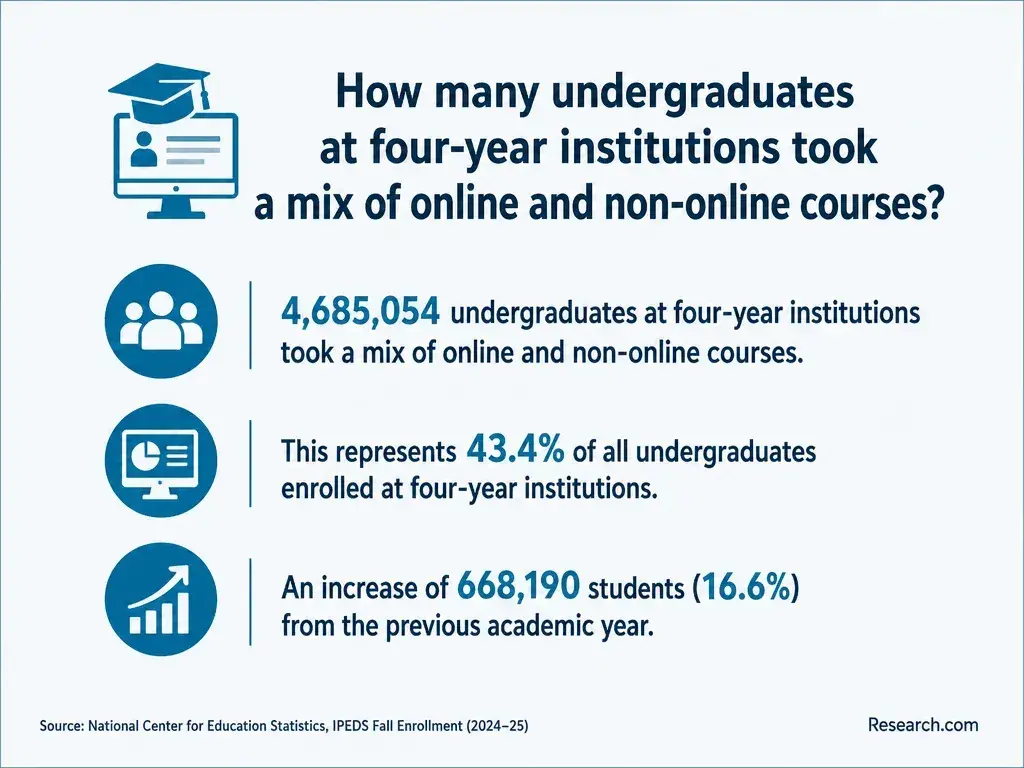
An online program can award the same type of accredited degree as a campus program. Credibility depends on the institution, curriculum, assessment, and opportunities to demonstrate relevant skills, not the delivery label alone.
Online study also cannot waive a regulator's in-person training or practical assessment if one applies to your intended work.
Check how students complete hospitality-specific learning: live group work, simulations, internships, site visits, proctored assessments, and any required campus sessions. Ask whether placements are available near you and whether your employer can support an approved project.
If speed matters, compare online colleges with accelerated business programs against the actual course sequence and fieldwork requirements; an accelerated calendar does not remove the hours needed for study or a separate credential.
Requirements depend on whether you are applying as a first-time student, a transfer student, or someone returning with prior college work. A school may admit you to the university before you meet separate business-major requirements.
Previous hospitality employment can strengthen an application, but it does not automatically replace prerequisite courses or earn credit.
Review the program's published rules for transcripts, prior mathematics and business courses, transfer evaluation, and any major-entry threshold.
Ask for an official degree audit showing where accepted credits apply: general education, business core, hospitality focus, or electives. The business administration applicant eligibility checklist can help organize questions, but the admitting school decides eligibility and credit applicability.
Completion time depends on remaining requirements, accepted credits, course availability, and whether you study full time or part time. Request a term-by-term plan before assuming previous coursework will shorten the degree; accepted electives may leave business-core or hospitality requirements untouched.
For a useful cost comparison, total the tuition and mandatory fees for the courses you still need, then account for books, technology, travel or placement costs, and any separately purchased credential.
Ask when tuition is due and whether financial aid or employer reimbursement can cover the courses in your approved plan. Application fees are a smaller cost, but applicants comparing several schools can compare no-fee college applications without treating a waived fee as evidence of lower total tuition.
There is no reliable salary that applies to every graduate of this degree. Pay depends on the occupation, duties, location, employer, and experience.
The U.S. Bureau of Labor Statistics reports a May 2025 median annual wage of $61,160 for meeting and event planners. That is a median for people employed in the occupation, not an offer to a new graduate or a wage specific to this major.
Compare pay for the exact roles you could enter now with roles you might qualify for after gaining experience. Factor in tuition and any additional training before deciding whether the degree is worth its cost.
A broader comparison of business administration degrees compared by cost duration and outlook may help frame that calculation, but it cannot replace occupation- and location-specific job postings.
What Is the Job Outlook for Hospitality and Tourism Careers?
Outlook also belongs to an occupation, not a degree title. The Bureau of Labor Statistics projects 6% U.S. employment growth for meeting and event planners from 2025 to 2035. That projection indicates an expanding occupation nationally; it does not predict openings in your city or guarantee entry without relevant event experience.
Use the outlook as a reason to investigate, not as the deciding factor. Review local postings for recurring duties and required credentials, then compare those demands with your experience and the proposed curriculum.
If you are considering a move from events into broader project work, weigh the additional preparation and cost against available roles before switching paths; projected growth alone cannot tell you which job you can qualify for.
If you already have college credits and are considering a move toward hotel staffing instead, examine human resources bachelor's credit transfer options before assuming a hospitality concentration is the shortest route.
Other Things You Should Know About Business Administration
Yes. Describe the duties you performed and skills you demonstrated, such as handling reservations or coordinating staff. The admissions office decides how that evidence affects admission; academic credit requires a separate evaluation.
Possibly, if the program approves the role, learning objectives, supervision, and assessment. Get approval before assuming paid work satisfies an internship.
Only if the authorized issuer has awarded it to you. Course completion, exam eligibility, and certification are different statuses; use the exact qualification you can document.
Usually only with appropriate permission and protection of guest, employee, and company information. An anonymized summary of your methods may be safer than sharing internal records or claiming unverified results.
- Sellers of Travel - Washington Department of Revenue - WA.gov https://dor.wa.gov/manage-business/state-endorsements/sellers-travel
- Hospitality and Tourism - Ohio Department of Education https://education.ohio.gov/Topics/Ohio-s-Graduation-Requirements/Contacts-and-Resources/Industry-Recognized-Credentials/Industry-Recognized-Credentials-by-Career-Field/Hospitality-and-Tourism
- Recognition of Foreign Qualifications | ed.gov http://www.ed.gov/about/initiatives/international-affairs/recognition-of-foreign-qualifications
- Licensing of Certified Food Manager Training Programs | Texas DSHS https://www.dshs.texas.gov/retail-food-establishments/licensing-certified-food-manager-training-programs
- Alcohol server training programs now available - SCDOR https://dor.sc.gov/news/alcohol-server-training-programs-now-available
- Food Personnel Requirements | Austin Public Health | AustinTexas.gov https://www.austintexas.gov/health/programs/food-personnel-requirements
- Seller of Travel | State of California - Department of Justice https://oag.ca.gov/travel
- TEN_25-19_Attachment_1.pdf | dol.gov https://www.dol.gov/node/161266
- What You Can Do With a Hospitality Management Degree? | American Military University https://www.amu.apus.edu/area-of-study/business-administration-and-management/resources/what-you-can-do-with-a-hospitality-management-degree/
- License vs. Credential: What's the Difference? | Goodwin University https://www.goodwin.edu/enews/choosing-a-career-path-what-is-the-difference-between-a-license-and-a-professional-credential/