PharmD Interview Questions and Preparation

Co-Founder and Chief Data Scientist
A PharmD interview is more than a chance to explain your grades. It helps an admissions committee assess how you communicate, respond to uncertainty, and understand the responsibilities of a pharmacist. For applicants, it is also a chance to test whether a school's curriculum, clinical training, and costs fit their goals. This guide gives you questions to practice, a preparation plan, and criteria for evaluating programs after the interview - so you can make an informed choice if an offer arrives.
Key Things You Should Know
- Prepare evidence-based examples of your motivation, teamwork, communication, and judgment; interviewers may assess how you reason, not just whether you reach a particular answer.
- Ask about Accreditation Council for Pharmacy Education (ACPE) status, clinical placements, total costs, and licensure preparation before accepting an offer.
- The U.S. Bureau of Labor Statistics reports median pharmacist pay of $140,910 in May 2025, but that occupation-wide figure is not a promised starting salary or a reason to overlook program debt.
What is a PharmD interview, and what should applicants expect?
A Doctor of Pharmacy (Pharm.D.) interview is an admissions assessment for a professional degree program. Depending on the school, it may involve individual conversations, a panel, group activities, written exercises, or multiple mini-interviews (MMIs) - short stations built around different prompts.
Some schools interview online; others require a campus visit. The invitation should specify the format and schedule.
Expect questions about your interest in pharmacy, academic readiness, experiences with patients or colleagues, and responses to difficult situations. Interviewers generally do not expect an applicant to practice as a pharmacist. They do expect honesty about what you know and when you would seek help.
Admission begins professional study; it does not complete it. Comparisons of online doctorate completion periods may cover credentials with different requirements, so use a school's published Pharm.D. curriculum - not a general doctoral-degree timeline - to judge the commitment.
What are the most common PharmD interview questions?
Questions vary by program, but these prompts cover the themes most worth rehearsing. Prepare a specific example for each rather than memorizing a speech:
- Why do you want to become a pharmacist rather than pursue another health profession?
- What did you learn from observing or working with pharmacists?
- Describe a time you made a mistake. What did you do next?
- Tell us about a disagreement on a team and how you handled it.
- How would you respond if a patient did not understand medication instructions?
- What would you do if you noticed a possible medication-safety concern?
Programs may also ask about a weak grade, a gap in education, or an unfinished prerequisite. Explain the circumstances briefly, then describe what changed and provide evidence of improvement. Before interviewing, check each school's pharmacy admissions criteria; a minimum academic threshold is not a guarantee of admission, and interview criteria differ.
How should you prepare for a PharmD interview?
Start with the invitation and the program's current admissions materials. Confirm the format, timing, permitted materials, and whether there are activities beyond the conversation. Then use this sequence to turn general practice into school-specific preparation:
- Review your application and identify examples that demonstrate service, reliability, scientific learning, and working with others.
- Check the school's prerequisite, interview, and matriculation requirements; note anything still in progress and how you will complete it.
- Practice speaking your answers aloud with someone who will ask follow-up questions. Aim for a clear situation, your action, and what you learned.
- Rehearse one ethics scenario by identifying the safety issue, your limits as an applicant, and whom you would consult.
- Prepare questions about costs, experiential education, and student support that the school's published materials do not resolve.
If previous coursework is central to your application, request a school-specific review of pharmacy degree entry requirements. Undergraduate prerequisite credits are not the same as credits within the professional Pharm.D. curriculum. Do not assume an unfinished course, an online lab, or a prior bachelor's degree will be treated the same way by every school.
Interviewers may ask, "Why pharmacy?", "Which practice settings interest you?", or "How has your experience changed your view of the profession?" A strong answer connects an observed pharmacist responsibility - such as checking medication safety or helping a patient understand a treatment plan - to your own interests. It also acknowledges that your goals may evolve during clinical training.
If you are moving from biology, chemistry, or another field, explain what you bring and what you still need to learn. Reading about online Pharm.D. options for science graduates can help you frame questions about prerequisites and delivery, but a science degree does not itself qualify someone for pharmacist licensure.
Be precise about career plans. Pharmacist roles require state licensure after the degree and other jurisdiction-specific requirements. Residency or fellowship training may serve particular goals, while board certification is a separate credential - not a license or a universal condition of employment. If your main interest is a pharmacy technician role, ask whether that distinct occupation meets your goals without the time and expense of a Pharm.D.
For a patient-safety scenario, first state the concern, then explain what you would do within your role. For example, if you notice instructions that appear inconsistent, avoid guessing or independently changing treatment.
Say you would pause the process, gather the relevant facts, and promptly involve the supervising pharmacist or appropriate clinician. Describe how you would communicate respectfully and document or escalate the concern according to policy.
Ethics questions can also concern admissions honesty. If asked about a prerequisite you believe should transfer, do not describe it as approved until the receiving school confirms it. A formal pharmacy prerequisite credit evaluation establishes how that school will count the work; being transparent about uncertainty demonstrates the same judgment interviewers want to see in patient care.
A common weak answer is to prioritize sounding decisive over protecting the patient. It is stronger to name your uncertainty, seek qualified supervision, and explain why timely action matters.
Interviewers can assess these skills through both your examples and your behavior during the interview. They may ask about a conflict, invite you to explain a complex idea plainly, or observe how you include others in a group exercise. Listening, answering the question asked, and making room for a teammate can matter as much as speaking confidently.
For a teamwork example, identify your responsibility, the disagreement, how you checked your understanding of the other person's position, and the result. Avoid portraying colleagues as obstacles. For a patient-communication prompt, use plain language and explain how you would check understanding rather than assuming that a nod means the patient is comfortable.
If remote collaboration matters to you, ask how group work and feedback function when you choose an online Pharm.D. program. An online interview may reveal the school's communication style, but it cannot by itself establish how its courses and clinical experiences operate.
Review the pharmacist's role in medication safety, patient counseling, collaboration with prescribers, and supervised clinical care. Be ready to distinguish a pharmacist from a pharmacy technician and to explain why a medication question may require checking a reliable reference rather than relying on memory. Refresh relevant science from your own coursework, but do not claim clinical expertise you have not acquired.
It also helps to understand the education sequence: undergraduate prerequisite study comes before the professional Pharm.D. curriculum, which includes classroom learning and supervised experiential education.
Introductory pharmacy practice experiences (IPPEs) and advanced pharmacy practice experiences (APPEs) are distinct stages of that training. Graduating does not automatically issue a pharmacist license; examination and other requirements depend on the state board.
If you are considering accelerated pharmacy school options, ask how the condensed schedule accommodates foundational learning and clinical experiences. An interview answer should show readiness to learn safely - not an attempt to demonstrate speed at the expense of accuracy.
Use your interview time for answers that could change your enrollment decision. Published tuition or a broad claim about clinical opportunities is less useful than a clear explanation of what you would pay and how placements work.
- What is the current ACPE accreditation status of this professional Pharm.D. program, and where can I verify it?
- Who arranges or approves IPPE and APPE sites, and when might students need to travel or relocate?
- What are the full expected tuition and mandatory fees, and which clinical, technology, or travel costs are separate?
- How are students supported if they struggle academically or need to strengthen clinical skills?
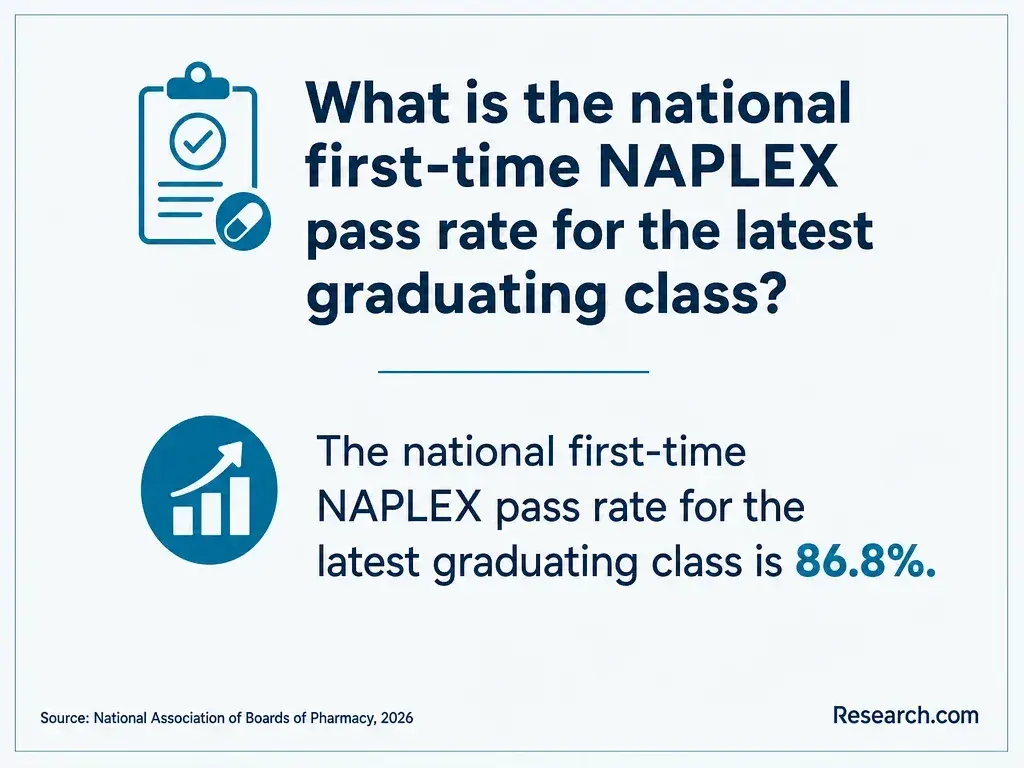
- Which recent NAPLEX outcomes does the school publish, and what do those results include or exclude?
If cost is a deciding factor, compare the school's answers with budget-friendly pharmacy degree programs using the same cost categories. A lower advertised tuition figure may not offset substantial travel or placement expenses. Ask the financial aid office which rules apply to your entry year; federal borrowing rules changed for many new graduate and professional borrowers beginning July 1, 2026.
Both formats can assess the same qualities, but they create different practical demands. Use the comparison below to anticipate the experience without assuming every school follows the same format.
| Feature | Online interview | Campus interview |
| Logistics | Requires a reliable connection, a quiet space, and familiarity with the meeting platform | Requires travel planning and time to navigate the location |
| Interaction | Group cues may be harder to read on screen | May offer more informal contact with students or faculty |
| Program observation | May include virtual tours or information sessions | May allow a direct look at facilities and campus routines |
Test your equipment and keep admissions contact information available for a technical failure. For an in-person visit, check travel timing and accessibility arrangements in advance. Neither interview format proves that the degree itself can be completed remotely.
In particular, a program marketed online may still require scheduled sessions, campus activities, and in-person rotations. Claims about online pharmacy program length can refer to credentials other than the professional Pharm.D.; confirm the exact degree, curriculum, and attendance requirements with the school.
How can you choose an accredited PharmD program after the interview?
Begin by verifying the program's current ACPE professional-program status in ACPE's official records. Separately confirm the institution's accreditation and, for distance education, whether it can enroll you in your state. Those are different questions; none replaces checking your intended state board's licensure requirements.
Use the same fields for each offer so a compelling interview does not obscure a material difference. Fill in the comparison with written answers from the schools rather than impressions alone.
| Comparison field | Program A | Program B |
| Verified ACPE status | To confirm | To confirm |
| Prerequisites still required | To confirm | To confirm |
| Tuition, mandatory fees, and major travel costs | To confirm | To confirm |
| Required campus attendance and weekly schedule | To confirm | To confirm |
| Clinical placement responsibility and likely travel | To confirm | To confirm |
| Published NAPLEX outcomes and student support | To confirm | To confirm |
A school may be the better choice if its schedule and placements are feasible and its total cost is manageable - not simply because its interview felt warmer or its advertised program is shorter.
Compare pharmacy program tuition and length only after confirming that the options award the same professional credential and that cost estimates cover comparable items. Before paying a deposit, get unresolved prerequisite, placement, and aid questions answered in writing.
Other Things You Should Know About PharmD
Follow any dress guidance in your invitation. Otherwise, choose clean, professional clothing that lets you participate comfortably, whether you are on camera or on campus.
If the school permits follow-up, a brief note thanking your interviewers is appropriate. Keep it specific and professional; a note does not substitute for required application materials.
Yes. Contact the school's designated admissions or accessibility office as early as possible to ask about its process. You generally do not need to explain a medical condition to individual interviewers.
Follow the school's instructions for confirming continued interest and submitting updates. Ask when decisions may be made, and protect any deposit or reply deadlines attached to other offers.
- PharmD Admissions Selection Criteria | Doctor of Pharmacy https://pharmacy.wisc.edu/pharmd/selection-criteria/
- Using the STAR method for your next behavioral interview (worksheet included) | MIT https://capd.mit.edu/resources/the-star-method-for-behavioral-interviews/
- 21 Questions to Ask at the End of An Interview | Eller College of Management https://eller.arizona.edu/news/21-questions-ask-end-interview
- SAMPLE PHARMACY SCHOOL INTERVIEW QUESTIONS | utexas.edu https://healthprofessions.utexas.edu/media/259/download
- PharmD Core Competencies | Western New England University https://wne.edu/pharmacy-and-health-sciences/academics/pharmd/core-competencies.cfm
- Multiple Mini Interviews (MMIs) - MSU Pre-Health https://prehealth.natsci.msu.edu/applying/MMIs.aspx
- The Rx for a Winning Pharmacy School Interview | University of Health Sciences and Pharmacy in St. Louis https://www.uhsp.edu/the-rx-for-a-winning-pharmacy-school-interview/
- PharmD FAQs - UNC Eshelman School of Pharmacy https://pharmacy.unc.edu/education/pharmd/pharmd-admissions-faqs/
- Why choose pharmacy as a career? | Medical College of Wisconsin https://www.mcw.edu/education/pharmacy-school/prospective-students/chat-with-us/why-pharmacy-blog
- Pharmacy School Interview Questions: What You Need to Know | PCOM https://www.pcom.edu/pharmacy/news/pharmacy-school-interview-questions.html