
2027 Information Technology Careers: Skills, Education, Salary & Job Outlook

Co-Founder and Chief Data Scientist
Choosing an information technology career is not just a question of whether you “like computers.” It is a decision about the kind of problems you want to solve: keeping systems online, protecting data, supporting users, building software, managing cloud infrastructure, analyzing information, or leading technology change inside an organization.
IT remains one of the more flexible career fields because employers need technical talent in nearly every industry. The field can also be demanding. Skills age quickly, security risks keep changing, and many roles require both technical accuracy and clear communication with nontechnical teams.
For career changers, students, and working adults, the key is to understand the path before investing time and money. This guide explains what information technology professionals do, the skills and credentials that matter, earning potential, job outlook, work environments, advancement options, and related careers to consider. Demand remains strong, with roles growing 11% through 2032 and salaries regularly exceeding $120,000 in key specializations, but the best results usually come from matching your training plan to a specific IT role rather than pursuing random tools or certifications.
Key Things You Should Know About Information Technology Career
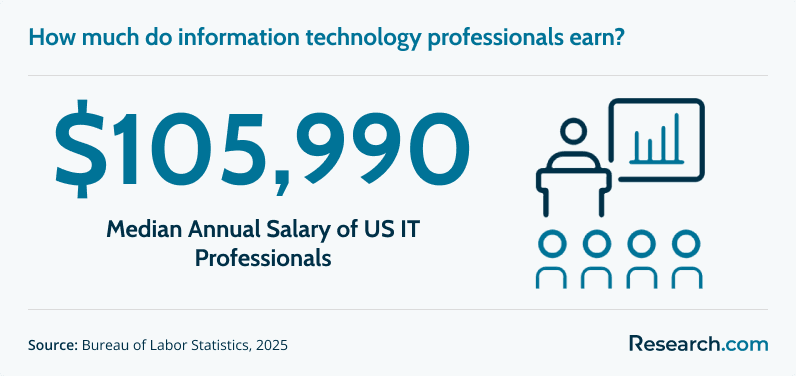
- The median annual salary for information technology professionals in the United States is $112,667, reflecting strong earning potential well above the national average.
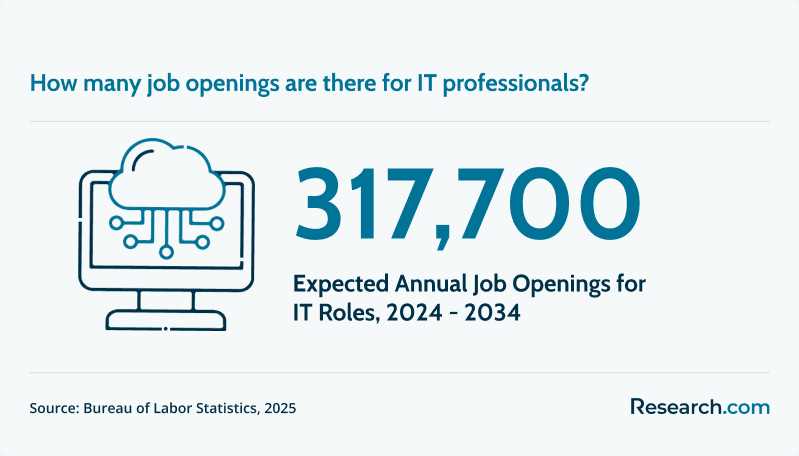
- The tech workforce grew by 1.2% in 2024 with about 72,500 new jobs added, and demand is expected to stay robust through 2034 thanks to growth in AI, cybersecurity, and cloud technologies.
- Most IT positions require at least a bachelor's degree in computer science, information technology, or a related field, though some support roles accept associate degrees or certifications.
- Key skills for success include problem-solving, critical thinking, communication, and expertise in software development, cybersecurity, cloud computing, data analysis, and AI/automation.
- Careers commonly advance from support or junior technical roles to systems analyst, network architect, or security analyst, with further growth to senior engineer, IT manager, or chief information officer, especially when specializing in high-demand fields.
What do information technology professionals do?
Information technology professionals plan, install, secure, maintain, and improve the digital systems that organizations rely on every day. Their work may involve computers, servers, networks, software, databases, cloud platforms, cybersecurity tools, communication systems, or user support. In practical terms, they help people and businesses use technology reliably and safely.
The role varies widely by job title. An IT support specialist may spend most of the day resolving user problems. A systems administrator may manage servers, access permissions, backups, and performance. A cybersecurity analyst may monitor threats and investigate suspicious activity. A cloud engineer may design infrastructure that scales with business needs. What connects these roles is the same core mission: keep technology useful, secure, and aligned with organizational goals.
A day in the life of information technology professionals
A typical day often blends planned work with unexpected issues. An IT professional might review system alerts, respond to support tickets, update security patches, document changes, test a new software rollout, join a project meeting, and troubleshoot a network or application problem before it affects users.
The work is rarely isolated from the rest of the organization. IT teams coordinate with finance, operations, human resources, customer service, executives, vendors, and end users. Strong professionals are not only good at fixing technical problems; they can explain risks, set priorities, and help others understand what needs to happen next.
What are the key responsibilities of information technology professionals?
Information technology professionals are responsible for keeping technology environments stable, secure, and usable. The exact duties depend on the employer and specialization, but most IT roles include a mix of maintenance, troubleshooting, security, documentation, and communication.
- Troubleshoot hardware, software, and access issues: Diagnose user problems, identify root causes, and restore service with as little downtime as possible.
- Install and configure systems: Set up workstations, applications, servers, networks, mobile devices, and related infrastructure.
- Maintain networks and platforms: Monitor performance, apply updates, manage storage, verify backups, and ensure systems remain available.
- Support cybersecurity practices: Apply patches, enforce access controls, monitor threats, respond to incidents, and help users follow security policies.
- Document processes and assets: Track equipment, software licenses, configurations, procedures, and troubleshooting steps so systems can be supported consistently.
- Train and assist users: Help employees or clients use tools correctly, adopt new systems, and avoid common technology mistakes.
- Coordinate communication tools: Support email, messaging, video conferencing, phone systems, and collaboration platforms that keep teams connected.
The most challenging vs. the most rewarding tasks
The hardest moments often involve high-pressure outages, failed updates, security alerts, or urgent requests from multiple stakeholders at once. These situations require technical judgment, calm communication, and the ability to separate symptoms from root causes. Mistakes can affect productivity, revenue, customer trust, or sensitive data.
The most rewarding work usually comes when an IT professional solves a problem that was slowing people down or putting the organization at risk. Restoring data, eliminating recurring network failures, automating a manual process, or launching a secure new platform can make a visible difference in how people work.
If you are trying to enter the field while balancing work or family obligations, exploring accelerated online degree options for working adults can help you compare education paths that may shorten the time to career readiness.
What are the key skills for information technology professionals?
Strong IT professionals combine technical depth with practical judgment. Employers value people who can configure systems, protect data, solve problems, and communicate clearly with users who may not understand technical details.
Core technical skills
- Networking: Understanding routers, switches, firewalls, DNS, VPNs, IP addressing, and connectivity troubleshooting is foundational in many IT roles.
- Operating systems: IT professionals often support Windows, Linux, macOS, mobile operating systems, or server environments depending on the organization.
- Cybersecurity: Security skills include access control, threat monitoring, patch management, incident response, compliance awareness, and secure configuration.
- Cloud computing: Cloud roles involve managing scalable platforms, storage, identity, virtual machines, containers, and cloud security controls.
- Scripting and automation: Basic scripting can reduce repetitive work, improve consistency, and help teams manage larger systems more efficiently.
- Data analytics: Skills in SQL, Python, Tableau, or related tools can help professionals interpret data, build reports, and support evidence-based decisions.
- Artificial intelligence and machine learning: AI-related skills are increasingly useful for automation, analytics, workflow improvement, and intelligent system design.
Essential soft skills
- Critical thinking: IT work often requires evaluating incomplete information, testing assumptions, and choosing the safest solution.
- Problem solving: The best technicians and engineers do not just apply quick fixes; they identify patterns and prevent repeat issues.
- Communication: Professionals must explain technical risks, timelines, and trade-offs in language that managers, clients, and users can understand.
- Prioritization: Not every issue has the same urgency. IT teams must balance security, productivity, cost, and user impact.
- Emotional intelligence: Support and project work often involve frustrated users, competing needs, and high-pressure situations.
The overlooked skill that separates good IT professionals from great ones
One of the most valuable but underdeveloped skills is process improvement leadership. Great IT professionals do not only resolve tickets or maintain systems; they notice where work is inefficient, risky, or repetitive, then help redesign the process.
For example, an IT professional who sees frequent deployment errors might help introduce automated testing, clearer documentation, and a more reliable rollout process. That kind of contribution reduces downtime, improves user trust, and shows leadership beyond a narrow technical task.
For learners comparing later-career education options, reviewing online degree options for seniors can provide additional context on flexible academic routes into technology-related fields.
Information Technology Careers: A Step-by-Step Guide to Getting Started
Starting an IT career is easier when you work backward from the role you want. A future help desk technician, cybersecurity analyst, cloud engineer, and software developer may all begin with basic computing knowledge, but their next steps differ. Use the following roadmap to move from interest to employability.
- Choose a target entry point: Common starting roles include help desk technician, IT support specialist, junior systems administrator, network support technician, quality assurance tester, or junior developer. Pick one before choosing courses or certifications.
- Build foundational knowledge: Learn core concepts in hardware, operating systems, networking, security, databases, and basic scripting or programming. A degree, certificate program, bootcamp, community college course, or structured self-study plan can all work if the training matches your goal.
- Create evidence of practical ability: Employers want proof that you can apply what you know. Build a small home lab, document projects, contribute to simple technical work, complete internships, volunteer for tech tasks, or pursue entry-level employment.
- Earn relevant credentials: Certifications can help validate skills, especially for early-career candidates. Choose credentials tied to the job description you are targeting rather than collecting certifications without a plan.
- Prepare for the job search: Translate technical learning into resume bullets that show outcomes. Practice explaining problems you solved, tools you used, and how you handled users or stakeholders.
- Specialize after building a base: Once you understand general IT operations, move toward cybersecurity, cloud computing, data analytics, software development, DevOps, networking, or management based on your strengths and interests.
The biggest mistake beginners make is trying to learn everything at once. A focused path usually produces faster progress than jumping between unrelated tools, languages, and certifications.
What education, training, or certifications are required?
The required education for information technology careers depends on the role, employer, and level of responsibility. Many employers prefer or require a bachelor's degree in Information Technology, Computer Science, Information Systems, or a related field, especially for analyst, engineering, development, and management roles. However, some entry-level support and technician roles may place more weight on demonstrable skills, certifications, internships, or prior technical experience.
Formal education can be valuable because it builds a broad base in systems, programming, networking, databases, security, and project work. It may also help with long-term advancement. Shorter training options, such as certificates, bootcamps, vendor training, and community college programs, can be useful when they are aligned with a specific job target.
Common certifications
Certifications are not a substitute for practical ability, but they can strengthen a resume and help employers verify baseline knowledge. CompTIA A+ is often used to validate foundational IT support skills. The Certified Information Technology Professional (CITP) credential is recognized for professionals who integrate IT with accounting and business knowledge, and it is associated with the AICPA.
Advanced credentials may require experience as well as study. For example, CITP candidates must demonstrate a minimum of 1,000 business-related IT hours in recent years. Ongoing education is also important because many certifications require renewal, and technology practices change quickly.
Are advanced degrees or niche certifications worth the investment?
Advanced degrees and specialized certifications can be worth it when they connect directly to your career goal. A graduate degree may help candidates move into leadership, architecture, analytics, research, or specialized technical roles. Niche certifications can be useful in cybersecurity, audit, cloud infrastructure, networking, and enterprise platforms.
The return on investment depends on cost, time, experience requirements, employer recognition, and whether the credential appears in job postings for your target role. Some credentials, such as CITP, may be most relevant to professionals with specific accounting or business backgrounds. Others, such as CISA, can have strategic value in audit and security-related work and may even waive exam requirements for others.
Before enrolling, compare the credential against real job listings. If employers in your target market do not ask for it, a portfolio project, internship, lower-cost certification, or direct work experience may be a better next step. If you are weighing graduate-level options, reviewing high-paying master's degree paths can help you think more carefully about cost, specialization, and long-term payoff.
What is the earning potential for information technology professionals?
Information technology can offer strong earning potential, but pay varies by role, location, industry, experience, specialization, and credential level. Entry-level support roles typically pay less than senior engineering, cybersecurity, cloud, architecture, management, or data-focused roles.
On a national scale, the entry-level salary is about $61,950 per year, reflecting what the lowest 10% in computer and information technology occupations typically earn. The median annual salary for computer and information technology roles stands at $100,530. At the senior level, top professionals can earn as much as $167,180 per year.
Those figures show why IT can be financially attractive, but they should not be read as guaranteed outcomes. A new graduate in a smaller market, a help desk worker, a senior cloud engineer, and a cybersecurity manager may all fall in very different salary ranges. Fields such as AI, cybersecurity, and cloud computing often command higher pay when professionals have the experience to handle complex systems and risk.
What most affects IT pay?
- Specialization: Security, cloud, AI, data, architecture, and engineering roles often have higher earning ceilings than general support roles.
- Experience: Employers pay more for professionals who can work independently, prevent problems, and lead complex projects.
- Location: Tech hubs and major metropolitan areas typically offer more competitive salaries, although cost of living can also be higher.
- Industry: Finance, enterprise technology, consulting, healthcare, government contracting, and large-scale infrastructure environments may pay differently for similar skills.
- Certifications and degrees: Credentials can help, but they usually matter most when paired with hands-on experience.
What is the job outlook for information technology professionals?
The job outlook for information technology professionals is strong. Employment in this field is projected to grow 11% from 2024 to 2034, much faster than the 4% average across all occupations. Technology has become essential to business operations, so organizations continue to need professionals who can secure, maintain, modernize, and scale digital systems.
The key factors shaping the future outlook
Digital transformation is a major driver. Organizations continue replacing manual processes, legacy systems, and disconnected tools with integrated digital platforms. That creates demand for professionals who can implement systems, manage change, support users, and keep operations stable.
Cloud migration and remote work infrastructure also support demand. Employers need people who understand cloud services, identity management, collaboration tools, endpoint security, and distributed networks.
Artificial intelligence and cybersecurity are expanding the field further. AI creates demand for professionals who can manage data, automate workflows, evaluate tools, and support intelligent systems. Cybersecurity continues to create roles focused on risk, monitoring, incident response, compliance, and secure architecture.
For students and career changers who want a faster route into a growing field, comparing quick schooling options that can lead to higher-paying careers may help clarify practical entry points.
What is the typical work environment for information technology professionals?
Information technology professionals work in offices, data centers, schools, hospitals, government agencies, financial institutions, consulting firms, software companies, and remote or hybrid settings. Many roles require both independent technical work and collaboration with users, managers, vendors, and other IT specialists.
Most IT professionals work in environments such as professional, scientific, and technical services (26%), information industries (18%), and finance and insurance (12%). These settings often involve a mix of project work, maintenance, support, documentation, and security responsibilities.
Schedules vary. Many IT roles follow standard business hours, especially support, analyst, administrative, and internal operations positions. However, some jobs require evenings, weekends, on-call rotations, or emergency response when systems fail, maintenance windows are scheduled, or security incidents occur.
Teamwork vs. solo work in IT
IT is rarely purely solo work. Even highly technical roles require coordination. A systems administrator may work independently on a server issue but still need to communicate downtime risk. A cybersecurity analyst may investigate an alert alone but must report findings to leadership. A developer may write code independently but still participate in reviews, testing, and deployment planning.
If you prefer structured collaboration, look at support, project coordination, business systems, training, or management paths. If you prefer deep technical focus, consider systems engineering, cloud infrastructure, security operations, data engineering, or software development, while still expecting regular communication.
What are the pros and cons of information technology careers?
Information technology careers can be rewarding, stable, and intellectually engaging, but they are not effortless. The same features that make IT attractive—constant change, high demand, complex systems, and business impact—can also create pressure.
Pros
- Strong demand: Organizations across industries need people who can manage technology, protect data, and support digital operations.
- Multiple entry points: Candidates may enter through degrees, certifications, internships, support roles, military experience, self-study, or career-change programs.
- Clear specialization options: IT offers paths in cybersecurity, cloud computing, networking, systems administration, data, software, DevOps, and management.
- Problem-solving satisfaction: Many professionals enjoy diagnosing issues, improving systems, and seeing immediate results from their work.
- Remote and hybrid possibilities: Many roles can be performed partly or fully remotely, depending on the employer and responsibilities.
- Advancement potential: Technical depth, leadership ability, and business understanding can lead to higher-level roles.
Cons
- Continuous learning is required: Tools, threats, platforms, and best practices change quickly.
- Pressure can be high: Outages, security incidents, and urgent executive requests can create stressful workdays.
- On-call work may be necessary: Some roles involve nights, weekends, or emergency response.
- Users may be frustrated: Support and operations roles require patience when people are stressed or unable to work.
- Requirements can shift: Projects may change due to budget, business needs, vendor issues, or security concerns.
The best fit depends on your temperament. If you enjoy learning, troubleshooting, and helping organizations operate better, IT can be a strong choice. If you dislike ambiguity, urgent requests, or frequent skill updates, consider whether a more predictable technical or nontechnical path would suit you better. Similar trade-offs exist in many practical career routes, including careers for trade school graduates.
What are the opportunities for advancement for information technology professionals?
Information technology offers several advancement paths. Some professionals move into management. Others become senior technical specialists. The right path depends on whether you prefer leading people, designing systems, solving advanced technical problems, or shaping technology strategy.
Common advancement path
- Entry-level roles: IT Support Specialist, Help Desk Technician, Junior IT Professional, Desktop Support Technician, or Junior Network Technician. These jobs focus on troubleshooting, user support, documentation, and basic system maintenance.
- Mid-level roles: Systems Administrator, Network Administrator, IT Specialist, Security Analyst, Cloud Administrator, or Application Support Analyst. These roles involve more ownership, deeper troubleshooting, and responsibility for systems or platforms.
- Senior technical roles: Systems Engineer, Cloud Engineer, Cybersecurity Engineer, Network Engineer, DevOps Engineer, Solutions Architect, or Senior Developer. These jobs require independent judgment and the ability to design or improve complex environments.
- Leadership roles: IT Manager, Technical Lead, Infrastructure Manager, Security Manager, Director of IT, or Chief Information Officer. These positions involve strategy, budgets, staffing, risk management, and cross-functional decision-making.
Specialization opportunities
- Cybersecurity: Professionals protect systems and data, investigate threats, and may pursue credentials such as CISSP as their careers advance.
- Cloud computing: Specialists design, deploy, and manage cloud infrastructure on platforms such as AWS and Azure.
- Artificial intelligence and data science: Professionals implement analytics, machine learning, automation, and data-driven solutions.
- Network and systems administration: Specialists maintain secure, reliable infrastructure that supports daily operations.
- Software development: Developers build applications, improve systems, and collaborate with product, design, and operations teams.
- DevOps: DevOps professionals connect development and operations through automation, deployment pipelines, monitoring, and reliability practices.
- Web development: Web professionals build and maintain websites, applications, integrations, and user-facing digital tools.
How to get promoted in IT
Promotion usually requires more than technical skill. Document measurable results, volunteer for higher-impact projects, improve processes, mentor junior colleagues, communicate risks clearly, and learn how your work supports business goals. Managers tend to promote IT professionals who reduce uncertainty, prevent recurring problems, and can be trusted with broader responsibility.
What other careers should you consider?
If you are interested in information technology but unsure which role fits best, compare related careers by the type of work you want to do every day. Some roles are more user-facing, while others focus on data, security, systems, code, or training.
- Data Scientist: A strong option if you enjoy statistics, programming, data modeling, and using information to guide decisions.
- Network Administrator: A practical fit if you like infrastructure, connectivity, firewalls, routing, reliability, and hands-on systems work.
- Cybersecurity Analyst: A good path if you are interested in risk, investigation, threat detection, compliance, and protecting digital assets.
- Web Developer: A strong choice if you prefer building user-facing websites, applications, and digital experiences through programming and design collaboration.
- Corporate Trainer (Tech): A fit for people who understand technology and enjoy teaching employees how to use systems, software, and digital tools effectively.
To narrow your choice, ask three questions: Do you want to work mostly with people, systems, data, security, or code? Do you prefer immediate troubleshooting or long-term project work? Do you want to become a technical expert, a manager, or a bridge between business and technology? Your answers will point you toward the best IT-related path.
Here's What Professionals Say About Their Information Technology Careers
- : "Building applications that people actually use to make their day easier gives me a real sense of purpose. Every line of code I write is a step toward solving practical problems, like improving workflow efficiency or enhancing security for users. Knowing that my work helps businesses run smoother and people feel more connected keeps me motivated. It is rewarding to see how something I create can positively influence so many lives. — Carlos"
- : "Starting out, I often felt overwhelmed by how much there was to learn—languages, frameworks, endless tools—and being surrounded by seasoned pros was intimidating. But instead of shutting down, I leaned into the challenge and learned from their expertise. Each mistake became a lesson, and every hurdle pushed me to sharpen my skills further. Facing those early fears head-on made me stronger and gave me confidence I never expected. Now, complexity excites rather than scares me. — Lena"
- : "I never imagined that switching to IT support would bring such stability and fulfillment to my life. After securing my role, I saw a $45,000 increase in my income, which transformed my ability to balance work with caring for my family. The chance to provide dependable tech help while having consistent hours means the world to me. This career gave me what I needed to feel proud and secure, and each day of success motivates me to keep growing. I am grateful someone believed in me when I was just starting. — Jamal"
Key Findings
- Information technology professionals keep digital systems secure, reliable, and useful across organizations and industries.
- Common responsibilities include troubleshooting, system setup, network maintenance, cybersecurity support, user training, documentation, and technology coordination.
- Important skills include networking, operating systems, cybersecurity, cloud computing, data analytics, scripting, communication, critical thinking, and process improvement.
- Many IT roles prefer a bachelor's degree in Information Technology, Computer Science, Information Systems, or a related field, but entry-level paths may also include certifications, projects, internships, and hands-on experience.
- CompTIA A+ can validate foundational IT skills, while the Certified Information Technology Professional (CITP) credential is relevant for professionals integrating IT with accounting and business knowledge.
- National salary figures range from about $61,950 per year at the entry level to a median annual salary of $100,530 and senior-level earnings as high as $167,180 per year.
- The job outlook is strong, with projected growth of 11% from 2024 to 2034 compared with the 4% average across all occupations.
- Advancement can lead to senior technical roles, management, cybersecurity, cloud computing, data science, DevOps, software development, and IT leadership.
Other Things You Should Know About Information Technology
In 2027, a successful career in IT demands proficiency in areas like cloud computing, cybersecurity, data analysis, and artificial intelligence. Skills in programming languages such as Python and Java, alongside soft skills like problem-solving and adaptability, are also crucial in this rapidly evolving field.
Certifications such as CompTIA Security+, Cisco Certified Network Associate (CCNA), and AWS Certified Cloud Practitioner are recommended for IT professionals in 2027. These demonstrate proficiency in security, networking, and cloud computing — crucial areas that can enhance job prospects and salary potential.
References
- Is the IT Industry a Good Career Path? - MyComputerCareer https://www.mycomputercareer.edu/what-are-the-pros-and-cons-of-working-in-the-it-industry/
- Hard Skills vs. Soft Skills: Definitions and 50+ Examples | EdgePoint Learning https://www.edgepointlearning.com/blog/hard-skills-vs-soft-skills/
- Office of Teaching Initiatives https://www.highered.nysed.gov/tcert/certificate/cte/industry-relatedcredentials-inf.html
- Information Technology (IT) Certifications & Tech Training | CompTIA https://www.comptia.org/en/
- What is the work environment like in information technology? https://www.careervillage.org/questions/217117/what-is-the-work-environment-like-in-information-technology
- Information Technology career cluster | Explore Careers | CareerOneStop https://www.careeronestop.org/ExploreCareers/Learn/CareerClusters/information-technology-career-cluster.aspx
- Computer and Information Technology Occupations : Occupational Outlook Handbook: : U.S. Bureau of Labor Statistics https://www.bls.gov/ooh/computer-and-information-technology/
- Why Is Information Technology Alignment Important for Your Business? - DQE Communications https://dqe.com/resources/tech-talk/technology-alignment-means-for-you-business/
- 10 Facts About Starting Career in Information Technology - SABT https://sabt.edu.au/career-in-information-technology/
- IT FAQs | IT Support FAQs | Faq for IT Services | Micro Pro https://micropro.com/blog/the-most-frequently-asked-questions-our-it-support-helpdesk-is-asked-answered/


