2027 Resource Nurse Careers: Skills, Education, Salary & Job Outlook

Co-Founder and Chief Data Scientist
Becoming a resource nurse is a practical next step for registered nurses who like solving problems, supporting colleagues, and keeping patient care moving when a unit is stretched. The role is not usually an entry-level nursing job. It typically requires a solid RN foundation, sound clinical judgment, and enough bedside experience to guide other nurses under pressure.
This guide explains what resource nurses do, the skills and credentials employers commonly look for, how salary and job outlook compare, and what advancement can look like. It is written for current nursing students, newly licensed RNs planning their path, and experienced nurses considering a move into a more flexible, leadership-oriented clinical role. The career can be demanding, but the combination of direct patient impact, team leadership, and stable demand makes it worth serious consideration.
Key Things You Should Know About Resource Nurse Career
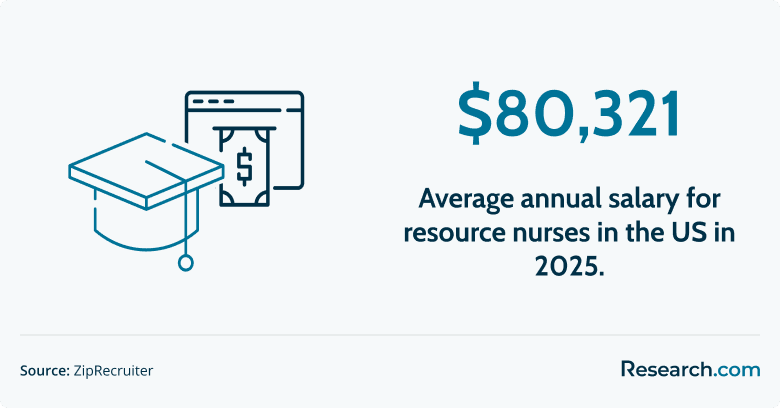
- The typical earning potential for a resource nurse is around $80,321 per year, with an average hourly rate of approximately $38.62.
- Employment in this field is expected to grow 5% from 2024 to 2034, indicating a stable and expanding demand for skilled nurses.
- Starting as a resource nurse generally requires a Bachelor of Science in Nursing (BSN) or an Associate Degree in Nursing (ADN), successful completion of the NCLEX-RN exam, and active RN licensure.
- Success as a resource nurse depends on strong clinical assessment, critical thinking, adaptability, multitasking, leadership, and effective communication skills.
- A resource nurse can advance into roles such as charge nurse, nurse manager, clinical educator, or specialized nursing and administrative positions, often with further education or certification.
What do Resource Nurses do?
Resource nurses support nursing units by stepping in where clinical expertise, staffing support, or workflow coordination is needed most. They may help with difficult procedures, mentor less experienced nurses, respond to urgent patient-care concerns, or coordinate coverage when a unit becomes short-staffed. In many settings, they function as the person nurses call when a situation is too complex, too urgent, or too disruptive to handle alone.
The role sits between bedside care and nursing leadership. Resource nurses are not removed from patient care; they are often deeply involved in it. At the same time, they are expected to think beyond one patient assignment and consider the needs of the whole unit, shift, or care team.
A Day in the Life of Resource Nurses
A typical shift can change quickly. A resource nurse might begin by reviewing staffing needs, checking in with charge nurses, and identifying high-acuity patients. Later in the shift, they may help start an IV, assist with a deteriorating patient, coach a new nurse through a procedure, or help rebalance assignments after an admission surge.
The best resource nurses are calm, visible, and approachable. They do not simply “float” from task to task; they recognize patterns, prevent small problems from becoming major delays, and help staff nurses feel supported when the workload becomes difficult. Their impact is often measured in smoother handoffs, safer care, fewer bottlenecks, and a stronger clinical team.
What are the key responsibilities of Resource Nurses?
Resource nurses are responsible for keeping care delivery safe, coordinated, and responsive. Their work may vary by employer, unit size, specialty, and shift, but the core responsibility is the same: help the nursing team manage patient care effectively when demands exceed routine staffing or experience levels.
- Provide direct clinical assistance to nursing staff, including procedures such as starting IVs, drawing lab work, assisting with assessments, and supporting urgent interventions.
- Serve as a first point of escalation for complex clinical concerns, especially when staff nurses need a second set of eyes or help interpreting a change in patient condition.
- Support daily workflow by helping with staff assignments, patient flow, admissions, transfers, discharges, and unexpected coverage gaps.
- Mentor newer nurses, reinforce safe practice, and help staff apply policies and protocols in real clinical situations.
- Lead or participate in huddles, communicate operational concerns, and help connect bedside nurses with charge nurses, physicians, case managers, and other departments.
- Complete unit-based administrative checks, such as reviewing emergency equipment, checking code carts, monitoring supplies, and confirming that required standards are being followed.
The Most Challenging vs. The Most Rewarding Tasks
The hardest part of the job is the constant reprioritization. A resource nurse may be helping one nurse with a procedure when another patient deteriorates, a family conflict escalates, or a staffing issue requires immediate attention. The role requires quick judgment without losing professionalism or emotional control.
The most rewarding part is the immediate value of the work. A successful IV start, a timely intervention, or a calm coaching conversation can change the course of a shift for both patients and staff. Resource nurses often see the direct result of their expertise: a safer patient, a more confident nurse, or a unit that recovers from a difficult moment. Nurses planning for leadership responsibilities may also consider whether a 12 month master's degree online fits their long-term goals, schedule, and licensure requirements.
What are the key skills for Resource Nurses?
Resource nurses need more than strong bedside skills. They must combine clinical competence, communication, prioritization, and situational awareness. Because they often support several nurses or patient needs at once, they must make fast decisions while staying within policy, scope of practice, and patient-safety standards.
Technical skills employers value
- Clinical assessment and patient care: Recognize changes in patient condition, respond appropriately, and help staff nurses tailor care to different acuity levels and unit needs.
- Life support and resuscitation readiness: Maintain competence in urgent interventions such as CPR and advanced cardiac life support when required by the setting.
- Care coordination and team-based practice: Communicate clearly with nurses, physicians, therapists, case managers, and other professionals to reduce delays and prevent miscommunication.
- Quality improvement and evidence-based practice: Apply protocols consistently, identify recurring workflow problems, and support improvements that protect patient outcomes.
Soft skills that matter on the floor
- Critical thinking: Sort through incomplete information and make safe, timely decisions.
- Active listening: Understand what a nurse, patient, or family member is really asking for before jumping to a solution.
- Judgment and decision making: Prioritize competing needs when several issues feel urgent at the same time.
- Social perceptiveness: Read stress, conflict, hesitation, and team dynamics before they affect care.
The One Overlooked Skill That Separates the Good from the Great
The skill that often separates excellent resource nurses from merely competent ones is rapid clinical prioritization. This means quickly deciding which patient, nurse, or operational issue needs attention first, which can safely wait, and which tasks can be delegated.
For example, in a busy emergency unit, several patients may arrive at once while staff nurses are already managing high-acuity cases. A strong resource nurse identifies the most unstable patient, assigns support where it is needed, and prevents less visible problems from being missed. Poor prioritization can lead to delayed care, duplicated work, staff frustration, or overlooked symptoms.
This skill becomes especially valuable in high-acuity settings such as General Medical and Surgical Hospitals. Nurses who want to move into advanced clinical, academic, or leadership roles may also compare options such as easiest online PhD programs, while carefully checking accreditation, program quality, and whether the degree supports their intended career path.
Resource Nurse Careers: A Step-by-Step Guide to Getting Started
The path to becoming a resource nurse usually begins with RN preparation, licensure, and direct clinical experience. Employers want nurses who can handle patient care independently before asking them to support other nurses across a unit or facility.
- Complete an approved nursing program. Start with the nursing education required for RN eligibility, such as an ADN or BSN program, and build a strong foundation in assessment, pharmacology, pathophysiology, communication, and clinical practice.
- Pass the NCLEX-RN and obtain RN licensure. Resource nurses must be licensed registered nurses. Licensure requirements vary by state, so candidates should confirm requirements with their state board of nursing.
- Gain direct RN experience. Build confidence through bedside practice. At least one year of direct RN experience is commonly important because resource nurses need real-world judgment, not only classroom knowledge.
- Develop unit-specific expertise. Seek assignments, precepting opportunities, float experience, and mentorship that expose you to different patient needs, staffing patterns, and clinical challenges.
- Earn relevant certifications and training. Depending on the setting, this may include BLS, ACLS, specialty certifications, or facility-based training in emergency response, patient flow, or charge nurse duties.
- Apply for resource nurse, float nurse, or charge-support roles. Look for positions that match your specialty background and be ready to show examples of leadership, prioritization, communication, and safe clinical decision-making.
This career path is most manageable when approached in stages. First become a strong RN, then develop the credibility and judgment to support others. Trying to move too quickly into a resource role without enough bedside experience can make the job more stressful and may limit your effectiveness.
What education, training, or certifications are required?
The basic requirement for resource nurse roles is an active RN license, earned after completing an approved nursing program and passing the NCLEX-RN. Many employers prefer a Bachelor of Science in Nursing (BSN), especially hospitals and larger health systems, because the BSN includes broader preparation in leadership, research, community health, and systems-based care. An Associate Degree in Nursing (ADN) can still provide an entry point into RN practice, but BSN completion may improve competitiveness for leadership-oriented positions.
Basic Life Support (BLS) is commonly required and is often issued by the American Heart Association or American Red Cross. Advanced Cardiovascular Life Support (ACLS) is frequently valuable in acute care, critical care, emergency, telemetry, and other higher-acuity environments. Some employers also require unit-specific competencies before a nurse can serve as a resource for others.
Training is often a mix of formal orientation and hands-on mentorship. Nurse residency programs may last 6-12 months, and resource nurse preparation may include unit orientation, preceptorship, leadership training, simulation, policy review, and supervised practice under experienced nurses or charge nurses.
Are advanced degrees or niche certifications worth the investment?
Advanced education and certifications can be worthwhile when they match a specific career goal. A Master of Science in Nursing (MSN) may support advancement into nurse education, administration, informatics, clinical leadership, or advanced practice depending on the program and licensure pathway. Specialty certifications such as the Certified Medical-Surgical Registered Nurse (CMSRN) can also strengthen credibility in a particular clinical area.
The key is return on investment. Tuition, fees, schedule demands, clinical requirements, and time away from work can be significant. Before enrolling, nurses should confirm accreditation, employer tuition support, certification eligibility, state licensure implications, and whether the credential is preferred or required for the target role. Those exploring doctoral pathways may compare options such as a low cost PhD while evaluating program fit, outcomes, and professional value.
For many nurses, the best sequence is to gain experience first, then invest in credentials that solve a clear career problem: moving into leadership, qualifying for a specialty, teaching nurses, or transitioning into advanced practice.
What is the earning potential for Resource Nurses?
Resource nurse earning potential varies by experience, employer, specialty, location, shift, and whether the role includes charge, float, or leadership responsibilities. Entry-level salaries are around $61,500, while the current median stands at $80,321 annually in the United States. Senior-level resource nurses may earn as much as $118,000.
The Resource nurse salary range 2025 therefore runs from approximately $61,500 at the lower end to as much as $118,000 for senior-level nurses. This wide range reflects the difference between nurses new to expanded support duties and those who bring advanced clinical judgment, specialty expertise, and leadership experience.
Location matters. Some states, such as South Carolina, typically offer lower salaries than the national average. Pay can also be higher in specialty clinical settings, high-acuity units, hospitals with staffing shortages, evening or weekend schedules, and roles that require floating across multiple departments.
What can increase earning potential?
- Experience: Resource nurses who can independently support complex patient situations are usually more competitive.
- Specialty setting: Critical care, emergency, perioperative, and other high-acuity environments may offer stronger pay opportunities.
- Certifications: Relevant credentials can support promotion or specialty placement, though they do not guarantee a salary increase.
- Shift and differential pay: Nights, weekends, holidays, and float roles may include additional compensation depending on employer policy.
- Leadership responsibilities: Resource roles that overlap with charge nurse, educator, or patient-flow duties may offer stronger advancement potential.
When comparing offers, look beyond base pay. Benefits, retirement contributions, tuition reimbursement, staffing ratios, overtime expectations, and burnout risk all affect the real value of a position.
What is the job outlook for Resource Nurses?
The demand for resource nurses is expected to grow at about 6% from 2023 to 2033, which is slightly slower than the 7.7% average growth rate projected for all occupations. Even with that comparison, nursing remains a relatively stable field because healthcare organizations continue to need licensed professionals who can deliver care, coordinate teams, and respond to patient needs.
The Key Factors Shaping the Future Outlook
An aging population increases demand for nursing care, which supports ongoing need for experienced nurses who can help units manage higher patient volume and acuity. At the same time, healthcare technology continues to change how nurses document, monitor, communicate, and coordinate care. Resource nurses who adapt well to new systems and help others use them effectively can become especially valuable.
Workforce dynamics also affect the outlook. Retirements, staffing shortages, turnover, and constraints in nursing education can create pressure on healthcare employers. In this environment, resource nurses may be used to stabilize units, mentor newer nurses, and improve patient flow. However, job availability and working conditions still vary widely by region, specialty, and employer.
Students preparing for RN education can reduce unnecessary barriers by comparing accredited options carefully. Some may consider accredited online universities that don't charge to apply, but should still verify nursing program approval, clinical placement requirements, NCLEX eligibility, and state authorization before enrolling.
What is the typical work environment for Resource Nurses?
Resource nurses most often work in hands-on clinical environments where staffing, patient acuity, and workflow can change throughout the shift. Hospitals employ about 60% of resource nurses, making acute care the most common setting. Other employers include ambulatory healthcare services and nursing or residential care facilities.
The work culture is highly collaborative. Resource nurses interact with staff nurses, charge nurses, nurse managers, physicians, therapists, case managers, and support staff. They must be comfortable entering situations where people may be stressed, behind schedule, or uncertain about the next step.
Schedules depend heavily on the setting. Outpatient and ambulatory roles may be more likely to follow day shifts, while hospital roles may require rotating shifts, evenings, weekends, holidays, or coverage across multiple units. Remote work is generally not realistic because the job requires direct clinical presence, immediate response, and hands-on support.
Common work settings
- Hospitals: Fast-paced settings with higher acuity, rotating schedules, and frequent need for real-time clinical support.
- Ambulatory care: More predictable schedules in some cases, with emphasis on patient flow, procedures, education, and coordination.
- Nursing or residential care facilities: Ongoing patient support, staff guidance, and coordination across long-term care needs.
Before accepting a role, candidates should ask how the employer defines “resource nurse.” In some facilities, the role is primarily clinical support. In others, it may include staffing coordination, charge duties, education, or floating across several units.
What are the pros and cons of Resource Nurse careers?
A resource nurse career can be highly satisfying for nurses who enjoy variety, leadership, and problem-solving. It can also be stressful because the role often involves urgent requests, competing priorities, and responsibility without full managerial authority.
Pros
- Meaningful clinical impact: Resource nurses often improve care in the moment, whether by assisting with a procedure, recognizing deterioration, or helping a nurse avoid an error.
- Professional respect: The role positions experienced nurses as trusted clinical advisors and mentors.
- Variety: Shifts are rarely repetitive because patient needs, staffing levels, and unit priorities change constantly.
- Leadership development: Resource nursing builds skills that transfer well to charge nurse, educator, supervisor, and management roles.
- Team support: Many resource nurses find purpose in helping colleagues feel less overwhelmed and more confident.
Cons
- Unpredictable workload: Priorities can shift suddenly, and resource nurses may be pulled in several directions at once.
- High pressure: Staff may expect quick answers for complex clinical or workflow problems that do not have simple solutions.
- Emotional strain: Supporting overwhelmed colleagues while managing patient needs can be draining.
- Limited control: Resource nurses may be responsible for solving problems created by staffing, policy, or system issues they cannot fully change.
- Conflict management: The role may require correcting practice issues, enforcing policies, or navigating tension between staff members.
This career is a strong fit for nurses who stay composed under pressure, communicate directly, and enjoy helping others succeed. Nurses still building their academic foundation may compare options such as an online bachelor's degree cheap program, while confirming accreditation, transfer policies, clinical requirements, and employer recognition.
What are the opportunities for advancement for Resource Nurses?
Resource nursing can become a bridge to formal leadership, specialty practice, education, or advanced clinical roles. Because the job develops decision-making, communication, and unit-level awareness, it can help nurses prove they are ready for broader responsibility.
Advancement Pathways for Growth
- Resource Nurse → Charge Nurse: Move into shift-level leadership by coordinating assignments, managing patient flow, and serving as a key decision-maker on the unit.
- Charge Nurse → Nurse Manager or Nurse Supervisor: Take on broader responsibilities such as scheduling, staff development, performance feedback, compliance, budgeting, and policy implementation.
- Nurse Manager/Supervisor → Director of Nursing or Advanced Practice Roles: Pursue higher-level leadership or clinical roles such as Director of Nursing, Clinical Nurse Specialist, Nurse Educator, or Nurse Practitioner with higher degrees (MSN/DNP).
Specialization Areas to Deepen Expertise
- Critical Care/Emergency Nursing: Work in ICUs, ERs, or trauma units and consider certifications such as CCRN or TNCC when relevant to the role.
- Oncology Nursing: Develop expertise in cancer care, chemotherapy support, symptom management, and patient education, often with AOCN certification.
- Pediatrics or Neonatal Nursing: Focus on children or newborns in pediatric units or NICUs and pursue related certifications as appropriate.
- Medical-Surgical Nursing: Build broad expertise in caring for diverse adult patient populations and consider relevant specialty certification.
The best advancement path depends on what part of resource nursing you enjoy most. If you like staffing, workflow, and operations, management may fit. If you prefer teaching, nurse education may be a better direction. If complex patient care is most rewarding, specialty certification or advanced practice may be worth exploring.
What other careers should you consider?
If resource nursing sounds appealing but not quite right, several related roles use similar strengths. Comparing these options can help you decide whether you want more bedside care, more leadership, more teaching, or more operational responsibility.
- Charge Nurse: A strong option for nurses who want formal shift leadership, staff coordination, and responsibility for unit-level decision-making.
- Nurse Educator: A better fit for nurses who enjoy teaching, onboarding, competency development, and translating policy or evidence into practice.
- Clinical Nurse Specialist: A path for nurses who want advanced clinical influence, quality improvement responsibilities, and system-level patient-care expertise.
- Patient Flow Coordinator: A good match for nurses interested in admissions, transfers, bed management, resource allocation, and hospital throughput.
- Preceptor Nurse: A focused mentoring role for nurses who want to guide new hires or students through clinical practice and professional adjustment.
When comparing roles, consider your preferred pace, tolerance for conflict, interest in teaching, desire for formal authority, and willingness to pursue additional education or certification. The closest match is not always the highest title; it is the role that fits how you want to use your nursing judgment every day.
Here's What Professionals Say About Their Resource Nurse Careers
- : "In my role as a resource nurse, I find great fulfillment in sharing my clinical experiences with newer nurses and creating a space where they feel supported. It is meaningful to help not only patients but also my colleagues, especially when the floor is short-staffed and tensions run high. I remember how much it meant to me when senior nurses stepped in during my early shifts, so I try to offer that same reassurance now. Being present for people during vulnerable moments reminds me why I chose this path in the first place. — Naomi"
- : "Every day as a resource nurse brings unpredictable challenges, and no two shifts are ever the same. Some days I am called on to help stabilize a tricky IV or medicate a patient urgently, while on others I am simply giving a fellow nurse a quiet moment to collect themselves. I have learned that staying calm and flexible is essential because the floor's needs shift constantly, and preparing ahead is nearly impossible. That ability to adapt and prioritize on the fly keeps me sharp and engaged. — Darius"
- : "What keeps me in this role is the genuine impact I can make on someone's day, whether it is a grateful nurse catching their breath or a patient who needs a little extra attention. The small moments, like staying that little bit longer to comfort a confused patient or jumping in when a nurse is overwhelmed, add up to something deeply rewarding. I know my support gives others the space they need to do their best, and that knowledge stays with me long after the shift ends. — Celeste"
Key Findings
- Resource nurses are experienced RNs who support staff nurses, patient care, workflow, and clinical problem-solving across a unit or facility.
- The role usually requires RN licensure through the NCLEX-RN, a strong clinical foundation, and at least one year of direct RN experience.
- A BSN is increasingly preferred, though many nurses begin with an ADN and later complete additional education.
- Common certifications include BLS and, in many acute care settings, ACLS; specialty certifications can support advancement when aligned with career goals.
- Resource nurse salaries range from approximately $61,500 to as much as $118,000, with a current median of $80,321 annually in the United States.
- Demand is expected to grow at about 6% from 2023 to 2033, supported by ongoing healthcare needs, workforce shortages, and an aging population.
- The career is best suited for nurses who are calm under pressure, clinically credible, strong communicators, and comfortable with shifting priorities.
- Common advancement options include charge nurse, nurse manager, nurse supervisor, Director of Nursing, Clinical Nurse Specialist, Nurse Educator, and Nurse Practitioner with higher degrees (MSN/DNP).
Other Things You Should Know About Resource Nurse
BLS and ACLS are the most useful baseline certifications for a resource nurse, and many hospitals prefer PALS for those working with children. Specialty credentials from the ANCC can strengthen applications, but employers usually require an active RN license first and at least one to two years of bedside experience.
In 2027, the starting salary for resource nurses varies depending on the geographic location, healthcare facility, and experience. On average, new resource nurses can expect to make between $55,000 and $65,000 annually. This salary can increase with additional certifications and experience.
References
- 10 Nurse Advancement Opportunities to Make the Most Money - CareerStaff Unlimited https://www.careerstaff.com/clinician-life-blog/nursing/nurse-advancement-opportunities/
- Nursing Career FAQs https://nursing.jnj.com/nursing-career-faqs
- 12 Nursing Student Skills for Resume Writing - Northeastern https://absn.northeastern.edu/blog/nursing-student-skills-for-resume/
- How Much Do Resource Nurses Make? | NursingEducation https://nursingeducation.org/careers/resource-nurse/salary/
- The 35 Best Specialty Career Choices For Nurses - NurseJournal.org https://nursejournal.org/articles/best-specialty-career-choices-for-nursing/
- Registered Nurse - Clinical Resource - Medical Unit | WellSpan Careers https://www.joinwellspan.org/jobs/Registered_Nurse_-_Clinical_Resource_-_Medical_Unit/102/392794/
- Nurses retention: the impact of transformational leadership, career growth, work well-being, and work-life Balance - BMC Nursing https://bmcnurs.biomedcentral.com/articles/10.1186/s12912-025-02762-1
- Nursing Career Path: Options & Pathways Explained | ANA https://www.nursingworld.org/content-hub/resources/becoming-a-nurse/nursing-career-pathways/
- 5 Nursing Recruitment Strategies That Work - Allegrow https://allegrow.com/nursing-recruitment-strategies/
- The Top 10 Pros & Cons of a Nursing Career https://ihm.edu.au/blog/the-pros-cons-of-a-nursing-career/