
2027 Perinatal Nurse Careers: Skills, Education, Salary & Job Outlook

Co-Founder and Chief Data Scientist
Perinatal nursing is for registered nurses who want to focus their careers on pregnancy, childbirth, postpartum recovery, and newborn care. The decision is not only whether the work sounds meaningful. You also need to understand the education path, licensure requirements, clinical demands, schedule realities, salary potential, and emotional weight of caring for families during high-stakes moments.
This guide explains what perinatal nurses do, what skills and credentials matter, how to get started, and where the career can lead. It is designed for nursing students, registered nurses considering a maternal-child specialty, and career changers comparing healthcare paths. With projected job growth of 7% and median salaries around $86,000 to $94,000 annually, perinatal nurse careers can offer both stability and purpose, but they require strong clinical judgment, emotional resilience, and a commitment to continuous learning.
Key Things You Should Know About Perinatal Nurse Career
- Perinatal nurses typically earn a median annual salary ranging from $86,070 to $94,480, depending on the source and specific role within the field.
- The employment rate for advanced practice nurses, including perinatal nurses, is projected to grow by 7% over the next decade, which is faster than the national average.
- To become a perinatal nurse, one typically needs a Bachelor of Science in Nursing (BSN) and may require additional certifications or a Master's degree for advanced roles.
- Essential skills include strong communication, critical thinking, empathy, and technical abilities related to prenatal care and patient assessment.
- Common advancement paths include specializing in neonatal care, becoming a nurse practitioner or midwife, or moving into leadership roles within healthcare organizations.
What do Perinatal Nurses do?
Perinatal nurses care for patients and families during pregnancy, labor, birth, postpartum recovery, and the early newborn period. Their work combines clinical assessment, patient education, care coordination, and emotional support. They help monitor maternal and fetal health, identify warning signs, support safe delivery plans, and guide families through decisions that can feel overwhelming.
In practice, perinatal nurses often serve as the link between patients and the broader care team. They translate medical information into clear next steps, advocate for patient preferences when appropriate, and act quickly when symptoms suggest complications. The role is especially important because perinatal care affects two patients at once: the pregnant or postpartum patient and the baby.
A Day in the Life of Perinatal Nurses
A typical shift may include reviewing patient histories, checking vital signs, monitoring fetal heart rate patterns, assisting during labor, preparing patients for procedures, documenting assessments, and teaching families about recovery or newborn care. The pace can change quickly. A stable patient may suddenly need emergency intervention, while another may need calm coaching through a long labor.
Perinatal nurses work closely with obstetricians, midwives, neonatologists, anesthesiology teams, lactation consultants, social workers, and other nurses. Strong teamwork matters because maternal-child care depends on timely communication, accurate documentation, and shared decision-making. The best perinatal nurses are clinically sharp, emotionally steady, and able to make patients feel heard during vulnerable moments.
What are the key responsibilities of Perinatal Nurses?
Perinatal nurses are responsible for safe, continuous, patient-centered care before, during, and after birth. Their duties vary by unit and employer, but most roles require a blend of assessment, intervention, education, advocacy, and documentation.
- Assess patients through physical exams, vital sign monitoring, symptom review, and interpretation of fetal data.
- Monitor pregnancy, labor, postpartum recovery, and newborn status for signs of complications or clinical change.
- Educate patients and families about prenatal care, labor options, pain management, postpartum warning signs, breastfeeding, and newborn care.
- Support labor and delivery by coaching patients, assisting the care team, preparing equipment, and responding to urgent needs.
- Administer medications, perform routine tests, and follow clinical protocols designed to protect maternal and fetal health.
- Coordinate transitions between prenatal care, labor and delivery, postpartum units, neonatal care, and follow-up services.
- Document assessments, interventions, care plans, patient education, clinical reports, summaries, and official birth records accurately.
The Most Challenging vs. The Most Rewarding Tasks
The hardest parts of perinatal nursing often involve high-risk pregnancies, obstetric emergencies, fetal distress, neonatal complications, traumatic birth experiences, or loss. These situations require fast thinking, precise communication, and emotional control. Nurses must support the family while also performing technical tasks correctly under pressure.
The most rewarding moments are often just as powerful: helping a patient feel safe during labor, seeing a newborn stabilize after a difficult delivery, teaching new parents how to care for their baby, or advocating for a patient whose concerns might otherwise be overlooked. For readers comparing healthcare credentials and career value, reviewing what certificate programs pay well can help place perinatal nursing in a broader career-planning context.
What are the key skills for Perinatal Nurses?
Perinatal nurses need strong bedside skills and the judgment to recognize when a normal pregnancy, labor, or postpartum recovery is becoming unsafe. Employers commonly look for nurses who are comfortable with neonatal resuscitation protocols (NRP), advanced cardiac life support (ACLS), electronic fetal monitoring, patient education, and interdisciplinary communication.
The strongest candidates combine technical competence with trust-building communication. Patients may be scared, in pain, exhausted, or processing unexpected news. A perinatal nurse must explain clearly, listen carefully, and act decisively without making the patient feel ignored or rushed.
Key Technical Skills
- Maternal and newborn assessment, including recognition of abnormal findings and escalating symptoms.
- Electronic fetal monitoring and interpretation of fetal data within the nurse’s scope of practice.
- Response to urgent maternal and neonatal conditions, including preparation for rapid interventions.
- Medication administration, routine testing, infection prevention, and evidence-based nursing interventions.
- Lactation support, postpartum education, and newborn care instruction.
- Accurate clinical documentation and communication across multidisciplinary teams.
Key Soft Skills
- Critical thinking under pressure, especially when a patient’s condition changes quickly.
- Active listening and plain-language communication with patients and families.
- Empathy, patience, and emotional steadiness during intense or painful experiences.
- Sound judgment, prioritization, and willingness to escalate concerns promptly.
- Respectful advocacy for patient preferences, safety concerns, and informed consent.
The One Overlooked Skill That Separates the Good from the Great
Cultural competence and cultural humility can separate capable perinatal nurses from exceptional ones. Perinatal care is deeply personal. Beliefs about birth, pain, family roles, breastfeeding, modesty, grief, and medical intervention vary widely. Nurses who ask respectful questions, avoid assumptions, and incorporate cultural, spiritual, and family needs when clinically appropriate can build trust faster and reduce misunderstandings.
This skill is especially important when caring for Indigenous and marginalized populations, where distrust, communication barriers, or prior negative healthcare experiences may affect care. A culturally humble nurse does more than “be aware.” They invite the patient’s perspective, confirm understanding, and advocate for safe care that respects the patient’s voice.
For nurses aiming for advanced practice, education, research, or leadership roles, graduate study may eventually become part of the plan. Exploring options such as the easiest PhD to get online can help readers understand how doctoral pathways compare, although any nursing graduate program should still be evaluated for accreditation, clinical requirements, cost, and career fit.
Becoming a perinatal nurse usually starts with registered nurse preparation, followed by licensure, maternal-child clinical experience, and specialty training. The path is not identical for every nurse, but the sequence below reflects the decisions most aspiring perinatal nurses will face.
- Complete a nursing education program that qualifies you to pursue registered nurse licensure.
- Pass the required licensing exam and meet your state board of nursing’s requirements to practice as an RN.
- Apply for roles or clinical placements in maternal-child health settings, such as labor and delivery, postpartum, maternity, OB/GYN, or newborn care units.
- Build core bedside skills in assessment, fetal monitoring, patient education, documentation, and emergency response.
- Pursue employer-required or career-enhancing certifications and training as you gain experience.
- Consider advanced education if your goal is to become a nurse practitioner, clinical nurse specialist, educator, manager, or consultant.
- Develop leadership habits early by volunteering for quality improvement, mentoring, committee work, or unit education projects.
The practical takeaway is straightforward: earn the nursing credential, obtain RN licensure, seek hands-on maternal-child experience, add specialty training, and then use advanced education or leadership experience to move into higher-level roles. New nurses should not worry if they do not start in their ideal unit immediately. Experience in medical-surgical nursing, pediatrics, women’s health, emergency care, or newborn care can still build useful clinical judgment.
Perinatal nurses must first become registered nurses. Common entry routes include an Associate Degree in Nursing (ADN) or a Bachelor of Science in Nursing (BSN). Many employers prefer a BSN, especially for hospital-based roles, competitive maternity units, leadership tracks, and long-term advancement. Graduating from an accredited nursing program is required to sit for the NCLEX-RN exam and obtain RN licensure.
Core credentials typically include an RN license issued by the appropriate state board of nursing and Basic Life Support (BLS) certification from the American Heart Association or a similar body. Depending on the employer and unit, nurses may also need training related to fetal monitoring, obstetric emergencies, neonatal resuscitation protocols (NRP), advanced cardiac life support (ACLS), or other maternal-newborn competencies.
Training continues on the job. Nursing programs usually include clinical rotations, but perinatal competence develops through supervised practice in maternity, labor and delivery, postpartum, OB/GYN, or newborn care settings. Some employers require a structured orientation, preceptorship, or documented clinical hours before a nurse can work independently in higher-acuity perinatal roles.
Are advanced degrees or niche certifications worth the investment?
Advanced degrees can be worthwhile when they match a clear career goal. A Master of Science in Nursing (MSN) or Doctor of Nursing Practice (DNP) may support roles such as nurse practitioner, clinical nurse specialist, educator, leader, or advanced maternal-child health clinician. These pathways can offer more autonomy, broader responsibility, and stronger access to leadership opportunities.
The trade-off is cost, time, and clinical intensity. Graduate nursing programs can take several years, may reduce your ability to work full time, and often require clinical placements. Before enrolling, compare tuition, accreditation, licensure outcomes, certification eligibility, clinical placement support, employer tuition assistance, and the actual roles available in your state or health system.
A smart education plan starts with the role you want, not the credential that sounds most impressive. If you are comparing long-term earning potential across majors and degree paths, resources on what major make the most money can provide useful context, but nursing decisions should also account for licensure, accreditation, clinical training quality, and patient-care fit.
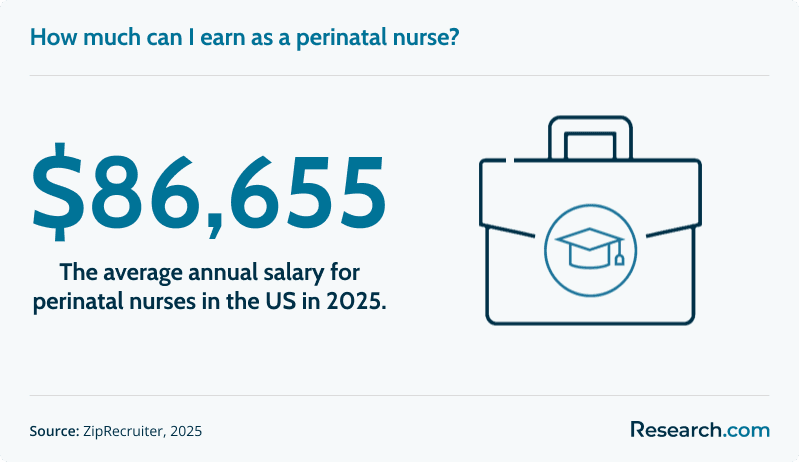
Perinatal nurse earning potential is generally strong because the role requires RN licensure, specialized maternal-child knowledge, and the ability to work in high-responsibility clinical settings. The median annual salary is $86,070, based on 2023 Bureau of Labor Statistics data cited for this role.
The perinatal nurse salary range 2025 spans from about $63,720 for entry-level nurses to as much as $132,680 for experienced professionals. That range is wide because compensation depends on more than job title. Location, employer type, shift differentials, union contracts, years of experience, specialty training, and advanced practice credentials can all affect pay.
| Salary point | Amount | What it may represent |
| Entry-level range | $63,720 | Newer nurses or nurses in lower-paying settings or regions |
| Median annual salary | $86,070 | A midpoint benchmark for the occupation based on cited 2023 data |
| Experienced range | $132,680 | Seasoned nurses, higher-paying regions, specialized units, or advanced roles |
To improve earning potential, nurses can pursue high-demand clinical experience, complete employer-valued certifications, consider BSN or graduate education when aligned with career goals, and evaluate compensation beyond base pay. Benefits, overtime rules, shift differentials, retirement contributions, tuition support, and staffing ratios can make one job more valuable than another even when the advertised salary is similar.
The job outlook for perinatal nurses is positive, with a projected 5% growth rate from 2024 to 2034. That is faster than the average growth for all occupations, which typically hovers around 3%. Demand is supported by the ongoing need for maternal, newborn, and postpartum care in hospitals, clinics, and community health settings.
The Key Factors Shaping the Future Outlook
Several forces influence demand. First, maternal and infant healthcare remains essential regardless of economic cycles. Patients still need prenatal monitoring, labor support, postpartum care, newborn assessment, and education. Second, nursing shortages driven by retirements and fewer new graduates can increase demand for qualified nurses with specialty experience.
Technology is also changing the role. Advanced monitoring, telehealth, and electronic health records require nurses who can use clinical tools accurately while still maintaining strong bedside communication. Perinatal nurses who continue learning and adapt to new documentation systems, monitoring methods, and care models will be better positioned for stable employment.
Education access also matters. Aspiring nurses who need flexible or financial-aid-eligible options may want to research an online school that accepts FAFSA, while carefully confirming accreditation, nursing board approval, in-person clinical requirements, and NCLEX-RN eligibility. In nursing, convenience should never outweigh licensure readiness.
Perinatal nurses most often work in hospital maternity units, labor and delivery rooms, postpartum units, OB/GYN departments, and neonatal intensive care units (NICUs). Because 55% of registered nurses work within general medical and surgical hospitals, hospitals remain the dominant setting for this type of role. Some perinatal nurses may also work in outpatient clinics, community health programs, childbirth education, or perinatal support services.
The work environment is hands-on, fast-moving, and team-based. Nurses coordinate with obstetricians, midwives, neonatologists, anesthesiology teams, lactation consultants, social workers, and other support staff. Communication must be precise because a delay or missed detail can affect patient safety.
Schedules often include rotating shifts, nights, weekends, holidays, and extended hours, depending on the employer. Childbirth and neonatal complications do not follow business hours, so 24-hour staffing is common. Remote or hybrid work is generally not available for direct perinatal nursing roles because assessment, monitoring, medication administration, and patient support require physical presence. Nurses who later move into education, case management, consulting, or administrative roles may find more predictable schedules, but bedside perinatal nursing is usually shift-based.
Perinatal nursing can be deeply meaningful, but it is not an easy specialty. The same events that make the work rewarding can also make it emotionally demanding. Before choosing this path, compare the benefits with the realities of shift work, clinical risk, and exposure to trauma.
Intrinsic Rewards
- Strong sense of purpose from supporting families through pregnancy, birth, postpartum recovery, and newborn care.
- Emotional fulfillment from helping patients feel informed, respected, and safe during major life events.
- Opportunities to witness healthy births, improving newborn outcomes, and family bonding.
- Professional pride in developing specialized maternal-child expertise.
- Close teamwork with clinicians who share responsibility for complex, time-sensitive care.
Intrinsic Challenges
- Emotional strain from complications, traumatic births, pregnancy loss, neonatal decline, or family distress.
- High stress during emergencies that require immediate action and coordinated care.
- Burnout risk from rotating shifts, nights, weekends, holidays, and staffing pressures.
- Competing priorities when multiple patients need attention at the same time.
- Secondary traumatic stress from repeatedly supporting families through painful outcomes.
This career is best suited to nurses who can combine compassion with composure. If you are drawn to maternal-child health but also want broader preparation for leadership, policy, public health, or administration, comparing dual-degree programs may help you think through long-term options.
Perinatal nurses can advance by deepening clinical expertise, taking on leadership responsibilities, earning advanced credentials, or moving into education and consulting. The right path depends on whether you want more direct patient care, more authority, more teaching responsibility, or more influence over systems and policy.
Paths for Promotion and Leadership
- Begin in direct patient care as a perinatal nurse, labor and delivery nurse, postpartum nurse, or maternal-newborn nurse.
- Advance to senior perinatal nurse, preceptor, charge nurse, or unit resource nurse after building strong clinical judgment and reliability.
- Pursue an MSN or DNP when required for roles such as perinatal nurse practitioner, clinical nurse specialist, educator, or advanced practice clinician.
- Move into nurse manager or director roles to oversee staffing, quality improvement, budgets, policies, and patient-care standards.
- Contribute to safety initiatives, staff training, evidence-based practice projects, or maternal-infant quality improvement programs.
Getting promoted as a perinatal nurse usually requires more than years on the job. Employers look for nurses who communicate well, stay calm during emergencies, mentor others, document accurately, follow evidence-based protocols, and help improve unit performance.
Specialization Areas to Expand Expertise
- Neonatal intensive care unit (NICU) nursing: Focuses on critically ill or premature newborns who require advanced monitoring and specialized care.
- High-risk obstetrics: Supports patients with complex pregnancies, complications, or increased monitoring needs.
- Lactation consulting: Helps parents with breastfeeding education and support, often requiring IBCLC certification.
- Perinatal education and counseling: Prepares families for childbirth, postpartum recovery, newborn care, and community-based support.
- Clinical education or quality improvement: Trains staff, updates protocols, and supports safer maternal-newborn care practices.
Advancement is strongest when nurses choose a direction intentionally. A nurse who wants leadership should seek charge roles and management training. A nurse who wants advanced practice should verify graduate program requirements and state scope-of-practice rules. A nurse who wants teaching or consulting should build expertise, communication skills, and documented outcomes.
If you are interested in pregnancy, childbirth, newborn care, or family health but are unsure whether perinatal nursing is the exact fit, several related careers may be worth comparing. Each option uses overlapping skills but differs in scope, patient population, education requirements, and day-to-day responsibilities.
- Certified Nurse-Midwife (CNM): Provides prenatal, birth, and postnatal care with a broader role in managing pregnancy and childbirth for eligible patients.
- Neonatal Intensive Care Nurse: Cares for premature or critically ill newborns who need intensive monitoring, specialized equipment, and complex interventions.
- Pediatric Nurse: Focuses on children’s health, development, illness prevention, family education, and ongoing care beyond the newborn period.
- Labor and Delivery Nurse: Works directly with patients during labor, birth, and immediate recovery, often in fast-paced hospital settings.
- Perinatal Nurse Consultant: Uses maternal-infant expertise to advise healthcare teams, organizations, or programs on best practices, safety, education, or care improvement.
When comparing these paths, ask three questions: Do you want to focus on the birthing parent, the newborn, the family system, or the healthcare team? Do you prefer bedside care, advanced practice, education, or consulting? And are you willing to complete the additional education or certification required for the role you want?
- : "Every birth I assist feels significant because I know I am helping bring new life into the world with dignity and care. I make it my mission to ensure each patient, no matter their background or situation, receives attention that respects their needs and makes their voice heard. The moments before a baby arrives are intense and full of hope, and my presence during that time can offer calm and assurance. Being a perinatal nurse means standing as an advocate when it matters most. — Aliyah"
- : "I remember the first time I saw a newborn I had cared for suddenly stop breathing. It hit me harder than I expected, especially because I had been with her for several days. Processing that loss has been tough, but colleagues who understand and listen have helped me cope. I have learned the importance of resilience and the value of speaking openly about the emotional weight this role carries. — Karen"
- : "There is no feeling like helping deliver a baby who has struggled through labor and then watching that baby thrive in the NICU afterward. My first solo delivery was unforgettable. I stayed calm, used the positioning techniques I had practiced, and when the baby finally cried, I knew I had done my job well. Seeing tiny infants grow stronger and eventually leave the hospital reminds me why this work matters. — Jessica"
Key Findings
- Perinatal nurses specialize in care during pregnancy, labor, birth, postpartum recovery, and the early newborn period.
- The role requires RN preparation, state licensure, clinical experience, and often employer-required training such as BLS, NRP, ACLS, or fetal monitoring-related competencies.
- Perinatal nursing can be emotionally rewarding, but it also involves high-pressure situations, rotating schedules, and exposure to complications or loss.
- The median annual salary is $86,070, with a cited perinatal nurse salary range 2025 from $63,720 to $132,680 depending on experience, location, employer, and credentials.
- The job outlook is strong, with projected 5% growth from 2024 to 2034, supported by ongoing demand for maternal and newborn healthcare.
- Advancement options include charge nurse, nurse manager, clinical nurse specialist, nurse practitioner, educator, lactation consultant, NICU specialization, high-risk obstetrics, and consulting.
- The best education path depends on your target role. Start with accredited RN preparation and licensure, then add specialty training or graduate education only when it supports a clear career goal.
Other Things You Should Know About Perinatal Nurse
Two widely recognized credentials are RNC-OB from the National Certification Corporation and Inpatient Obstetric Nursing certification. RNC-OB requires an active RN license and documented recent experience in maternal-newborn nursing. These certifications strengthen clinical credibility and can support advancement into higher-responsibility perinatal roles.
In 2027, the entry-level education requirement for a perinatal nurse is typically a Bachelor of Science in Nursing (BSN). After obtaining a BSN, aspiring perinatal nurses must pass the NCLEX-RN examination to become a licensed registered nurse, opening opportunities in this specialized field.
- Perinatal Nurse Leader: Clinical Competencies and Education Guide - ScienceDirect https://www.sciencedirect.com/science/article/pii/S1751485125000418
- 6 Perinatal Nurse Interview Questions | LACT https://careercenter.leadingagect.org/interview-questions/perinatal-nurse
- Top 20 Perinatal Nurse Interview Questions and Answers (Updated 2025) https://www.cvowl.com/blog/perinatal-nurse-interview-questions-answers
- 14 Alternative Careers for Nurses - Madonna ABSN https://absn.madonna.edu/blog/14-alternative-careers-for-nurses/
- 6 Perinatal Nurse Interview Questions | Sigma https://jobs.sigmanursing.org/interview-questions/perinatal-nurse
- Balancing the Benefits and Drawbacks of Postpartum Nursing https://www.hctravelnursing.com/blog/pros-and-cons-of-postpartum-nursing
- 10 Types of Nurses that Work With Babies | IntelyCare https://www.intelycare.com/career-advice/10-types-of-nurses-that-work-with-babies/
- Registered Nurses https://www.bls.gov/ooh/healthcare/registered-nurses.htm
- Career Center https://nann.org/professional-development/career-center/


