
2027 Environmental Sustainability Careers: Skills, Education, Salary & Job Outlook

Co-Founder and Chief Data Scientist
Environmental sustainability careers are for people who want to turn climate, resource, compliance, and social-impact goals into practical work inside organizations. The decision is not simply whether you care about the environment. It is whether you want a role that combines science, data, policy, operations, communication, and change management.
The field can feel difficult to enter because employers often look for both academic preparation and applied experience. A strong candidate may need environmental science knowledge, business fluency, project experience, and, in some cases, recognized credentials. At the same time, demand for sustainability expertise continues to create realistic opportunities. Growth rates for specialists are projected between 4% to 7%, with median salaries ranging from about $80,000 to over $120,000.
This guide explains what environmental sustainability specialists do, what skills and education matter, how compensation and job outlook vary, and how to decide whether this career path fits your strengths. Drawing on expertise developed over more than ten years in career advising, Research.com focuses on the practical choices that help you enter the field with clearer expectations and a stronger plan.
Key Things You Should Know About Environmental Sustainability Career
- The typical earning potential for environmental sustainability specialists ranges from approximately $80,000 to $89,000 annually, with some reports indicating averages as high as $122,600.
- Employment in this field is expected to grow between 4% and 7% over the next decade, reflecting stable and even faster-than-average job opportunities.
- A bachelor's degree in environmental science, sustainability, natural sciences, or a related field is generally required to start a career as a specialist.
- Success depends on strong skills in data analysis, project management, knowledge of environmental regulations, sustainability practices, communication, and problem-solving.
- Career progression often moves from entry-level specialist to senior roles or management, with potential to advance into director or executive positions, especially with a master's degree or professional certifications.
What do environmental sustainability specialists do?
Environmental sustainability specialists help organizations reduce environmental harm while meeting operational, regulatory, and business goals. Their work may involve tracking resource use, improving waste and recycling systems, supporting emissions-reduction plans, preparing reports, and advising teams on more sustainable practices.
The role sits between technical analysis and organizational change. A specialist may interpret environmental data one day, meet with facilities or procurement teams the next, and then help leadership understand which initiatives are realistic, measurable, and cost-conscious. The best sustainability work is not only idealistic; it is specific, documented, and tied to decisions an organization can actually implement.
A day in the life of environmental sustainability specialists
A typical day may include reviewing energy, water, waste, or purchasing data; preparing internal progress updates; researching regulations or voluntary standards; coordinating with vendors; and meeting with departments that need help reducing environmental impacts. Depending on the employer, specialists may also visit facilities, inspect operational practices, attend community meetings, or support public-facing sustainability programs.
The work pace is usually manageable but can become demanding around reporting deadlines, audits, grant submissions, public meetings, or major project launches. People who enjoy both independent analysis and cross-functional collaboration tend to fit this role well.
What are the key responsibilities of environmental sustainability specialists?
Environmental sustainability specialists turn broad environmental commitments into measurable action. Their responsibilities vary by employer, but most roles involve planning, tracking, advising, reporting, and helping people change how work gets done.
- Develop sustainability plans: Help set goals, define initiatives, assign timelines, and document how progress will be measured.
- Track resource use: Analyze energy, water, materials, waste, emissions, or purchasing data to identify avoidable environmental impact.
- Support compliance and reporting: Research regulations, voluntary frameworks, industry standards, and internal reporting requirements.
- Evaluate programs: Measure whether initiatives are working through metrics such as energy consumption, recycling rates, or waste reduction.
- Coordinate across departments: Work with facilities, operations, finance, procurement, communications, legal, and leadership teams.
- Educate employees and stakeholders: Create campaigns, presentations, training materials, and community engagement efforts.
- Build partnerships: Organize volunteer activities, vendor collaborations, nonprofit relationships, or community initiatives that support environmental goals.
The most challenging vs. the most rewarding tasks
The hardest part is often not the science; it is the change management. Sustainability initiatives may require new purchasing habits, operational adjustments, reporting discipline, or upfront costs. Specialists must be able to explain trade-offs, answer skeptical questions, and show how environmental goals can align with budget, risk, compliance, reputation, and long-term resilience.
The most rewarding part is seeing measurable progress. A successful project might reduce energy use, improve recycling participation, prevent waste, strengthen community trust, or help an organization meet a reporting requirement with better data. For professionals who want practical credentials to support this work, exploring certificate careers that pay well can help identify training options with career value.
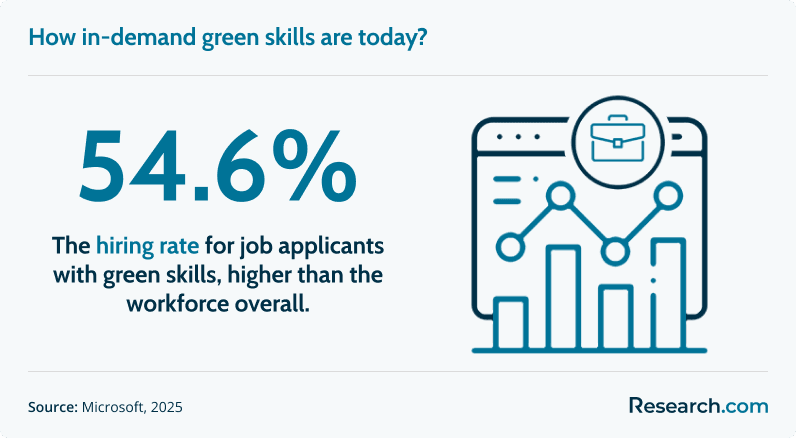
What are the key skills for environmental sustainability specialists?
Environmental sustainability specialists need a blend of technical, analytical, and interpersonal skills. Employers usually look for candidates who can understand environmental issues, work with data, manage projects, and communicate recommendations to people who may not have a science background.
- Data analysis: Used to evaluate environmental impact, track sustainability metrics, identify trends, and support evidence-based decisions.
- Environmental science knowledge: Helps specialists understand ecological systems, pollution, resource use, climate impacts, and environmental risk.
- Geographic Information Systems (GIS): Useful for mapping and visualizing environmental data, site conditions, land use, infrastructure, or risk patterns.
- Project management: Essential for moving sustainability initiatives from planning to implementation, especially when multiple departments are involved.
- Communication: Needed to translate technical findings into clear recommendations for executives, employees, vendors, regulators, or community members.
- Regulatory awareness: Helps organizations understand obligations, documentation needs, and potential compliance risks.
- Business judgment: Allows specialists to connect sustainability goals with cost, feasibility, operations, and stakeholder priorities.
The one overlooked skill that separates the good from the great
Systems thinking is one of the most valuable skills in this career. Sustainability problems rarely sit in one department. A change in packaging may affect procurement, shipping costs, customer perception, waste streams, supplier relationships, and emissions. A systems thinker can see those connections before recommending a solution.
For example, a specialist evaluating a company’s supply chain must consider not only carbon impact but also local ecosystems, labor practices, community effects, transportation, cost, reliability, and reporting requirements. This broader view helps prevent short-term fixes that create new problems elsewhere.
Professionals who combine core environmental sustainability skills with systems thinking are better prepared for complex roles in sectors such as Scientific Research and Development Services. If you are comparing graduate-level pathways, reviewing easy master degrees may help you think through efficient ways to build additional credentials while balancing time and cost.
Environmental Sustainability Careers: A Step-by-Step Guide to Getting Started
Starting a career in environmental sustainability is easier when you treat it as a sequence of decisions: what knowledge to build, where to get experience, which credentials matter, and what type of sustainability work fits your strengths.
- Build foundational knowledge. Start with coursework or training in environmental science, sustainability, environmental studies, policy, engineering, biology, geology, business, data analysis, or related fields. The goal is to understand both environmental systems and how organizations make decisions.
- Gain practical experience early. Look for internships, volunteer projects, campus sustainability work, nonprofit roles, local government projects, research assistantships, or entry-level environmental support positions. Employers value candidates who can show they have worked with real data, projects, people, or sites.
- Create a focused portfolio. Save examples of reports, dashboards, project summaries, outreach campaigns, GIS maps, waste audits, energy analyses, or sustainability plans when you are allowed to share them. A portfolio can make your experience easier for hiring managers to understand.
- Build a professional network. Connect with sustainability professionals, faculty, alumni, local environmental groups, industry associations, and mentors. Many sustainability jobs are interdisciplinary, so conversations can reveal roles you may not find through a basic job-title search.
- Choose credentials strategically. Do not collect certifications at random. Select credentials that match your target role, such as green building, sustainability reporting, environmental compliance, energy management, or project management.
- Specialize as your interests become clearer. After gaining exposure, decide whether you want to focus on corporate sustainability, consulting, government, renewable energy, green building, compliance, supply chains, ESG reporting, or community programs.
- Move toward leadership or technical depth. Advancement may come through managing larger programs, supervising teams, leading reporting strategy, consulting independently, or becoming a subject-matter expert in a high-demand niche.
The most common mistake is waiting until you feel fully qualified before applying. Entry-level sustainability roles often expect candidates to keep learning on the job. A stronger approach is to build a credible base, document hands-on experience, and apply to roles where your skills match the employer’s most important needs.
What education, training, or certifications are required?
Most environmental sustainability specialist roles require at least a bachelor’s degree in a relevant field. Common majors include Environmental Science, Environmental Studies, Sustainability, and Environmental Engineering. Depending on the employer, degrees in Biology, Geology, Agribusiness, or Environmental Architecture may also be relevant.
Education requirements vary by sector. A corporate sustainability role may value business, reporting, and operations knowledge. A consulting or compliance role may emphasize technical environmental science and regulatory familiarity. A green building role may require knowledge of building systems, materials, energy performance, and certification processes.
Recognized certifications can strengthen your profile, especially when they align with the job. Essential certifications include the LEED Green Associate from the U.S. Green Building Council and the Certified Sustainability Professional from the International Society of Sustainability Professionals. These credentials can help demonstrate specialized knowledge, but they work best when paired with experience.
Practical training is also important. Many academic programs encourage or require internships in government, nonprofit, or industry settings. Entry-level positions such as research assistant, environmental technician, sustainability coordinator, or program assistant can provide the applied experience employers want to see.
Are advanced degrees or niche certifications worth the investment?
Advanced credentials can be worthwhile when they clearly support your target role. A master’s degree in Environmental Science or Sustainability may help candidates pursue senior, consulting, research, policy, or specialized technical positions. Specialized certificates may be useful for professionals who want to pivot into a focused area without committing to a full graduate degree.
The trade-off is cost and time. Advanced study can require 1 to 3 years of study and tens of thousands of dollars in tuition. Before enrolling, compare the credential against job postings for the roles you want. If most employers ask for experience rather than another degree, an internship, project role, or employer-sponsored credential may be the better next step.
Some professionals interested in research or high-level consulting may also explore doctoral options. If that path fits your goals, reviewing a doctorate degree without dissertation can help you understand alternative formats and requirements.
What is the earning potential for environmental sustainability specialists?
Environmental sustainability specialist salaries vary widely because the field spans government, consulting, engineering, energy, finance, corporate operations, nonprofit work, and research. Median earnings stand at $83,120 annually as of January 2025. Entry-level positions typically start around $61,647, while senior roles can reach $105,415.
Compensation depends on several factors. Experience matters, but so does the type of employer. Roles connected to energy, finance, consulting, technical reporting, risk management, or large-scale corporate operations may offer stronger pay than small nonprofit or local program roles. Location also affects salary; professionals in higher-cost areas like California often command premium salaries due to market demand and cost of living.
Specialization can improve earning potential over time. Skills in ESG reporting, environmental compliance, renewable energy, green building, supply chain sustainability, carbon accounting, data analytics, and project leadership may make a candidate more competitive for higher-responsibility roles. However, salary should be evaluated alongside workload, mission fit, advancement potential, benefits, and the level of technical responsibility required.
What is the job outlook for environmental sustainability specialists?
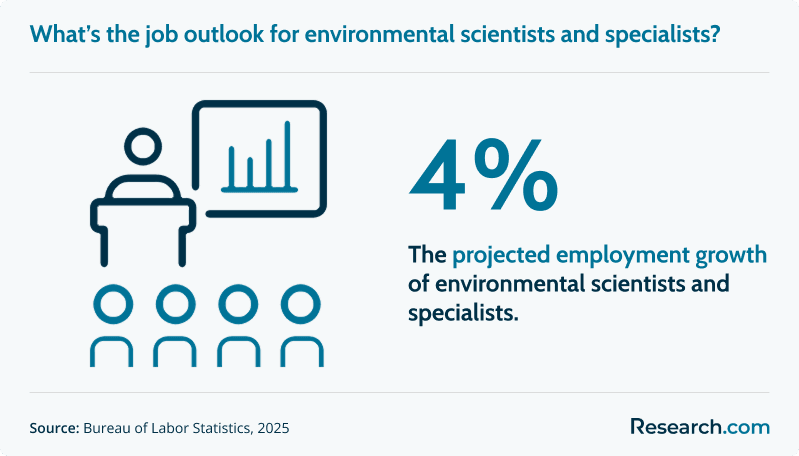
Employment of environmental scientists and specialists, including environmental sustainability specialists, is projected to grow 4% from 2024 to 2034. This is about as fast as the average for all occupations. The outlook is stable because organizations continue to face environmental regulations, reporting expectations, resource constraints, and public pressure to reduce environmental impact.
The key factors shaping the future outlook
Regulation remains a major driver. Environmental rules, permitting requirements, compliance documentation, and corporate sustainability reporting needs create ongoing demand for professionals who can interpret requirements and help organizations respond responsibly.
Corporate environmental, social, and governance commitments are another important factor. Many organizations now need people who can collect reliable data, coordinate sustainability programs, communicate progress, and identify realistic improvements. This does not mean every sustainability role is secure or high-paying, but it does mean the skill set is becoming more relevant across industries.
Technology is also changing the field. Renewable energy, green building, environmental monitoring, and data tools are reshaping how sustainability work is planned and measured. Candidates who combine environmental knowledge with data literacy, communication, and business awareness will be better positioned for new opportunities.
For students comparing education options, choosing among top colleges can help build a stronger academic foundation and improve access to internships, faculty networks, and career services.
What is the typical work environment for environmental sustainability specialists?
The environmental sustainability job work environment usually combines office-based analysis with meetings, site visits, and occasional fieldwork. Most professionals are employed in state and local government, excluding education and hospitals (22%), management, scientific, and technical consulting services (15%), and engineering services (10%).
In an office or hybrid setting, specialists may analyze data, prepare reports, coordinate projects, meet with internal teams, and communicate with vendors or external partners. Fieldwork may include facility walk-throughs, waste audits, inspections, construction or infrastructure site visits, community events, or environmental assessments.
The schedule often follows standard business hours Monday through Friday. However, evening or weekend work may be needed for public meetings, community programs, deadlines, travel, or major project milestones. Remote or hybrid work is possible for tasks such as reporting, research, and data analysis, but roles involving inspections, facilities, construction, or community engagement still require in-person work.
This environment is a good fit for people who want variety. It may be less ideal for someone who wants a fully remote role with predictable tasks and little stakeholder interaction.
What are the pros and cons of environmental sustainability specialists careers?
A career as an environmental sustainability specialist can be meaningful, intellectually engaging, and practical. It can also be slow-moving, politically complex, and constrained by budgets or regulations. Understanding both sides helps you decide whether the work fits your temperament.
Pros
- Mission-driven work: You can contribute directly to environmental protection, resource efficiency, and long-term sustainability goals.
- Visible results: Projects may lead to lower energy use, improved recycling, better purchasing practices, stronger compliance, or reduced waste.
- Cross-functional experience: The role builds skills across science, business, communication, operations, and policy.
- Multiple career paths: Sustainability experience can lead to roles in consulting, government, corporate operations, green building, energy, reporting, or compliance.
- Values alignment: Many professionals find the work personally fulfilling because it connects their career with environmental responsibility.
Cons
- Resistance to change: Employees, managers, vendors, or community members may oppose new processes, especially when costs or habits are involved.
- Complex reporting demands: Sustainability work often requires careful documentation, data quality checks, and regulatory awareness.
- Competing priorities: Environmental goals may have to compete with budget limits, operational needs, timelines, and leadership changes.
- Incremental progress: Meaningful change can take months or years, and not every proposal will be approved.
- Emotional pressure: Working on environmental problems can be motivating but also frustrating when progress feels too slow.
If the advantages outweigh the challenges, targeted training may help you move closer to the field. Reviewing certificate programs that pay well can be a practical way to compare credential options before committing to a longer degree path.
What are the opportunities for advancement for environmental sustainability specialists?
Environmental sustainability specialists can advance by managing larger programs, moving into leadership, or developing expertise in a specialized area. The best path depends on whether you prefer people management, technical depth, strategy, consulting, or policy work.
Advancement path
- Entry-level: Sustainability Coordinator or Environmental Analyst roles focus on data collection, project support, reporting assistance, outreach, and basic analysis.
- Mid-level: Environmental Sustainability Specialist or Sustainability Manager roles involve leading programs, coordinating departments, developing policies, and measuring outcomes.
- Senior/leadership: Director of Sustainability or Chief Sustainability Officer (CSO) roles focus on enterprise-wide strategy, executive communication, risk management, reporting, and long-term planning.
Promotion is usually tied to results: stronger reporting systems, successful project implementation, measurable resource savings, regulatory competence, stakeholder trust, and the ability to influence decisions across an organization.
Specialization areas
- Sustainable supply chain management: Focuses on sourcing, logistics, supplier standards, materials, and lifecycle impacts.
- Corporate Social Responsibility (CSR) & Reporting: Involves stakeholder communication, disclosure, certifications, and social-impact initiatives.
- Renewable Energy & Energy Efficiency: Supports solar, wind, conservation, audits, retrofits, and energy-reduction planning.
- Green Building & Sustainable Construction: Centers on LEED certification, building performance, sustainable materials, and design practices.
- Environmental Policy & Compliance: Focuses on regulations, permits, inspections, documentation, and policy development.
To advance, document outcomes whenever possible. Employers are more likely to promote professionals who can show what changed because of their work, not just what tasks they handled.
What other careers should you consider?
If environmental sustainability specialist roles interest you, several related careers may also fit your goals. The right choice depends on whether you prefer science, compliance, strategy, communications, policy, consulting, or operations.
- Environmental Scientist and Specialist: Focuses on collecting and analyzing environmental data, studying environmental problems, and supporting protection of natural resources.
- Sustainability Manager: Leads sustainability programs across an organization, sets priorities, coordinates departments, and oversees implementation.
- Environmental Compliance Officer: Monitors adherence to environmental laws through inspections, reporting, documentation, and corrective action planning.
- Corporate Social Responsibility (CSR) Coordinator: Supports initiatives that connect environmental and social responsibility with company strategy, communications, and stakeholder engagement.
- Environmental Consultant: Advises organizations on environmental risks, compliance needs, sustainability practices, and impact-reduction strategies.
Use these alternatives to clarify your direction. If you enjoy field data and scientific analysis, environmental science may be a better fit. If you prefer reporting and stakeholder communication, CSR may be stronger. If you like regulations and documentation, compliance may suit you. If you want variety and client work, consulting may be worth exploring.
Here's What Professionals Say About Their Environmental Sustainability Careers
Professional experiences in sustainability vary, but several themes appear often: the work can be competitive to enter, collaboration matters, and the most satisfying moments come when projects create visible change.
- Daylight: "When I first declared my passion for environmental sustainability, I found myself reaching out to everyone around me to share my vision. It was refreshing to discover a network of colleagues equally invested in making a real impact. Soon enough, I was entrusted with overseeing sustainability initiatives across multiple regions, including Hong Kong and Taiwan, which was both challenging and deeply rewarding. Being able to see tangible changes from my efforts keeps me motivated every day."
- Matt: "Applying to dozens of sustainability roles felt exhausting, especially when half didn't respond and many rejected me outright. I kept detailed records of every application, determined to improve my approach. I started out supporting event sustainability part-time, which taught me invaluable lessons in coordination and impact measurement. By the following year, I secured a full-time position and eventually earned a promotion to lead projects that genuinely align with my values."
- Gracely: "Working on sustainability within nationally significant infrastructure projects has given me a profound sense of purpose. Each day, I see how adjustments in planning and resource use reduce environmental harm on a large scale. Knowing that my contributions help shape greener development fills me with pride and determination to push further. It's fulfilling to witness the difference that informed, sustainable choices can make beyond just paper reports."
Key Findings
- Environmental sustainability specialists help organizations reduce environmental impact through planning, data analysis, compliance support, reporting, and stakeholder coordination.
- The career requires both technical and interpersonal strengths, especially environmental science knowledge, data analysis, project management, communication, and systems thinking.
- A bachelor’s degree in a relevant field is commonly expected, while certifications such as LEED Green Associate and Certified Sustainability Professional can strengthen a candidate’s profile.
- Median earnings stand at $83,120 annually as of January 2025, with entry-level positions typically starting around $61,647 and senior roles reaching $105,415.
- Employment of environmental scientists and specialists, including environmental sustainability specialists, is projected to grow 4% from 2024 to 2034.
- The work environment often blends office analysis, meetings, hybrid tasks, and site-based work, depending on the employer and project type.
- This career is best suited for people who want mission-driven work and can handle slow progress, complex reporting, competing priorities, and organizational resistance to change.
Other Things You Should Know About Environmental Sustainability
Professional certifications can improve hiring prospects, especially in ESG reporting, environmental management, and green building. Common examples include LEED Green Associate from the U.S. Green Building Council, ISSP sustainability credentials, and ISO 14001 lead auditor training. Employers often value these when paired with degree-level coursework and internship experience.
Technological advances, such as AI and automation, are expanding opportunities in environmental sustainability. They enhance data analysis, improve resource management, and streamline processes, thereby increasing the demand for specialists with both tech and sustainability expertise, making the job outlook promising in 2027.
References
- How stakeholder alignment on sustainability unlocks a competitive advantage https://www.weforum.org/stories/2022/02/how-to-strengthen-sustainability-by-engaging-with-stakeholders/
- 7 Steps to Start Your Career in Sustainability https://publicaffairs.northeastern.edu/articles/start-your-sustainability-career/
- ISEP Jobs | Sustainability & Environmental Jobs https://www.isepjobs.org/
- Navigating the challenges of starting a sustainability career - Green Careers Hub https://www.greencareershub.com/insights/blogs-and-articles/navigating-the-challenges-of-starting-a-sustainability-career/
- Sustainability: implications for career development - International Journal for Educational and Vocational Guidance https://link.springer.com/article/10.1007/s10775-024-09693-4
- How to get a job in sustainability https://www.prospects.ac.uk/jobs-and-work-experience/job-sectors/environment-and-agriculture/how-to-get-a-job-in-sustainability
- The Green Skills Revolution: 15 High-Demand Sustainability Jobs for 2025 (That Pay Well) - The Interview Guys https://blog.theinterviewguys.com/the-green-skills-revolution/
- Is a corporate sustainability career right for you? 6 questions to ask https://trellis.net/article/is-a-corporate-sustainability-career-right-for-you-ask-yourself-these-6-questions/
- 10 green jobs with strong growth potential | U.S. Green Building Council https://www.usgbc.org/articles/10-green-jobs-strong-growth-potential
- Careers in the environment, sustainability, and climate change | Undergraduate Programs | University of Waterloo https://uwaterloo.ca/future-students/missing-manual/careers/careers-environment-sustainability-and-climate-change


