
2027 Chief Learning Officer Careers: Skills, Education, Salary & Job Outlook

Co-Founder and Chief Data Scientist
Becoming a Chief Learning Officer is not an entry-level career goal. It is a senior leadership path for professionals who want to connect employee learning, talent strategy, technology adoption, and business performance. The central question is not simply whether you like training people; it is whether you can lead learning as an enterprise function with measurable impact.
The role can be demanding. Employers often look for advanced knowledge of education, organizational development, psychology, human resources, analytics, and change management, along with years of progressive experience in training or talent development. The payoff can also be substantial: reported compensation includes median salaries between $160,000 and $168,000, with demand supported by continued corporate investment in workforce learning.
This guide explains what Chief Learning Officers do, the skills and education typically expected, salary and job outlook, work environment, advancement paths, and related careers. Use it to decide whether this leadership track fits your strengths, timeline, and professional goals.
Key Things You Should Know About Chief Learning Officer Career
- The typical national annual compensation for a chief learning officer ranges from $160,062 to over $168,000, reflecting strong earning potential in this leadership role.
- Demand for chief learning officers is expected to grow as organizations prioritize workplace learning and development, making it a stable and expanding field.
- A bachelor's degree is generally required to enter this career, but many successful chief learning officers hold a master's degree or higher for advanced opportunities.
- Success hinges on skills like strategic planning, leadership, communication, project management, and aligning learning initiatives with organizational goals.
- Career advancement often follows a path from learning and development manager to director of learning, leading ultimately to chief learning officer based on experience and leadership ability.
What do Chief Learning Officers do?
A Chief Learning Officer, or CLO, leads an organization’s learning strategy. The role sits at the intersection of business leadership, employee development, technology, and organizational change. Instead of managing isolated training sessions, CLOs decide how learning should support company priorities such as productivity, innovation, compliance, leadership development, retention, and workforce transformation.
In practice, this means a CLO identifies capability gaps, builds learning systems, guides training investments, selects or oversees learning technologies, and works with executives to make employee development part of the organization’s long-term strategy. Strong CLOs are not measured only by course completion rates. They are expected to show how learning improves performance, supports business goals, and prepares the workforce for future demands.
A day in the life of Chief Learning Officers
A typical day is highly collaborative. A CLO may meet with senior executives about workforce priorities, review data from a learning platform, evaluate the return on a leadership development program, approve vendor decisions, and coach learning and development leaders on program design. The work is usually less about personally delivering training and more about setting direction, removing barriers, and ensuring learning investments produce useful outcomes.
The role also requires constant translation. CLOs must explain learning needs in business language to executives, explain business priorities to learning teams, and help managers see development as part of everyday work rather than a separate HR activity.
What are the key responsibilities of Chief Learning Officers?
Chief Learning Officers are responsible for making learning a strategic capability, not just an employee benefit. Their work spans planning, leadership, technology, budgeting, evaluation, and change management.
- Develop and implement learning strategies that align with organizational goals, workforce plans, and business priorities.
- Identify skill gaps across roles, teams, and leadership levels, then design learning solutions that address those gaps.
- Oversee professional development activities such as onboarding, workshops, e-learning, conferences, leadership programs, coaching, and technical training.
- Select, integrate, and manage learning technologies, including learning management systems, digital content platforms, analytics tools, and AI-supported learning solutions.
- Partner with C-suite executives, HR leaders, department heads, and business unit leaders to connect talent development with strategic priorities.
- Build, lead, and evaluate learning and development teams, including instructional designers, program managers, facilitators, analysts, and vendor partners.
- Manage budgets, prioritize investments, and evaluate whether programs produce measurable improvements.
- Use data, feedback, and business outcomes to refine learning programs and discontinue efforts that are not working.
The most challenging vs. the most rewarding tasks
The hardest part of the role is often alignment. Business priorities shift, budgets tighten, technologies change, and different leaders may have competing expectations. A CLO must decide which learning initiatives matter most and defend those choices with evidence.
The most rewarding part is seeing development change people’s careers and organizational performance. Effective learning programs can help employees build confidence, move into new roles, improve leadership behavior, and adapt to changing business needs. For professionals still building an educational foundation, options such as the best associate degrees in 6 months online may be one way to begin developing relevant academic credentials.
What are the key skills for Chief Learning Officers?
Chief Learning Officers need more than training expertise. The strongest candidates combine learning science, business judgment, technology fluency, leadership ability, and analytical discipline. The role rewards professionals who can design effective learning and also explain why it matters to the organization.
Hard skills
- Learning technology proficiency: CLOs must understand learning management systems, digital learning platforms, AI tools, content systems, and virtual delivery methods well enough to choose and govern them effectively.
- People analytics: They need to interpret learning data, employee performance trends, engagement signals, and business metrics to evaluate impact.
- Instructional design and adult learning principles: CLOs should understand how adults learn, what makes training transfer to the job, and how to avoid programs that look polished but do not change behavior.
- Change management: Learning initiatives often require new habits, new systems, and new expectations. CLOs must help leaders and employees adopt those changes.
- Budgeting and vendor management: Senior learning leaders must evaluate costs, negotiate with providers, manage contracts, and prioritize limited resources.
- Program evaluation: CLOs need methods for measuring participation, satisfaction, skill gains, behavior change, business results, and return on investment when appropriate.
Soft skills
- Strategic thinking: CLOs must connect learning investments to organizational goals instead of reacting to every training request.
- Executive communication: They need to present recommendations clearly to senior leaders and translate learning outcomes into business terms.
- Leadership: The role requires building capable teams, setting standards, and creating a culture of accountability.
- Collaboration: CLOs work across HR, operations, finance, technology, compliance, and business units, so influence matters as much as authority.
- Analytical thinking: They must separate useful evidence from vanity metrics and make decisions based on results.
- Adaptability: The learning function must keep pace with changing technology, workforce expectations, and competitive pressure.
The overlooked skill that separates good CLOs from great CLOs
Business acumen is often the difference between a learning leader and an enterprise leader. A CLO who understands revenue models, operating constraints, customer expectations, risk, productivity, and workforce planning can design learning programs that solve real business problems.
For example, a CLO with strong business acumen can explain why a new training program deserves funding, which employee groups should be prioritized, and how success will be measured. This helps prevent spending on attractive but low-impact initiatives. It also positions CLOs for high-paying sectors such as Professional, Scientific, and Technical Services, where measurable business impact is especially important.
Professionals who want to strengthen targeted skills may also consider easy certifications to get online that pay well, especially when a focused credential fills a specific gap in analytics, technology, leadership, or talent development.
Chief Learning Officer Careers: A Step-by-Step Guide to Getting Started
The path to becoming a Chief Learning Officer usually takes years because the role requires both technical learning expertise and senior leadership credibility. A practical route is to build from education, to hands-on learning roles, to broader talent leadership, and finally to executive responsibility.
- Complete a relevant bachelor’s degree. Common fields include business administration, human resource management, education, psychology, organizational development, instructional design, or information technology.
- Gain early experience in HR, training, education, or employee development. Entry-level roles such as HR coordinator, training assistant, classroom instructor, learning coordinator, or instructional design assistant can help you understand how people learn and how organizations support development.
- Build technical expertise in learning design and delivery. Learn how to conduct needs assessments, design curriculum, facilitate training, manage learning platforms, and evaluate outcomes.
- Pursue advanced education or professional development. Graduate degrees, executive education, and professional certifications can strengthen your profile, especially for roles that require strategic planning, analytics, technology, and leadership.
- Move into management roles. Positions such as learning and development manager, talent development manager, or training manager help you gain experience leading teams, managing budgets, and overseeing programs.
- Develop enterprise-level leadership experience. Senior roles such as director of learning, head of learning and development, or vice president of talent development prepare you to align learning with workforce planning and business strategy.
- Demonstrate measurable impact. CLO candidates are stronger when they can show evidence that their programs improved performance, leadership readiness, retention, compliance, productivity, or another business priority.
Each stage should build a broader portfolio of results. The goal is not just to collect credentials or job titles; it is to prove that you can lead learning at scale and influence senior decision-making.
What education, training, or certifications are required?
Chief Learning Officers typically hold a bachelor’s degree in a field such as Business Administration, Human Resource Management, Education, or Information Technology. Many employers also value graduate study in education technology, human resources, organizational leadership, business administration, instructional design, or organizational development.
Certification is not always mandatory, but it can help demonstrate specialized competence. One widely recognized option is the Certified Professional in Talent Development (CPTD) offered by the Association for Talent Development. Professional development from organizations such as the International Society for Performance Improvement can also support skills in performance improvement, instructional strategy, and organizational effectiveness.
Experience is especially important. Most CLOs accumulate at least a decade of progressive experience, often in executive or senior managerial roles. This commonly includes at least 18 months leading professional staff and a minimum of six years working in learning-focused positions involving instructional design and program management.
Are advanced degrees or niche certifications worth the investment?
Advanced degrees can be worthwhile when they help you qualify for senior roles, deepen your strategic thinking, or build credibility with executive teams. Master’s programs in education technology, human resources, organizational leadership, or business administration can be useful because they often cover leadership, analytics, digital transformation, and organizational strategy.
Certifications and executive certificates may be better choices when you need targeted skill development without the time and cost of a full degree. They can be especially useful for areas such as learning analytics, leadership development, instructional design, coaching, change management, or learning technology.
The best choice depends on your current experience and target role. If you lack senior management exposure, a degree alone will not substitute for leading teams and delivering results. If you already have substantial leadership experience, a focused credential may fill a more immediate gap. To compare potential economic value, review masters degrees with the highest ROI before committing to a program.
What is the earning potential for Chief Learning Officers?
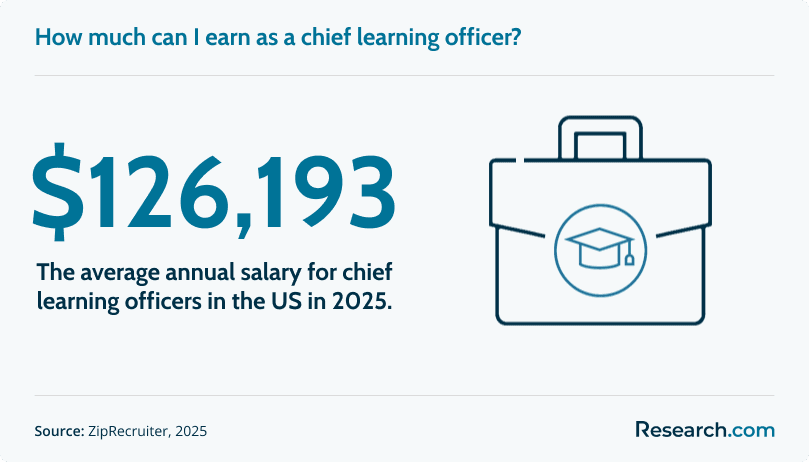
Chief Learning Officer compensation can be high because the role operates at an executive or senior leadership level. The average annual salary for this role stands at $160,062 in 2025. Reported pay ranges from starting pay around $99,000 to top earners making up to $223,000.
Where a CLO falls within that range depends on several factors. Larger employers often have bigger learning budgets, more complex workforce needs, and higher compensation structures. Industry also matters, especially when learning directly supports revenue growth, technical capability, compliance, or large-scale transformation. Location, education level, executive experience, and advanced credentials can also affect compensation.
To maximize earning potential, focus on outcomes that executives value: measurable performance improvement, leadership pipeline strength, workforce reskilling, technology adoption, retention support, and clear return on major learning investments. CLOs who can show that learning improves business results are usually better positioned for senior compensation.
What is the job outlook for Chief Learning Officers?
The projected growth rate for chief learning officer roles is 6% from 2018 to 2028, which is about average compared to all occupations. While this does not suggest explosive growth, it does indicate stable demand for senior learning leaders who can help organizations adapt to changing skills needs.
The key factors shaping the future outlook
Technology is one of the strongest forces shaping the role. AI, automation, digital platforms, and data analytics are changing both what employees need to learn and how training is delivered. Organizations need leaders who can decide which tools are useful, protect learning quality, and connect technology adoption to workforce capability.
Skills shortages also support demand. When hiring alone cannot solve talent gaps, employers must reskill, upskill, and retain the people they already have. CLOs are central to that work because they design the systems that help employees grow into new responsibilities.
Another major factor is the shift toward continuous learning cultures. More organizations expect employees to learn regularly as part of the job, not only during formal training events. CLOs who can build that culture, measure its impact, and keep it aligned with strategy will remain valuable. For professionals seeking an accessible education pathway, the cheapest online universities may help reduce the cost of building relevant credentials.
What is the typical work environment for Chief Learning Officers?
Chief Learning Officers usually work in corporate, government, nonprofit, or large institutional settings where employee development is complex enough to require senior leadership. Their work environment is collaborative and meeting-heavy, with frequent interaction across executive leadership, HR, operations, technology, finance, compliance, and external vendors.
Most chief learning officers perform their duties in corporate offices, usually within technology companies, Fortune 500 firms, or government agencies—industries that collectively employ about 40% of CLOs. The schedule is typically based on standard business hours, Monday through Friday, but senior leaders may work additional hours during major program launches, executive planning cycles, acquisitions, reorganizations, or technology implementations.
Remote and hybrid work are also common in learning leadership because many CLO responsibilities can be handled through digital collaboration tools, learning platforms, dashboards, and virtual meetings. However, the role still requires visibility with senior leaders and strong relationships across the organization.
What are the pros and cons of Chief Learning Officers careers?
A Chief Learning Officer career can be meaningful, influential, and financially rewarding, but it is not a low-pressure role. It suits professionals who enjoy strategy, leadership, organizational change, and measurable impact. It may be less appealing to those who prefer direct instruction over executive decision-making or who dislike navigating politics and ambiguity.
Pros
- Strategic influence: CLOs help shape workforce capability, leadership development, and organizational culture.
- Meaningful employee impact: Effective programs can support promotions, career mobility, engagement, and retention.
- High earning potential: Compensation can be strong because the role is tied to senior leadership responsibilities.
- Intellectual variety: CLOs work with learning science, technology, analytics, leadership, business strategy, and change management.
- Organizational visibility: The role often involves direct work with executives and major business initiatives.
Cons
- Pressure to prove value: CLOs must show that learning investments produce measurable results, not just participation.
- Competing priorities: Different executives may want different programs, and budgets may not support every request.
- Resistance to change: Employees and managers may resist new learning systems, performance expectations, or development models.
- Technology complexity: Selecting, integrating, and scaling learning tools can be difficult across large or diverse organizations.
- High expectations: CLOs are often expected to support transformation while managing limited resources and uncertain conditions.
If you are still exploring the educational foundation for a learning or workforce development career, trade colleges online may offer practical pathways for building career-ready skills before moving into broader leadership development.
What are the opportunities for advancement for Chief Learning Officers?
Chief Learning Officer is already a senior role, but it can lead to broader executive positions or deeper specialization. Advancement depends on whether you want to expand your authority across people strategy, move into general business leadership, or become known for a high-demand learning specialty.
Clear advancement path
- Entry-level roles: HR coordinator, training coordinator, learning and development coordinator, or instructional support roles build experience with employee development operations.
- Mid-level roles: Learning and development specialist, instructional designer, talent development specialist, or L&D manager roles develop program design and management skills.
- Senior roles: Director of learning, head of L&D, director of talent development, or organizational development leader roles build strategic and team leadership experience.
- Executive role: The Chief Learning Officer defines enterprise learning strategy and aligns it with business goals.
- Further progression: Some CLOs move into broader C-suite roles such as chief HR officer or chief people officer.
Key specialization areas
- Digital learning and learning technologies: Focuses on platforms, AI-supported learning, analytics, and scalable digital delivery.
- Workforce development and talent strategy: Connects learning to workforce planning, succession, reskilling, and retention.
- Diversity, equity, and inclusion programs: Builds inclusive learning environments and supports development access across employee groups.
- Leadership development and executive coaching: Prepares managers and senior leaders for larger responsibilities.
- Learning measurement and analytics: Evaluates impact and helps demonstrate return on learning investments.
- Organizational change and culture transformation: Uses learning to support adaptability, new behaviors, and strategic change.
The strongest advancement strategy is to build a record of measurable impact. CLOs who can show how learning improves leadership readiness, workforce capability, retention, compliance, or performance are better positioned for executive mobility.
What other careers should you consider?
If the Chief Learning Officer path interests you, several adjacent careers may also fit. Some offer a more direct focus on training delivery or program management, while others move closer to enterprise HR, organizational strategy, or culture change.
- Director of Learning and Development: Oversees learning programs and teams, often serving as a key step before a CLO role.
- Chief Human Resources Officer: Leads the broader HR function, including talent management, employee relations, workforce planning, compensation, and organizational development.
- Organizational Development Director: Designs initiatives that improve culture, structure, engagement, change readiness, and organizational effectiveness.
- Corporate Training Manager: Plans, delivers, and evaluates employee training programs tied to operational or business needs.
- Talent Development Manager: Identifies skill gaps, supports employee growth, manages development programs, and helps strengthen the internal talent pipeline.
Choose among these paths based on the kind of work you want to do most. If you want enterprise-wide strategy and executive influence, the CLO or CHRO path may fit. If you prefer program design and delivery, learning and development leadership may be a better match. If culture, systems, and change are your strongest interests, organizational development may be the most aligned option.
Here's What Professionals Say About Their Chief Learning Officer Careers
- : "As a Chief Learning Officer, I find immense fulfillment in designing programs that truly transform how employees engage with their work and each other. Knowing that my efforts help foster a culture where continuous learning is not just encouraged but embedded in daily routines keeps me motivated. I take pride in witnessing individuals grow their capabilities and teams innovate because they feel supported to explore new ideas. It's rewarding to see our company evolve in agility and resilience through these learning strategies. — Remuel"
- : "One of the toughest parts of my role as CLO is aligning learning initiatives with shifting business priorities, especially when budget constraints and rapid digital advances create tension. Resistance from some stakeholders often slows progress, but I've learned that investing in cross-departmental collaboration and proving impact through data-driven pilots makes a real difference. Building those relationships carefully helps turn skepticism into support, allowing valuable programs to gain traction. Patience and persistence have become key tools in managing these obstacles. — Vincent"
- : "Hearing an employee share how a training program I developed enabled their promotion brings me a deep sense of accomplishment. After pouring months into launching a new learning platform, watching participation spike and receiving positive feedback from staff made all the long nights worthwhile. Those moments of personal and professional growth among employees remind me that the work I do has tangible, meaningful effects. It's powerful to see learning open doors that once felt out of reach. — Raul"
Key Findings
- Chief Learning Officers lead enterprise learning strategy and connect employee development to business goals.
- The role typically requires a bachelor’s degree, substantial learning and development experience, and often advanced education or professional certification.
- Most CLOs build at least a decade of progressive experience, including leadership of professional staff and learning-focused responsibilities.
- The average annual salary for this role stands at $160,062 in 2025, with reported pay ranging from around $99,000 to up to $223,000.
- The projected growth rate for chief learning officer roles is 6% from 2018 to 2028, about average compared to all occupations.
- Strong candidates combine instructional design knowledge, learning technology skills, analytics, change management, executive communication, and business acumen.
- The career is best suited for professionals who want strategic influence, measurable organizational impact, and senior leadership responsibility.
Other Things You Should Know About Chief Learning Officer
In 2027, the job market for Chief Learning Officers (CLOs) remains robust, reflecting the growing prioritization of employee development. Industries such as tech and finance see a particularly high demand for CLOs. Companies are seeking CLOs to spearhead adaptive learning strategies to build competitive, future-ready workforces.
Chief Learning Officers are often expected to oversee learning management systems, talent analytics platforms, and AI-supported training tools in 2027. Many employers also want experience with virtual classroom software, HRIS integrations, and data dashboards used to track completion rates, skills gaps, and program effectiveness.
References
- Soft skills are more valuable than hard skills https://www.chieflearningofficer.com/2024/02/15/soft-skills-are-more-valuable-than-hard-skills/
- Chief Learning Officer Salary: Attracting Top Talent to Your Organization https://www.coursera.org/enterprise/articles/chief-learning-officer-salary
- What are the biggest priorities for Chief Learning and Talent officers? https://iventiv.com/insights/what-are-the-biggest-priorities-for-chief-learning-and-talent-officers
- Top 10 Chief Learning Officer (CLO) Interview Questions https://www.interviews.chat/questions/chief-learning-officer-clo
- What Is A Chief Learning Officer? CLO Role Explained https://www.forbes.com/sites/melissadaimler/article/chief-learning-officer-clo/
- Chief Learning Officer Salary - October 2025 https://www.comparably.com/salaries/salaries-for-chief-learning-officer
- Chief Learning Officer Career Path | Jobtrees https://www.jobtrees.com/tree/chief-learning-officer-career-path
- Chief Learning Officer Salary in United Kingdom (2025) - ERI SalaryExpert https://www.salaryexpert.com/salary/job/chief-learning-officer/united-kingdom
- 8 Skills Every Chief Learning Officer Needs https://elearningindustry.com/skills-every-chief-learning-officer-needs


