2027 How to Become a History Teacher in Washington: Requirements & Certification

Co-Founder and Chief Data Scientist
Becoming a history teacher in Washington means meeting state certification rules, completing supervised classroom training, and earning the endorsement that allows you to teach history or social studies in public schools. The decision matters because Washington educates over 1.1 million students and employs 69,499 public school teachers, according to the Washington Office of Superintendent of Public Instruction (OSPI). At the same time, 4% of educators hold limited certification and 5.2% teach outside their assigned subject area, which shows why fully prepared teachers remain important in specialized subjects such as history.
This guide is for aspiring teachers, career changers, out-of-state educators, and current Washington teachers who want to add a history-related endorsement or move into broader social studies roles. You will learn the certification steps, degree and testing expectations, salary data, career options, funding sources, professional development opportunities, and common mistakes to avoid before investing time and money in a teacher preparation program.
Quick answer: How do you become a history teacher in Washington?
To become a history teacher in Washington public schools, you generally need a bachelor’s degree, completion of a state-approved teacher preparation program, supervised student teaching, passing scores on required assessments such as the WEST-B and WEST-E or NES, a background check, and a Washington teaching certificate with the appropriate endorsement. Career changers and some out-of-state teachers may qualify through alternative routes, but Washington still requires state-specific certification before public school employment.
| Decision point | What it means for aspiring Washington history teachers |
| Best starting path | A state-approved educator preparation program with history, social studies, or secondary education coursework |
| Typical credential goal | Washington teaching certificate plus the appropriate endorsement for the grade level and subject |
| Testing to plan for | WEST-B for basic skills and WEST-E or NES for endorsement content knowledge |
| Salary context | A history teacher in Washington generally earns $60,214 annually, while most teachers earn as much as $86,804 according to National Education Association data cited in this guide |
| Financial aid to check | Teacher Shortage Conditional Scholarship, Educator Retooling Conditional Scholarship, Alternative Routes Conditional Scholarship, TEACH Grant, and school-based scholarships |
| Main caution | Do not assume an online degree, out-of-state license, or private school experience automatically qualifies you for Washington public school certification |
Key Things You Should Know About Becoming a History Teacher in Washington
- Washington has a large public education system, and history teachers work within a state that serves over 1.1 million students and employs 69,499 public school teachers.
- The need for well-qualified teachers remains visible because 4% of teachers hold limited certification and 5.2% teach outside their subject area.
- The demand for history teachers remains steady at around 16%, supported by continuing attention to civic learning, historical reasoning, and critical thinking.
- The average salary for teachers in Washington is approximately $86,804, which places Washington fourth nationally for teacher wages.
- Washington offers professional development, teacher scholarships, union support, and alternative certification options, but candidates should also prepare for testing requirements, classroom workload, and limits on curricular flexibility.
- Requirements for becoming a history teacher in Washington
- Grants and scholarships for aspiring history teachers
- Special certifications and endorsement exams
- Certification reciprocity for out-of-state teachers
- Washington history teacher salary data
- Career paths for history teachers
- Professional development opportunities
- Skills history teachers need
- Fastest and simplest routes into the classroomSkills to build firstProfessional learning options
- Career-building steps after certification
- Specialized roles beyond classroom teaching
- Advanced degrees for career growth
- Interdisciplinary expertise for history educators
- Education leadership degrees for advancement
- Best resources for Washington history teachers
- Whether Washington is a good state to teach in
- Challenges of teaching history in Washington
- Collaboration with English educators
- How history teachers can advance
- Art integration in history instruction
- How school librarians support history teachers
- Elementary education opportunities
- Private school teaching options
- How certification choices affect your careerPrivate school transitionElementary rolesLibrary collaborationCareer advancementKey insights
What are the requirements to become a history teacher in Washington?
The standard route to becoming a public school history teacher in Washington combines academic preparation, classroom practice, state testing, and certification through the state educator system. A strong candidate should plan for both content expertise in history and evidence-based teaching skills for middle or high school learners.
| Step | What to do | Why it matters |
| Earn the right degree | Complete a bachelor’s degree, ideally through a teacher preparation pathway that includes history, social studies, adolescent learning, instructional design, and assessment. Flexible candidates may compare the best online teaching degrees if they need an online format. | Washington certification depends on both academic preparation and approved educator training, not history knowledge alone. |
| Complete field experience | Participate in classroom observations, internships, practicum placements, and student teaching in a Washington school or approved setting. | Student teaching helps you practice lesson planning, classroom management, differentiation, and assessment under supervision. |
| Pass required assessments | Prepare for the state-required basic skills and endorsement exams, including the WEST-B and WEST-E or NES where applicable. | Testing verifies that you have foundational teaching readiness and subject-area knowledge. |
| Apply for certification | Submit the required materials through the Washington certification process, including transcripts, test results, program completion evidence, and background check documentation. | Public schools generally require a valid Washington teaching certificate before you can be hired into a certified teaching role. |
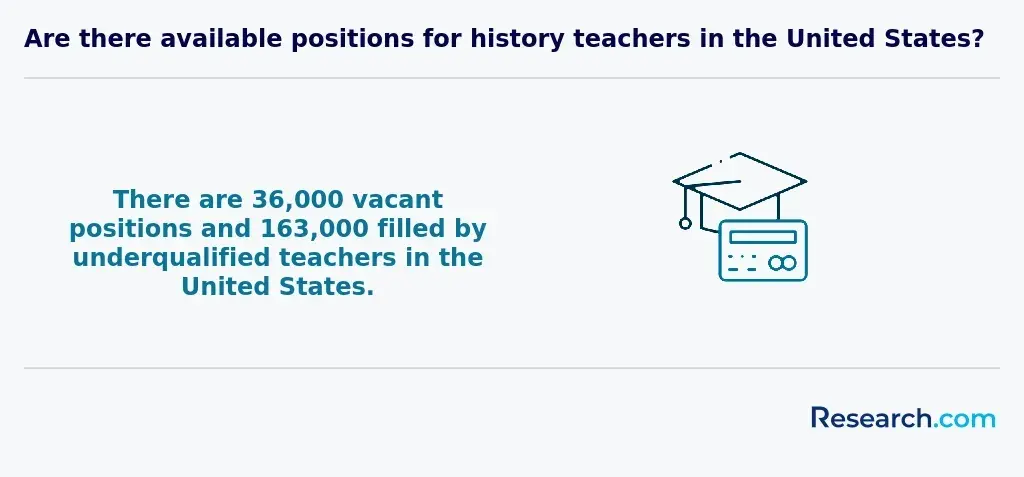
Nationally, approximately 36,000 teaching positions remain vacant. Washington reported 776 unfilled roles during the 2021-22 school year. These figures do not guarantee a job in every district or subject, but they show why schools continue to need prepared educators who can step into hard-to-staff classrooms and teach within state expectations.
Before enrolling, confirm that your program is state-approved, leads to the endorsement you need, includes supervised teaching, and fits your target grade level. A history major by itself may not be enough if the program does not include educator preparation.
Are there grants or scholarships available for aspiring history teachers in Washington?
Yes. Washington students and career changers may be able to reduce the cost of teacher preparation through state, federal, and institutional aid. The most important detail is that several programs come with service obligations, so applicants should read the repayment and employment conditions before accepting funds.
| Funding option | Amount stated | Who should look at it | Important caution |
| Teacher Shortage Conditional Scholarship | Up to $8,000 | Students pursuing a teaching degree who are willing to teach in a high-need subject area, including history, in a Washington public school for a specified period | Because it is conditional, failing to meet the service requirement can create repayment obligations. |
| Educator Retooling Conditional Scholarship | Up to $3,000 for each endorsement in a shortage area | Current educators who want to add a shortage-area endorsement to their credentials | Recipients must work in a Washington public school. |
| Alternative Routes Conditional Scholarship | $8,000 annually for a maximum of two years | Candidates using an alternative route program to earn a Washington Residency Teacher Certificate | Best for applicants who already have relevant education or work experience and need a faster certification pathway. |
| TEACH Grant | Up to $4,000 per year | Students who agree to teach in a high-need field, such as history, at a low-income school | If the teaching obligation is not completed, the grant can convert to a loan that must be repaid. |
| College and university scholarships | From a few hundred to several thousand dollars | Education majors at Washington institutions such as the University of Washington and Washington State University | Deadlines, GPA rules, and major requirements vary by school. |
Financial aid should be part of your program comparison, not an afterthought. Ask each school whether aid can be stacked, whether scholarships apply to online or alternative routes, and whether student teaching affects your ability to work while enrolled. If you are comparing teacher preparation policies in other states, a resource on Arkansas teacher induction programs may help you understand how state requirements can differ.
Do history teachers need special certifications in Washington?
Washington history teachers need the appropriate teaching certificate and endorsement for the subject and grade band they intend to teach. In practice, this means you should prepare for general teacher certification requirements and the subject-specific assessment tied to history or social studies instruction.
The key exams named in Washington’s certification process include:
- Washington Educator Skills Test – Basic (WEST-B): This exam measures basic skills in reading, writing, and mathematics before or during entry into teacher preparation.
- Washington Educator Skills Test – Endorsement (WEST-E): This assessment evaluates whether a candidate has the content knowledge needed for the endorsement area. Some candidates may use the National Evaluation Series (NES) instead.
Teachers who already hold National Board certification may also have options for adding an endorsement to an existing certificate. This can be useful for experienced teachers who want to move into history or social studies without starting their preparation from the beginning.
Because 41% of teachers nationwide regularly teach social sciences, endorsement accuracy matters. A teacher assigned to history, civics, geography, economics, or broader social studies may need credentials that match the actual assignment, not just a general education background.
The chart below shows teachers' regular assignments nationwide during the 2021-22 academic year.
Is there certification reciprocity for history teachers in Washington?
Washington participates in the National Association of State Directors of Teacher Education and Certification (NASDTEC) interstate agreement, but OSPI indicates that the state does not generally allow educators to use another state’s license for direct public school employment without obtaining a Washington certificate. Reciprocity can help with recognition of preparation, but it is not the same as automatic approval.
Out-of-state applicants should expect to document their education, testing history, preparation program, and professional background. Washington may recognize a state-approved educator preparation program and a degree from an accredited institution as part of the basic certification review.
- Submit official transcripts showing conferral of a bachelor’s or higher degree.
- Complete the WEST-B and WEST-E or NES assessments if required.
- Provide evidence of a state-approved teacher preparation program, or submit proof of an out-of-state teaching license and at least three years of experience.
- Complete the required background check.
Some educators with specific credentials, including the Wisconsin Masters Educator License or the Ohio Professional Teaching License, may apply directly for Washington Professional Teacher certification. Because exceptions are narrow, out-of-state teachers should verify requirements with Washington’s educator certification office before accepting a position or relocating.
How much do history teachers make in Washington?
Washington history teacher pay depends on district salary schedules, years of experience, education level, union agreements, school type, and location. The broad statewide figure cited for a history teacher in Washington is $60,214 annually.
National Education Association data cited for 2024 show that most new educators in Washington earn around $55,631, while the majority of teachers earn as much as $86,804. These figures place Washington among the highest-paying states for new and experienced teachers, but they should be interpreted alongside local cost of living, commuting expenses, benefits, and workload.
| Role or salary category | Annual wage or salary stated | What candidates should consider |
| History teacher in Washington | $60,214 | Useful as a general statewide reference, but district schedules may vary. |
| Most new educators in Washington | Around $55,631 | Starting pay may improve with graduate credits, prior experience, or district-specific salary rules. |
| Majority of teachers in Washington | As much as $86,804 | Higher pay is often tied to experience, education credits, and longevity. |
| Middle school teachers | $95,642 | Washington Employment Security Department wage data may include a broader group of teachers, not only history educators. |
| High school teachers | $98,617 | Secondary roles may involve specialized content, testing responsibilities, and extracurricular expectations. |
| Postsecondary social sciences educators | $62,533 | College roles often require graduate study and may vary by institution type. |
| History professors | $82,896 | University-level history teaching generally requires advanced academic credentials. |
Do not evaluate salary in isolation. Compare the full compensation package, including health insurance, retirement contributions, professional development support, planning time, class size, union representation, and the cost of living in the district where you hope to teach.

What career paths are available for history teachers in Washington?
A history teaching credential can lead to more than one kind of job. Many educators begin in middle or high school classrooms, then move into curriculum, leadership, higher education, museum education, or specialized instructional roles after gaining experience.
| Career path | Typical responsibilities | Best fit |
| High school history teacher | Teach U.S. history, world history, government, civics, or related social studies courses; prepare students for exams and graduation requirements. | Teachers who enjoy deeper content discussions, primary-source analysis, and older adolescents. |
| Middle school social studies educator | Introduce foundational historical themes, geography, culture, government, and evidence-based reasoning. | Educators who like helping younger students build study habits and historical thinking skills. |
| Curriculum developer | Create instructional materials, pacing guides, assessments, and standards-aligned units for districts or education organizations. | Experienced teachers who enjoy planning, writing, research, and teacher support. |
| Higher education instructor | Teach history or social sciences at a college or university, often requiring advanced degrees. | Teachers who want more scholarly work, adult learners, or academic specialization. |
| Educational administrator | Serve as department chair, instructional coach, principal, or program leader after meeting additional requirements. | Teachers interested in school-wide decision-making, mentoring, and policy implementation. |
| Museum educator | Design public programs, school field trips, exhibits, learning materials, and community history experiences. | Educators who want to connect historical content with public engagement outside the traditional classroom. |
Districts such as Seattle Public Schools, Spokane Public Schools, Tacoma Public Schools, and Bellevue School District may offer opportunities for qualified educators, although openings vary by year, school level, and budget. History teachers who are considering career mobility can also review how other states structure preparation, such as West Virginia teacher education programs, to better understand credential portability and professional options.
What professional development opportunities are available for history teachers in Washington?
Professional development is not optional for strong history teaching. Historical scholarship changes, classroom technology evolves, and students need lessons that connect evidence, context, and civic reasoning. Washington educators can strengthen their practice through workshops, conferences, graduate study, and local history projects.
- OSPI workshops: State-level sessions can help teachers interpret standards, improve assessment practices, and align instruction with K-12 expectations.
- Pacific Northwest History Conference: This event can connect educators with historians, local history resources, and teaching strategies rooted in regional context.
- Washington Education Association and Washington State Council for the Social Studies: These organizations can provide professional learning, advocacy information, and classroom resources for social studies teachers.
- Graduate programs: Teachers who want advanced training may compare affordable online M.Ed programs if they need flexible study while teaching.
- Washington History Day: Project-based history programs can help teachers build student research, argumentation, and primary-source analysis skills.
A good professional development plan should have a purpose. New teachers may need classroom management and assessment support. Mid-career teachers may benefit from endorsement expansion or leadership training. Veteran teachers may focus on mentoring, curriculum design, or advanced research in a historical field.
What are the top skills needed to succeed as a history teacher in Washington?
Effective history teachers combine content knowledge with instructional judgment. In Washington, the most successful educators are usually those who can teach difficult material responsibly, connect local and global histories, support diverse learners, and help students distinguish evidence from opinion.
- Cultural competence: Teachers should be able to include multiple perspectives, including Indigenous histories, immigrant experiences, labor history, civil rights, and Washington-specific historical contexts.
- Adaptability: History lessons often involve sensitive topics. Teachers need to respond to student questions, district expectations, family concerns, and changing classroom needs without weakening academic rigor.
- Technology fluency: Digital archives, online primary sources, interactive timelines, mapping tools, and learning platforms can help students investigate the past more actively.
- Critical thinking facilitation: Students need practice comparing sources, identifying bias, building claims from evidence, and explaining how historical interpretations are formed.
- Clear communication: Strong teachers translate complex events, timelines, policies, and social movements into lessons students can understand without oversimplifying the material.
- Local history integration: Washington topics such as the Klondike Gold Rush and the Japanese internment during WWII can help students see how national and global events affected communities close to home.
If you are still choosing a degree pathway, a bachelor of education online degree may be worth comparing with campus programs, especially if you need flexibility. Just make sure the program supports Washington certification goals and includes the field experience required for teacher preparation.
What is the easiest way to become a history teacher in Washington?
The easiest route depends on where you are starting. A first-time college student usually needs a teacher preparation bachelor’s program. A career changer who already has a bachelor’s degree in history or a related field may be better served by a state-approved alternative route. A licensed out-of-state teacher should start with Washington’s certification review process before enrolling in additional coursework.
| Your background | Likely best route | What to verify first |
| No bachelor’s degree yet | Earn a bachelor’s degree through an approved teacher preparation program. | Confirm that the program leads to the endorsement and grade level you want. |
| Bachelor’s degree in history or related field | Consider an alternative route certification program that combines coursework with school-based training. | Ask whether your prior credits satisfy content requirements and whether you can teach while completing training. |
| Current Washington teacher | Add an endorsement, pursue educator retooling support, or complete approved coursework and assessments. | Check whether the endorsement qualifies you for the exact social studies or history assignment you want. |
| Licensed teacher from another state | Apply through Washington’s out-of-state certification process. | Do not assume reciprocity equals automatic employment eligibility. |
Cost is often the deciding factor. Candidates who need a lower-cost route should review the cheapest way to get teaching credential in Washington and compare total program cost, testing fees, student teaching logistics, transfer credit, and eligibility for conditional scholarships.
What additional steps can history teachers in Washington take to further their careers?
Once certified, history teachers can grow by becoming stronger instructors, adding credentials, taking leadership roles, or building expertise in a historical specialty. The best next step depends on whether you want higher pay, more influence over curriculum, a different school setting, or a pathway outside K-12 classrooms.
- Add endorsements: Broader social studies, civics, geography, or related endorsements can improve assignment flexibility.
- Build a specialty: Teachers may focus on U.S. history, world history, Indigenous history, civic education, local Washington history, or historical research methods.
- Lead curriculum work: Experienced teachers can help design units, assessments, and department-wide resources aligned to state standards.
- Mentor newer educators: Coaching student teachers or early-career colleagues can build leadership experience.
- Consider graduate study: A master’s degree in history, teaching, curriculum, or education leadership may support advancement depending on district salary schedules and career goals.
For a deeper look at the secondary history path, see how to become a high school history teacher in Washington.
Can history teachers pursue specialized roles beyond the classroom?
Yes. History teachers develop research, writing, analysis, presentation, and student-support skills that can transfer into curriculum design, instructional coaching, museum education, academic advising, education consulting, assessment writing, and community education roles. Some teachers also move into specialized student services fields, although those paths may require a separate degree, clinical preparation, or license.
If you are considering a student-support profession outside history instruction, compare the education and licensure requirements carefully. For example, the pathway explained in how to become a speech pathologist in Washington shows how a related helping profession can require a very different credential structure.
Should Washington history teachers pursue advanced degrees for career growth?
An advanced degree can be useful, but it is not automatically the best investment for every history teacher. It may make sense if it supports a district salary lane, qualifies you for leadership roles, deepens your historical expertise, or prepares you for curriculum, administration, or higher education work.
| Advanced degree goal | When it may be worth it | When to be cautious |
| Master’s in teaching or education | You want stronger pedagogy, possible salary advancement, or instructional leadership preparation. | The cost may not pay off if your district does not reward graduate credits or if the program lacks relevance to your role. |
| Master’s in history | You want deeper subject expertise, dual-credit opportunities, or preparation for college-level teaching. | It may offer less direct classroom strategy training than an education-focused degree. |
| Doctorate in education | You want research, policy, district leadership, or senior curriculum roles. | A doctorate requires a major time commitment and should be tied to a clear career plan. |
Teachers comparing doctoral options may want to review flexible and lower-cost programs such as the cheapest PhD in education, while remembering that affordability, accreditation, faculty support, and career alignment all matter.
How can interdisciplinary expertise benefit history teachers in Washington?
Interdisciplinary teaching can make history more concrete. Data analysis can help students interpret demographic change, voting patterns, economic shifts, and migration. Literature can illuminate lived experience. Art can reveal visual propaganda, identity, and cultural memory. Geography can explain conflict, trade, settlement, and environmental change.
Teachers who expand into another subject area may become more versatile, but they should be realistic about certification requirements. Exploring a path such as how to become a middle school math teacher in Washington can show how adding a very different endorsement may require additional preparation and testing.
Can advanced degrees in education leadership boost my career as a history teacher in Washington?
Education leadership training can help a history teacher move from classroom instruction into department leadership, curriculum coordination, instructional coaching, assistant principal roles, or school administration. The value is strongest when the degree includes practical leadership training, school law, supervision, equity-focused decision-making, data use, and organizational management.
Before enrolling, ask whether the program aligns with Washington administrative credential requirements, whether your district recognizes the degree for salary advancement, and whether the curriculum includes field-based leadership experience. For broader career possibilities, review what can I do with masters in education leadership.
What are the best resources for history teachers in Washington?
Strong history instruction depends on high-quality sources, not just textbooks. Washington teachers can build better lessons by using archives, museums, newspapers, libraries, and professional communities that support evidence-based learning.
- Washington State Archives: Primary documents, maps, photographs, and government records can help students practice historical inquiry with authentic materials.
- Washington State Historical Society: Lesson plans, field trip options, history boxes, workshops, and public history resources can connect classrooms to state history.
- Washington Digital Newspapers: Digitized newspapers allow students to examine how people understood events at the time they occurred.
- Cultural institutions: Museums and historical societies, including the Washington State History Museum, can support field trips, exhibit-based assignments, and community history projects.
- Teacher communities: Social media groups, educator blogs, PBS Learning Media, and National Geographic can help teachers find lesson ideas and classroom-ready materials.
- Local libraries: Public libraries can provide books, databases, local history collections, and research support for both teachers and students.
Teachers exploring certification processes in different states can compare resources such as Oklahoma teacher certification online, but Washington candidates should always follow OSPI and state-specific guidance for licensure decisions.
The chart below highlights resources frequently used by history teachers.
Is Washington a good state to teach in?
Washington can be a strong state for history teachers, especially for candidates who value relatively high teacher wages, union representation, professional development, and a large public school system. It is not without challenges. Teacher turnover, workload, representation gaps, and district-level differences can affect day-to-day experience.
| Potential advantage | Why it matters |
| Job market | Between 2022 and 2027, Washington is expected to have 3,012 annual openings for middle school teachers, 4,056 for high school teachers, and 92 for history professors in higher education. |
| Professional support | State and district initiatives can provide mentoring, training, and development opportunities for new and experienced teachers. |
| Union presence | Active teachers’ unions can support advocacy around compensation, working conditions, due process, and educator resources. |
| Potential drawback | Why candidates should pay attention |
| Compensation pressure | Starting pay may feel limited in high-cost areas, even though the starting salary ranks as the third highest in the nation and average incomes can reach the $80,000s. |
| Teacher attrition | The 2022 teacher attrition rate reached 8.91%, the highest in 37 years, while the overall turnover rate was 19.76%, according to Goldhaber & Theobald (2023). |
| Workforce diversity | Washington teachers are predominantly White at 85.5%, which can create representation gaps between educators and students in some communities. |
The practical takeaway: Washington may be a good place to teach if you choose your district carefully, understand the salary schedule, use available mentorship, and prepare for the realities of workload and retention pressures.
What are the challenges of teaching history to students in Washington?
History teaching can be rewarding, but it requires careful planning. Washington teachers often work with diverse classrooms, uneven resources, and public debate over how history should be taught. These realities make professional judgment essential.
- Diverse student needs: Students may bring different cultural backgrounds, languages, family histories, academic preparation levels, and learning needs. Teachers must design lessons that are inclusive without becoming shallow.
- Limited resources: Some schools may lack updated materials, substitutes for professional learning days, travel funds for field trips, or access to current instructional tools.
- Political and community pressure: Topics such as civil rights, race, labor, immigration, Indigenous history, war, and government power can draw scrutiny. Teachers need to rely on standards, evidence, and transparent learning goals.
- Student engagement: Many students see history as memorization unless teachers make inquiry, debate, primary sources, and present-day connections central to the course.
- Technology and AI: Students now have easier access to AI-generated summaries, which makes source evaluation, citation, and historical evidence skills more important.
Teachers can reduce these challenges by building strong unit plans, communicating learning objectives clearly, using vetted primary sources, partnering with librarians, and creating classroom norms for evidence-based discussion.
How can history teachers collaborate with English educators to enhance interdisciplinary learning?
History and English teachers can build stronger learning experiences when they coordinate reading, writing, and evidence-based analysis. A unit on war, migration, civil rights, or political change can pair primary sources with memoirs, speeches, essays, novels, poems, or journalism. Students then practice both historical interpretation and written argumentation.
Useful collaborations include shared research papers, source analysis rubrics, Socratic seminars, document-based essays, and projects that ask students to compare historical evidence with literary representation. Educators interested in this partnership can review how to become an English teacher in Washington to better understand the preparation of English colleagues.
How can history teachers in Washington advance their careers?
Career advancement for Washington history teachers usually comes from a combination of better instruction, additional credentials, leadership experience, and strategic professional learning. The right option depends on whether you want to stay in the classroom, become a leader, move into curriculum, or pursue higher education teaching.
- Earn additional academic credentials: A history degree online may help teachers deepen subject knowledge while continuing to work.
- Use district professional development: Training in assessment, educational technology, culturally responsive teaching, and standards alignment can improve classroom practice.
- Add endorsements or certifications: Broader credentials can open more teaching assignments and leadership opportunities.
- Join professional organizations: Groups such as the National Council for History Education and the Washington State Council for the Social Studies can provide networking, resources, and conference access.
- Document impact: Keep evidence of curriculum work, student projects, assessment results, mentoring, and leadership contributions for future applications.
How can art integration elevate history education in Washington?
Art integration can help students understand how people in different eras expressed power, resistance, identity, memory, and belief. History teachers can collaborate with art educators on projects involving political cartoons, propaganda posters, murals, architecture, museum curation, oral history exhibits, or visual timelines.
This approach is especially helpful for students who learn well through visual analysis and creative production. Teachers who want to build cross-department projects may benefit from understanding the requirements to be an art teacher in Washington so collaboration aligns with both subjects’ standards.
How can school librarians support history educators in Washington?
School librarians can be essential partners for history teachers. They help students locate credible sources, distinguish primary from secondary evidence, use databases, cite sources, and avoid weak internet research. They can also curate materials for units on Washington history, national events, global conflicts, and civic issues.
Collaboration with librarians is especially valuable now that students can generate quick answers with AI tools. Librarians can teach verification habits that history students need: tracing claims, checking authorship, comparing sources, and identifying missing perspectives. For educators interested in this related career, see how to become a school librarian in Washington.
How can history educators leverage elementary education opportunities?
History educators who enjoy younger learners may consider elementary education, where social studies is often integrated with reading, writing, geography, community studies, and civic behavior. Early exposure to history can help children build curiosity, empathy, sequencing skills, and awareness of local communities.
This path is different from secondary history teaching because elementary teachers usually teach multiple subjects. Candidates should compare certification requirements, grade-level expectations, and classroom structure before switching. For more detail, review how to become an elementary school teacher in Washington.
Can history teachers in Washington transition to private school settings?
Yes, history teachers may move into private schools, but the hiring rules, curriculum expectations, class sizes, religious or mission-based requirements, and certification preferences can differ from public schools. Some private schools may value state certification strongly, while others may emphasize subject expertise, advanced degrees, or experience with a particular curriculum model.
Before transitioning, ask about teaching load, planning expectations, benefits, salary schedule, professional development, academic freedom, and contract renewal policies. Educators comparing this route should review private school teacher requirements in Washington.
How Do Certification Options Impact a History Teacher’s Career in Washington?
Your certification pathway can shape where you can teach, how quickly you can enter the workforce, which subjects you can be assigned, and how easily you can move into leadership or specialized roles. Full certification with the correct endorsement generally gives candidates more flexibility than limited or emergency credentials.
| Certification choice | Career impact | Best question to ask |
| Full Washington teaching certificate with appropriate endorsement | Supports public school eligibility and stronger long-term mobility. | Does this credential match the exact history or social studies assignment I want? |
| Limited certification | May help schools address immediate staffing needs but can restrict long-term options. | What must I complete to move from limited status to full certification? |
| Added endorsement | Can expand teaching assignments and increase competitiveness for openings. | Will this endorsement qualify me for middle school, high school, or both? |
| Alternative route certification | Can shorten the path for eligible career changers or classified staff. | Is the program state-approved and connected to a school placement? |
For a broader explanation of available tracks, review Washington teacher certification types and requirements.
Common mistakes to avoid when becoming a history teacher in Washington
- Choosing a program before checking approval: A degree is not enough if the teacher preparation program does not meet Washington certification expectations.
- Focusing only on tuition: Testing fees, books, transportation, unpaid student teaching, technology, and lost work hours can change the real cost.
- Assuming online automatically works: Online coursework can be convenient, but student teaching, endorsement alignment, and state approval still matter.
- Misunderstanding reciprocity: An out-of-state license may support your application, but Washington still requires state-specific certification.
- Ignoring endorsement details: History, social studies, middle school, and high school assignments may not be interchangeable.
- Relying only on rankings: Program fit, placement quality, cost, certification outcomes, advising, and local district relationships matter more than a school’s reputation alone.
- Assuming salary outcomes are guaranteed: Pay depends on district schedules, experience, education credits, and location.
Questions to ask before choosing a Washington teacher preparation program
- Is this program approved for Washington teacher certification?
- Which endorsement will I earn, and what grades will it allow me to teach?
- Where do students complete fieldwork and student teaching?
- What are the pass-rate expectations and supports for WEST-B, WEST-E, or NES exams?
- Can I use transfer credits or prior graduate credits?
- What is the total cost after fees, testing, books, travel, and student teaching expenses?
- Does the program help with scholarship applications, alternative route funding, or conditional scholarship requirements?
- How does the program prepare teachers to teach diverse students and sensitive historical topics?
- What career support is available for district hiring, interviews, and first-year teaching?
What History Teachers in Washington Say About Their Careers
- “Teaching history in Washington has given me the chance to connect national events with local stories my students recognize. The most meaningful moments happen when students stop memorizing dates and start asking why people made the choices they did.” - Molly
- “My students bring many different experiences into class, and that makes our discussions richer. The challenge is making sure every unit is accurate, respectful, and grounded in evidence.” - Nina
- “History teaching works best when it feels like investigation. Washington’s archives, museums, and local communities give teachers many ways to help students see the past as something they can question and understand.” - June
Related Articles for Nearby States
- 2027 How to Become a History Teacher in Oregon: Requirements & Certification
- 2027 How to Become a History Teacher in Idaho: Requirements & Certification
- 2027 How to Become a History Teacher in Montana: Requirements & Certification
- 2027 How to Become a History Teacher in California: Requirements & Certification
- 2027 How to Become a History Teacher in Nevada: Requirements & Certification
- 2027 How to Become a History Teacher in Utah: Requirements & Certification
- 2027 How to Become a History Teacher in Wyoming: Requirements & Certification
- 2027 How to Become a History Teacher in Arizona: Requirements & Certification
- 2027 How to Become a History Teacher in Colorado: Requirements & Certification
- 2027 How to Become a History Teacher in New Mexico: Requirements & Certification
Key Insights
- Washington history teachers generally need a bachelor’s degree, approved teacher preparation, supervised classroom experience, required testing, a background check, and the correct state endorsement.
- Out-of-state teachers should not rely on automatic reciprocity. Washington may recognize prior preparation, but candidates still need a Washington certificate for public school roles.
- Salary prospects can be strong compared with many states, but district salary schedules, cost of living, experience, and graduate credits will affect actual earnings.
- Alternative routes and conditional scholarships can reduce time and cost for eligible candidates, especially career changers and current educators adding endorsements.
- The best program is not simply the cheapest or most prestigious one. It is the one that is state-approved, leads to the right endorsement, provides quality student teaching, and fits your budget and timeline.
- History teachers can advance through additional endorsements, graduate study, curriculum leadership, interdisciplinary collaboration, museum education, private school teaching, or education administration.
- The strongest Washington history teachers know how to teach evidence, context, multiple perspectives, civic reasoning, and source evaluation in classrooms where history can be both meaningful and contested.
References:
- Goldhaber, D., & Theobald, R. (2023). Teacher Turnover Three Years into the Pandemic Era: Evidence from Washington State. CALDER, Policy Brief No. 32-0223. https://caldercenter.org/sites/default/files/CALDER%20Policy%20Brief%2032-0223.pdf
- National Education Association. (2024). Educator Pay Data 2024. Retrieved September 2024, from https://www.nea.org/resource-library/educator-pay-and-student-spending-how-does-your-state-rank
- ONET OnLine. (2024, August 9). History Teachers, Postsecondary. Employment Trends. Retrieved September 2024, from https://www.onetonline.org/link/localtrends/25-2022.00?st=WA
- Washington Employment Security Department. (2023, May). Occupational employment and wage statistics (OEWS). Retrieved September 2024, from https://esd.wa.gov/labormarketinfo/occupations
- Washington Office of Superintendent of Public Instruction. (2023). Washington State Report Card. Retrieved September 2024, from https://ospi.k12.wa.us/data-reporting/data-portal
Other Things You Should Know About Becoming a History Teacher in Washington
Washington history endorsements are issued by the Office of Superintendent of Public Instruction after a teacher completes an approved preparation program and subject-area coursework. Candidates typically need at least 30 semester credits in history-related study, plus pedagogy required by their educator program.
To convert an out-of-state teaching license to Washington in 2027, applicants must apply through OSPI, submit fingerprints, pass the NES, and meet additional State Board requirements. Prior teaching experience and credentials are assessed for eligibility, ensuring state standards compliance.
In 2027, the history endorsement for Washington teachers typically includes courses on U.S. history, world history, geography, civics, and economics. These subjects ensure that teachers are equipped with comprehensive knowledge to educate students effectively in historical contexts.