2027 How to Become a Middle School Math Teacher in Washington: Requirements & Certification

Co-Founder and Chief Data Scientist
Becoming a middle school math teacher in Washington is a practical career goal, but the path is not just “earn a degree and apply for jobs.” You need the right teacher preparation program, the correct math endorsement, passing exam scores, classroom experience, background clearance, and a plan for renewing your credential once you begin teaching. You also need to understand what the job is really like: middle school math teachers work with students who may be building confidence, filling skill gaps, preparing for algebra, or losing interest in math altogether.
This guide explains the Washington pathway step by step. It is designed for high school graduates planning an education degree, college students choosing a teacher preparation program, career changers considering certification, and current educators who want to add middle school math to their credentials. You will learn how certification works, what education and testing requirements to expect, how salaries and job demand look, what classroom skills matter most, and how to make a cost-conscious decision before enrolling in a program.
Quick answer: How do you become a middle school math teacher in Washington?
To become a middle school math teacher in Washington, you generally need to earn at least a bachelor’s degree, complete a state-approved teacher preparation program, pass the required Washington educator assessments for middle school mathematics, complete student teaching, pass fingerprinting and background checks, and apply for certification through the Washington Office of Superintendent of Public Instruction (OSPI). After certification, you must continue professional development to maintain and renew your credential.
Key things you should know before choosing this path
- Washington is experiencing a notable shortage of middle school math teachers, and many districts have difficulty filling math positions. That demand can create opportunities, but new teachers should still evaluate district support, mentoring, class sizes, and workload before accepting an offer.
- The average salary for middle school math teachers in Washington is approximately $66,000 per year. That can compare favorably with national averages, but the state’s cost of living matters, especially in urban areas such as Seattle.
- The employment outlook for middle school math teachers in Washington is promising, with projections indicating a 10% growth in job opportunities over the next decade. Enrollment trends and the need for qualified STEM educators both contribute to this outlook.
- Living costs vary sharply by region. Seattle’s median home price exceeds $800,000, while many smaller communities may offer more affordable housing. Your district location can affect your real take-home value as much as your salary schedule.
- Washington’s education policies place strong emphasis on STEM education, which can affect curriculum design, instructional expectations, professional development, and the types of skills schools value in math teachers.
- Steps to becoming a middle school math teacher in Washington
- Education requirements for Washington middle school math teachers
- Certification and licensing process in Washington
- Student teaching, internships, and classroom experience
- Washington middle school math standards and curriculum
- Job market, salary expectations, and cost-of-living factors
- Continuing education and professional development
- Classroom management and teaching methods for middle school math
- Career advancement and specialization options
- Legal and ethical responsibilities for Washington teachers
- Additional certifications that can strengthen your teaching career
- Why a broader skill set can improve long-term options
- Support systems for new middle school math teachers
- What math teachers can learn from music teacher preparation
- Mentorship and professional networks
- Cost-effective ways to earn teaching certification
- Next steps for aspiring middle school math teachers
- Interdisciplinary certifications for Washington educators
- Alternative certification pathways
- Common challenges and how to handle them
- Diversity, equity, and inclusion in middle school math
- Financial incentives and loan forgiveness options
- Transitioning from middle school to high school math teaching
What are the steps to becoming a middle school math teacher in Washington?
The Washington pathway combines college-level preparation, state-approved educator training, assessments, and certification paperwork. The exact route depends on whether you are a first-time college student, a bachelor’s degree holder, or an experienced professional changing careers.
| Step | What you need to do | Decision point |
| 1. Earn a bachelor’s degree | Complete at least a bachelor’s degree from an accredited institution, ideally with strong mathematics and education coursework. | If you are starting from high school, compare traditional and accelerated bachelor's degree online options carefully. |
| 2. Complete teacher preparation | Enroll in a Washington-approved teacher preparation program that includes pedagogy, classroom practice, and student teaching. | Confirm that the program leads to the endorsement you actually need for middle school math. |
| 3. Pass required assessments | Complete the Washington Educator Skills Test—Endorsements (WEST-E) for middle school mathematics and any other required assessments. | Ask your program when students normally take exams and what support is available for test preparation. |
| 4. Apply for certification | Submit your teaching certificate application through OSPI after meeting education, testing, and field experience requirements. | Budget for application fees, which can range from $75 to $100. |
| 5. Complete background clearance | Submit fingerprints and complete the required background check before working with students. | Fingerprinting and background checks often add costs around $50. |
| 6. Begin teaching and keep learning | Apply for district positions, complete induction requirements, and meet continuing education expectations. | Choose a district that offers mentoring, math curriculum support, and manageable onboarding for new teachers. |
According to DataUSA, in 2022, 3,269 total degrees were awarded in mathematics teacher education programs in the USA. The median in-state public tuition for these programs was $7,070, while the median out-of-state private tuition was $32,589, as shown in the graphic below.
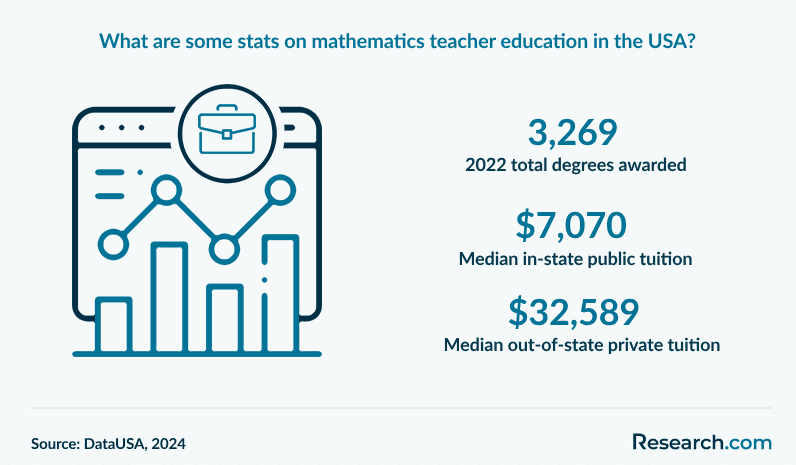
The main takeaway is simple: certification is achievable, but it is easiest when you choose the right program at the beginning. Before enrolling, verify accreditation, state approval, endorsement alignment, tuition, student teaching placement support, and exam pass-rate support.
What are the educational requirements for becoming a middle school math teacher in Washington?
Washington expects middle school math teachers to have both mathematical knowledge and teaching skill. A strong candidate understands algebra, geometry, data, proportional reasoning, and mathematical problem-solving, but also knows how to explain these ideas to early adolescents with different learning needs.
- Bachelor’s degree: A bachelor’s degree is the minimum academic foundation. Many candidates major in mathematics, mathematics education, elementary education with a math focus, or a related field, depending on the approved preparation route.
- Mathematics coursework: Your coursework should build comfort with algebra, geometry, calculus, statistics, and mathematical reasoning. Middle school teachers do not simply teach procedures; they help students understand why math works.
- Pedagogy and adolescent development: Teacher preparation should include classroom assessment, lesson design, educational psychology, differentiation, special education foundations, and strategies for supporting multilingual learners.
- State-approved teacher preparation: Completing an approved program is critical because it connects your degree to Washington certification requirements. It also gives you supervised field experience before you become the teacher of record.
- Accreditation: Do not assume every online or out-of-state program will qualify you for Washington certification. If you are comparing distance-learning options, review nationally accredited online colleges and confirm Washington approval or reciprocity requirements before committing.
- Subject matter competency: Candidates must show that they understand the math content they will teach, typically through required assessments such as the Washington Educator Skills Tests.
| Program choice | Best for | Watch out for |
| Traditional bachelor’s plus teacher preparation | First-time college students who want a clear, structured route into teaching. | Program length, total tuition, and whether the math endorsement is included. |
| Post-baccalaureate teacher preparation | Career changers or graduates who already hold a bachelor’s degree. | Student teaching may be unpaid, so plan for income and scheduling needs. |
| Master’s in teaching or education | Candidates who want graduate-level preparation or stronger long-term advancement options. | Do not assume every master’s program leads to initial certification. |
| Alternative certification pathway | Eligible candidates who need a faster or employment-connected route. | These pathways can be intensive and may require district sponsorship or specific eligibility. |
In short, the best education route is the one that leads directly to Washington certification, includes supervised math teaching experience, and fits your budget and timeline.
What is the certification and licensing process for a middle school math teacher in Washington?
The certification process exists to verify that you are ready to teach safely and effectively in Washington schools. It is not only a paperwork step; it confirms your preparation, content knowledge, field experience, and background clearance.
- Complete a state-approved teacher preparation program: Your program must meet Washington’s standards for educator preparation and should include both coursework and supervised classroom practice.
- Pass required exams: Aspiring teachers must complete the Washington Educator Skills Tests—Basic (WEST-B) and the WEST-E exam aligned with mathematics, unless an approved alternative applies.
- Apply for an Initial Teaching Certificate: After meeting the education and testing requirements, you submit documentation such as transcripts, test results, program completion verification, and background check information.
- Plan for fees: Certificate application fees vary by certificate type, and candidates should budget for both certification and background check costs.
- Begin teaching after certification: Once certified, you can apply for middle school math positions and begin gaining the experience needed for future credential renewal or advancement.
- Meet renewal expectations: Teachers must complete at least 15 hours of professional development focused on STEM integration during each renewal cycle.
According to DataUSA, 2024, there are approximately 5.11 million people working as math teachers in the USA. The average age of these teachers is 46.2 years old, and they earn an average annual wage of $64,648.
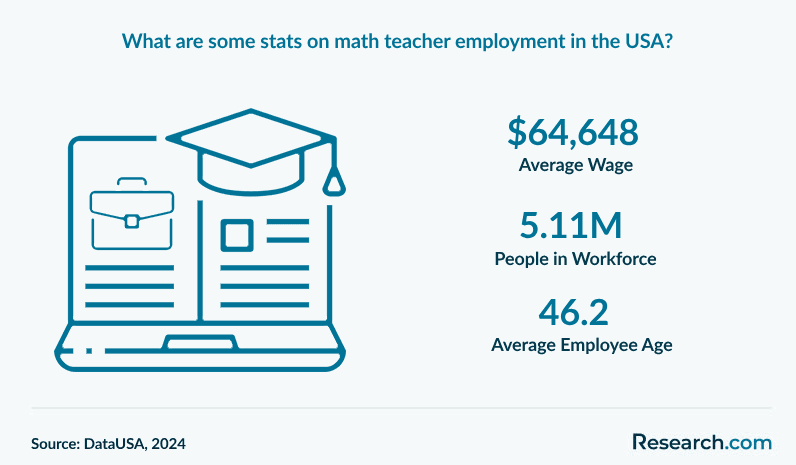
Certification rules can change, so candidates should verify requirements directly with OSPI and their preparation program before making enrollment or employment decisions. Educators interested in future leadership, policy, or higher education roles may also compare advanced options such as online doctoral programs in educational leadership and higher education.
How important is teaching experience and what are the internship opportunities for middle school math teachers in Washington?
Classroom experience is one of the most important parts of becoming a successful middle school math teacher. Math content knowledge matters, but student teaching is where candidates learn how to pace lessons, respond to confusion, manage transitions, build routines, use assessment data, and explain concepts more than one way.
- Student teaching: Washington candidates typically complete a supervised teaching placement as part of their preparation program. This experience helps bridge the gap between coursework and full classroom responsibility.
- University-school partnerships: Many Washington teacher preparation programs partner with local schools to place candidates in classrooms where they can observe, assist, teach lessons, and receive feedback.
- Residency-style options: Some candidates explore models that combine coursework with more immediate classroom involvement. These may be especially useful for career changers or candidates who need a more practice-based route.
- Alternative programs: Organizations such as Teach for America and the Washington State Teacher Certification Program may provide alternative routes, often connected to high-need schools or shortage areas.
- Feedback and reflection: The strongest student teachers ask for specific feedback, revise lessons, analyze student work, and keep evidence of growth for future job applications.
| Experience type | What you gain | How to use it in your job search |
| Observation hours | Exposure to routines, math discussions, assessment methods, and student behavior patterns. | Use observations to explain what kind of classroom culture you want to build. |
| Student teaching | Practice planning lessons, teaching units, managing behavior, and grading student work. | Ask your mentor for examples of your growth and request a strong reference. |
| Substitute teaching or tutoring | Additional practice with classroom presence, student questions, and flexible instruction. | Show hiring teams that you have worked directly with middle school learners. |
| Residency or alternative route placement | More intensive school-based preparation, often connected to district needs. | Highlight your readiness for high-need classrooms and collaborative teams. |
What are the Washington standards and curriculum requirements for teaching middle school math?
Washington middle school math instruction is guided by K-12 learning standards that emphasize reasoning, problem-solving, conceptual understanding, and real-world application. Teachers are expected to help students move beyond memorizing steps and toward explaining, modeling, justifying, and applying mathematical ideas.
- Alignment with Common Core State Standards: Washington’s math expectations are connected to the Common Core framework, but teachers still need to apply them in ways that fit local curriculum, district assessments, and student needs.
- Conceptual understanding: Students should understand mathematical relationships, not only complete procedures. For example, proportional reasoning should connect to graphs, tables, equations, and real-world contexts.
- Procedural fluency: Middle school students still need accurate computation and efficient methods, but fluency should develop alongside meaning.
- Application and modeling: Strong lessons ask students to use math to analyze situations, compare strategies, and solve practical problems.
- Equitable access: Standards-based instruction should support students who are advanced, on grade level, below grade level, multilingual, or receiving special education services.
- Instructional resources: OSPI provides mathematics resources, standards guidance, and assessment information. Teachers who want to strengthen information literacy and resource selection may also explore best online library science programs.
In terms of instructional quality, one often-cited National Center for Education Statistics comparison is worth reading cautiously because it dates back to 1999. In Germany, 34% of eighth-grade mathematics lessons were rated as having low quality mathematical content, 38% were rated as medium quality, and 28% were rated as high quality. In Japan, 11% of lessons were rated as low quality, 51% as medium quality, and 39% as high quality. In the United States, 89% of lessons were rated as having low quality mathematical content, 11% were rated as medium quality, and no lessons were rated as high quality, as shown in the graph below.
Because that study is older, it should not be treated as a current ranking of math instruction. However, it still reinforces an important point for new teachers: the quality of the mathematical task matters. A worksheet with many repeated steps is not the same as a lesson that asks students to reason, discuss, revise, and connect ideas.
How does technology integration enhance mathematics instruction in Washington middle schools?
Technology can improve math learning when it helps students visualize, test, model, and explain mathematical thinking. It is less useful when it simply replaces paper practice with digital worksheets.
- Interactive exploration: Graphing tools, simulations, and digital manipulatives can help students see patterns and test conjectures.
- Real-world modeling: Online data sets and simulation tools can connect math to science, finance, geography, and everyday decision-making.
- Differentiation: Digital platforms can support varied practice levels, but teachers still need to monitor whether students understand the reasoning behind answers.
- Feedback: Technology can provide quick checks for understanding, allowing teachers to adjust instruction before misconceptions harden.
What is the job market like and what are the salary expectations for middle school math teachers in Washington?
The job market for middle school math teachers in Washington is generally favorable because math remains a high-need subject area in many districts. However, candidates should look beyond statewide averages. Salary schedules, union agreements, graduate credits, years of experience, commute time, health benefits, housing costs, and district support can all change the real value of a job offer.
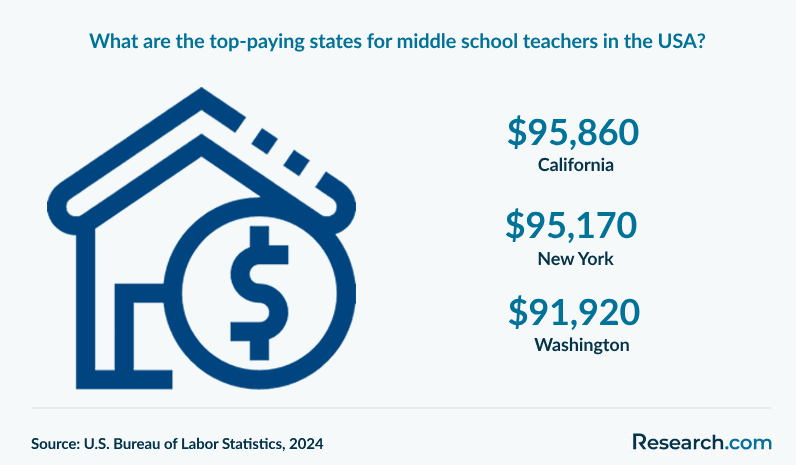
According to 2023 data from the U.S. Bureau of Labor Statistics, the top states offering the highest annual mean wages for middle school teachers, excluding special education and career/technical education, are California, New York, Washington, Massachusetts, and Connecticut. California has a mean wage of $95,860. New York follows with $95,170. Washington, Massachusetts, and Connecticut report annual mean wages of $91,920, $87,930, and $85,770, respectively. These figures help explain why teaching can be included among the online master's in education pathways that candidates consider when planning long-term earning potential.
Employment also differs by state. California reports 52,710 middle school teachers, New York reports 41,820, Washington reports 11,470, Massachusetts reports 14,720, and Connecticut reports 8,750, shown in the graphic below.
| State | Annual mean wage | Employment |
| California | $95,860 | 52,710 |
| New York | $95,170 | 41,820 |
| Washington | $91,920 | 11,470 |
| Massachusetts | $87,930 | 14,720 |
| Connecticut | $85,770 | 8,750 |
When evaluating whether the career is financially sustainable, compare district salary schedules with local housing costs. A higher-paying district in a high-cost area may not always provide a better quality of life than a somewhat lower-paying district in a more affordable community.
What professional development and continuing education opportunities are available for middle school math teachers in Washington?
Professional development is not optional for Washington math teachers. It supports certification renewal, keeps teachers aligned with standards, and helps educators respond to changing student needs, curriculum expectations, and technology tools.
- Educational Service Districts: Washington’s Educational Service Districts provide workshops, trainings, and collaborative learning opportunities for teachers, including math-focused sessions.
- District-based professional learning: Many school districts offer curriculum training, assessment calibration, math department collaboration, and coaching for new teachers.
- Online professional development: Online formats can be useful for teachers balancing classroom responsibilities. Educators often use digital courses, recorded demonstrations, and professional learning communities to study teaching methods at a flexible pace.
- Continuing education credits: Teachers should track professional learning hours carefully because renewal requirements must be documented.
- STEM integration: Washington requires at least 15 hours of professional development focused on STEM integration during each renewal cycle.
- Math organizations and curriculum resources: Resources from organizations such as the Mathematics Assessment Project and Illustrative Mathematics can help teachers design stronger tasks, assessments, and classroom discussions.
Choose professional development that solves a real instructional problem. For example, if your students struggle with proportional reasoning, a focused workshop on ratio tables, graphs, and unit rates may be more valuable than a generic training session.
What are effective classroom management strategies and teaching methods for middle school math teachers in Washington?
Middle school math teaching requires a blend of structure and flexibility. Students are old enough to question relevance but young enough to need consistent routines, frequent feedback, and clear expectations. A strong math classroom feels safe, active, and purposeful.
- Start with predictable routines: Use consistent warm-ups, transitions, group norms, and exit tickets so students know what to do without repeated reminders.
- Teach behavior expectations directly: Do not assume students know how to discuss math, disagree respectfully, use tools, or work in groups. Model and practice these behaviors.
- Build relationships before conflict escalates: Students are more willing to take academic risks when they feel seen and respected.
- Use multiple representations: Encourage students to connect equations, graphs, diagrams, tables, words, and physical models.
- Normalize mistakes: A math classroom should treat errors as evidence for learning, not as proof that a student “is bad at math.”
- Differentiate without lowering expectations: Provide scaffolds, small-group instruction, and extension tasks while keeping all students connected to grade-level ideas.
- Use technology deliberately: Tools such as graphing applications and interactive activities are most effective when they deepen reasoning rather than distract from it.
National mathematics data shows why middle school instruction is so important. The percentage of students in each grade who fell below the National Assessment of Educational Progress (NAEP) basic level, met the basic level, achieved proficiency, or attained advanced levels in mathematics in 2019 are shown in the graph below.
In fourth grade, 19% of students fell below the NAEP Basic level, 40% met the basic standard, 32% were proficient, and 9% were advanced in math. By eighth grade, 31% were below basic, 35% were at basic, 24% were proficient, and 10% were advanced. By twelfth grade, 40% were below basic, 35% were at basic, 21% were proficient, and only 3% were advanced.
For middle school teachers, this means intervention and enrichment must happen at the same time. Some students need help rebuilding number sense and fractions, while others are ready for advanced algebraic reasoning. Effective classroom management makes that range manageable.
What are the career advancement opportunities and specializations for middle school math teachers in Washington?
Middle school math teaching can lead to several career paths beyond the classroom. Some teachers stay in the classroom and become master teachers, while others move into coaching, curriculum, administration, or specialized instruction.
| Advancement path | What the role involves | Typical preparation |
| Department chair or math lead | Supports curriculum alignment, assessment planning, and collaboration among math teachers. | Strong teaching record, leadership experience, and district trust. |
| Instructional coach | Helps teachers improve lesson design, classroom discussion, assessment, and differentiation. | Often benefits from a master’s degree or advanced professional development. |
| Special education or intervention specialist | Supports students who need targeted math intervention or accommodations. | Additional endorsement or training in special education or intervention methods. |
| Curriculum developer | Designs lessons, assessments, pacing guides, and instructional resources. | Classroom expertise plus curriculum writing experience. |
| School administrator | Moves into assistant principal, principal, or district leadership roles. | Administrative credential and educational leadership preparation. |
If you are entering teaching from another career, you may also consider starting with broader educator preparation, such as elementary education degree online programs, then adding subject-specific endorsements as your goals become clearer.
-
: "
“I expected the classroom to be my only professional destination, but I became increasingly interested in curriculum development. Balancing teaching with additional certification work was demanding, but contributing to stronger math instruction for future students made the effort worthwhile.”
"
What legal and ethical considerations must Washington middle school math teachers follow?
Teachers hold significant responsibility because they work with minors, manage confidential information, evaluate student performance, and influence classroom culture. Washington middle school math teachers must understand both legal compliance and professional ethics.
- Valid certification: Teachers must hold the appropriate teaching certificate issued through Washington’s educator certification system.
- Student privacy: Educators must protect student records and follow laws such as the Family Educational Rights and Privacy Act (FERPA).
- Mandatory reporting: Washington educators are required to report suspected child abuse or neglect through the proper channels.
- Safe classroom environment: Teachers must follow district and state policies related to bullying, harassment, discrimination, and student safety.
- Equitable treatment: Ethical math teaching means giving students fair access to rigorous instruction, support, feedback, and learning materials.
- Professional boundaries: Teachers should maintain appropriate communication, grading practices, digital conduct, and relationships with students and families.
What additional certifications can boost my career as a middle school math teacher in Washington?
Additional endorsements can make you more versatile and better prepared for diverse classrooms. The right credential depends on your district’s needs and your long-term goals.
- Special education: A special education endorsement can help you support students with individualized education programs and learning differences. Candidates interested in this route can review how to become a special education teacher in Washington.
- STEM or technology integration: Training in STEM instruction, coding, data tools, or modeling can strengthen your math classroom and support district initiatives.
- English learner support: Math teachers who understand language development can better help multilingual students explain reasoning and access word problems.
- Gifted education or advanced mathematics: This preparation can help teachers design enrichment for students ready for accelerated content.
How can a diverse skill set enhance my long-term career opportunities?
Math expertise is essential, but it is not the only skill that builds a durable teaching career. Teachers who can use technology, communicate clearly, analyze data, design visual explanations, and collaborate across subjects often have more options in curriculum, coaching, and leadership.
For example, visual storytelling and design can help math teachers explain transformations, graph behavior, geometric reasoning, and data patterns more clearly. Educators interested in visual communication may even find ideas from a career in animation that can be adapted into classroom demonstrations and student projects.
What resources and support are available for new middle school math teachers in Washington?
New teachers need more than certification. The first years of teaching often determine whether educators stay in the profession, so mentoring, planning time, curriculum support, and peer collaboration matter.
- District mentorship: Many districts pair new teachers with experienced educators who can help with lesson planning, classroom routines, parent communication, and assessment.
- Professional organizations: Groups such as the Washington Association of Mathematics Teachers, the Washington Education Association, and the National Council of Teachers of Mathematics can provide conferences, resources, and professional networks.
- OSPI resources: OSPI offers state standards, mathematics resources, assessment information, and guidance that teachers can use for planning.
- Curriculum teams: Strong school-based math teams can help new teachers avoid planning in isolation.
- Online resource libraries: Digital lesson platforms and math task banks can be useful, but teachers should check alignment with Washington standards and district curriculum before using them.
What do graduates have to say about becoming a middle school math teacher in Washington?
- Teaching middle school math in Washington has challenged me in the best way. The curriculum gives room for engaging lessons, and support from colleagues and administrators has helped me grow. Professional development resources have also helped me keep improving my practice. The best moments happen when students finally understand a concept they thought was impossible. -Ines
- I was nervous about the realities of teaching middle school, but collaboration has made a major difference. Sharing strategies and materials with other teachers helps me improve faster. My students come from many backgrounds, and that diversity has made me a more thoughtful educator. -Louie
- I assumed middle school math might feel repetitive, but it has been much more creative than I expected. Washington’s focus on equity and innovative instruction gives me space to adapt lessons for different learners. Watching students gain confidence in math is deeply rewarding. -Felicity
What lessons can be learned from comparing math and music teacher education requirements?
Comparing teacher preparation across subjects can help math educators think differently about engagement, practice, feedback, and performance. For example, music teacher education requirements in Washington highlight the value of rehearsal, critique, and visible skill development. Math teachers can adapt similar ideas by having students explain strategies, revise reasoning, and practice mathematical communication instead of only completing silent problem sets.
How can mentorship and collaborative networks enhance my teaching practice?
Mentorship helps new teachers solve problems faster. A strong mentor can review lesson plans, observe instruction, suggest classroom routines, help interpret assessment data, and provide support after difficult days. Collaborative networks also reduce isolation by giving teachers access to shared resources and practical advice.
Teachers who want a broader view of adolescent learning may also benefit from studying adjacent grade-level preparation. For example, learning how to become an elementary teacher in Washington can help middle school math teachers understand the foundations students bring with them into grades six through eight.
How can I achieve a cost-effective teaching certification in Washington?
The least expensive route is not always the best route. A program that costs less upfront but does not lead cleanly to certification can create delays, extra coursework, and additional fees. A cost-effective path balances tuition, time, certification alignment, student teaching placement, exam support, and financial aid.
- Confirm that the program is approved for Washington certification before enrolling.
- Compare total program cost, not just per-credit tuition.
- Ask whether student teaching is full time and whether paid residency options exist.
- Check transfer credit policies if you already have college credits.
- Ask about scholarships, grants, district partnerships, and loan forgiveness eligibility.
- Review the cheapest way to get a teaching credential in Washington for additional cost-saving strategies.
What are the next steps for aspiring middle school math teachers in Washington?
If you are serious about becoming a Washington middle school math teacher, your next step is to turn general interest into a certification plan. Start by identifying your current status: high school graduate, college student, bachelor’s degree holder, substitute teacher, or career changer. Then compare preparation routes that match your starting point.
- Review Washington certification requirements through OSPI or an approved preparation provider.
- Choose whether you need a bachelor’s, post-baccalaureate program, master’s route, or alternative pathway.
- Verify that the program prepares you for middle school mathematics certification.
- Ask about student teaching placements, exam preparation, costs, and completion timelines.
- Build experience through tutoring, substitute teaching, after-school programs, or classroom volunteering.
- Use how to become a preschool teacher in Washington as a next resource for understanding how Washington teaching pathways are structured.
How can interdisciplinary certifications enhance my teaching expertise in Washington?
Interdisciplinary preparation can help math teachers communicate better, design richer tasks, and collaborate across departments. For example, teachers with stronger language arts knowledge may be better prepared to help students interpret word problems, justify claims, and write mathematical explanations. Reviewing the Washington English teacher certification requirements can provide insight into how another subject area approaches literacy, assessment, and classroom communication.
What alternative certification pathways can expedite my teaching career in Washington?
Alternative certification pathways may help eligible candidates enter teaching more quickly, especially if they already have a bachelor’s degree, relevant experience, or a district willing to support their preparation. These routes can be useful, but they are not shortcuts around quality. Candidates still need to meet Washington standards, complete required preparation, and demonstrate readiness for the classroom.
Before choosing an alternative route, compare admission requirements, time commitment, employment expectations, mentoring, costs, and endorsement outcomes. For a broader explanation of credential options, review teaching certificate requirements in Washington.
What challenges do middle school math teachers face in Washington, and how can they overcome them?
Middle school math teachers in Washington often face the same core challenge: students arrive with very different skill levels, confidence levels, and attitudes toward math. Some are ready for advanced reasoning, while others still struggle with fractions, multiplication, or problem-solving stamina.
| Challenge | Why it matters | Better response |
| Wide academic range | One class may include students who need remediation and students ready for acceleration. | Use small groups, formative checks, scaffolded tasks, and extension problems. |
| Pressure to cover standards | Rushing through content can leave misconceptions unresolved. | Prioritize key concepts, connect representations, and use assessment data to reteach strategically. |
| Limited resources | Some schools may have fewer tools, updated materials, or intervention supports. | Collaborate with colleagues, use standards-aligned open resources, and seek grants when appropriate. |
| Middle school behavior | Students are developing socially and emotionally while facing more academic demands. | Set routines, build relationships, use restorative responses, and keep lessons active. |
| Teacher burnout | Planning, grading, communication, and classroom management can become overwhelming. | Protect planning time, reuse strong routines, join a team, and set realistic boundaries. |
Teachers can also learn from how other states frame educator preparation. For example, reviewing elementary school teacher requirements in West Virginia can offer a comparison point for thinking about foundational math preparation and cross-grade instructional support.
How can diversity, equity, and inclusion initiatives boost middle school math teaching success in Washington?
Diversity, equity, and inclusion work in math is not separate from academic rigor. It is part of helping every student access meaningful mathematical thinking. In practice, this means choosing examples that connect to students’ lives, making participation norms explicit, using multiple ways to show understanding, and challenging the idea that only some students are “math people.”
- Use culturally responsive examples without reducing math complexity.
- Invite students to explain multiple strategies and compare reasoning.
- Monitor who participates in discussions and who is silent.
- Use data to identify patterns in achievement, placement, discipline, and access to advanced work.
- Collaborate with teachers in other subjects to design richer learning experiences. For example, a high school history teacher in Washington may offer ideas for data interpretation, timelines, maps, and evidence-based discussion.
What financial incentives and loan forgiveness programs are available for middle school math teachers in Washington?
Financial support can make teacher preparation more manageable, especially for candidates entering shortage areas or committing to high-need schools. Options may include scholarships, grants, district-based incentives, loan forgiveness programs, and support tied to service in underserved communities. Availability and eligibility can change, so candidates should verify program details through official state, federal, institutional, or district sources.
When comparing financial incentives, ask whether the program requires a service commitment, whether middle school math qualifies as a high-need subject, how long you must teach in an eligible school, and whether benefits apply before or after employment. Candidates who want broader elementary preparation may also compare an elementary education degree online accredited as part of a long-term credential strategy.
Can I transition from middle school to high school math teaching in Washington?
Yes, but moving from middle school to high school math usually requires additional subject-specific preparation and the appropriate endorsement for high school mathematics. High school teaching also involves more advanced content, such as algebra II, precalculus, statistics, or calculus, depending on the school and assignment.
Before transitioning, review endorsement requirements, exam expectations, district needs, and your comfort with advanced math content. For a focused explanation, see how to become a high school math teacher in Washington.
Common mistakes to avoid when pursuing Washington middle school math certification
- Choosing a program before checking approval: Always verify that your program leads to Washington certification and the correct math endorsement.
- Focusing only on tuition: Include fees, exam costs, background checks, commuting, books, lost income during student teaching, and time to completion.
- Assuming online means flexible: Many online teacher preparation programs still require scheduled fieldwork and in-person student teaching.
- Ignoring cost of living: A salary that looks strong statewide may feel different in Seattle than in a smaller community.
- Waiting too long to gain classroom experience: Tutoring, substitute teaching, volunteering, and after-school programs can help you confirm that middle school teaching fits you.
- Assuming salary outcomes are guaranteed: Pay depends on district salary schedules, education level, years of experience, contract terms, and location.
- Not asking about mentorship: New teachers need support. A strong induction program can make the first year more manageable.
Questions to ask before enrolling in a teacher preparation program
| Question | Why it matters |
| Is this program approved for Washington teacher certification? | Approval determines whether the program can actually move you toward licensure. |
| Does it prepare candidates for middle school mathematics? | You need the correct endorsement, not just a general education degree. |
| Where do students complete student teaching? | Placement quality affects your experience, mentoring, and hiring prospects. |
| What are the exam pass support options? | Preparation for WEST-B and WEST-E requirements can reduce delays. |
| What is the total cost through certification? | Total cost includes tuition, fees, assessments, background checks, transportation, and possible unpaid teaching time. |
| Can prior credits or experience apply? | Transfer credit and prior learning policies can reduce time and cost. |
| What support is available after graduation? | Job placement help, alumni networks, and district partnerships can improve your transition into teaching. |
References:
- Bureau of Labor Statistics. (2024). Middle school teachers. Bureau of Labor Statistics.
- Data USA. (2024). Mathematics teacher education. Data USA.
- Math Teacher Edu. (2024). How to become a math teacher in Washington | Requirements for math teacher jobs in WA. Math Teacher.
- National Center for Education Statistics. (1999). Mathematics performance. National Center for Education Statistics.
- National Center for Education Statistics. (2023). Mathematics performance. National Center for Education Statistics.
- Office of Superintendent of Public Instruction. (2024). Mathematics resources. Office of Superintendent of Public Instruction.
- Office of Superintendent of Public Instruction. (2024). NAEP state results. Office of Superintendent of Public Instruction.
- U.S. Bureau of Labor Statistics. (2024). Occupational employment and wages, May 2023: 25-2022 Middle school teachers, except special and career/technical education. U.S. Bureau of Labor Statistics.
Related Articles for Nearby States
- 2027 How to Become a Middle School Math Teacher in Oregon: Requirements & Certification
- 2027 How to Become a Middle School Math Teacher in Idaho: Requirements & Certification
- 2027 How to Become a Middle School Math Teacher in Montana: Requirements & Certification
- 2027 How to Become a Middle School Math Teacher in California: Requirements & Certification
- 2027 How to Become a Middle School Math Teacher in Nevada: Requirements & Certification
- 2027 How to Become a Middle School Math Teacher in Utah: Requirements & Certification
- 2027 How to Become a Middle School Math Teacher in Arizona: Requirements & Certification
- 2027 How to Become a Middle School Math Teacher in Colorado: Requirements & Certification
- 2027 How to Become a Middle School Math Teacher in New Mexico: Requirements & Certification
- 2027 How to Become a Middle School Math Teacher in South Dakota: Requirements & Certification
Key Insights
- Washington middle school math teachers generally need a bachelor’s degree, an approved teacher preparation program, passing assessment scores, student teaching, background clearance, and OSPI certification.
- The Washington State Professional Educator Standards Board (PESB) reports that as of 2023, there are approximately 1,500 new teachers entering the workforce each year, with a significant portion specializing in math education.
- According to the Office of Superintendent of Public Instruction (OSPI), candidates must complete a state-approved teacher preparation program, which typically includes at least 30 credits in mathematics.
- The average salary for a middle school math teacher in Washington is around $65,000 annually, with variations based on experience and district.
- On the higher end, California has a mean wage of $95,860, followed by New York at $95,170 and Washington state at $91,920.
- In 2022, 3,269 total degrees were awarded in mathematics teacher education programs in the USA, with median in-state public tuition at $7,070 and median out-of-state private tuition at $32,589.
- In 2024, there are approximately 5.11 million people working as math teachers in the USA. The average age of these teachers is 46.2 years old, and they earn an average annual wage of $64,648.
- Student performance data shows the importance of strong middle school math instruction: in fourth grade, 19% of students fell below the NAEP Basic level, 40% met the basic standard, 32% were proficient, and 9% were advanced in math. By eighth grade, 31% were below basic, 35% were basic, 24% were proficient, and 10% were advanced.
- By twelfth grade, 40% of students were below basic, 35% were basic, 21% were proficient, and only 3% were advanced in math.
- Recent data indicates that about 20% of new teachers in Washington leave the profession within their first five years, so candidates should look closely at mentoring, workload, school culture, and district support.
- The best certification route is not always the cheapest one. Choose a program that is accredited, Washington-approved, aligned with the middle school math endorsement, transparent about total cost, and strong in student teaching placement.
Other Things You Should Know About Becoming a Middle School Math Teacher in Washington
To become a certified middle school math teacher in Washington in 2027, complete a bachelor's degree in education with a focus on math. Pass the NES exam for mathematics, complete a teacher preparation program, and apply for a Residency Teacher Certificate through the Washington Office of Superintendent of Public Instruction.
To earn certification as a middle school math teacher in Washington, you need to pass the Washington Educator Skills Test—Basic (WEST-B) and the NES Middle Grades Mathematics exam. These exams assess your basic skills and subject-specific knowledge.
The Washington Office of Superintendent of Public Instruction, or OSPI, issues teacher certificates. Candidates apply through the state certification system after finishing an approved preparation program, meeting testing requirements, and submitting fingerprint-based background check results. Authorization is tied to Washington’s residency or initial teacher certificate structure.