2027 How to Become a Teacher in Louisiana – What Degree Do You Need to Be a Teacher?

Co-Founder and Chief Data Scientist
Becoming a teacher in Louisiana means choosing the right certification route, completing state-approved preparation, passing the required exams, and understanding how grade level, subject area, location, and credentials can affect your long-term opportunities. The path is manageable, but it is not one-size-fits-all: a first-time college student, a career changer with a non-education bachelor’s degree, and an out-of-state licensed teacher will each follow a different process.
This guide explains how to become a teacher in Louisiana, what education and testing requirements apply, which licenses are available, how salaries and job outlook differ by role, and how to compare teaching programs before enrolling. It is designed for aspiring teachers, current educators considering advancement, substitute teachers, career changers, and education majors evaluating whether teaching in Louisiana is the right move.
Quick answer: How do you become a teacher in Louisiana?
To become a certified teacher in Louisiana, you generally need to earn a bachelor’s degree from an accredited institution, complete a Louisiana Department of Education-approved teacher preparation program, pass the required Praxis exams for your grade level and subject area, complete a background check and fingerprinting, and apply for certification through the Louisiana Department of Education. Career changers with a non-education bachelor’s degree may be able to use an approved alternative certification pathway.
Key benefits of becoming a teacher in Louisiana
- The average annual salary of teachers in Louisiana was $55,911.
- Postsecondary teachers in all other fields have one of the highest average annual salaries, earning $81,620 annually.
- Lafayette, LA, Gretna, LA, and New Orleans, LA were the highest-paying cities for teachers in Louisiana.
- Mathematics degree holders experienced the highest estimated salary increase of 174.49% in Louisiana.
- The projected job growth for secondary school teachers in Louisiana through 2032 is 3.8%.
- What are the steps to become a teacher in Louisiana?
- What are the educational requirements for Louisiana teaching licensure?
- What is the easiest education degree for becoming a teacher in Louisiana?
- What is the state of the teaching industry in Louisiana?
- What is the job outlook for teachers in Louisiana?
- How much do teachers in Louisiana make?
- Where can I work as a teacher in Louisiana?
- What do teachers do?
- Top Teachers Programs in Louisiana for 2027
- Is teaching career in Louisiana worth it?
- What are the most effective ways to advance your teaching career in Louisiana?
- What is the return on investment for advanced teaching degrees in Louisiana?
- What networking opportunities are available for aspiring teachers in Louisiana?
- How can an online child development degree enhance your teaching career in Louisiana?
- How can I transition to a school librarian role in Louisiana?
- Can early childhood specialization boost your teaching career in Louisiana?
- What are the advantages of teaching in private schools in Louisiana?
- How can new educators overcome initial career challenges in Louisiana?
- What are my teacher certification options in Louisiana?
- How Can Substitute Teaching Provide a Gateway to Long-Term Educational Careers in Louisiana?
- What are the current technological trends in education for teachers in Louisiana?
- What alternative career pathways exist for Louisiana teachers?
- How can special education specialization advance your teaching career in Louisiana?
- What are the most in-demand teaching specialties in Louisiana?
- What are the financial aid opportunities for aspiring teachers in Louisiana
What are the steps to become a teacher in Louisiana?
Teaching is not usually considered one of the least demanding college majors, because teacher preparation includes academic coursework, field experience, classroom management training, and state testing. The payoff is that it prepares you for a public-facing profession where your work can shape students’ academic confidence, career readiness, and long-term opportunities.
The standard path to Louisiana teacher certification includes five core steps.
| Step | What you need to do | Why it matters |
| 1. Earn a bachelor’s degree | Complete an undergraduate degree from an accredited institution. | Louisiana teaching certification typically requires a bachelor’s degree as the academic foundation. |
| 2. Complete approved teacher preparation | Enroll in and finish a teacher preparation program approved by the Louisiana Department of Education. | Approved preparation programs include the education coursework and supervised fieldwork needed for licensure. |
| 3. Pass the required Praxis exams | Take the Praxis tests required for your intended grade band and subject area. | Praxis scores help demonstrate that you have the content knowledge and teaching readiness required for certification. |
| 4. Complete background screening | Submit to criminal background checks and fingerprinting. | Schools require screening because teachers work directly with children and adolescents. |
| 5. Apply for certification | Submit your application through the Louisiana Department of Education. | The state reviews your education, preparation, testing, and eligibility before issuing the appropriate certificate. |
After certification, teachers must continue developing professionally. Depending on your school system and license level, this may include district training, professional learning communities, workshops, graduate coursework, endorsements, or an advanced degree.
What are the different types of teaching licenses for Louisiana?
Louisiana uses several certification categories, and the right one depends on your preparation route, experience level, and career stage. Before you choose a degree or alternative route, verify which certificate the program is designed to support.
| Louisiana teaching license | Who it is for | Key details |
| Level 1 Professional Certificate | New educators who completed an approved teacher preparation program and passed the required Praxis exams. | This initial certificate is valid for three years and is non-renewable. |
| Level 2 Professional Certificate | Teachers who have completed three years of successful teaching experience and ongoing professional development. | This certificate is renewable every five years and reflects advancement beyond the entry-level credential. |
| Master Teacher Certificate | Experienced educators who can demonstrate high-level instructional skill and leadership. | This credential generally involves significant experience, advanced preparation, and a selective application process. |
| Alternative Certification Routes | Career changers and bachelor’s degree holders who did not major in education. | Louisiana recognizes alternative pathways, including options such as Teach For America or the American Board for Certification of Teacher Excellence (ABCTE). |
Out-of-State and Foreign Applicants
Teachers licensed outside Louisiana should not assume that their credential automatically transfers. Louisiana does not offer direct teacher certification reciprocity, so applicants from another state or country must apply through the Out-of-State (OS) Application Packet for teaching certification in Louisiana.
The Out-of-State teaching license remains valid for three years. After initial approval, teachers must pass the Praxis exam to move toward a renewable Louisiana teaching certificate. If you are licensed outside the United States or outside Louisiana, review the state’s official certification requirements for out-of-state and foreign applicants before committing to a school district or preparation program.
License Renewal
Louisiana teacher certification renewal depends on satisfactory progress in the educator’s employing institution. New teachers who hold a Level 1 Professional Teaching Certificate may renew it once after the initial three-year period.
To move from Level 1 to Level 2, teachers generally need three years of Louisiana teaching experience in their certified area and three years of positive evaluations from their school district. Because renewal rules can affect employment timelines, teachers should track evaluations, professional development records, and certification deadlines from the beginning of their careers.
Here's What Graduates Have to Say About Their Teaching Degrees
-
: "
Online coursework gave me the flexibility I needed while raising a family. I could study, complete assignments, and attend class sessions without giving up my daily responsibilities. Today, I’m certified and working with students in a classroom I care about. Jessica
"
-
: "
Changing careers into education felt intimidating at first, but my online teaching program gave me structure, advising, and practical support. It helped me move from interest to action, and now I’m doing work that feels meaningful. Mitch
"
-
: "
The strongest part of my online teaching degree was the educator community. Even though we met virtually, the discussions, peer feedback, and collaboration helped me feel connected and prepared. Emma
"
What are the educational requirements for Louisiana teaching licensure?
Louisiana teaching licensure requires both academic preparation and professional teacher training. The exact requirements depend on whether you are pursuing traditional certification, alternative certification, or out-of-state certification, but most candidates need the following.
- Bachelor's Degree. A bachelor’s degree from an accredited institution is the usual starting point for Louisiana teacher certification. Your degree may be in education, a teaching subject, or another field if you plan to enter through an approved alternative route.
- Teacher Preparation Program. After or during your bachelor’s degree, you must complete a teacher preparation program approved by the Louisiana Department of Education. These programs combine pedagogy, classroom management, assessment, curriculum planning, and field-based experience so candidates can apply theory in real classrooms.
- Praxis Exams. Louisiana requires candidates to pass the appropriate Praxis exams for the subject and grade level they plan to teach. These exams measure content knowledge and instructional readiness for new educators.
The safest approach is to choose your intended grade level and subject area early, then confirm that your program, clinical experience, and Praxis tests align with that certification area.
What is the easiest education degree for becoming a teacher in Louisiana?
The easiest education degree for becoming a teacher in Louisiana is the one that best matches your academic strengths, schedule, and intended certification area. For many first-time undergraduate students, a bachelor’s degree in early childhood education or elementary education can feel more straightforward because the program is usually structured around a clear certification sequence, required fieldwork, and a predictable student-teaching timeline.
Students comparing options may want to review what makes a program manageable, not just what sounds “easy.” A degree that aligns with your preferred age group, offers strong advising, includes Praxis preparation, and places you in supervised classrooms early may be easier to complete than a loosely organized program with fewer supports. Research.com’s guide to the easiest education degree can help you compare common routes.
| Degree path | Best fit | Potential challenge |
| Early childhood education | Students who want to work with very young learners and focus on foundational development. | Requires patience, family communication skills, and comfort with developmental assessment. |
| Elementary education | Students who prefer teaching multiple subjects to younger children. | You need broad content preparation rather than deep specialization in one subject. |
| Middle or secondary education | Students who want to teach a specific subject such as mathematics, science, English, or social studies. | Content-area Praxis exams may require stronger subject-specific preparation. |
| Online or accelerated education programs | Working adults, parents, and career changers who need scheduling flexibility. | You must verify accreditation, field placement support, and Louisiana certification alignment. |
What is the state of the teaching industry in Louisiana?
Louisiana’s teaching workforce is spread across several major instructional categories. The state employs 21,350 elementary school teachers, 14,930 secondary school teachers, 7,020 postsecondary teachers in various fields, 6,600 middle school teachers, and 3,510 special education teachers specializing in kindergarten and elementary school settings.
These roles differ in work setting, student age group, certification expectations, and salary potential. A kindergarten teacher, a high school mathematics teacher, a special education teacher, and a postsecondary instructor may all work in education, but their daily responsibilities and career ladders can look very different.
| Teaching group in Louisiana | Employment figure stated | What to consider before choosing this path |
| Elementary school teachers | 21,350 | Strong fit for candidates who want broad instruction across core subjects and consistent interaction with younger learners. |
| Secondary school teachers | 14,930 | Better fit for candidates with a strong subject specialty and interest in adolescent learning. |
| Postsecondary teachers in various fields | 7,020 | Usually requires graduate education and is more tied to college-level subject expertise. |
| Middle school teachers | 6,600 | Requires comfort with early adolescent development and often some subject specialization. |
| Special education teachers in kindergarten and elementary settings | 3,510 | Requires skill in individualized instruction, documentation, collaboration, and inclusive practices. |
What is the job outlook for teachers in Louisiana?
The job outlook for Louisiana teachers is stable but varies by grade level and specialty. Projected job growth rates for teaching occupations range from 0% to 3.5% through 2032, while secondary school teachers, except special and career/technical education, have a projected growth rate of 3.8%. Middle school teachers show projected growth of 3.5%, and elementary school teachers show projected growth of 3.4%. Career/technical education middle school teachers are projected at 0% growth.
That means aspiring teachers should choose their certification area carefully. Passion matters, but so do demand, transferability, and long-term flexibility. For example, candidates weighing an online early childhood education degree should compare early-childhood roles with elementary, middle school, secondary, special education, and high-need subject pathways before deciding.
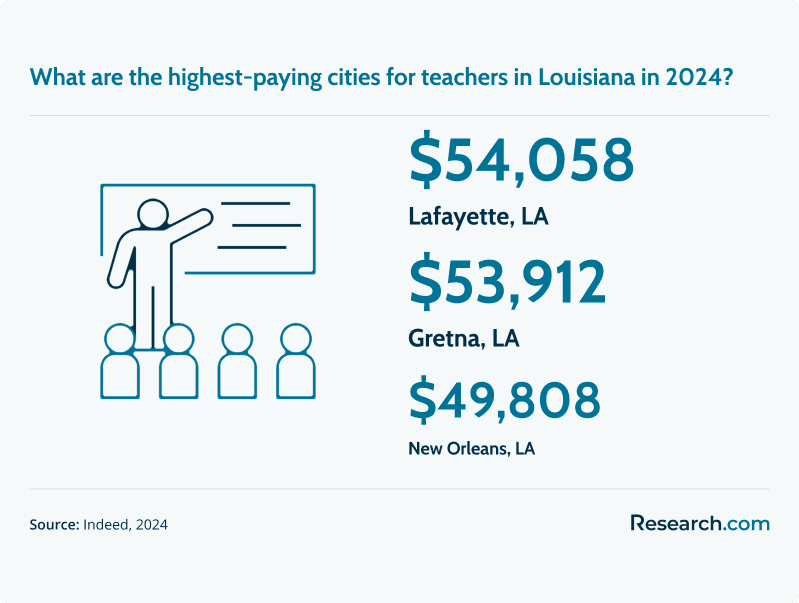
Location and specialization can also affect opportunity. Lafayette, Gretna, and New Orleans are among the highest-paying cities for teachers in the state, with average annual salaries ranging from $49,808 to $54,058. Skills and credentials can matter as well: a mathematics degree is associated with an estimated salary increase of 174.49%, special education certification with 35.64%, and video production skills with 63.31%.
The strongest career strategy is to combine certification alignment with a marketable specialty. Candidates interested in STEM, special education, or secondary education should ask programs how they prepare students for Praxis exams, classroom residency, and district hiring needs.
How much do teachers in Louisiana make?
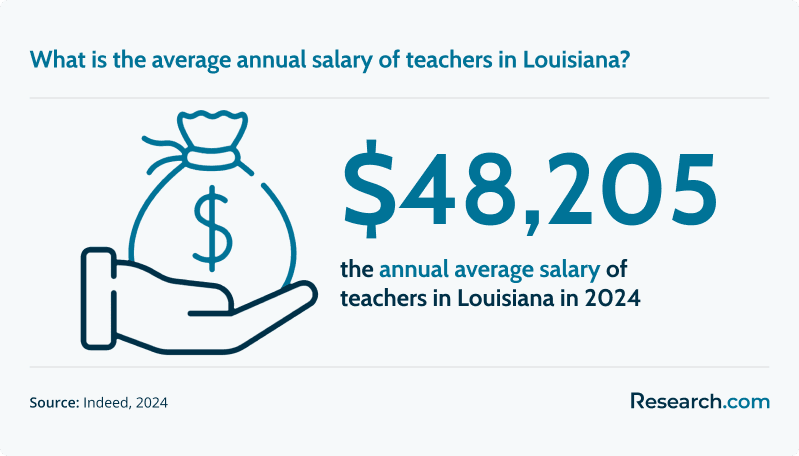
Teacher pay in Louisiana depends on district, years of experience, education level, subject area, and additional responsibilities. Teachers with less than 2 years of experience earned $44,414 to $44,481, while those with 6 to 9 years of experience earned $51,863. Teachers with more than 10 years of experience earned an average of $59,572 annually.
Across teachers in Louisiana, the average annual salary was $55,911.
| Experience level | Average annual salary stated | Planning note |
| Less than 2 years | $44,414 to $44,481 | Early-career teachers should budget carefully and ask districts about salary schedules, benefits, and stipends. |
| 6 to 9 years | $51,863 | Mid-career teachers may improve earnings through advanced credentials, leadership roles, or high-need endorsements. |
| More than 10 years | $59,572 | Experienced teachers can evaluate department chair roles, instructional coaching, administration, or graduate-level options. |
| Average for teachers in Louisiana | $55,911 | Use this as a general benchmark, not a salary guarantee for a specific district or role. |
Where can I work as a teacher in Louisiana?
Louisiana teachers can work in public schools, private schools, charter schools, specialized education programs, vocational settings, alternative education programs, and online learning environments. Your certification area will influence where you qualify to teach, while your preferred community type may influence your day-to-day experience.
Major cities such as New Orleans, Baton Rouge, and Shreveport may offer larger school systems, specialized programs, and more varied teaching environments. Rural and suburban districts may offer different advantages, including tighter school communities, broader responsibilities, or demand in hard-to-fill subjects.
| Work setting | Why it may appeal to teachers | Question to ask before applying |
| Public schools | Clear certification requirements, district salary schedules, and broad student access. | Does the district offer mentoring, induction support, and advancement pathways? |
| Private schools | May offer smaller communities, mission-driven curricula, or specialized school cultures. | What certification, degree, or experience expectations does the school set? |
| Charter schools | Can provide innovative models, school-specific missions, or flexible instructional approaches. | How does the school support new teachers and evaluate performance? |
| Specialized programs | Good fit for educators interested in special education, career preparation, alternative education, or online instruction. | Will you need additional endorsements, training, or technology skills? |
The highest-paying cities for teachers include Lafayette, LA, with an average salary of $54,058, followed by Gretna, LA, at $53,912, and New Orleans, LA, at $49,808.
What do teachers do?
Teachers design lessons, explain concepts, assess learning, manage classrooms, communicate with families, and adapt instruction for students with different needs. They also document progress, collaborate with colleagues, participate in school initiatives, and use data to adjust instruction.
The role increasingly overlaps with skills used by specialists in student development, assessment, and learning support. Candidates interested in child learning and developmental support may also want to compare classroom teaching with fields connected to educational psychology and early childhood education.
- Instruction: Plan and deliver lessons that align with curriculum standards and student readiness.
- Assessment: Use quizzes, projects, observations, and formal measures to track progress.
- Classroom management: Build routines, expectations, and relationships that support learning.
- Differentiation: Adjust materials, pacing, and supports for students with varying needs.
- Collaboration: Work with families, administrators, counselors, interventionists, and other teachers.
- Mentorship: Help students build confidence, persistence, respect, responsibility, and academic habits.
Top Teachers Programs in Louisiana for 2027
How do we rank schools?
Research.com evaluates online teaching degree programs using institutional data, program information, and outcome-focused indicators. Our ranking methodology draws from sources such as the IPEDS database maintained by the National Center for Education Statistics, Peterson's database and its Distance Learning Licensed Data Set, and the College Scorecard, which provides information on costs and outcomes.
Use rankings as a starting point, not the only decision factor. Before enrolling, verify accreditation, Louisiana certification alignment, field placement support, Praxis preparation, total cost, transfer policies, and whether online coursework meets your timeline.
1. Louisiana State University-Baton Rouge
Louisiana State University-Baton Rouge offers a Doctor of Education (EdD) in developmental education program designed for researchers, practitioners, and leaders working across areas such as human services, postsecondary education, business, industry, and government. The program emphasizes administration, counseling, instructional design, management, and support for nontraditional learners who face educational barriers.
- Program Length: 4 years
- Tracks/Concentrations: B-K, P-K tracks
- Required Credits to Graduate: 120-122
- Tuition (annual): $11,954 (in-state); $28,631 (out-of-state)
- Accreditation: Council for the Accreditation of Educator Preparation (CAEP) and the Council for Accreditation of Counseling and Related Educational Programs (CACREP)
2. University of Louisiana-Monroe
University of Louisiana-Monroe offers a Master of Education (MEd) in Educational Leadership program through Louisiana Tech University’s College of Education and Human Sciences. The program is intended for certified teachers preparing for administrative roles in elementary and secondary education. Applicants are nominated by professionals and must meet requirements that include holding a current state-issued Level II or Level III Professional Teaching Certificate or equivalent. Graduate candidates must also pass the Louisiana State Department of Education identified test for educational leaders, complete a program oral presentation, and finish a culminating e-portfolio.
- Program Length: 15 months
- Tracks/Concentrations: Various
- Required Credits to Graduate: 36
- Cost per Credit: $315
- Accreditation: Council for the Accreditation of Educator Preparation (CAEP)
3. University of Louisiana at Lafayette
University of Louisiana at Lafayette's College of Education and Human Development provides several undergraduate teacher education options. Programs include Art or Music Education for Grades K-12, BA in Early Childhood Education for Grades PK-3, BS in Elementary Education for Grades 1-5, BS in Middle School Education for Grades 4-8, and BS in Secondary Education and Teaching concentrations such as biology education, business education, and mathematics education. Students build classroom experience through fieldwork, lesson planning, teacher residency opportunities, and practical activities in local schools.
- Program Length: 4 years
- Tracks/Concentrations: Various
- Required Credits to Graduate: 127
- Cost per Credit: $1,252 (citizens); $2,123 (international)
- Accreditation: Council for the Accreditation of Educator Preparation (CAEP)
4. Louisiana Tech University
Louisiana Tech University's MEd Curriculum and Instruction program, offered online by the University of Louisiana at Monroe, is a graduate-level option for educators seeking advanced training. This 100% online program includes specializations such as Reading Specialist, English as a Second Language (ESL), and Early Intervention. Coursework focuses on instructional design, classroom diversity, student comprehension, and teaching strategies, while also supporting teacher leader certification.
- Program Length: 36 semesters
- Tracks/Concentrations: Various
- Required Credits to Graduate: 127
- Cost per Credit: $714
- Accreditation: National Council for the Accreditation of Teacher Education
5. Grambling State University
Grambling State University offers undergraduate and graduate programs in Curriculum and Instruction and Educational Leadership, Research, and Counseling in collaboration with Louisiana State University at Baton Rouge’s Lutrill and Pearl Payne School of Education. The programs prepare students for P-12 teaching roles and focus on current issues in education. Its Bachelor of Science in Early Childhood Education, recognized by the National Association for the Education of Young Children (NAEYC), prepares students for B-K and PK-3 teacher certification through hands-on experience, cohort learning, and field teaching blocks.
- Program Length: 2 to 2.5 years (EdD)
- Required Credits to Graduate: 127
- Tuition: $3,811.50 (in-state); $8,323 (out-of-state)
- Accreditation: National Council for the Accreditation of Teacher Education
Program comparison checklist
| Factor | Why it matters | Question to ask |
| Accreditation | Accreditation can affect licensure, transfer credit, employer confidence, and financial aid eligibility. | Is the education program approved for Louisiana teacher certification? |
| Clinical placement | Student teaching and fieldwork are essential for classroom readiness. | Will the school help place me in a Louisiana classroom? |
| Praxis preparation | Passing required Praxis exams is a major certification step. | What exam preparation, pass-rate support, or tutoring is available? |
| Total cost | Tuition is only one part of the price; fees, books, testing, and commuting also matter. | What is the full estimated cost through graduation and certification? |
| Format | Online, hybrid, and campus programs differ in flexibility and support. | Can I complete coursework and field experience on my schedule? |
Is teaching career in Louisiana worth it?
Teaching in Louisiana can be worth it for people who want stable community-centered work, enjoy helping students grow, and are willing to meet certification and professional development expectations. It can also be financially stronger for educators who move into specialized or advanced roles.
Some of the highest-paid teaching-related roles are at the postsecondary level. Postsecondary architecture teachers average $157,610 annually, postsecondary law teachers average $143,830, and engineering teachers average $118,470. These roles often require graduate education and subject-matter expertise, which is why educators interested in long-term advancement may compare higher-paying careers with a master’s in education or related advanced credentials.
For classroom teachers, the value calculation should include more than salary. Consider benefits, pension rules, loan forgiveness eligibility, district support, workload, commute, school culture, and whether your certification area has long-term demand. Credentials and specialized skills may also influence earning potential: a mathematics degree is associated with an estimated salary increase of 174.49%, special education certification with 35.64%, and video production expertise with 63.31%.
What are the most effective ways to advance your teaching career in Louisiana?
Louisiana teachers can advance by building expertise in high-need subjects, earning endorsements, pursuing graduate education, taking on instructional leadership, mentoring new teachers, or moving toward administration. Advancement works best when each step supports a clear goal: higher pay, stronger job security, leadership responsibility, or a move into a specialized role.
- Strengthen a high-demand subject area. Mathematics, science, special education, and literacy-related expertise can make a teacher more competitive.
- Pursue targeted certification. Add-on credentials can expand the grades, subjects, or student populations you are qualified to teach.
- Document impact. Keep evidence of student growth, successful projects, leadership work, and positive evaluations.
- Find mentors. Experienced teachers and administrators can help you navigate district expectations and promotion pathways.
- Explore adjacent specialties. For example, teachers interested in literacy and language instruction can review how to become an English teacher in Louisiana.
What is the return on investment for advanced teaching degrees in Louisiana?
The return on investment for an advanced teaching degree depends on the cost of the program, your district’s salary schedule, your desired role, and whether the credential qualifies you for leadership, specialist, or postsecondary opportunities. A master’s degree may be financially worthwhile if it leads to a pay increase, administrative eligibility, stronger job security, or access to roles outside the traditional classroom.
Before enrolling, compare total program cost with realistic career outcomes. Educators trying to control expenses can review affordable options such as the cheapest master's in elementary education, but cost should be weighed alongside accreditation, certification alignment, faculty support, and completion timeline.
What networking opportunities are available for aspiring teachers in Louisiana?
Networking can help aspiring teachers find mentors, learn about district hiring needs, prepare for interviews, and understand school culture before accepting a position. Strong networks are especially useful for career changers and online students who may not have daily access to campus-based education communities.
- Education conferences and workshops: These events connect candidates with teachers, school leaders, and subject-area specialists.
- Professional associations: Groups such as the Louisiana Association of Educators (LAE) and the Louisiana Council of Teachers of Mathematics (LCTM) can provide professional learning and peer connections.
- Field placements: Student teaching and practicum sites are often the strongest networking opportunities because administrators can see your work directly.
- LinkedIn and educator forums: Online networking can help candidates follow districts, connect with alumni, and learn about openings.
- University career services: Education departments often host job fairs, resume reviews, and district recruitment events.
How can an online child development degree enhance your teaching career in Louisiana?
An online child development degree can strengthen a teacher’s understanding of early learning, developmental milestones, family engagement, assessment, and inclusive practice. This can be useful for educators working with young children, early intervention programs, or classrooms where developmental differences shape instruction.
Online study can also help working adults and paraprofessionals continue their education without leaving their current jobs. Before enrolling, compare affordability, transfer credit rules, fieldwork requirements, and whether the program aligns with Louisiana certification goals. Research.com’s list of the most affordable online child development degree programs can help you evaluate lower-cost options.
How can I transition to a school librarian role in Louisiana?
A school librarian role can be a strong fit for teachers who enjoy literacy, research, digital resources, student support, and schoolwide collaboration. Instead of teaching one classroom all day, school librarians often support many teachers and students by managing information resources, promoting reading, teaching digital literacy, and helping students use research tools responsibly.
Teachers considering this move should review certification expectations, library science training, and technology requirements. For a focused career path, see Research.com’s guide on how to be a school librarian in Louisiana.
Can early childhood specialization boost your teaching career in Louisiana?
Early childhood specialization can help teachers build expertise in foundational literacy, numeracy, social-emotional development, play-based learning, family communication, and age-appropriate assessment. This can be valuable for educators who want to work with young children or move into leadership roles connected to early learning.
Teachers interested in this pathway should confirm grade-band certification requirements and practical experience expectations. If your goal is kindergarten or early elementary teaching, review the kindergarten teacher requirements in Louisiana before selecting a program.
What are the advantages of teaching in private schools in Louisiana?
Private schools in Louisiana may offer smaller school communities, mission-specific curricula, religious or independent school settings, specialized academic models, and closer family engagement. For some teachers, this environment can offer more curricular identity or a different type of professional culture than a public district.
However, private school expectations vary by institution. Certification, salary schedules, benefits, class sizes, and advancement pathways may differ from public schools. Before applying, review the private school teacher requirements in Louisiana and ask each employer what qualifications it requires.
How can new educators overcome initial career challenges in Louisiana?
New teachers often struggle most with classroom management, pacing lessons, grading efficiently, communicating with families, and meeting district expectations. The first year can feel overwhelming because teaching requires decisions all day, often with limited downtime.
- Use your mentor actively. Ask to observe experienced teachers and request feedback on specific routines.
- Keep classroom systems simple. Clear procedures for entering class, turning in work, asking questions, and transitioning between activities reduce stress.
- Plan backward from standards. Begin with what students need to learn, then build lessons and assessments around that goal.
- Track certification deadlines. Missing renewal or testing requirements can create avoidable career problems.
- Choose flexible training when needed. Candidates balancing work and certification can explore how to become a teacher online in Louisiana.
What are my teacher certification options in Louisiana?
Louisiana offers traditional certification for education majors, alternative certification for eligible career changers, out-of-state certification routes for licensed teachers moving into Louisiana, and substitute teaching pathways for those seeking classroom exposure before committing to full certification.
The right route depends on your current education level, whether you already hold a bachelor’s degree, your target grade level, and how quickly you want to enter the classroom. Before choosing, compare the current teacher certification requirements in Louisiana with your long-term goals.
| Certification route | Best for | Important caution |
| Traditional teacher preparation | Undergraduate students who know they want to teach. | Make sure the program is approved for your intended Louisiana certification area. |
| Alternative certification | Bachelor’s degree holders changing careers. | Fast does not always mean easy; confirm coursework, mentoring, testing, and employment rules. |
| Out-of-state application | Licensed teachers moving from another state or country. | Louisiana requires an Out-of-State (OS) Application Packet and later Praxis completion for a renewable certificate. |
| Substitute teaching | People who want classroom experience before a permanent teaching role. | Requirements and long-term certification eligibility are not the same as full teacher certification. |
How Can Substitute Teaching Provide a Gateway to Long-Term Educational Careers in Louisiana?
Substitute teaching can help aspiring educators test whether they enjoy classroom work before investing in a full degree or certification program. It also builds practical skills in classroom management, lesson follow-through, student interaction, and school routines.
By meeting the Louisiana substitute teacher requirements, candidates can gain school-based experience, build district contacts, and decide whether they want to pursue traditional or alternative certification. Substitute teaching is not a replacement for full licensure, but it can be a useful first step toward a long-term education career.
What are the current technological trends in education for teachers in Louisiana?
Technology is now part of everyday teaching. Louisiana educators use digital tools to organize assignments, communicate with students, support remote or blended learning, personalize instruction, and analyze student performance. The most effective teachers use technology to improve learning, not simply to add screens to the classroom.
- Learning Management Systems (LMS): Platforms such as Google Classroom and Moodle help teachers distribute assignments, collect work, communicate with students, and monitor progress.
- Virtual Reality (VR) and Augmented Reality (AR): Tools such as Nearpod and Google Expeditions can create immersive experiences, including virtual field trips and simulated demonstrations.
- Educational Apps: Kahoot! and Quizlet can support review, practice, and interactive learning when used with clear instructional goals.
- Data Analytics in Education: Student performance data can help teachers identify learning gaps, adjust instruction, and provide targeted support.
- Online Collaboration Tools: Zoom and Microsoft Teams support virtual meetings, tutoring, parent communication, and remote learning activities.
Teachers should also be prepared to evaluate digital tools critically. Important questions include whether a tool protects student privacy, aligns with curriculum standards, supports accessibility, and provides useful evidence of learning.
What alternative career pathways exist for Louisiana teachers?
Teaching experience can lead to roles beyond the traditional classroom. Louisiana educators may move into instructional coordination, special education consulting, educational technology, curriculum design, literacy coaching, school administration, student support, or training roles in organizations outside K-12 schools.
Some alternative roles require graduate degrees, endorsements, or specialized certification. If cost is a concern, candidates should compare pathways carefully and review the types of teaching certificates in Louisiana before enrolling in additional training.
| Alternative pathway | Good fit for teachers who enjoy | Likely preparation focus |
| Instructional coordinator | Curriculum, teacher support, assessment, and school improvement. | Advanced study in curriculum and instruction or instructional leadership. |
| Educational technology specialist | Digital tools, online learning, teacher training, and classroom innovation. | Technology integration, learning design, and data-informed instruction. |
| Special education consultant | Supporting diverse learners, compliance, individualized instruction, and collaboration. | Special education certification, intervention strategies, and documentation practices. |
| School librarian | Literacy, research, information access, and digital citizenship. | Library science, media resources, and school-based information systems. |
How can special education specialization advance your teaching career in Louisiana?
Special education specialization can make a teacher more versatile and better prepared to serve students with diverse learning needs. It strengthens skills in individualized instruction, accommodations, behavior support, progress monitoring, legal documentation, and collaboration with families and specialists.
Teachers who earn special education teacher certification in Louisiana may improve their career flexibility, qualify for specialized roles, and contribute to inclusive school practices. It is a strong option for educators who want challenging, high-impact work and are comfortable with documentation, teamwork, and individualized planning.
What are the most in-demand teaching specialties in Louisiana?
Demand varies by district, grade level, and subject area. Aspiring teachers who want to improve employability should pay attention to high-need areas such as mathematics, science, and special education. Candidates who prefer younger learners can also review how to become an elementary school teacher in Louisiana and compare that pathway with middle school, secondary, and special education options.
The best specialty is not always the one with the fastest projected growth. It should also match your strengths, patience level, communication style, subject confidence, and willingness to complete any required endorsements or exams.
What are the financial aid opportunities for aspiring teachers in Louisiana
Teacher preparation can be expensive, but aspiring educators in Louisiana may be able to reduce costs through grants, scholarships, loan forgiveness, state programs, and university-specific aid. Always confirm eligibility rules before relying on any funding source, because service commitments, enrollment status, income rules, and program type can affect qualification.
| Financial aid option | What it offers | Important requirement or caution |
| TEACH Grant | The federal Teacher Education Assistance for College and Higher Education (TEACH) Grant provides up to $4,000 annually for students pursuing a degree in education. | Recipients must commit to teaching in high-need fields or schools serving low-income communities for at least four years after graduation. |
| Louisiana Go Grant | This state-funded program supports students from low- to moderate-income backgrounds. | It is available to both full-time and part-time students, which can help working aspiring teachers. |
| TOPS Program | The Taylor Opportunity Program for Students (TOPS) is a merit-based scholarship for Louisiana residents. | It covers tuition at public colleges and universities, while private school students may qualify for partial funding. |
| Federal Loan Forgiveness Programs | Programs such as Public Service Loan Forgiveness (PSLF) and Teacher Loan Forgiveness may reduce or eliminate qualifying student loan debt. | Teachers usually must meet specific service requirements, such as working in low-income schools or high-need subject areas. |
| University-Specific Scholarships | Louisiana institutions may offer merit-based and need-based scholarships for education majors. | Examples include awards from institutions such as Louisiana State University and the University of Louisiana at Lafayette. |
Online programs may also be eligible for aid when they meet institutional and program requirements. Students considering flexible options can compare bachelor of education online programs, but they should verify accreditation, certification alignment, and financial aid eligibility before enrolling.
Common mistakes to avoid when becoming a teacher in Louisiana
| Mistake | Why it can hurt you | Better approach |
| Choosing a program without checking Louisiana approval | You may finish coursework that does not lead smoothly to state certification. | Confirm that the program is approved for your intended Louisiana grade level and subject area. |
| Looking only at tuition | Fees, books, Praxis exams, commuting, and lost work time can change the real cost. | Compare total cost through certification, not just per-credit tuition. |
| Assuming online programs handle field placement automatically | Some programs may not place you in a local Louisiana classroom. | Ask exactly how student teaching, observations, and residency placements work. |
| Waiting too long to prepare for Praxis exams | Testing delays can postpone certification and job eligibility. | Build exam preparation into your program timeline early. |
| Relying only on rankings | A highly ranked program may not be the best fit for your certification area, budget, or schedule. | Use rankings with accreditation, outcomes, advising, placement, and cost data. |
| Assuming salary outcomes are guaranteed | Pay varies by district, role, experience, and credentials. | Review district salary schedules and ask about stipends, benefits, and advancement rules. |
Other Things You Should Know About How to Become a Teacher in Louisiana
How to become a teacher without a teaching degree in Louisiana?
If you have a bachelor’s degree in a field other than education, you may be able to become a teacher in Louisiana through an approved alternative certification program. These programs are designed for career changers and other degree holders who need professional teacher preparation without completing a traditional undergraduate education major.
Alternative certification candidates typically complete training, coursework, supervised classroom experience, and required exams. Some may teach while completing certification requirements under program and district rules. Candidates must still meet Louisiana Department of Education requirements, including background checks and applicable Praxis exams.
What is the fastest way to become a teacher?
The fastest common route for someone who already has a bachelor’s degree is an approved alternative certification program. These programs are built to move eligible career changers into the classroom more quickly than a second bachelor’s degree, while still requiring coursework, training, testing, and classroom experience.
Fastest does not always mean best. Before choosing an accelerated route, ask about mentor support, completion rates, Praxis preparation, district partnerships, and whether you can realistically manage coursework while teaching or working.
Can I teach in Louisiana without a degree?
For standard teacher certification in Louisiana, a bachelor’s degree is typically required. Alternative certification programs may allow non-education bachelor’s degree holders to become teachers without completing a traditional education degree, but they do not usually remove the bachelor’s degree requirement.
Some districts may use emergency or temporary staffing options in high-need situations, but candidates should not rely on these as a long-term substitute for certification. Always check current Louisiana Department of Education and district requirements before accepting a role.
What are the GPA requirements for teacher certification programs in Louisiana?
GPA requirements vary by institution and program. Many teacher preparation programs require a minimum GPA of 2.5 or higher for admission, though some programs or subject areas may set higher standards. Candidates may also need to maintain a required GPA to remain in good standing and qualify for certification recommendation.
Because GPA rules differ, applicants should ask each program for its admission criteria, progression requirements, student-teaching eligibility rules, and any GPA standards tied to certification.
What alternative pathways are available for obtaining a teaching certification in Louisiana?
Louisiana alternative pathways are generally intended for people who already hold a bachelor’s degree and want to enter teaching without completing a traditional undergraduate teacher education program. Options may include alternative certification providers, residency-style programs, district-supported pathways, or nationally recognized routes accepted by the state.
When comparing alternatives, ask whether the pathway leads to the exact certification area you want, whether you can teach while completing requirements, what exams are required, how mentoring works, and what happens if you do not pass required assessments on the first attempt.
Related Articles for Nearby States
- 2027 How to Become a Teacher in Mississippi – What Degree Do You Need to Be a Teacher?
- 2027 How to Become a Teacher in Arkansas – What Degree Do You Need to Be a Teacher?
- 2027 How to Become a Teacher in Texas – What Degree Do You Need to Be a Teacher
- 2027 How to Become a Teacher in Alabama – What Degree Do You Need to Be a Teacher?
- 2027 How to Become a Teacher in Tennessee – What Degree Do You Need to Be a Teacher
- 2027 How to Become a Teacher in Missouri – What Degree Do You Need to Be a Teacher?
- 2027 How to Become a Teacher in Oklahoma – What Degree Do You Need to Be a Teacher?
- 2027 How to Become a Teacher in Florida – What Degree Do You Need to Be a Teacher
- 2027 How to Become a Teacher in Kentucky – What Degree Do You Need to Be a Teacher?
- 2027 How to Become a Teacher in Georgia – What Degree Do You Need to Be a Teacher
References:
- Indeed. (2026). Teacher salary in Louisiana. Retrieved from Indeed.
- Projections Central. (n.d.). Long-Term Occupational Projections. Retrieved from Projections Central.
- U.S. Bureau of Labor Statistics. (2024). Occupational Employment and Wage Statistics. Area: Louisiana. Retrieved from BLS.
Key Insights
- Most Louisiana teaching candidates need a bachelor’s degree, state-approved teacher preparation, required Praxis exams, background screening, and an application through the Louisiana Department of Education.
- Career changers with a non-education bachelor’s degree may use alternative certification, but they still need to meet testing, training, and state eligibility requirements.
- Louisiana teacher demand varies by role. Secondary school teachers have projected job growth of 3.8% through 2032, while career/technical education middle school teachers are projected at 0% growth.
- Teacher pay depends heavily on experience, district, specialization, and credentials. The average annual salary of teachers in Louisiana was $55,911, but early-career and experienced teachers may see different figures.
- Program choice matters. Before enrolling, verify accreditation, Louisiana certification alignment, field placement support, Praxis preparation, total cost, and financial aid eligibility.
- Specializations such as mathematics and special education can improve flexibility and may affect earning potential, but no degree or credential guarantees a specific salary or job offer.
- Teaching is most worth it for candidates who want student-centered work, can manage certification requirements, and choose a pathway that fits both their mission and the realities of Louisiana’s education labor market.
Other Things You Should Know About How to Become a Teacher in Louisiana
The Louisiana Department of Education issues teacher licenses in Louisiana. Applicants must meet state requirements, including an approved degree, teacher preparation, and passing scores on required exams such as Praxis tests before a certificate is granted.
In Louisiana, alternative certification programs like Teach Louisiana’s Practitioner Teacher Program offer paths for individuals holding a bachelor's degree in non-education fields. This pathway includes complete coursework and professional experience. It's a viable option for those aiming to start teaching without a traditional education degree.
Yes, prospective teachers in Louisiana must pass the Praxis series exams, including Praxis Core Academic Skills for Educators and Praxis Subject Assessments. These exams evaluate your teaching and subject-specific knowledge, ensuring you meet the state's certification standards.