PharmD Application After a Biology Degree

Co-Founder and Chief Data Scientist
A biology degree can put you close to pharmacy school admission without necessarily completing every requirement. The important decision is whether your courses qualify for the programs you want - and whether the time and cost of a Doctor of Pharmacy (Pharm.D.) match your career goal. This guide shows biology graduates how to check prerequisites, apply, compare accredited programs and plan for licensure. It also identifies costs and scheduling commitments that are easy to miss before accepting an offer.
Key Things You Should Know
- A biology bachelor's degree can support a Pharm.D. application, but each school decides which courses, labs, grades and credits meet its prerequisites; the degree itself does not waive them.
- Most traditional Pharm.D. curricula take four professional years after prerequisites; some accelerated programs have shorter, more intensive schedules. Graduation alone does not grant a pharmacist license.
- The U.S. median annual pay for pharmacists was $140,910 in May 2025, according to the Bureau of Labor Statistics. Compare that occupation-wide figure with your full education costs - not with an assumed starting salary.
Can you apply to a PharmD program with a biology degree?
A biology bachelor's degree is a valid academic starting point for applying to a Pharm.D. program, but admission depends on the specific school's prerequisite and selection rules.
Some schools admit students after completing required undergraduate coursework without a bachelor's degree; others may value or require additional preparation. A completed biology major is therefore neither a universal requirement nor a substitute for checking eligibility.
Biology graduates often bring substantial laboratory and scientific experience. They may still need courses their major did not require, such as particular chemistry sequences, mathematics or general education subjects.
Schools also evaluate grades, recommendations, interviews and evidence that applicants understand pharmacy practice. If you are comparing online pharmacy programs for science-background students, check their admissions rules and in-person commitments rather than assuming your major provides advanced standing.
What prerequisites are required for PharmD admission after biology?
There is no nationwide prerequisite checklist. Schools commonly evaluate undergraduate biology, chemistry and other science coursework, along with mathematics and general education, but the required subjects, labs, minimum grades, credit totals and course-age limits differ. Prerequisites are pre-professional coursework; they are not the professional Pharm.D. curriculum.
A useful first step is a course-by-course audit. For each school on your shortlist, compare its current admissions page and PharmCAS directory entry with your transcript, then resolve these questions with admissions staff:
- Which required courses and labs does my biology transcript satisfy, and which remain missing?
- Can I apply with a course in progress, and when must I complete it?
- Will the school accept my community-college, online-lab, AP/IB, repeated or older coursework?
- Are stated GPA and grade minimums eligibility thresholds rather than indicators of a competitive application?
The receiving school makes the final credit decision. If you need to finish a class before matriculation, compare pharmacy programs before all requirements are complete, but obtain each school's written policy before enrolling in replacement coursework. The Pharmacy College Admission Test (PCAT) was retired in January 2024; do not plan around taking it.
How do you apply to PharmD programs through PharmCAS?
PharmCAS is the centralized application service used by many, but not all, U.S. pharmacy schools. It collects application information for participating programs; each school still sets its own deadlines, supplemental requirements, interview process and admission decisions.
Once you have confirmed that a school uses PharmCAS and that your coursework fits its policy, follow this application sequence:
- Check the current application cycle, each program's deadline and whether it requires a separate supplemental application or fee.
- Request transcripts from every required institution and enter coursework as PharmCAS instructs, allowing time for processing and verification.
- Arrange recommendations from people who can describe your academic, work or service performance, using each school's stated requirements.
- Submit early enough to address verification issues, then monitor requests for interviews, remaining prerequisites and any enrollment deposit.
A strong biology record does not guarantee admission. Applicants returning to school should also check policies on older coursework and recommendations; pharmacy programs for nontraditional applicants can be a starting point for a shortlist, not a substitute for current school requirements.
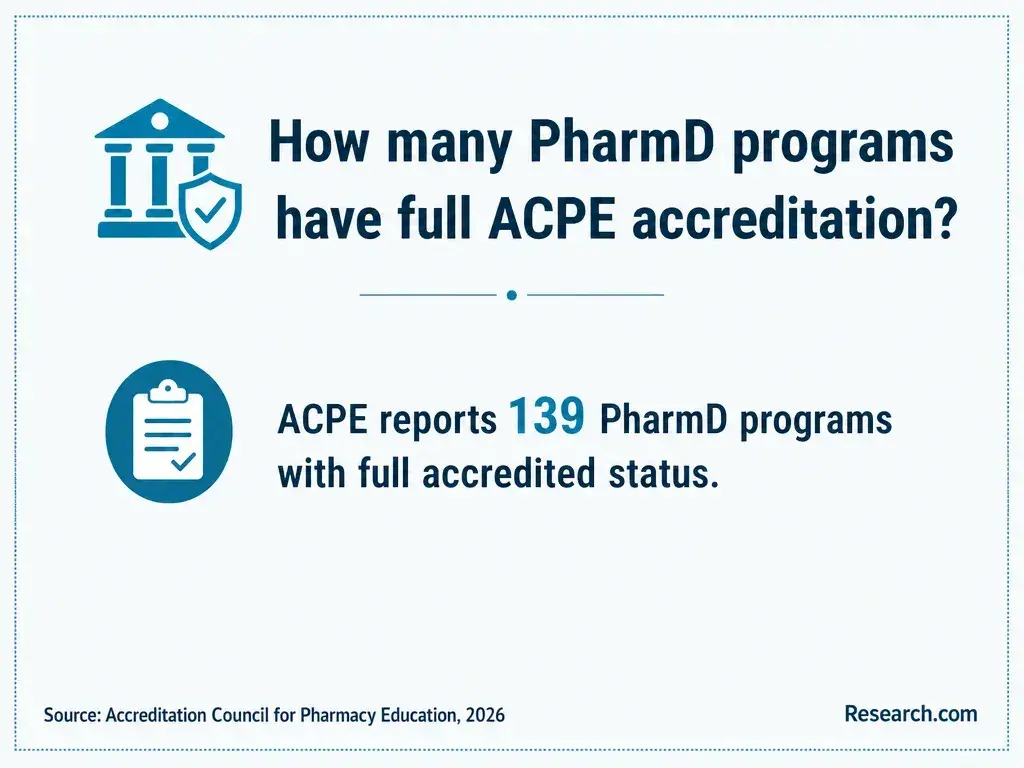
The Accreditation Council for Pharmacy Education (ACPE) accredits professional Pharm.D. programs, not individual pharmacists. Before committing, check the program's current status in ACPE's official directory and ask the licensing board where you intend to practice whether the degree meets its education requirements.
Accreditation status, institutional accreditation and permission to enroll a student in an online program from a particular state are separate matters. An accredited Pharm.D. is an important part of the usual U.S.-educated pharmacist licensure pathway, but it is not a license. State boards also impose examination and other requirements.
Be especially cautious when a program is described as an inexpensive or quick "pharmacy doctorate": short online doctorate programs in other fields do not replace a qualifying Pharm.D. for pharmacist licensure. Internationally educated pharmacists follow a different eligibility pathway and should check National Association of Boards of Pharmacy (NABP) and state-board rules.
The professional curriculum moves beyond a biology major's study of living systems to the use of medicines in patient care. Typical subjects include pharmacology, pharmacotherapy, medicinal chemistry, calculations, drug information, medication safety, patient assessment, communication and pharmacy law. Students apply that knowledge to decisions about medication selection, monitoring and counseling under appropriate supervision.
Programs also include experiential education: introductory pharmacy practice experiences (IPPEs) introduce practice settings, while advanced pharmacy practice experiences (APPEs) provide more extensive rotations later in the curriculum.
Settings, scheduling and placement responsibilities vary by school. Review a program's published curriculum and ask who approves sites, whether travel is likely and what intern registration or health requirements apply.
Prior biology coursework usually satisfies admission prerequisites rather than replacing professional courses or rotations. If you have studied elsewhere, pharmacy degree programs for transfer students may help you identify schools to contact, but only the receiving program can determine whether any credit applies to its Pharm.D. curriculum.
A traditional full-time Pharm.D. generally takes four professional years after prerequisites. Some accelerated programs compress the professional curriculum into about three years, often with shorter breaks and less scheduling flexibility. Your biology degree does not automatically shorten either route; missing prerequisites add time before enrollment.
The comparison below separates time spent becoming eligible from time in the professional program, which is the distinction most likely to change your plan.
| Starting position or route | Typical timing implication | Main trade-off |
| Biology graduate with all prerequisites met | Can apply for the program's next eligible intake | Must still complete the professional curriculum |
| Biology graduate missing prerequisites | Needs additional coursework before the school's required deadline | Added tuition and a possible delay to matriculation |
| Accelerated Pharm.D. route | Shorter professional calendar if admitted | More intensive schedule and potentially less time for paid work |
When reviewing Doctor of Pharmacy accelerated tracks, compare the actual academic calendar, rotation schedule and total cost - not just the number of years advertised. Licensure steps after graduation also take time.
Some Pharm.D. programs offer online or hybrid instruction, but "online" does not mean fully remote, self-paced or compatible with unrestricted full-time work. A program may require live classes, on-campus labs or assessments and in-person IPPEs and APPEs. Placement near home is not something to assume.
For each option, ask for its current schedule of live sessions and campus visits, its clinical-site approval process, and any states where enrollment or placements are restricted.
Also confirm who arranges rotations, what travel you might bear and whether intern registration is required where you train. Doctor of Pharmacy study online may reduce routine commuting, but it does not remove hands-on training or state-specific licensure checks.
There is no reliable single price for a biology graduate. Your cost depends on residency-based tuition, the school's fees, missing prerequisites, program length and where rotations occur. Ask each school for its current academic-year cost of attendance and an estimate covering the entire pathway - not just first-year tuition.
These cost categories make school estimates easier to compare on the same basis. A low advertised tuition figure can lose its advantage if it excludes substantial required travel or prerequisite study.
| Cost category | What to include in your comparison |
| Before enrollment | Outstanding prerequisites, application charges and transcript costs |
| Professional program | Tuition, mandatory fees, books, technology and required supplies |
| Experiential training | Background checks, immunizations, transportation and possible temporary housing |
| After graduation | Licensure applications, examinations and any moving costs |
An online Pharm.D. cost comparison is useful only if you also account for campus visits and rotations. Federal borrowing rules changed for many new graduate and professional borrowers beginning July 1, 2026; ask the financial aid office to explain the rules that apply to your enrollment date and circumstances before assuming a particular loan will cover your full cost.
Licensed pharmacists work in community and hospital pharmacies and may pursue roles in ambulatory care, specialty pharmacy, managed care or other settings. Duties and hiring expectations differ: a residency is often relevant to some clinical positions but is not required for every pharmacist job.
A fellowship may support certain research or industry paths; neither postgraduate route substitutes for state licensure when the role requires it.
According to the Bureau of Labor Statistics, pharmacists had median annual pay of $140,910 in May 2025, with 5% projected job growth, 2025-2035 and about 12,500 projected openings per year. Those occupation-wide figures do not predict a new graduate's pay, a local job market or a return on a particular school's tuition.
If your goal is a pharmacy-adjacent job rather than pharmacist practice, examine shorter online pharmacy study options before taking on a Pharm.D. Pharmacy technician work is a separate occupation that does not ordinarily require a Pharm.D.; a pharmaceutical sciences role may call for different training. Choose the professional degree when the work you want actually requires pharmacist education and licensure.
What licensing exams and requirements follow PharmD graduation?
Graduation from a qualifying Pharm.D. program establishes an education credential; the state board decides whether to issue a pharmacist license. U.S.-educated applicants generally must meet their board's eligibility rules and pass the North American Pharmacist Licensure Examination (NAPLEX). Jurisprudence requirements vary: a jurisdiction may use the Multistate Pharmacy Jurisprudence Examination (MPJE), the Uniform Multistate Pharmacy Jurisprudence Examination (UMPJE) or another approach. Check the board's current rules rather than assuming the MPJE applies everywhere.
Boards may also require an application, fees, supervised experience, background review or other state-specific steps. Passing an exam alone does not authorize practice. Even if you find affordable pharmacy studies with a focused timeline, leave room in that timeline and budget for board processing and examinations. If you expect to practice in a particular state, confirm its requirements before enrolling - not after graduation.
Other Things You Should Know About PharmD
Requirements vary by school. Even when experience is not mandatory, observing pharmacists or working in a pharmacy can help you assess the job and discuss your motivation in an interview.
Often, yes, if the school accepts that type of recommender. Choose someone who can give specific examples of your work, and check whether a program also requests a pharmacist or course-instructor reference.
Possibly, but schools set their own international-credit and transcript-evaluation policies. Ask each admissions office what documentation it requires before relying on those courses.
Not necessarily. Research roles have different education requirements; some may suit a biology graduate or call for another graduate degree. A Pharm.D. is most directly relevant when your intended work depends on pharmacist training or licensure.
- Predictors of Academic Success in a Doctor of Pharmacy Program - PMC https://pmc.ncbi.nlm.nih.gov/articles/PMC1637008/
- PharmD Application Process - School of Pharmacy https://wwwtest.pharmacy.wisc.edu/pharmd/application-process/
- Professional development | indiana.edu https://guidebook.hppla.indiana.edu/pharmacy/professional-development.html
- Prerequisite Information - UW School of Pharmacy https://sop.washington.edu/pharmd/admissions/prerequisite-info/
- Admissions FAQ | Doctor of Pharmacy Program https://www.umes.edu/pharmd/admissions-faq/
- Step Two: PharmCAS Application - UMKC School of Pharmacy https://pharmacy.umkc.edu/admissions/pharmd-application-process/step-two-pharmcas-application.html
- How to Apply to the PharmD Program | Texas A&M University Irma Lerma Rangel College of Pharmacy https://pharmacy.tamu.edu/pharmd/apply.html
- Pharmacy | Pre-Health Advising https://prehealth.ucmerced.edu/health-careers/pharmacy
- PharmD Admissions Selection Criteria | Doctor of Pharmacy https://pharmacy.wisc.edu/pharmd/selection-criteria/
- Pharmacy (BS to PharmD) - Philadelphia | Saint Joseph's University https://www.sju.edu/degree-programs/bs-doctor-pharmacy-pharmd