Community Pharmacist Salary and Work Schedule

Co-Founder and Chief Data Scientist
Community pharmacy can offer strong pay, but the hours may include evenings, weekends, and holidays. If you are considering a Doctor of Pharmacy (Pharm.D.) degree or a move into retail practice, salary alone will not tell you whether the career fits your life. This guide separates national pay data from what an individual employer might offer, explains how staffing and store hours shape the workweek, and outlines the education and licensing commitments behind the job. Use it to weigh earning potential against schedule flexibility, training costs, and the realities of patient-facing work.
Key Things You Should Know
- The median annual pay for pharmacists was $140,910 in May 2025, according to the Bureau of Labor Statistics (BLS). That figure covers pharmacists across settings, not community pharmacists alone.
- Community pharmacist shifts follow the pharmacy's operating hours and staffing needs; evenings, weekends, holidays, and time spent closing after customer hours may be part of an offer.
- A Pharm.D. and state licensure are the standard route into U.S. pharmacist practice. BLS projects 5% growth for pharmacists in 2025-2035, but that projection does not guarantee openings at a particular store or location.
What does a community pharmacist do, and where do they work?
Community pharmacists provide medication services directly to people outside hospitals, commonly in chain pharmacies, independently owned pharmacies, and grocery or mass-merchandise pharmacies.
They review prescriptions for safety and appropriateness, oversee dispensing, counsel patients, resolve insurance or prescriber questions, and supervise pharmacy technicians. Depending on state law, employer policy, and additional training, they may also administer vaccines or provide other clinical services.
The work combines clinical judgment with a high-volume service operation. A pharmacist remains responsible for professional decisions even when technicians prepare prescriptions or automated systems assist with dispensing.
If you prefer extended patient appointments over frequent interruptions and competing tasks, ask prospective employers how they staff counseling, immunization, and dispensing work.
A pharmacy technician is a different occupation with different education and legal responsibilities. If your goal is to work in a pharmacy without becoming the licensed pharmacist responsible for prescriptions, compare technician training and other low-cost and shorter pharmacy degree programs before committing to a Pharm.D. A shorter credential does not qualify its holder for pharmacist licensure.
How much do community pharmacists earn in the United States?
The BLS reports median annual pay of $140,910 in May 2025 for pharmacists. The median means half of pharmacists earned more and half earned less; it is not a starting salary or a community-pharmacy-specific figure. Actual offers depend on location, employer, experience, hours, and whether the position includes management duties.
Compare offers using more than the annual figure. A quoted salary may assume a particular weekly schedule, while an hourly offer can vary with assigned shifts.
Ask whether bonuses are discretionary, how paid leave and health coverage work, and whether travel between stores is compensated. An offer with higher pay may be less attractive if it requires a longer commute, more holidays, or unpredictable shifts.
For a prospective student, the useful comparison is expected take-home capacity against the full cost of qualifying for the job - not salary against advertised tuition alone.
Build a budget that includes prerequisites, Pharm.D. tuition and fees, living costs, rotation travel, and borrowing costs. A pharmacy doctorate financial planning comparison can help frame that calculation, but request current cost and aid details from each school before deciding.
What is a typical community pharmacist work schedule?
Many community pharmacists work shifts that cover the pharmacy's public hours, including evenings and weekends where the store is open. A full-time role may use rotating shifts rather than a consistent weekday schedule.
Some jobs involve holiday coverage, opening and closing duties, or shifts at multiple locations. The exact pattern depends on store hours, prescription volume, staffing, and the employment agreement.
The table shows why two jobs with similar pay can feel very different. These are scheduling patterns to compare, not promises about any employer.
| Schedule feature | What it can mean for your workweek |
| Fixed-store rotation | A familiar team and commute, with possible alternating opening, closing, or weekend shifts |
| Floating coverage | Assignments at different stores, with potentially changing commutes and start times |
| Extended store hours | More evening or holiday coverage, even if the position's total hours are similar |
Before accepting an offer, request the actual rotation, expected weekly hours, weekend and holiday frequency, notice given for changes, and expectations when a technician calls out. Also ask whether required closing work fits within paid time.
If you plan to study while employed, remember that estimates of online doctoral study duration do not establish whether a Pharm.D. program's scheduled classes and in-person rotations can fit around your shifts.
For the usual U.S.-educated pathway, aspiring community pharmacists complete a professional Doctor of Pharmacy (Pharm.D.) program accredited by the Accreditation Council for Pharmacy Education (ACPE), then meet the licensing requirements of the state where they intend to practice.
Undergraduate pre-pharmacy courses prepare applicants for admission; they are not the professional Pharm.D. curriculum. A completed bachelor's degree is not universally required for entry, although individual schools set their own rules.
Students coming from biology, chemistry, or another field should compare their transcripts with each school's prerequisites rather than assume their major covers them.
Guidance on Pharm.D. admission after pre-pharmacy coursework can help identify questions to take to admissions staff. A pharmaceutical sciences degree, pharmacology degree, or pharmacy technician credential does not substitute for the professional degree and license required to practice as a pharmacist.
Graduating with a Pharm.D. does not itself authorize someone to practice. State boards of pharmacy issue pharmacist licenses. For U.S.-educated applicants, the process generally involves an eligible pharmacy degree, required supervised experience, the North American Pharmacist Licensure Examination (NAPLEX), and any jurisdiction-specific law examination or other board requirements.
Rules for intern registration, background checks, experience hours, and continuing education vary by state. Check the board in the state where you want to work before enrolling, particularly if your program or clinical placements cross state lines.
Do not assume every jurisdiction uses the Multistate Pharmacy Jurisprudence Examination (MPJE): requirements differ, and some jurisdictions began transitioning to the Uniform Multistate Pharmacy Jurisprudence Examination (UMPJE) in 2026. Passing an exam is only one part of obtaining a license.
Returning students should keep admission flexibility separate from licensing eligibility. A school may offer pharmacy school routes for returning students, but an admission offer does not waive prerequisite completion conditions, intern-registration rules, or later board requirements.
Internationally educated pharmacists may face a separate credential-evaluation and certification pathway; they should confirm requirements with the relevant state board and the National Association of Boards of Pharmacy.
A Pharm.D. builds on prerequisite science coursework with professional study of pharmacology, therapeutics, patient assessment, medication safety, pharmacy law, and communication.
Students learn to apply that knowledge to medication decisions and explain those decisions to patients and other clinicians. Schools also require supervised experiential education: introductory pharmacy practice experiences (IPPEs) during the program and more intensive advanced pharmacy practice experiences (APPEs), typically later in the curriculum.
Community pharmacy is an important training setting, but students also learn in other practice environments. Rotations require approved sites and preceptors and may involve daytime availability, travel, background checks, immunizations, or state intern registration.
Ask each school who arranges placements and whether a placement near home is possible; do not assume a current pharmacy job can replace a required rotation.
Be careful when comparing credentials by speed. Claims about online pharmacy program length may describe pharmacy-related credentials rather than a licensure-qualifying Pharm.D. Check the exact degree and its required hands-on training before treating a shorter program as a route to pharmacist practice.
Students must complete a school's pre-professional prerequisites before starting its professional Pharm.D. curriculum, unless admitted through a pathway that incorporates them.
The professional phase commonly takes several academic years; the total timeline depends on previously completed coursework, course sequencing, and program design. Some Pharm.D. programs with an accelerated format compress the calendar, but a shorter calendar can leave less room for paid work or breaks.
There is no responsible single price for pharmacy school: tuition and required fees vary by institution, residency status, and academic year. Compare each school's current 2026-27 cost of attendance, not just its tuition headline.
Include prerequisite courses, books and clinical references, equipment, checks and immunizations, rotation travel or housing, and licensing-related expenses. Ask whether tuition changes during the program and whether an accelerated calendar changes living costs or opportunities to earn income.
Before borrowing, confirm your own eligibility and limits with each school's financial aid office. Federal borrowing rules changed for many new graduate and professional students beginning July 1, 2026, so an older description of Grad PLUS access or loan limits may not apply to a new entrant. A lower-priced program is not automatically the better financial choice if its location, placement travel, or schedule substantially raises your total cost.
Requirements vary by school. Applicants typically need specified pre-professional courses and transcripts, while schools may also evaluate grades, recommendations, experiences, interviews, and written responses.
Science labs, minimum grades, course-age rules, and whether unfinished prerequisites are allowed at application or enrollment are program-specific. The Pharmacy College Admission Test (PCAT) was retired in January 2024; it is not a current exam applicants can plan to take.
Review each school's current admissions page and, if it participates, its PharmCAS listing. PharmCAS is an application service, not a universal requirement or a substitute for a school's supplemental steps. Use pharmacy program applicant requirements as a starting point for comparison, then confirm deadlines, prerequisite equivalencies, and selection criteria directly with the programs. Meeting a published minimum does not guarantee admission.
Online or hybrid instruction can reduce routine travel to lectures, but it does not remove scheduled coursework, hands-on requirements, or in-person IPPEs and APPEs. "Online" also does not necessarily mean self-paced: programs may require live sessions, campus visits, proctored assessments, and a fixed cohort sequence.
Campus-based study offers more routine in-person contact but may require relocation or a longer commute. When reviewing Doctor of Pharmacy distance learning programs, verify that the professional Pharm.D. program has the appropriate ACPE status.
Check institutional accreditation and authorization to enroll you in your state separately; neither substitutes for ACPE professional-program accreditation or guarantees eligibility for every clinical placement or state license. Ask for a written calendar of required visits and rotations, plus the school's placement responsibilities, before deciding that the format will let you keep a full-time job.
What is the job outlook for community pharmacists, and how can students choose a reputable program?
The BLS projects 5% growth for pharmacists in 2025-2035, with about 12,500 openings per year. Those are occupation-wide projections, not forecasts specifically for community pharmacies. They support looking into the profession, but local hiring conditions and the kinds of shifts available matter more when judging a particular job market.
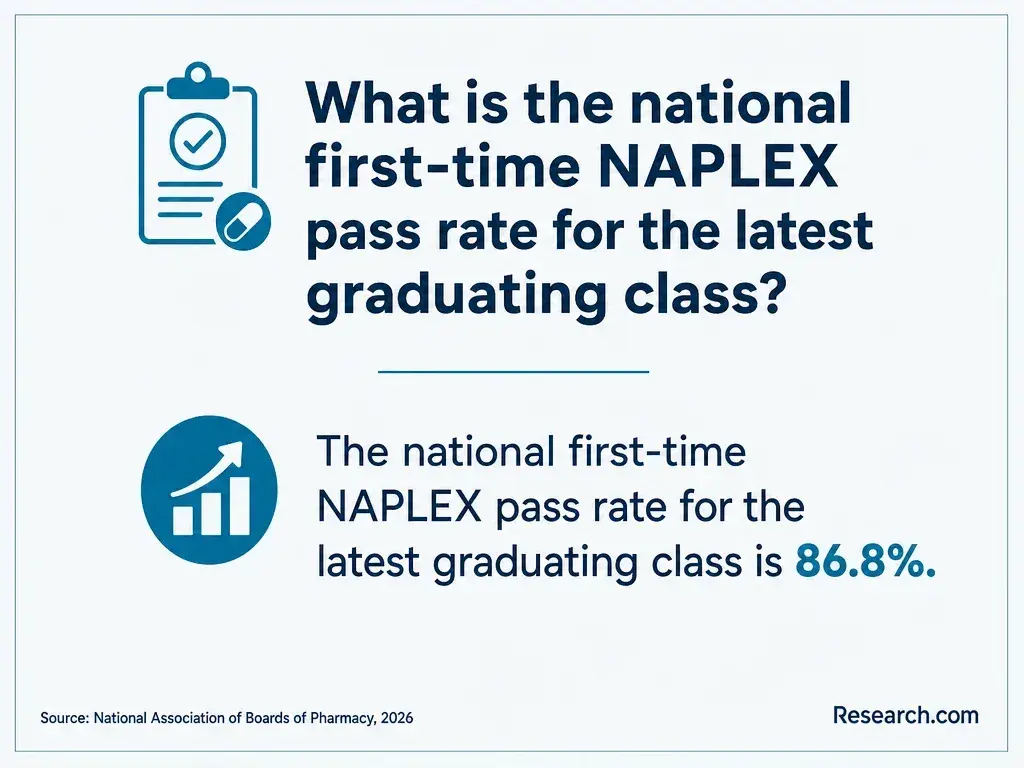
For a program decision, start with ACPE's professional-program accreditation records, then examine the school's curriculum, published NAPLEX outcomes, total costs, and rotation support.
Interpret exam outcomes in context rather than treating one year's result as a guarantee. If you have prior college work, investigate pharmacy programs with transfer pathways, but get the receiving school's evaluation of how each course applies; transferable prerequisite credit is not the same as credit toward the professional curriculum.
Choose community pharmacy if its mix of medication expertise, frequent patient contact, and operating-hour shifts appeals to you - not solely because the national median pay is attractive. Before committing to a school or employer, confirm the program's licensure pathway and full cost, then compare local job postings and ask employers for actual schedules, staffing expectations, and written compensation terms.
Other Things You Should Know About PharmD
No single rule covers every job. Pay for breaks depends on applicable law, the position's pay arrangement, and employer policy. Ask how breaks are scheduled and paid, particularly when only one pharmacist is on duty.
Not necessarily. Overtime eligibility depends on applicable wage-and-hour law and how the job is classified, not simply on the pharmacist title. Have the employer explain its policy in writing.
Yes, some employers offer part-time positions. Confirm minimum shifts, weekend expectations, and benefit eligibility, which may differ from a full-time offer.
A floating pharmacist covers shifts at more than one pharmacy location. Before accepting such a role, clarify the service area, travel expectations, advance notice for assignments, and reimbursement policy.
- More Than 60% of U.S. Pharmacists Were Women but They Earned Less Than Their Male Counterparts | Census.gov https://www.census.gov/library/stories/2024/10/american-pharmacists-month.html
- Pharmacy Practice in High-Volume Community Settings - PMC https://pmc.ncbi.nlm.nih.gov/articles/PMC8167746/
- Pharmacy Career Outlook: Is a Career in Pharmacy Worth It? | Roseman University https://www.roseman.edu/student-experience/news/pharmacy-career-outlook-is-a-career-in-pharmacy-worth-it/
- Clinical Pharmacist Salary Range for Your Job Posting | accp.com https://careers.accp.com/career-resources/employer-4/clinical-pharmacist-salary-range-for-job-posting-153
- 2024 National Pharmacist Workforce Study | AACP https://www.aacp.org/node/3746
- Community Chain | pharmacist.com https://www.pharmacist.com/Career/Career-Pathways/Career-Option-Profiles/Community-Chain
- Nontraditional work schedules for pharmacists | Ovid https://www.ovid.com/00043627-200811150-00021
- Competition, Consolidation, and Evolution in the Pharmacy Market | Commonwealth Fund https://www.commonwealthfund.org/publications/issue-briefs/2021/aug/competition-consolidation-evolution-pharmacy-market