
Government pharmacist career path after a PharmD

Co-Founder and Chief Data Scientist
A government pharmacy job can mean caring for veterans, supporting public health, reviewing drug information, or managing medication programs - but these jobs do not share one hiring checklist. If you are choosing a Pharm.D. program or deciding what to do after graduation, the important questions are which agency and role you want, where you must be licensed, and whether additional training is worth the time and cost. This guide separates requirements from preferences so you can target realistic openings and avoid paying for credentials you may not need.
Key Things You Should Know
- A clinical government pharmacist generally needs a Pharm.D. and an active pharmacist license; the acceptable licensing jurisdiction depends on the position. A Pharm.D. alone does not authorize practice.
- Residency and board certification can strengthen applications for specialized clinical roles, but neither is universally required for government pharmacy employment.
- The Bureau of Labor Statistics reports $140,910 median annual pay for pharmacists in May 2025 and projects 5% growth from 2025-2035; neither figure isolates government jobs.
What does a government pharmacist do after earning a PharmD?
Government pharmacists use medication expertise in patient care, public programs, regulation, and operations. A Department of Veterans Affairs (VA) pharmacist might review therapies and counsel patients; a public health pharmacist might coordinate vaccination services or medication access; and a regulatory pharmacist might evaluate drug-related information rather than dispense prescriptions. The actual duties - and whether a pharmacist license is required - come from the position description.
This distinction matters if you are still choosing a degree. Someone interested mainly in laboratory research or policy analysis should compare the required credentials for those jobs before committing to a professional pharmacy degree. Pharm.D. programs for biology majors may be worth exploring if your goal specifically involves pharmacist practice or roles that value clinical medication training.
How do you become a government pharmacist with a PharmD?
The direct route is to complete the education and licensing requirements, then apply to vacancies whose stated qualifications you meet. A residency, fellowship, or advanced degree is a separate decision driven by the work you want to do - not an automatic next step for every graduate.
Use this sequence to test whether a particular career target is realistic before investing in extra training:
- Identify actual vacancy titles and read their duties, citizenship or appointment conditions, license requirements, and specialized-experience criteria.
- Complete any required undergraduate prerequisites and an eligible professional Pharm.D. program; prerequisite study is not the Pharm.D. curriculum.
- Meet the applicable board's intern, examination, background-check, and other licensure requirements. Passing the NAPLEX alone does not issue a license.
- Build relevant experience through clinical rotations, internships, direct employment, residency, or fellowship, depending on the vacancy.
- Apply through the agency's stated hiring channel and tailor your application to its documented qualifications.
If you have not started pharmacy school, compare pharmacy application eligibility pathways against each school's current prerequisites. A school's willingness to consider an applicant with coursework in progress does not waive its conditions for enrollment or eventual licensure.
Which government agencies hire pharmacists with a PharmD?
Agency names are useful starting points, but the vacancy - not the agency alone - determines whether a role is clinical, regulatory, operational, or research-focused. This comparison shows where to look and what distinction to check.
| Employer or setting | Potential pharmacist work | Key hiring distinction |
| VA | Veteran care, ambulatory services, inpatient pharmacy, and medication-use programs | Clinical responsibilities and license conditions vary by vacancy. |
| Department of Defense and military health facilities | Patient care and pharmacy operations | Civilian and uniformed positions have different appointment conditions. |
| Indian Health Service and participating tribal health programs | Clinical care and community-based medication services | The employing organization, duty station, and applicable practice rules matter. |
| Food and Drug Administration | Drug review, safety, policy, and regulatory work | Some positions value pharmacy training without requiring a practice license; check the announcement. |
| Federal, state, and local public health or correctional systems | Population health, medication access, direct care, and program administration | Licensing and hiring rules depend on the employer and role. |
Start with openings whose duties match your interests, then work backward to qualifications. The availability of online pharmacy education options does not determine whether an agency accepts a credential: confirm professional-program accreditation and the vacancy's education requirements separately.
A patient-care pharmacist position generally requires a current, unrestricted pharmacist license. Some federal positions accept a license from any U.S. state or other jurisdiction named in the announcement, while state and local positions commonly require licensure in the relevant jurisdiction. Never assume a federal hiring rule also grants authority for every task or every nonfederal practice site.
State boards determine the pathway to a license, including examination and other eligibility requirements. U.S.-educated applicants generally encounter the North American Pharmacist Licensure Examination (NAPLEX), but jurisprudence requirements differ by jurisdiction; do not assume every state uses the MPJE. Internationally educated applicants may face additional credentialing requirements. Check the relevant board and the hiring announcement before scheduling exams or relocating.
Prior college work may help with admission, but pharmacy transfer credit requirements are set by the receiving school. Transferred undergraduate credits do not substitute for a pharmacist license or automatically satisfy the professional Pharm.D. curriculum.
For someone planning to become a U.S.-licensed pharmacist, the program's Accreditation Council for Pharmacy Education (ACPE) professional-program status is a critical check. ACPE accredits pharmacy education programs, not individual pharmacists. A degree from an accredited program does not itself provide licensure, and a government employer may impose additional education or eligibility conditions.
Check the program's current ACPE status directly before enrolling, especially if its name, ownership, or delivery model has changed. Institutional accreditation concerns the college or university as a whole; authorization to enroll online students in a state is another separate issue. Neither should be mistaken for ACPE professional-program accreditation or a state board's licensure decision.
When comparing a low-cost online pharmacy doctorate with a campus option, also confirm required in-person labs, introductory and advanced clinical experiences, placement arrangements, and eligibility in your intended licensing jurisdiction. An online label does not mean a fully remote route to pharmacist practice.
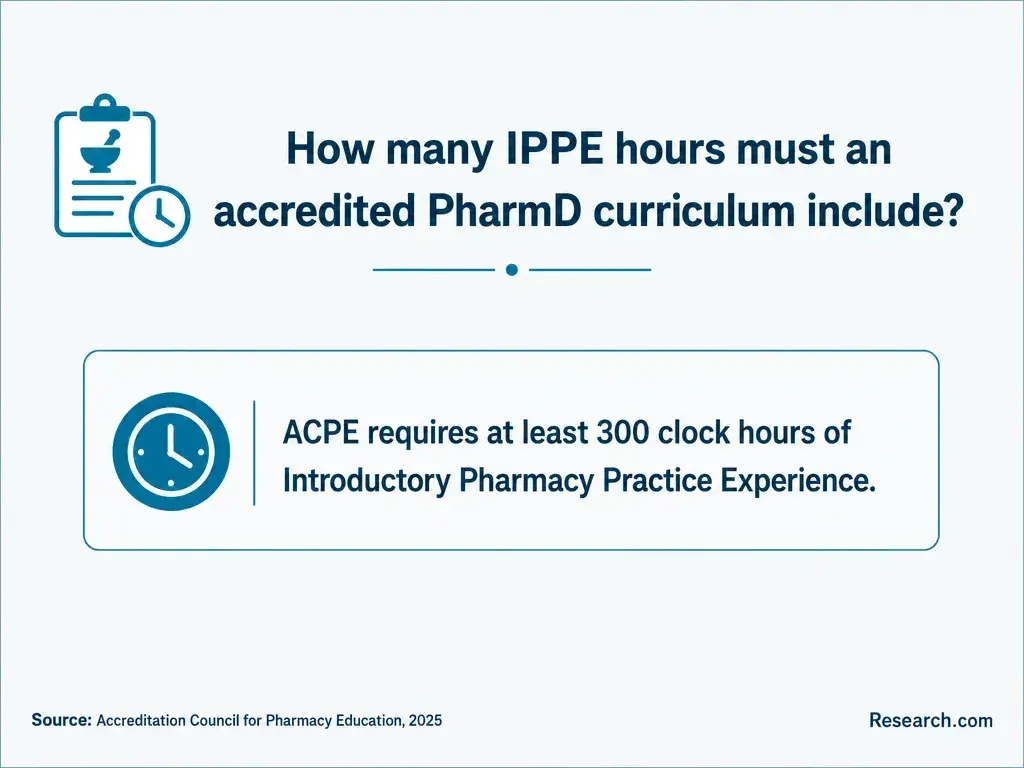
The professional Pharm.D. combines classroom learning with supervised introductory pharmacy practice experiences (IPPEs) and advanced pharmacy practice experiences (APPEs). Undergraduate pre-pharmacy courses prepare students to enter that curriculum; they are not a substitute for it. Government-focused preparation can include rotations in ambulatory care, hospitals, public health, or other relevant settings when a school offers and approves them.
After graduation, direct employment may be suitable for an opening that accepts entry-level licensed pharmacists. A postgraduate year one (PGY1) residency provides broad, structured practice training; a postgraduate year two (PGY2) residency concentrates on a specialty and generally follows PGY1 training or another qualifying route specified by the program. Fellowships more often emphasize research, policy, or other program-specific work. Compare each opportunity's current eligibility, application process, compensation, and required relocation before applying.
For applicants trying to reduce time in school, accelerated online pharmacy programs deserve a schedule check, not just a duration comparison. Required clinical placements, in-person work, and licensure steps remain consequential even when academic terms are compressed.
Government careers span direct patient care and work that affects medication use across a population. The best specialty to pursue depends on whether you want continuing relationships with patients, facility-based clinical work, or systems-level decisions.
These common directions illustrate what to look for in vacancy descriptions:
- Ambulatory and primary care: chronic-disease medication management and patient education where authorized by the practice setting.
- Inpatient and specialty care: medication review, interdisciplinary care, and services such as oncology or infectious diseases.
- Public health and population health: medication-access initiatives, prevention programs, and evaluation of medication-use patterns.
- Regulatory and medication safety: drug information, safety evaluation, policy, and quality work that may not involve dispensing.
- Operations and leadership: formulary processes, supply systems, informatics, and pharmacy-service management.
Specialty titles do not establish a universal residency or certification requirement. Likewise, pharmacy schools that may be easier to enter do not provide a shortcut into a competitive government specialty; compare their accreditation, clinical opportunities, cost, and outcomes rather than admissions selectivity alone.
Not universally. Licensure is a legal practice requirement for pharmacist positions that call for it; a residency is postgraduate training; and Board of Pharmacy Specialties (BPS) certification is a separate specialty credential with its own eligibility and examination rules. Employers may require, prefer, or not mention these additional qualifications.
A residency is most worth considering when the vacancies you want consistently request advanced clinical experience that you cannot readily gain through direct employment. Weigh that advantage against the time commitment, application effort, and foregone earnings. Board certification may become useful after you have the qualifying training or practice experience, but it does not replace licensure.
Be cautious with claims about fastest online pharmacy degree programs. A short program may serve a different educational purpose; verify that it is an eligible professional Pharm.D. pathway before treating it as a route to a licensed government pharmacist job.
The Bureau of Labor Statistics reports median annual pay of $140,910 in May 2025 for pharmacists overall. That is a benchmark for the occupation, not a government-only salary or an offer a new graduate should expect. For a specific job, compare its published pay range with the duty location, grade or classification, experience requirements, and potential promotion path.
Benefits can include health coverage, retirement programs, paid leave, and training support, but eligibility and terms differ across federal, state, local, civilian, and uniformed employment. Evaluate the full offer against tuition debt, relocation, and the earnings you would forgo during optional postgraduate training. Affordable pharmacy studies with a focused timeline can help frame the education decision, but advertised tuition alone leaves out fees, travel, rotations, and licensure costs.
If you expect to borrow for school, obtain a current aid estimate rather than relying on an older loan-limit example. Federal borrowing rules changed for many new graduate and professional borrowers beginning July 1, 2026, and eligibility depends on the student and program.
What is the job outlook for pharmacists in government agencies?
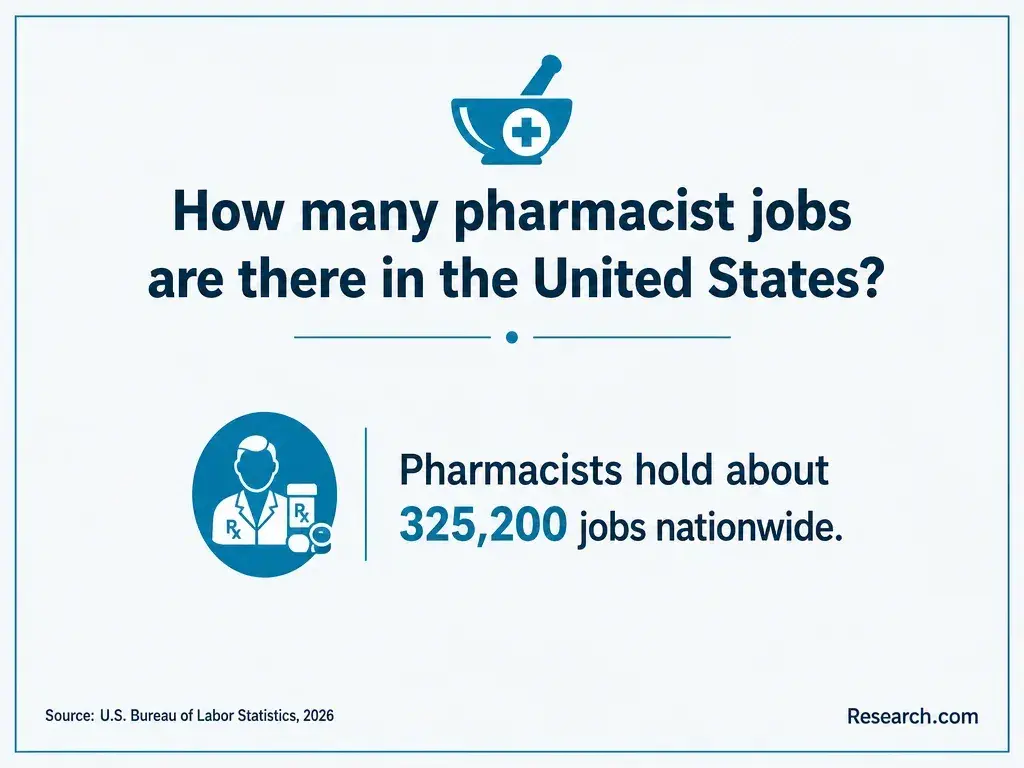
The Bureau of Labor Statistics projects 5% growth for pharmacists from 2025-2035, with about 12,500 openings per year projected across the occupation. Those projections include employers beyond government, so they cannot tell you how many VA, FDA, or state-agency positions will open in your preferred location.
Government hiring depends on agency needs, funding, vacancies, and the match between your qualifications and a specific posting. A narrow location preference or interest in one specialty can make the search more competitive than the occupation-wide outlook suggests. Nor should broad pharmacist demand be read as evidence that shorter online doctorate completion periods lead to pharmacist eligibility; the credential and licensure pathway must match the job.
For a practical next step, collect several current postings in your target setting and compare their required licenses, experience, and preferred training. If you meet the requirements now, apply rather than assuming you need another credential. If the same gap repeatedly blocks you, choose a rotation, job, residency, or other training route that addresses that specific gap.
Other Things You Should Know About PharmD
Not every government role has identical eligibility rules. Federal appointments and particular agencies may have citizenship or other conditions; state and local employers set their own rules. Read the individual announcement before applying.
Qualifying government employment may count, but employment alone is insufficient. Loan type, repayment plan, qualifying payments, and other federal program rules matter. Confirm your eligibility through Federal Student Aid before including forgiveness in a financial plan.
It can demonstrate familiarity with pharmacy workflows and public service, but it does not replace a Pharm.D., pharmacist license, or clinical experience required by a posting. Pharmacy technician and pharmacist are distinct occupations.
Some administrative or regulatory postings may allow remote or hybrid work; direct patient-care and dispensing roles often require an on-site presence. Check the vacancy's stated work arrangement and duty location rather than assuming flexibility based on the job title.
- GAC - Chapter 480-2 LICENSURE AS A PHARMACIST https://rules.sos.ga.gov/gac/480-2
- The case of pharmacist-administered vaccinations - PMC - NIH https://pmc.ncbi.nlm.nih.gov/articles/PMC9057933/
- Pharmacist Licensure Guide | Department of State https://www.pa.gov/agencies/dos/resources/professional-licensing-resources/licensure-processing-guides-and-timelines/pharmacist-guide
- Pharmacist - Florida Board of Pharmacy https://floridaspharmacy.gov/pharmacist/
- Pharmacy jobs - VA Careers - Veterans Affairs https://vacareers.va.gov/careers/pharmacy-jobs/
- Pharmacist | Commissioned Corps of the U.S. Public Health Service https://www.usphs.gov/professions/pharmacist/
- Pharmacist Licensure by Exam - Texas State Board of Pharmacy https://www.pharmacy.texas.gov/applicants/pharmacist-exam.asp
- NYS Pharmacy: License Requirements - Office of the Professions https://www.op.nysed.gov/professions/pharmacist/license-requirements
- Career | usc.edu https://mann.usc.edu/program/doctor-of-pharmacy-pharmd/your-pharmd-career/
- Evaluating board certification within international advance pharmacy practice frameworks - ScienceDirect https://www.sciencedirect.com/science/article/pii/S1130634323001563


