2027 Paying for an Online BS in Business Administration: An Application Fee Charged Before a Credit Evaluation
Audited and Verified:
Our Editorial and Data Verification Process
Research.com uses government datasets, official education statistics and primary institutional information to support its career and degree guides. Our review process checks factual accuracy, occupational definitions, source dates and the requirements associated with the credentials discussed.
How This Article Was Fact-Checked
Our editorial team verifies salary estimates, employment projections, education requirements and program information against original data providers and official organizations. Salary figures are checked against the relevant occupational definitions and reporting periods. Information about licensure, accreditation and required in-person training is reviewed separately.
Fact-checked and verified on:

Co-Founder and Chief Data Scientist
An application fee can become a costly gamble when you need to know how much of your previous coursework will count toward an online BS in Business Administration. This matters especially for transfer and returning students comparing several schools: a program may offer a free preliminary credit estimate but require payment and admission before issuing an official evaluation. This guide explains how to identify that sequence, compare the costs behind it, and get useful answers before you commit money or time.
Key Things You Should Know
- Yes, a school may charge an application fee before its official transfer-credit evaluation; another may offer a free preliminary estimate first. Ask which document you will receive at each stage.
- The financially important number is not credits accepted but credits still required for your degree, including business-core, residency, and concentration requirements.
- Before paying, request the fee and waiver policy, the evaluation timeline, and a written explanation of what can be assessed without an application.
What Does an Online Bachelor's in Business Administration Cost?
Your cost depends on the school's charging model and the courses you must actually complete there. A per-credit tuition rate is not a total-degree price; a per-term rate can also grow if required courses are unavailable when you need them. Application and transcript charges matter up front, but an unfavorable credit evaluation can have a much larger effect on the final bill.
Compare schools using the same assumptions: tuition for remaining required credits or terms, mandatory online and technology fees, books or software, and any travel or proctored-assessment costs. Ask whether a transfer scholarship requires admission, a minimum enrollment load, or particular credits. Online business administration school cost comparisons can help build a shortlist, but replace advertised prices with estimates based on your own degree audit.
Keep immediate cash flow separate from total cost. A nonrefundable application fee is an expense even if you choose another school; a refundable tuition deposit has different terms. Neither should be confused with tuition you might eventually owe.
Is an Application Fee Charged Before a Credit Evaluation?
It can be. There is no single sequence for online business programs. Some schools review unofficial transcripts at no charge, some require an application before any individualized review, and some assess credits only after admission and receipt of official records. "Credit evaluation" may mean a rough estimate of transferable hours, a course-by-course decision, or an official audit showing how credits fulfill this particular BS.
The distinction below helps you determine what an application fee would buy - and what it would not.
| Review stage | What it may tell you | What remains uncertain |
| Pre-application estimate | Likely transferable courses based on unofficial records | Final equivalencies and degree applicability |
| Official transfer evaluation | Credits accepted after required records are reviewed | How every accepted credit fits a chosen degree plan, unless an audit is included |
| Program-specific degree audit | Requirements satisfied and courses still needed | Future scheduling, policy changes, and successful course completion |
Before paying, ask admissions and the transfer-credit office: "Is the fee due before any transcript review? Can I receive a free preliminary estimate? When will I receive an official, program-specific audit? Is the fee refundable or waivable?" Request the answers in writing, along with the policy applicable to your intended entry term. If a school cannot estimate applicability before payment, decide whether the fee is worth that uncertainty rather than treating an advertised fast-completion pathway as your own timeline. A national comparison of accelerated business bachelor's schools is a starting point for questions, not a substitute for your audit.
How Can You Pay for an Online Business Administration Degree?
Start by separating money needed before admission from aid available after enrollment. Ask whether the school waives application fees for eligible applicants and whether it charges for a preliminary transcript review. Then compare grants, scholarships, federal student aid where eligible, employer education benefits, payment plans, and loans against your remaining degree costs.
FAFSA-based aid depends on eligibility, the institution, enrollment, and other rules; filing a FAFSA does not itself pay an application fee or guarantee a grant. Employer programs may reimburse tuition only after a course is completed and may exclude application fees, books, or repeated courses. Confirm caps, grade requirements, reimbursement timing, and any obligation to repay the employer. Guidance on financial aid for online project management bachelor's degrees covers aid questions that can also inform your comparison, but verify every benefit against the business program and your eligibility.
Borrow only after reviewing the school's aid offer and a realistic completion plan. An additional required course or term can change both borrowing needs and the amount of time you must balance school with work.
Check that the institution has accreditation recognized by the U.S. Department of Education or the Council for Higher Education Accreditation, and confirm its current status with the accreditor. Institutional accreditation is particularly important when assessing federal-aid eligibility and future credit-transfer possibilities, although another school retains authority over what it will accept.
Business-specific accreditation through AACSB, ACBSP, or IACBE is a separate consideration. If a school advertises it, check whether the accreditation covers the business unit and the online BS you are considering; do not assume an institution-wide claim applies to every degree. Accreditation is not a promise that your credits will satisfy the business major or that graduates obtain particular jobs. When comparing business administration programs for advancement while working, weigh verified accreditation alongside the program's transfer policies, course availability, and support for working students.
Requirements vary by institution and by whether you are applying as a first-year, transfer, returning, or second-degree student. Schools may request an application, prior-school transcripts, proof of secondary-school completion, and evidence that you meet academic-standing or minimum-coursework rules. Admission to the university may be distinct from entry into its business major.
For a returning student, the useful question is not merely "Am I admissible?" Ask whether accounting, economics, mathematics, statistics, or other introductory courses must be completed before entering the major or before taking upper-level work. Previous study outside business does not automatically bar entry, but it may leave prerequisites to complete. Review required credits before entering business administration study, then obtain the intended school's current requirements in writing before ordering extra records or paying a fee.
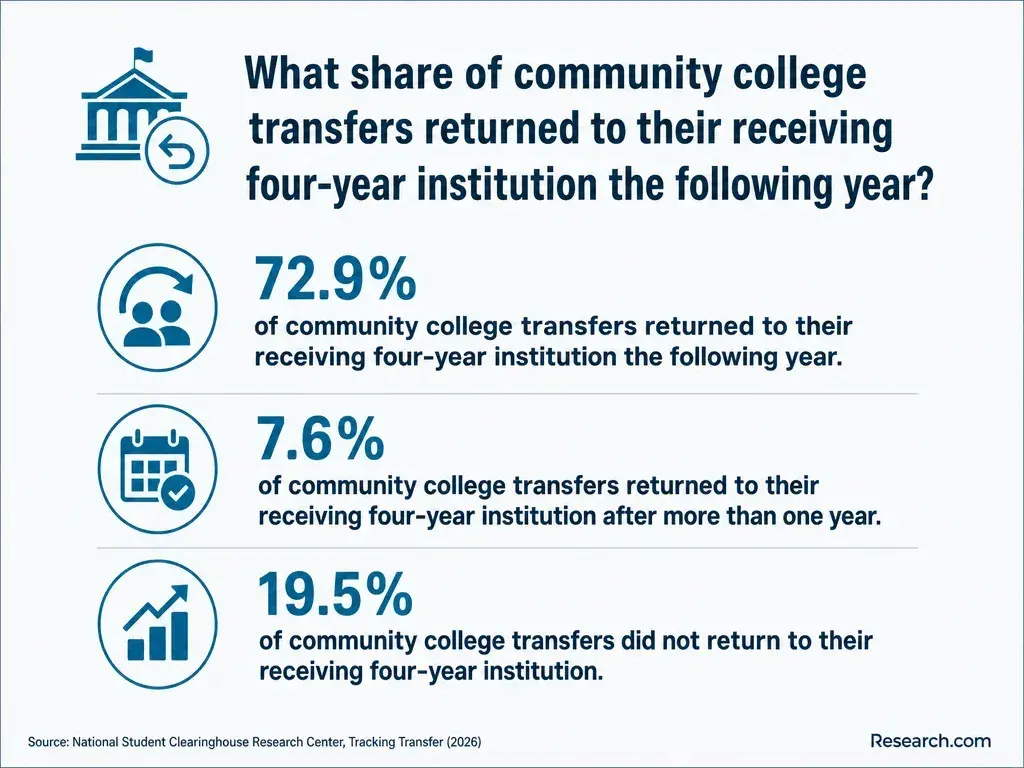
The receiving institution makes the final decision. It may consider the prior school, course level, content, grade, age of coursework, and the number of credits allowed in transfer. Quarter credits may need conversion. A course can be accepted yet count only as a free elective rather than satisfy accounting, statistics, a concentration, or a general-education requirement.
Gather transcripts, catalog descriptions, and, for uncertain courses, syllabi. Ask the transfer office for equivalencies and a business adviser for a degree audit that separates general education, business core, concentration, electives, and credits that must be earned at the school. If an accounting or quantitative course is classified unexpectedly, ask about a documented review or appeal before registering for a repeat. Human resources bachelor's credit transfer options may be worth comparing if your goal is specifically HR, but a course accepted into an HR program may apply differently to a BS in Business Administration.
A BS in Business Administration generally combines general education with business foundations and upper-level work in areas such as accounting, finance, economics, marketing, management, operations, business law, and quantitative analysis. The actual mix - and whether statistics, spreadsheets, an internship, or a capstone is required - depends on the catalog. A concentration is official only if the school names and awards it as part of the degree requirements.
Course content affects the application-fee decision because a school may accept many prior credits without granting equivalents for sequenced business courses. Request the curriculum map, then check which required courses your prior work may replace and when the remaining courses are offered online. If your goal is specifically project management rather than broad business preparation, compare lower-priced project management degrees as a separate option; do not assume their specialized courses or transfer rules match those of a business administration BS.
There is no reliable personal completion date until a program-specific audit identifies remaining courses and their prerequisites. The number of accepted credits matters less than whether those credits clear requirements that would otherwise delay upper-level study. Also ask whether required classes run every term, whether courses have live meetings or group-work deadlines, and how many you can realistically take while working or caregiving.
Compare a manageable part-time schedule with any accelerated offer using the same remaining-course list. Faster calendar time may require heavier weekly work or more tuition paid before employer reimbursement. If leadership, rather than a general business degree, is your objective, shorter study timelines for leadership bachelor's students provide an alternative to investigate - not a promise that your credits will produce the advertised finish date.
A business administration BS can support applications for roles such as operations coordinator, marketing coordinator, HR assistant, purchasing support staff, or project coordinator. The best fit depends on your previous work and evidence of relevant skills. Customer-service experience, for example, may strengthen a move toward sales operations; documented scheduling and process work may be more useful for operations roles.
Coursework alone does not confer a management title, professional license, or certification. Look for opportunities to demonstrate spreadsheets, financial-statement literacy, communication, and responsible business decisions through relevant work or approved projects. If an employer mainly requires any accredited bachelor's degree, investigate shorter routes to an online bachelor's before paying an application fee for a business program that would require substantial repeated coursework.
What Salary and Job Outlook Can Business Administration Graduates Expect?
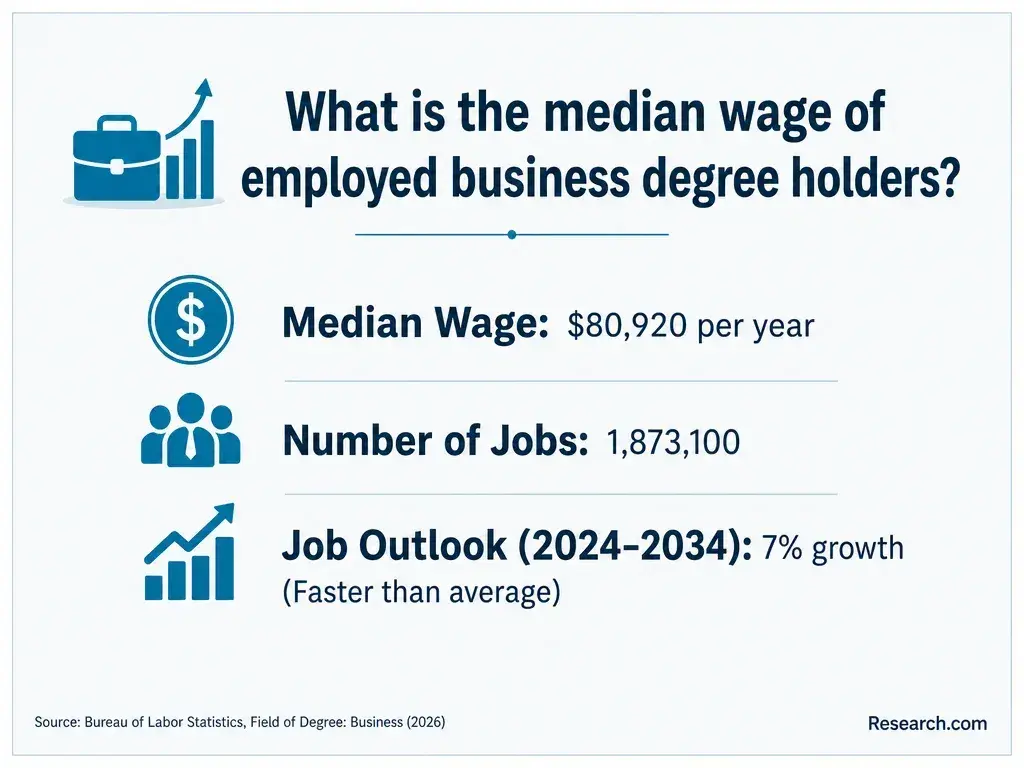
There is no single salary or growth rate for business administration graduates: employers hire into occupations, not a uniform "business graduate" job. For context, the U.S. Bureau of Labor Statistics reports a May 2025 median annual wage of $78,760 for market research analysts. That is an occupation-wide median, not an expected starting salary for someone who has just completed an online BS; research and analytical skills, experience, employer, and location matter.
Use a target occupation and local postings when considering whether a degree's remaining cost is justified. Compare required skills and experience with what you already have, then weigh tuition, any loan costs, and time away from paid work against the opportunities the credential might help you pursue. Business administration degrees compared by cost, duration, and outlook can help frame that review, but neither an occupational median nor a school's advertised completion time establishes your personal return.
Other Things You Should Know About Business Administration
No. Applying and enrolling are separate decisions. Check any later deposit or enrollment agreement before accepting an offer.
That depends on the school's portal. Check whether your draft and uploaded documents remain available and whether a deadline applies.
Possibly, but many education benefits cover specified tuition or course expenses instead. Ask your benefits administrator about application fees and receipt requirements before paying.
Not necessarily. An application fee generally pays for processing, not admission or a seat. Confirm how the school handles admission decisions, enrollment deadlines, and deposits.
- Types of Financial Aid: Grants, Work-Study, and Loans | studentaid.gov https://studentaid.gov/understand-aid/types
- How Eligibility for Financial Aid is Determined | Charter Oak State College https://www.charteroak.edu/current/sfa/determining-eligibility.php
- Financial aid steps | Twin Cities One Stop Student Services https://onestop.umn.edu/finances/financial-aid/financial-aid-steps
- Transfer Applicants - UTSA Admissions - Future Roadrunner https://future.utsa.edu/transfer/
- Understanding Your Transfer Credits | Transfer Hub https://transfer.ecu.edu/understanding-your-transfer-credits/
- Frequently Asked Questions - Utah Admissions https://admissions.utah.edu/information-resources/faqs/
- Domestic Transcript Evaluation for College Transcripts | ccsf.edu https://www.ccsf.edu/admissions-recordsregistration/domestic-transcript-evaluation-college-transcripts
- Transfer Credit Resources - University of Texas Admissions https://admissions.utexas.edu/apply/transfer-students/transfer-credit-resources/
- Transfer Credit Evaluation | Office of Admissions https://admissions.tc.umn.edu/admissions/transfer-admission/transfer-credit-evaluation
- Transfer Student Requirements | University of Oregon https://www.uoregon.edu/admissions/undergraduate/find-your-path/transfer-students/