
2027 Fast Track LPN Programs Online - 6, 9, 10, 11, 12 Month Programs

Co-Founder and Chief Data Scientist
In the United States, the projected job growth for licensed practical nurses (LPNs) from 2022 to 2032 is estimated at five percent. Despite this promising outlook, many individuals face the challenge of pursuing a career in nursing while juggling existing commitments.
Recognizing this dilemma, I explore the realm of fast track LPN programs online, offering a solution for those seeking to enter the nursing profession swiftly and efficiently. From program duration to financial aid options and career prospects, this article provides valuable insights to guide individuals toward a rewarding career in nursing.
What are the benefits of enrolling in fast track LPN programs online?
- Fast track LPN programs online enable access to in-demand nursing positions, offering diverse job opportunities in various healthcare settings.
- Graduates of fast track LPN programs online can expect a median annual salary of $59,730, aligning with the competitive earnings in the nursing field.
- Enrolling in a fast track LPN program online provides flexibility and convenience, allowing individuals to pursue their education while balancing other commitments.
What can I expect from a fast track LPN program online?
In a fast track LPN program online, you can expect an accelerated and comprehensive curriculum tailored to prepare you for a rewarding career in nursing. These programs typically offer flexible schedules and convenient online learning platforms, allowing you to study at your own pace while balancing other commitments. You'll cover essential topics such as anatomy, physiology, pharmacology, and patient care, gaining the knowledge and skills necessary to excel in the healthcare industry. Additionally, many programs provide clinical practicum opportunities to ensure hands-on experience and proficiency in real-world healthcare settings, preparing you for success as a licensed practical nurse.
Where can I work after finishing a fast track LPN program online?
After completing a fast track LPN program online, you can explore a wide range of employment opportunities in diverse healthcare settings. These include hospitals, nursing homes, rehabilitation centers, clinics, and home health agencies. Licensed practical nurses (LPNs) play crucial roles in patient care, administering medications, monitoring vital signs, and providing support to patients and their families. With the skills and knowledge gained from your online LPN program, you'll be equipped to embark on a fulfilling career, making a meaningful difference in the lives of patients across various healthcare environments.
How much can I make with a certificate from a fast track LPN program online?
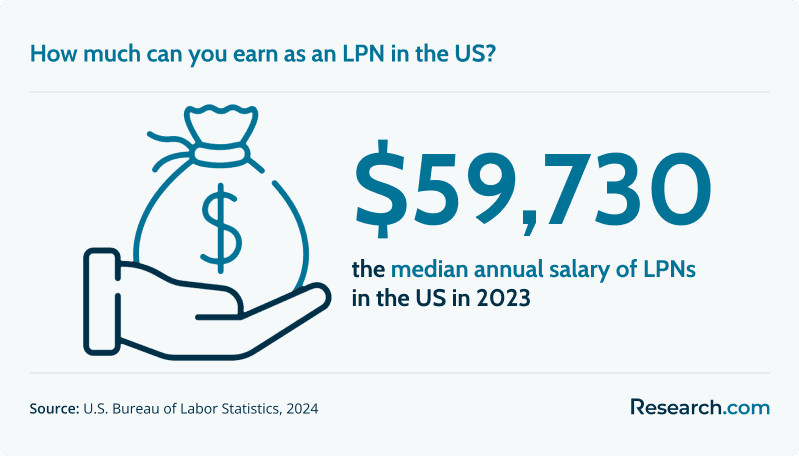
With a certificate from a fast track LPN program online, you can expect to earn a median annual salary of $59,730, according to 2023 data. Additionally, LPNs in the top percentiles can earn even higher salaries, with the 90th percentile reaching $77,870 annually. Industries such as management, scientific, and technical consulting, as well as employment services, offer particularly lucrative opportunities for LPNs, with average salaries exceeding $72,000 per year.
- 2027 Fast Track LPN Programs Online List of Programs
- How long does it take to complete fast track LPN programs online? Program Length
- How do fast track LPN programs online compare to an on-campus program? How do fast track LPN programs online compare to an on-campus program?
- What are the differences between LPN and RN programs? What are the differences between LPN and RN programs?
- What is the average cost of fast track LPN programs online? Program Cost
- What are the financial aid options for students enrolling in fast track LPN programs online? What are the financial aid options for students enrolling in fast track LPN programs online?
- What are the prerequisites for enrolling in fast track LPN programs online? Admission Requirements
- What courses are typically in fast track LPN programs online? Typical Courses
- What types of specializations are available in fast track LPN programs online? What types of specializations are available in fast track LPN programs online?
- How do you choose the best fast track LPN programs online? How do you choose the best fast track LPN programs online?
- Is accreditation essential for fast track LPN programs online? Is accreditation essential for fast track LPN programs online?
- What career paths are available for graduates of fast track LPN programs online? What career paths are available for graduates of fast track LPN programs online?
- What challenges may I face during fast track LPN programs online? What challenges may I face during fast track LPN programs online?
- What are the NCLEX-PN pass rates for fast track LPN programs online? What are the NCLEX-PN pass rates for fast track LPN programs online?
- How do fast track LPN programs online ensure robust clinical training quality? How do fast track LPN programs online ensure robust clinical training quality?
- What is the job market for graduates of fast track LPN programs online? Job Outlook
- What are some flexible study options for aspiring LPNs? What are some flexible study options for aspiring LPNs?
- Are fast-track LPN programs just as good as standard LPN programs? Are fast-track LPN programs just as good as standard LPN programs?
- How can fast track LPN programs serve as a pathway to advanced nursing education? How can fast track LPN programs serve as a pathway to advanced nursing education?
- What kind of support and resources are available to students in fast track LPN programs online? What kind of support and resources are available to students in fast track LPN programs online?
- What are the potential drawbacks of fast track LPN programs online? What are the potential drawbacks of fast track LPN programs online?
- What role do instructor expertise and clinical partnerships play in fast track LPN programs online? What role do instructor expertise and clinical partnerships play in fast track LPN programs online?
2027 Guide to Fast-Track Online LPN Programs
Choosing a fast-track LPN program is usually a time-sensitive decision: you want to enter nursing quickly, but you also need a program that qualifies you for licensure, provides real clinical training, and fits your budget. The challenge is that “online LPN program” can be misleading. Practical nursing programs may place lectures or assignments online, but they still require in-person labs, simulations, and clinical rotations because LPNs must demonstrate hands-on patient care skills.
This guide explains how fast-track online and hybrid LPN programs work, what they cost, how long they take, how to compare them with campus-based options, and what to check before enrolling. It is designed for students who want a quicker route into practical nursing without overlooking accreditation, NCLEX-PN readiness, state licensure rules, clinical quality, or long-term career mobility.
Quick answer: Are there fast-track LPN programs online?
Yes, but most are hybrid rather than fully online. Fast-track LPN programs commonly allow students to complete theory-based coursework online while requiring in-person clinical training, skills labs, and supervised patient care experiences. Many accelerated options take 6 to 12 months, although exact timelines depend on the school, format, state requirements, and whether the student has prior healthcare or military medic experience.
How Research.com evaluates schools
Research.com reviews programs using institutional and program-level information from established education data sources. For this ranking, our team considered data from the IPEDS higher education database, Peterson’s education data resources, including distance learning datasets, and the College Scorecard. Readers can review our broader ranking process in the Research.com methodology.
Featured fast-track LPN and practical nursing programs
The programs below illustrate the types of accelerated, hybrid, blended, or career-focused practical nursing pathways available to students. Before applying, confirm current tuition, clinical site availability, state board approval, admissions deadlines, and whether the program meets licensure requirements in the state where you plan to work.
| Program | Best fit | Length | Credits | Published cost information | Accreditation or approval listed |
| Mountainland Technical College - LPN Program | Students seeking a short certificate pathway with NCLEX-PN preparation | 2 semesters | 23 | $6,032 total | Accreditation Commission for Education in Nursing (ACEN) |
| Lake Superior College - Military Bridge Medic to LPN Program | Veterans and active-duty medics transitioning into civilian nursing | 6 to 12 months | 40 | $204.17 per credit | Accreditation Commission for Education in Nursing (ACEN) |
| Blinn College - Vocational Nursing Program | Texas students who want traditional or blended vocational nursing options | 10 to 12 months | 39 | $63 per credit; $8,532 total | Texas Board of Nursing (BON) |
| Capital Area School of Practical Nursing - 9-Month LPN Program | Students who can attend daytime classes in an intensive quarter-based format | 9 months | 54 | $15,475 total | Accreditation Commission for Education in Nursing (ACEN) |
| Lake Area Technical College - 11-Month LPN Program | Students looking for broad practical nursing preparation across patient populations | 11 months | 44.5 | $124 per credit; $9,690 total | Accreditation Commission for Education in Nursing (ACEN) |
1. Mountainland Technical College - LPN Program
Mountainland Technical College offers a practical nursing pathway for students preparing to deliver basic nursing care under the supervision of licensed healthcare professionals. The program combines classroom learning with clinical preparation and leads to a Certificate of Completion from MTECH. Graduates are positioned to take the NCLEX-PN Exam and may later use their LPN education as a foundation for bridge programs leading to registered nursing roles.
- Program Length: 2 semesters
- Required Credits to Graduate: 23
- Total Cost: $6,032
- Accreditation: Accreditation Commission for Education in Nursing (ACEN)
2. Lake Superior College - 6-Month Military Bridge Medic to LPN Program
Lake Superior College in Duluth, Minnesota offers a practical nursing bridge option designed for recently discharged veterans with medic training and active-duty service members working in medic roles. The pathway recognizes military healthcare experience and helps eligible students move toward a civilian practical nursing diploma in a condensed format. It is especially relevant for applicants who already have hands-on emergency or clinical training from military service.
- Program Length: 6 to 12 months
- Required Credits to Graduate: 40
- Cost per Credit: $204.17
- Accreditation: Accreditation Commission for Education in Nursing (ACEN)
3. Blinn College - Vocational Nursing Program
Blinn College's Vocational Nursing Program is based at the Brenham Campus and prepares students for licensed vocational nurse roles through classroom, lab, and clinical learning. Applicants do not need prerequisite courses for the program. Students may choose a face-to-face format completed in 10 to 11 months or a blended option completed in 12 months, with faculty-supervised clinical experiences in Brenham and nearby healthcare settings.
- Program Length: 10 to 12 months
- Required Credits to Graduate: 39
- Cost per Credit: $63 ($8,532 total)
- Accreditation: Texas Board of Nursing (BON)
4. Capital Area School of Practical Nursing - 9-Month LPN Program
The Capital Area School of Practical Nursing offers an accelerated LPN certificate structured across four sequential quarters. The program uses daytime scheduling and is intended for students who can commit to a focused, fast-paced format. Graduates may sit for the NCLEX-PN examination and, after passing, can pursue licensure as an LPN in the State of Illinois.
- Program Length: 9 months
- Required Credits to Graduate: 54
- Total Cost: $15,475
- Accreditation: Accreditation Commission for Education in Nursing (ACEN)
5. Lake Area Technical College - 11-Month LPN Program
Lake Area Technical College provides practical nursing preparation across multiple care areas, including obstetrical, pediatric, medical, psychiatric, surgical, and geriatric nursing. The curriculum is aligned with professional licensure expectations in South Dakota and other states, but students should verify requirements with the licensing agency in the state where they plan to practice because nursing licensure rules can differ by location.
- Program Length: 11 months
- Required Credits to Graduate: 44.5
- Cost per Credit: $124 ($9,690 total)
- Accreditation: Accreditation Commission for Education in Nursing (ACEN)
How long does a fast-track online LPN program take?
Fast-track LPN programs commonly take 6 to 12 months, making them shorter than many traditional practical nursing pathways. The fastest programs are often built for students with prior healthcare experience, such as military medics, while other accelerated options compress classroom instruction, labs, and clinical rotations into a year or less.
Program length depends on several factors: the number of required credits, clinical hour requirements, whether prerequisite courses are built into the curriculum, and whether the school offers full-time, part-time, evening, or blended scheduling. A shorter timeline can be helpful if you want to enter the workforce quickly, but it also means less flexibility if you fall behind.
| Timeline | Who it may fit | Trade-off |
| 6 months | Students with relevant healthcare or military medic training | Very intense pace and limited room for scheduling disruptions |
| 9 to 11 months | Students who can study full time and attend regular clinical sessions | Requires strong time management and reliable transportation |
| 12 months | Students who want an accelerated path with slightly more breathing room | Still demanding, especially when clinical rotations begin |
How do online fast-track LPN programs compare with on-campus programs?
Fast-track “online” LPN programs are usually hybrid programs. Unlike fully remote fields such as affordable online medical billing and coding courses, practical nursing requires in-person training because students must practice patient care, medication administration, safety procedures, and clinical communication under supervision.
The main advantage of a hybrid LPN program is convenience for lecture-based work. Students may be able to complete readings, assignments, recorded lectures, quizzes, and discussion activities online. The main limitation is that clinical rotations, labs, and skills checkoffs still require physical attendance, often at specific times and locations.
| Format | Advantages | Limitations | Best for |
| Hybrid or online-supported LPN program | More flexibility for theory coursework; reduced campus commuting for some classes | Still requires in-person labs and clinical placements | Students balancing school with work, caregiving, or long commutes |
| Traditional on-campus LPN program | Regular face-to-face access to instructors, classmates, labs, and campus resources | Less scheduling flexibility and more frequent campus attendance | Students who learn best through structured in-person instruction |
| Blended vocational nursing program | Combines remote coursework with faculty-supervised clinical learning | May require careful coordination around clinical schedules | Students who want flexibility without losing hands-on practice |
LPN vs. RN programs: What is the difference?
LPN and RN programs both prepare students for nursing careers, but they lead to different scopes of practice, education levels, responsibilities, and advancement options. The right choice depends on how quickly you want to enter the workforce, how much responsibility you want in patient care, and whether you plan to continue into advanced nursing roles.
| Category | LPN program | RN program |
| Typical education path | Diploma or certificate training focused on practical nursing skills | Associate's degree (ADN) or bachelor's degree (BSN) |
| Common completion time | About 12 months for many programs | 2 to 4 years |
| Clinical focus | Basic nursing care, patient monitoring, medication administration, and daily living support | Comprehensive assessment, care planning, clinical judgment, leadership, and specialized practice |
| Supervision | Often works under RNs, physicians, or other licensed providers | May supervise LPNs and nursing assistants and coordinate broader care plans |
| Advancement route | Can pursue LPN-to-RN bridge programs | Can move into BSN, MSN, nurse practitioner, educator, leadership, or administrative roles |
An LPN pathway can make sense if you want a faster and less expensive entry into nursing. An RN pathway may be better if you want broader responsibilities, more long-term mobility, and access to advanced nursing education sooner.
How much do fast-track online LPN programs cost?
The average total tuition for fast-track online LPN programs is approximately $8,745. The average cost per credit is $188, with listed rates ranging from $63 to $287 per credit. Total tuition ranges from $5,518 to $15,475, depending on the school and program structure.
These figures make many LPN programs less expensive than longer nursing degree pathways, including some affordable RN to MSN online programs and low-cost RN to BSN online programs. However, tuition is only one part of the total price. Students should also ask about uniforms, background checks, drug screening, immunizations, testing fees, books, simulation fees, commuting to clinical sites, and NCLEX-PN preparation costs.
Return on investment depends on local wages, program cost, financial aid, licensure success, and how quickly a graduate finds work. In 2023, the median annual earnings for LPNs in the US stood at $59,730.
What financial aid options are available for fast-track LPN students?
Students in practical nursing programs may be able to use multiple types of aid, but eligibility depends on the school, program length, accreditation, enrollment status, and student circumstances. Even students comparing affordable online colleges should look beyond tuition and build a full funding plan before enrolling.
- Federal Financial Aid: Eligible students may qualify for grants, loans, or work-study programs through the U.S. Department of Education.
- Nursing Scholarships: Hospitals, community foundations, professional associations, and schools may offer awards for students pursuing practical nursing.
- State Aid: Some states support residents preparing for healthcare shortage occupations, including practical nursing.
- Employer Tuition Assistance: Healthcare employers may help current employees pay for training if the credential supports workforce needs.
- Military Education Benefits: Veterans and active-duty service members may be able to apply benefits through the GI Bill or other military tuition assistance programs.
Apply early, ask whether the LPN program is aid-eligible, and confirm whether you must maintain full-time enrollment or minimum academic progress to keep funding.
What prerequisites do fast-track online LPN programs require?
Admissions requirements vary, but most fast-track LPN programs expect applicants to show academic readiness, meet health and safety requirements, and qualify for clinical placement. Because clinical partners may have their own requirements, students should complete admissions steps carefully and on time.
- High School Diploma or GED: Most programs require proof of secondary education or an equivalent credential.
- Prerequisite Coursework: Some schools require or recommend biology, anatomy, physiology, medical terminology, or related courses.
- Minimum GPA: Applicants may need to meet a school-defined GPA threshold in prior coursework.
- Background Check and Drug Screening: These are common because students work with patients during clinical rotations.
- Immunization Records: Programs may ask for documentation of hepatitis B, MMR, varicella, or other required vaccinations.
- CPR or Basic Life Support Certification: Many programs require BLS or CPR training before students enter clinical settings.
In 2021, there were a total of 44,900 LPN credentials awarded in the US. That scale of training does not mean every program is equal, so applicants should compare admissions requirements alongside licensure outcomes and clinical quality.
What courses are included in fast-track online LPN programs?
Accelerated LPN curricula focus on the knowledge and hands-on competencies needed for entry-level practical nursing. Coursework is usually paired with lab practice, simulation, and clinical rotations so students can apply theory in supervised settings.
- Fundamentals of Nursing: Introduces patient assessment, vital signs, infection control, documentation, safety, and basic bedside care.
- Pharmacology: Covers medication classifications, dosage calculations, safe administration practices, and patient monitoring.
- Medical-Surgical Nursing: Prepares students to support patients with acute and chronic conditions, surgical needs, and recovery plans.
- Maternal and Child Health Nursing: Addresses pregnancy, birth, postpartum care, infant health, and pediatric nursing principles.
- Mental Health Nursing: Builds understanding of psychiatric conditions, therapeutic communication, and psychosocial care.
Clinical practicum experiences are not optional add-ons; they are central to LPN preparation. In 2023, the industry with the highest level of employment in LPNs and LVNs was nursing care facilities at 171,290.
Can students specialize during a fast-track LPN program?
Most LPN programs prioritize broad entry-level preparation rather than deep specialization. Still, some programs include electives, clinical exposure, or focused learning experiences that help students explore patient populations or care environments they may want to pursue after licensure.
- Gerontology: Emphasizes care for older adults, chronic conditions, mobility needs, and age-related health concerns.
- Pediatrics: Introduces nursing care for infants, children, and adolescents, including growth, development, and family-centered support.
- Mental Health: Focuses on psychiatric care, behavioral health support, communication, and patient safety.
- Maternal Health: Covers prenatal, labor, postpartum, and newborn care. Students interested in reproductive health may also explore how to become a fertility nurse practitioner.
- Community Health: Looks at health education, prevention, and care delivery in community-based settings.
Specialization often develops after licensure through work experience, employer training, and additional credentials. In 2023, the top-paying industries for LPNs were management, scientific, and technical consulting ($72,720) and employment services ($72,200).
How should you choose the best fast-track online LPN program?
The best fast-track LPN program is not simply the shortest or cheapest option. It is the program that meets state licensure requirements, gives you enough clinical practice, fits your schedule, prepares you for the NCLEX-PN, and offers a realistic path to employment or further nursing education.
| What to check | Why it matters | Question to ask |
| Accreditation and state board approval | Licensure eligibility and credit transfer may depend on program recognition | Is the program approved for LPN licensure in the state where I plan to work? |
| Clinical placement quality | Hands-on experience affects confidence, skill development, and job readiness | Where are clinicals held, and who supervises students? |
| NCLEX-PN preparation | Passing the exam is required for licensure | What are the most recent NCLEX-PN pass rates? |
| Schedule design | Accelerated programs can conflict with work or caregiving responsibilities | Are classes asynchronous, live online, daytime, evening, or weekend-based? |
| Total cost | Fees, supplies, travel, and exams can change affordability | What is the full estimated cost beyond tuition? |
| Student support | Fast formats leave little time to recover from academic difficulty | Are tutoring, advising, remediation, and technical support included? |
- Verify accreditation: Look for recognized nursing accreditation such as Accreditation Commission for Education in Nursing (ACEN) or relevant state board approval.
- Read the curriculum carefully: Make sure it includes nursing theory, lab practice, supervised clinicals, and NCLEX-PN preparation.
- Review faculty qualifications: Instructors should have practical nursing or registered nursing experience that connects coursework to real patient care.
- Ask about clinical sites before enrolling: A convenient online lecture format will not help if clinical placements are far away or hard to schedule.
- Compare flexibility honestly: Part-time options may be easier to manage, while full-time accelerated formats can shorten the time to licensure.
- Use support services early: Academic advising, tutoring, and career counseling are especially important in compressed programs.
- Evaluate cost and aid together: Compare tuition, fees, scholarships, loans, and employer assistance before committing.
Is accreditation essential for fast-track online LPN programs?
Yes. Accreditation and state board approval are among the most important factors in choosing an LPN program. They help show that the program follows recognized educational standards, includes appropriate clinical training, and is designed to prepare students for licensure and entry-level practice.
Students should confirm both nursing accreditation and state approval. Accreditation may also affect eligibility for financial aid, employer recognition, future bridge programs, and transfer credit. When comparing value, consider the full cost of LPN training alongside program outcomes, clinical access, and NCLEX-PN preparation.
What careers can graduates pursue after a fast-track LPN program?
After completing an approved program and passing the NCLEX-PN, graduates can pursue licensed practical nurse or licensed vocational nurse roles in healthcare settings such as nursing homes, hospitals, clinics, rehabilitation centers, physician offices, and home health agencies. LPNs typically provide direct patient care, monitor vital signs, administer medications within their scope, document changes, and support patients with daily care needs under the supervision of RNs, physicians, or other licensed providers.
Some LPNs build experience in gerontology, pediatrics, maternal health, mental health, or community care. Others use the LPN role as a stepping stone toward RN education through bridge pathways. Students comparing healthcare support roles may also review nursing assistant career and salary information to understand how responsibilities and advancement differ.
Longer-term, LPNs who continue their education may work toward RN, BSN, MSN, or advanced practice goals. For example, nurses planning graduate-level practice may later compare affordable online FNP programs or low-cost online DNP programs, although those pathways require additional nursing education and licensure steps.
What challenges should students expect in fast-track online LPN programs?
Accelerated LPN programs can be demanding because they compress nursing theory, exams, skills practice, simulations, and clinical rotations into a short period. Students need consistent study time, reliable transportation, dependable technology, and the ability to manage stress when assignments and clinical requirements overlap.
The online component can also create a false sense of flexibility. Even if lectures are remote, clinical attendance is usually fixed, and missed clinical hours may be difficult to make up. Students who plan to continue into advanced nursing education should also consider how an accelerated practical nursing pathway could later connect to RN to MSN programs or other bridge options.
What NCLEX-PN pass rates should you look for?
NCLEX-PN pass rates are a key indicator of whether a program is preparing students for licensure. Prospective students should ask schools for their most recent pass rates, how those rates compare with state benchmarks, and what support is offered to students who struggle with exam preparation.
Pass rates should not be viewed in isolation. Compare them with graduation rates, clinical placement quality, student support, and LPN program costs. A low-cost program may not be a good value if graduates are not well prepared for licensure.
How do hybrid LPN programs provide clinical training?
Hybrid and online-supported LPN programs typically deliver lectures and assignments online while arranging in-person clinical experiences through healthcare partners, simulation labs, and faculty-supervised practice. Clinical training helps students demonstrate safe patient care, communication, documentation, infection control, and medication-related competencies.
Quality programs use licensed instructors, clinical preceptors, skills checkoffs, and performance evaluations to verify readiness. Students should ask whether the program secures clinical placements or expects students to find their own sites. Strong clinical systems are important at every nursing level, from practical nursing through advanced pathways such as online post master's FNP programs.
What is the job market for LPN graduates?
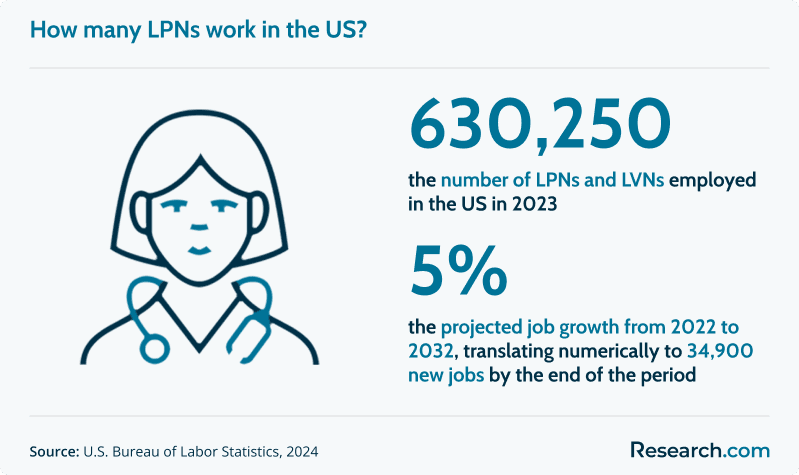
The LPN job market remains tied to the needs of healthcare facilities that provide direct patient care, particularly long-term care, nursing care facilities, outpatient settings, and home health services. In the United States, there were approximately 630,250 licensed practical nurses (LPNs) and licensed vocational nurses (LVNs) employed in 2023. The projected job growth is 5% from 2022 to 2032, equal to 34,900 new jobs by the end of the period.
Job opportunities can vary by state, region, employer type, and scope-of-practice rules. Graduates should research local demand, clinical partners, employer hiring preferences, and whether employers in their area favor LPNs, RNs, or medical assistants for specific roles.
What flexible study options are available for aspiring LPNs?
Fast-track LPN programs may offer several scheduling models, but flexibility is always limited by required labs and clinical hours. Students should match the program format to their work schedule, family responsibilities, transportation options, and study habits.
- Asynchronous Online Coursework: Recorded lectures and online modules can help students study outside traditional classroom hours.
- Hybrid Delivery: Online theory courses are paired with required in-person labs, simulations, and clinical rotations.
- Accelerated Schedules: Some programs allow students to complete training in as little as 12 months.
- Lower-Cost Nursing Pathways: Cost-conscious students may compare LPN options with affordable accelerated nursing programs.
Before enrolling, request a sample weekly schedule. A program described as flexible may still require early-morning clinicals, weekday labs, or mandatory campus sessions.
Are fast-track LPN programs as strong as standard LPN programs?
Fast-track LPN programs can be just as legitimate as longer programs if they are approved, accredited where appropriate, clinically rigorous, and aligned with state licensure requirements. The difference is not necessarily the content; it is the pace. Accelerated programs often cover the same foundational areas, including anatomy, pharmacology, patient care, nursing theory, and clinical practice, but in a more compressed schedule.
The main concern is whether students have enough time to absorb complex material and develop confidence during hands-on care. Some accelerated programs address this by using focused clinical placements, intensive simulation labs, and structured NCLEX-PN preparation. Others may be too compressed for students who need more time, academic support, or schedule flexibility.
Employers generally care about licensure, competence, clinical readiness, and program reputation more than whether the program was accelerated or standard. Students considering the easiest LPN program to get into should still verify quality indicators rather than choosing based only on admissions accessibility.
How can a fast-track LPN program lead to advanced nursing education?
A fast-track LPN program can be the first step in a longer nursing career. After licensure and work experience, some LPNs enter bridge programs designed to help practical nurses become RNs. From there, nurses may continue into BSN, MSN, or advanced practice pathways depending on their goals and admission eligibility.
Bridge programs may consider prior nursing coursework, clinical experience, and licensure status, but transfer policies vary by school. Students with long-term goals should ask LPN programs whether their credits are accepted by partner colleges or nursing bridge pathways, including options such as the shortest RN to MSN online program.
What support services should fast-track LPN students expect?
Support services matter more in accelerated programs because students have less time to recover from academic or clinical setbacks. A strong program should make help easy to access before problems become serious.
- Academic Advising: Advisors help students understand course sequencing, clinical requirements, deadlines, and graduation rules.
- Tutoring and Study Support: Online tutoring, review sessions, or study groups can help students master difficult topics quickly.
- Career Services: Resume help, interview preparation, and employer connections can support the transition from student to nurse.
- Technical Support: Online coursework requires reliable learning platforms and responsive help when access problems occur.
- NCLEX-PN Preparation: Practice questions, review materials, exam plans, and remediation support can improve licensure readiness.
Students planning to advance after licensure may also compare accelerated LPN to RN programs as part of a longer career plan.
What are the drawbacks of fast-track online LPN programs?
Fast-track LPN programs can save time, but they are not the right fit for every student. The pace can be stressful, clinical schedules may be rigid, and online coursework requires self-discipline. Students who need extensive instructor interaction, slower review, or flexible clinical scheduling may find a traditional program more manageable.
| Common mistake | Why it can hurt you | Better approach |
| Choosing the shortest program available | A compressed timeline may not provide enough time for skill development | Compare clinical hours, support services, and NCLEX-PN preparation |
| Assuming “online” means fully remote | LPN programs require in-person clinical and lab experiences | Ask for all campus, lab, and clinical attendance requirements |
| Ignoring state licensure rules | A program may not meet requirements where you plan to work | Confirm approval with the relevant state nursing board |
| Focusing only on tuition | Fees, supplies, travel, and exam costs can add up | Request a complete cost breakdown before applying |
| Choosing based only on easy admission | Admission access does not guarantee strong outcomes | Use easiest nursing degree information alongside accreditation and outcomes data |
Why do instructor expertise and clinical partnerships matter?
Instructor quality and clinical partnerships directly affect how well online coursework translates into safe patient care. Experienced faculty can connect nursing concepts to real clinical situations, while strong clinical partners give students supervised exposure to patients, documentation systems, team communication, and workplace expectations.
Students should ask who teaches core nursing courses, who supervises clinicals, how students are evaluated, and whether clinical sites regularly host LPN students. These experiences can also support future academic progression, including movement into accessible RN to BSN bridge programs after becoming an RN.
What graduates say about blended fast-track LPN programs
- Jake: "The blended LPN format gave me the flexibility to complete lectures online while still getting the hands-on clinical experience I needed. The mix of virtual coursework, in-person practice, and faculty support helped me feel prepared for practical nursing responsibilities."
- Richard: "As a parent with a busy schedule, I needed a program that did not require me to be on campus every day. The online coursework helped me study from home, and the clinical rotations gave me the real patient care experience that made the training feel complete."
- Samantha: "The program worked because it did not try to replace clinical learning with online assignments. I could complete lectures virtually, then practice nursing skills during supervised in-person rotations. That balance helped me move from student to licensed practical nurse with confidence."
Key Insights
- Fast-track online LPN programs are usually hybrid: You may complete lectures online, but labs, simulations, and clinical rotations must be done in person.
- Most accelerated options take 6 to 12 months: Shorter programs can help you enter nursing faster, but they require strong time management and consistent availability.
- Accreditation and state approval are nonnegotiable: Always verify that the program qualifies you for NCLEX-PN eligibility and licensure in your intended state.
- Cost varies widely: Listed total tuition ranges from $5,518 to $15,475, with an average total tuition of approximately $8,745.
- Clinical quality matters as much as online convenience: Ask where clinicals take place, who supervises them, and whether the school arranges placements.
- LPN can be a starting point, not the endpoint: Many graduates later pursue LPN-to-RN, RN-to-BSN, MSN, or advanced practice pathways.
- Do not choose by speed alone: The best program balances timeline, affordability, licensure eligibility, NCLEX-PN preparation, support services, and clinical readiness.
References:
- Data USA. (2024). Licensed practical & vocational nurse training. Retrieved April 24, 2024, from Data USA.
- U.S. Bureau of Labor Statistics. (2024). Licensed practical and licensed vocational nurses. Retrieved April 24, 2024, from BLS.
- U.S. Bureau of Labor Statistics. (2024). Occupational employment and wages, May 2023 - 29-2061 Licensed practical and licensed vocational nurses. Retrieved April 24, 2024, from BLS.
Other Things You Should Know About Fast Track LPN Programs Online
Most 6-month fast-track LPN programs require at least 400 to 600 supervised clinical hours, completed in approved healthcare settings. Programs must also meet state board of nursing rules, which often set minimum clinical competencies before students can sit for the NCLEX-PN exam.
Yes, online fast-track LPN programs are accredited in February 2027. Accreditation ensures that the program meets standardized educational quality, crucially impacting eligibility for financial aid, credit transfers, and employment prospects upon graduation.
Prerequisites for online fast-track LPN programs typically include a high school diploma or GED, a background check, and certain health requirements such as immunizations. Some programs may also require basic healthcare experience or passing entrance exams. Checking specific program requirements is recommended for February 2027 enrollment.


