
2027 Best Online Master’s in Database Management Programs

Co-Founder and Chief Data Scientist
Online database management programs can provide the advanced skills necessary to design, implement, and maintain complex database systems that power modern businesses. These programs offers numerous opportunities, as the projected job growth for computer occupations requiring a master’s degree is at 20% until 2033.
This guide will provide a comprehensive overview of the best online master's in database management programs, helping you navigate your options and find the perfect fit. We'll also cover the career opportunities that await graduates, from database administrator and data architect to data scientist and information security analyst.
What are the benefits of getting a degree in database management?
- A degree in database management opens up various job opportunities, including database administrator, database manager, or data analyst.
- The median salary for professionals with a database management degree varies by specific role, but median wages are around $63,689 to $94,537 per year.
- Obtaining a degree in database management online offers flexibility and convenience, allowing students to balance studies with work and personal commitments.
What can I expect from a database management degree?
A database management degree program equips students with the knowledge and skills needed to organize, store, and manage data effectively in various types of organizations. The curriculum typically includes topics such as data modeling, database administration, performance optimization, and data governance.
Additionally, students explore advanced areas like data warehousing, big data technologies, cloud-based database management, and business intelligence analytics. The program prepares learners for real-world problem-solving by teaching them how to design efficient database schemas, write complex queries, and implement security measures to protect sensitive data.
Where can I work with a database management degree?
Upon completing online database management programs, one can work in various industries that rely heavily on data, such as information technology, healthcare, and finance. These positions are found in sectors ranging from large technology companies to government institutions and academic organizations.
There are also opportunities to work in smaller firms or startups where one might take on broader responsibilities and gain more diverse experiences.
How much can I make with a database management degree?
Earning a degree in database management can open the door to a variety of high-paying career paths in technology, business, and government. According to the U.S. Bureau of Labor Statistics (BLS), the median annual wage for database administrators was about $104,620 as of May 2024.
Those who advance into more specialized roles often see even higher salaries. For example, database architects earn a median salary of approximately $135,980, reflecting the advanced expertise required to design large-scale data systems and optimize them for organizational needs.
Meanwhile, database analysts typically earn between $69,000 and $104,000 annually, depending on experience and location, with average salaries landing around $91,945 for professionals holding a bachelor’s degree.
With demand for data-driven decision-making growing across nearly every industry, salaries for database management professionals are expected to remain strong, especially for those who pursue certifications, gain cloud computing skills, or move into leadership roles.
- List of the Best Online Master’s in Database Management Programs List of Programs
- How long does it take to complete an online master’s in database management program? Completion Time
- How does an online master’s in database management program compare to an on-campus program? How does an online master’s in database management program compare to an on-campus program?
- What is the average cost of an online master’s in database management program? Average Cost
- What are the financial aid options for students enrolling in an online master’s in database management program? Financial Aid
- What are the prerequisites for enrolling in an online master’s in database management program? Requirements
- What courses are typically in an online master’s in database management program? What courses are typically in an online master’s in database management program?
- What types of specializations are available in an online master’s in database management program? What types of specializations are available in an online master’s in database management program?
- How to choose the best online master’s in database management program? How to choose the best online master’s in database management program?
- Can integrating health informatics with database management accelerate my career progression? Can integrating health informatics with database management accelerate my career progression?
- What career paths are available for graduates of an online master’s in database management program? Career Paths
- What is the job market for graduates with an online master’s in database management program? Job Market
- What interdisciplinary certifications can enhance expertise in both health informatics and database management? What interdisciplinary certifications can enhance expertise in both health informatics and database management?
Best Online Master’s in Database Management Programs for 2026
Choosing an online master’s in database management is not just a question of which school has the lowest tuition. The better question is whether a program will help you build the database design, data engineering, cloud, analytics, and security skills employers expect from advanced data professionals. This guide is for working IT professionals, analysts, developers, and career changers who want to compare online graduate options without losing sight of cost, time commitment, accreditation, curriculum fit, and career value.
Database management now overlaps with data science, artificial intelligence, cybersecurity, cloud computing, business intelligence, and health informatics. That is why many students compare database-focused degrees with related technology pathways, including programs tied to master’s in cybersecurity salary outcomes, analytics, and data science. Below, you will find ranked program options, decision factors, common mistakes, career paths, and practical questions to ask before enrolling.
Quick answer: Is an online master’s in database management worth considering?
An online master’s in database management can be a strong option if you already have technical experience or a quantitative background and want to move into database administration, database architecture, data engineering, business intelligence, analytics leadership, or data governance. The degree is most useful when the curriculum includes SQL, database design, cloud databases, data warehousing, security, project management, and hands-on projects. It may be less useful if you want a short skills refresh, in which case a certificate or bootcamp may be more cost-effective.
How Research.com evaluates schools
Research.com uses a ranking process built around validated education data and program-level information. Readers who want a deeper explanation can review the Research.com methodology page. The goal is to help prospective students compare programs using consistent criteria rather than relying only on advertising claims or general reputation.
Sources used in the evaluation process include:
- Integrated Postsecondary Education Data System, also known as the IPEDS database
- Peterson’s database, including the Distance Learning Licensed Data Set
- College Scorecard database
- National Center for Education Statistics
Program comparison at a glance
| Rank | School and program | Program length | Cost per credit or course | Credits or courses required | Accreditation |
| 1 | George Mason University Master’s in Data Analytics Engineering | 2 years | $930 | 30 credits | Southern Association of Colleges and Schools Commission on Colleges (SACSCOC) |
| 2 | Regis University Master’s in Data Science | 2 years | $1,066 | 36 credits | The Higher Learning Commission |
| 3 | Lewis University Master’s in Data Science | 2 years | $860 | 33 credits | The Higher Learning Commission |
| 4 | University of Denver Master’s Database Design and Administration | 18 months | $859 | 33 credits | The Higher Learning Commission |
| 5 | DePaul University Master’s in Data Science | 18 months | $918 | 48 credits | The Higher Learning Commission |
| 6 | Auburn University Master’s in Data Science and Engineering | 2 years | $949 | 30 credits | Southern Association of Colleges and Schools Commission on Colleges (SACSCOC) |
| 7 | University of Detroit Mercy Master’s in Applied Data Analytics | 18 months | $953 | 30 credits | The Higher Learning Commission |
| 8 | University of Southern California Master’s in Applied Data Science | 18 months | $2,424 | 30 credits | Western Association of Schools and Colleges |
| 9 | Northwestern University Master’s in Data Science | 1 year | $5,098 per course | 12 courses | Western Association of Schools and Colleges |
| 10 | University of Illinois Springfield Master’s in Data Analytics | 2 years | $332 | 36 | The Higher Learning Commission |
1. George Mason University Master’s in Data Analytics Engineering
George Mason University offers a graduate pathway in Data Analytics Engineering that can suit students who want database knowledge within a broader analytics engineering framework. The program covers technical foundations such as database system architecture, transaction management, database design, and Entity-Relationship (ER) modeling, making it relevant for students aiming to manage complex data systems in applied settings.
- Program Length: 2 years
- Cost per credit: $930
- Required credits to graduate: 30 credits
- Accreditation: Southern Association of Colleges and Schools Commission on Colleges (SACSCOC)
2. Regis University Master’s in Data Science
The online Master’s in Data Science at Regis University is designed for students who want to connect data engineering, relational databases, and applied data science. Learners can develop skills in designing, building, organizing, and managing data systems, which can be useful for database-focused roles as well as broader analytics careers.
- Program Length: 2 years
- Cost per credit: $1,066
- Required credits to graduate: 36 credits
- Accreditation: The Higher Learning Commission
3. Lewis University Master’s in Data Science
Lewis University provides a fully online Master’s in Data Science that emphasizes mathematical reasoning, computing, and large-scale data analysis. The curriculum includes data mining, visualization, predictive analytics, machine learning, statistical programming, and large-scale data storage systems, making it a practical option for students who want database skills with a strong analytics orientation.
- Program Length: 2 years
- Cost per credit: $860
- Required credits to graduate: 33 credits
- Accreditation: The Higher Learning Commission
4. University of Denver Master’s Database Design and Administration
The University of Denver offers a Master of Science in Information Technology with a concentration in Database Design and Administration. This option is especially relevant for students who want a more direct focus on database architecture, data modeling, data warehousing, performance tuning, and technology-driven database administration.
- Program Length: 18 months
- Cost per credit: $859
- Required credits to graduate: 33 credits
- Accreditation: The Higher Learning Commission
5. DePaul University Master’s in Data Science
The Master’s in Data Science at DePaul University’s College of Computing and Digital Media (CDM) focuses on advanced technical and computational skills for big data analytics. Students also learn to explain analytical results to non-technical audiences, an important skill for database professionals who need to support business decisions, governance, and reporting.
- Program Length: 18 months
- Cost per credit: $918
- Required credits to graduate: 48 credits
- Accreditation: The Higher Learning Commission
6. Auburn University Master’s in Data Science and Engineering
Auburn University offers a Master of Science in Data Science and Engineering that combines graduate study in data mining, machine learning, and statistical learning. Graduates can pursue roles in data engineering, data science, machine learning, and analytics across technology, finance, healthcare, and consulting.
- Program Length: 2 years
- Cost per credit: $949
- Required credits to graduate: 30 credits
- Accreditation: Southern Association of Colleges and Schools Commission on Colleges (SACSCOC)
7. University of Detroit Mercy Master’s in Applied Data Analytics
The University of Detroit Mercy offers a Master of Science in Applied Data Analytics for students who want a practical blend of analytics, business intelligence, and applied data work. The program emphasizes projects and case studies, which can help students demonstrate skills in realistic data environments.
- Program Length: 18 months
- Cost per credit: $953
- Required credits to graduate: 30 credits
- Accreditation: The Higher Learning Commission
8. University of Southern California Master’s in Applied Data Science
The University of Southern California (USC) offers a Master of Science in Applied Data Science with coursework in applied statistics, data preparation, database systems, machine learning, data mining, and data visualization. Students can use electives to shape the program toward specific interests within data science and database-related work.
- Program Length: 18 months
- Cost per credit: $2,424
- Required credits to graduate: 30 credits
- Accreditation: Western Association of Schools and Colleges
9. Northwestern University Master’s in Data Science
Northwestern University’s School of Professional Studies offers a fully online Master of Science in Data Science (MSDS) for working professionals who want advanced analytics, technical, and leadership training. Students complete a capstone project or thesis to apply their learning to a real-world problem.
- Program Length: 1 year
- Tracks/concentrations: Analytics and Modeling, Analytics Management, Artificial Intelligence, Data Engineering, or Technology Entrepreneurship.
- Cost per credit: $5,098 per course
- Required credits to graduate: 12 courses
- Accreditation: Western Association of Schools and Colleges
10. University of Illinois Springfield Master’s in Data Analytics
The University of Illinois Springfield (UIS) offers an M.S. in Data Analytics that brings together mathematics, computing, data processing, visualization, and interpretation. The curriculum prepares students to clean datasets, identify patterns, extract knowledge, and predict trends using data analytics tools.
- Program Length: 2 years
- Cost per credit: $332
- Required credits to graduate: 36
- Accreditation: The Higher Learning Commission
How long does an online master’s in database management take?
Most online master’s in database management programs take 1 to 2 years to complete. Many require 30 to 45 credit hours and offer both full-time and part-time pacing so students can balance graduate study with work, family, and other responsibilities.
Some programs use accelerated calendars and can be completed in as little as 18 months. Students comparing shorter technology degrees may also want to review options such as an accelerated online master’s in data science, especially if their career goals lean toward analytics or machine learning rather than database administration.
Program length depends on term structure, course load, transfer credit policies, capstone requirements, and whether the student enrolls continuously. Courses may be delivered in shorter terms of around 8 to 10 weeks each, which can make scheduling easier but may also increase weekly workload.
Online vs. on-campus master’s in database management: Which format is better?
An online master’s in database management is usually the better fit for working professionals who need schedule flexibility, cannot relocate, or want to avoid commuting. An on-campus program may be better for students who prefer face-to-face interaction, campus-based networking, research facilities, or a more structured weekly routine.
| Factor | Online program | On-campus program |
| Best for | Working adults, remote learners, students who need flexible scheduling | Students who want in-person instruction and campus involvement |
| Schedule | Often asynchronous or hybrid, with part-time and full-time options | Typically follows fixed class meeting times |
| Costs beyond tuition | May reduce commuting and relocation expenses | May require transportation, housing, parking, or relocation costs |
| Interaction | Uses online platforms, discussion boards, virtual labs, and group projects | Provides direct classroom access to faculty and peers |
| Degree quality | Can be comparable when the school is accredited and the curriculum is rigorous | Can offer strong academic support and campus resources |
Students who need especially flexible start dates sometimes compare graduate programs with broader online options, including online colleges with weekly start dates. However, flexibility should not be the only deciding factor. Accreditation, curriculum depth, faculty expertise, technical tools, and career support matter just as much.
How much does an online master’s in database management cost?
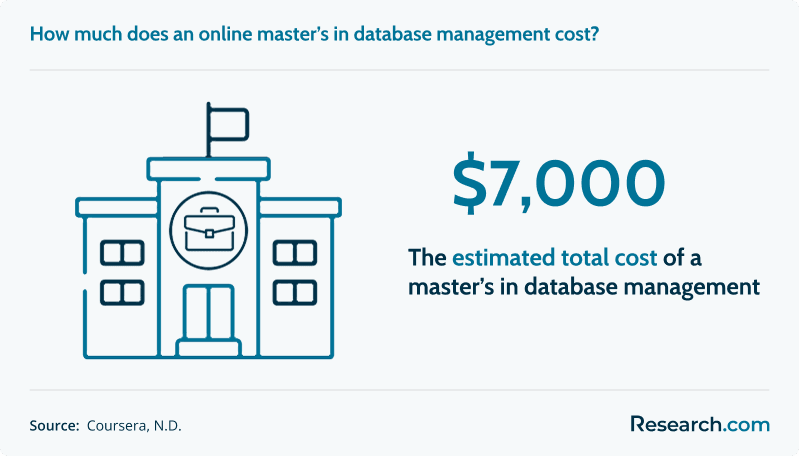
The cost of an online master’s in database management varies considerably by school type, residency status, credit requirements, and tuition model. Typical tuition ranges from about $7,000 to over $56,000 per year. Public universities may offer lower annual costs for in-state students, while private universities and highly ranked programs can be significantly more expensive.
More affordable programs at some public institutions may cost around $7,000 to $22,000 annually for in-state students. Private institutions or highly ranked options may fall between $35,000 and $57,000 per year. Some schools charge by credit hour, with costs ranging from a few hundred dollars to nearly $1,000 per credit.
Students should compare the full cost of attendance, not tuition alone. Fees, books, software, technology requirements, graduation fees, and the number of required credits can change the final price. Shorter programs may reduce time away from advancement opportunities, but a faster schedule can also be more demanding. Students looking at compact graduate formats in adjacent fields may compare options such as the shortest online cybersecurity master’s degree programs.
Financial aid options for online database management master’s students
Online graduate students may qualify for several forms of financial support. The best approach is to start with aid that does not need to be repaid, then compare federal loans, employer benefits, and private financing only after understanding the total program cost.
- Federal student loans: Students can complete the Free Application for Federal Student Aid (FAFSA) to determine eligibility for Direct Unsubsidized Loans or a Direct PLUS Loan.
- Scholarships and grants: Funding may come from the university, private foundations, STEM-focused organizations, professional associations such as the Association for Computing Machinery, or scholarships for women in technology and underrepresented groups.
- Employer tuition reimbursement: Some employers pay part or all of an employee’s tuition. Before enrolling, ask HR whether the benefit requires a minimum GPA, manager approval, course relevance, or a post-graduation service commitment.
- University-specific aid: Graduate students may be eligible for institutional scholarships, grants, assistantships, or other funding. Some opportunities may also be available to online learners, depending on the school.
- Private student loans: Private loans from banks or lenders may help cover remaining costs, but they should usually be considered after grants, scholarships, employer support, and federal loan options because rates and repayment terms can differ.
Because graduate school is a major financial decision, compare the degree with other professional routes if your goal is management rather than a technical data role. For example, students interested in healthcare leadership may also research online MHA programs with no GRE requirement as an alternative path into administrative roles.
Admission requirements for an online master’s in database management
Admissions requirements vary by institution, but most online master’s programs in database management expect applicants to show academic readiness, quantitative ability, and some technical preparation. Applicants who lack a formal computing background may strengthen their profile through prerequisite courses, professional experience, or targeted training such as accelerated online CompTIA CySA training if their interests include security-focused data work.
- Bachelor’s degree: Most programs require a bachelor’s degree from a regionally accredited institution. A background in computer science, information technology, data science, mathematics, engineering, or a related field is often preferred, but some programs consider applicants from other majors.
- Academic performance: Many graduate programs look for a minimum GPA of 3.0 on a 4.0 scale. Some schools review applicants with lower GPAs if they have strong professional experience or stronger grades in their last 60 credits.
- Technical foundation: Applicants are often expected to understand programming basics and may need experience with Python, Java, C++, SQL, relational databases, or similar tools.
- Standardized tests: Many online programs have reduced or removed GRE and GMAT requirements, but some still request scores or offer waivers based on GPA or work experience.
Typical courses in an online master’s in database management
A strong online database management curriculum should combine database theory, implementation, cloud and big data tools, data security, analytics, and project management. Many programs also expose students to the modern data stack, which includes the tools and workflows organizations use to collect, store, transform, govern, and analyze data.
| Course area | What students learn | Why it matters |
| Database design and implementation | Data modeling, normalization, Entity-Relationship diagrams, and SQL for defining and manipulating data | Builds the foundation for designing reliable relational databases |
| Database management systems | DBMS architecture, storage, transactions, data integrity, and platforms such as Oracle, SQL Server, and MySQL | Prepares students to manage and troubleshoot enterprise database systems |
| Big data and NoSQL databases | Large-scale datasets, unstructured and semi-structured data, and tools such as MongoDB and Cassandra | Helps students work beyond traditional relational databases |
| Information technology project management | Project scope, budgets, timelines, stakeholders, and technical delivery | Supports advancement into database leadership and architecture roles |
Some students add interdisciplinary coursework to understand how data systems operate inside regulated organizations. For example, business law courses can provide useful context for compliance, governance, contracts, and corporate data responsibilities.
Common specializations in online database management master’s programs
Specializations help students align their graduate study with a target role. Before choosing a concentration, compare course descriptions with job postings for the roles you want. A title such as “data science” or “analytics” may or may not include enough database design, administration, or cloud data engineering for your goals.
- Database management and business intelligence: This path focuses on database modeling, data warehousing, data mining, and business intelligence systems. It can prepare students for roles such as database designer, database developer, or BI analyst.
- Database administration: This specialization emphasizes database design, migration, backup, security, optimization, and cloud-based database operations. It is useful for students who want DBA, database operations, or infrastructure-focused roles.
- Data analytics: Students learn to collect, analyze, interpret, and communicate data for business decisions, forecasting, and reporting. This path may overlap with machine learning and data science.
- Information technology strategy and management: This option focuses on aligning technology systems with organizational goals, managing IT projects, and evaluating business solutions. Students who need faster technical upskilling may also compare short online IT training bootcamps.
- Big data and cloud computing: This concentration prepares students to work with large-scale data systems and cloud database environments, which are increasingly important in enterprise technology.
How to choose the best online master’s in database management program
The best program is the one that fits your career goal, technical background, budget, and learning style. A program that is excellent for data science may not be the right choice if you want database administration. A low-cost program may not be the best value if it lacks the tools, projects, or employer connections you need.
- Verify accreditation first. Confirm institutional accreditation before comparing rankings, tuition, or course lists.
- Match the curriculum to your target role. Review whether the program includes SQL, database design, DBMS, cloud platforms, data warehousing, NoSQL, data security, and hands-on projects. Resources explaining database management fundamentals can help you evaluate whether a curriculum is broad enough.
- Check technical prerequisites. If you lack programming, SQL, or systems experience, ask whether the school offers bridge courses.
- Compare total cost, not just cost per credit. Look at required credits, fees, software, course materials, and whether tuition differs by residency.
- Evaluate flexibility honestly. Asynchronous courses can be convenient, but accelerated formats may require heavy weekly study time.
- Ask about career support. Look for portfolio projects, capstones, employer partnerships, career coaching, resume help, and alumni outcomes.
- Review faculty and tools. Strong programs should expose students to current database platforms, cloud tools, analytics workflows, and security practices.
Questions to ask before enrolling
- Is the institution accredited, and is the online program covered by that accreditation?
- Does the curriculum focus on database management, or is it primarily a general analytics or data science degree?
- Which database platforms, programming languages, and cloud tools will I use?
- Are there live sessions, asynchronous lectures, virtual labs, or required group projects?
- Can I study part-time without losing access to financial aid or student support?
- What career services are available to online graduate students?
- Are capstone projects aligned with real employer problems?
- What is the total estimated cost, including fees and required materials?
Common mistakes to avoid
| Mistake | Why it can hurt your decision | Better approach |
| Choosing only by tuition | A cheaper program may lack the technical depth or support needed for your target role | Compare cost against curriculum, projects, tools, and career services |
| Ignoring accreditation | Accreditation can affect transferability, financial aid eligibility, and employer recognition | Confirm institutional accreditation before applying |
| Assuming all data degrees teach database management | Some analytics programs focus more on modeling than database architecture or administration | Read course descriptions and required technical outcomes carefully |
| Underestimating accelerated workload | Shorter programs may compress assignments, labs, and group work | Ask about weekly time expectations before enrolling |
| Relying only on rankings | A highly ranked school may not match your schedule, budget, or career goal | Use rankings as one input, not the final decision |
Can health informatics and database management create a faster career path?
Combining database management with health informatics can be valuable for professionals who want to work with healthcare data, patient information systems, compliance, analytics, or secure data exchange. Healthcare organizations rely on accurate, protected, and accessible data, so professionals who understand both database systems and healthcare workflows can be well positioned for interdisciplinary roles.
This path is not automatically faster for everyone. It makes the most sense if you want to work in healthcare technology, clinical analytics, health data governance, or healthcare information systems. Students interested in an accelerated interdisciplinary route can compare database-focused degrees with an accelerated online master’s in health informatics.
Career paths after an online master’s in database management
Graduates of online database management programs can pursue technical, analytical, and leadership roles. Students comparing related data-focused graduate options may also review the fastest online master’s degree programs in analytics if they prefer decision science, reporting, or modeling work.
| Career path | Main responsibilities | Best fit for students who enjoy |
| Database Administrator (DBA) | Managing database performance, backups, access, security, troubleshooting, and reliability | Systems operations, problem-solving, and maintaining critical infrastructure |
| Database Architect | Designing database structures, models, frameworks, and long-term data environments | Strategic design, large-scale planning, and enterprise data architecture |
| Data Engineer | Building pipelines and systems that collect, process, store, and prepare data for analysis | Coding, system design, automation, and cloud data infrastructure |
| Data Scientist | Using statistics and machine learning to identify patterns, build models, and solve complex problems | Modeling, experimentation, algorithms, and predictive analytics |
| Business Intelligence Analyst | Creating dashboards, reports, visualizations, and insights for business leaders | Explaining data, supporting decisions, and connecting technical work to business goals |
| Computer and Information Systems Manager | Leading IT teams, setting technology goals, and aligning systems with business strategy | Management, planning, budgeting, and cross-functional leadership |
Job outlook and salary for database management graduates
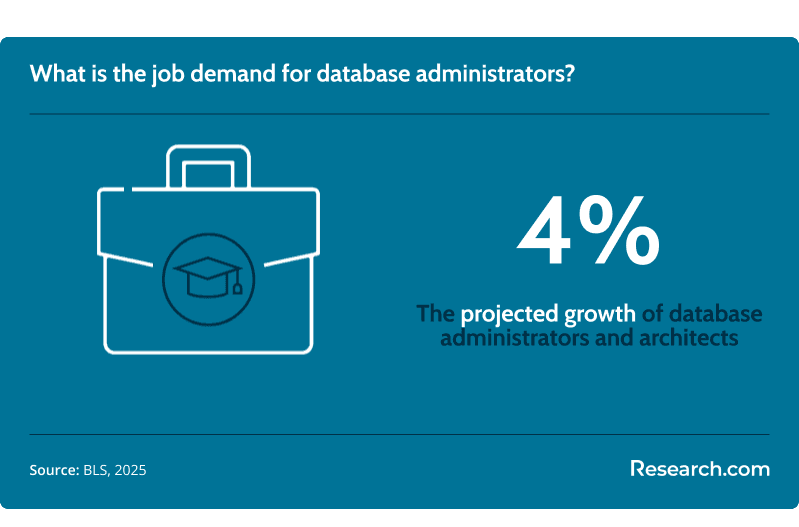
The job market for database management graduates remains tied to organizations’ need for secure, reliable, and scalable data systems. Employment for database administrators and architects is projected to grow about 4 percent from 2024 to 2034. Other computer and information technology occupations have a projected job growth of 20%.
Pay varies by role, industry, location, experience, and technical specialization. As of 2024, the median salary is about $104,620 for database administrators and approximately $135,980 for database architects. Students often compare these outcomes with related fields and may ask what business analytics salary levels look like before choosing between database management, analytics, cybersecurity, or data science.
AI, machine learning, automation, and cloud platforms are changing the work, not eliminating the need for database expertise. Employers increasingly need professionals who can manage data quality, optimize storage, secure sensitive information, support analytics pipelines, and understand governance. Graduates who combine database fundamentals with cloud, scripting, security, and analytics skills may have stronger options than those who focus on one tool alone.
Certifications that can strengthen health informatics and database management expertise
Certifications can help professionals show targeted expertise, especially when moving into healthcare data, compliance, data governance, or secure information management. The strongest credential strategy depends on the role: a database administrator may need vendor-specific database certifications, while a healthcare data professional may benefit from credentials tied to health information systems, privacy, analytics, or administration.
Students who want a broader healthcare management foundation can also compare database-focused graduate study with an accredited online healthcare administration degree. This may be useful for professionals who want to lead teams, manage operations, or work at the intersection of healthcare systems and data governance.
What graduates say about earning an online master’s in database management
- Lucas: "Studying online gave me the flexibility I needed to keep my full-time job while building stronger skills in SQL and data warehousing. The workload was serious, but the support from faculty and classmates helped me stay on track. The degree also helped me qualify for a promotion in my organization."
- Vidal: "I worried that an online program would feel isolating, but the group projects, discussion tools, and interactive course materials made the experience more engaging than I expected. Being able to review lectures on my own schedule let me focus on big data topics while still protecting family time. The program helped me move from technical support into a data architect role."
- Igor: "I wanted graduate training that would prepare me for more responsibility, not just another technical credential. Courses in database security and project management helped me understand how to lead complex data projects. The online format made the career change realistic because I could complete the program from home."
References
- Bureau of Labor Statistics. (2023, September 6). Occupational Outlook Handbook: Management Occupations. BLS
- Data USA. (2021). Management occupations. Retrieved August 4, 2021, from Data USA
- Engel, C. J. (2020). The acceptability of online degrees for obtaining entry-level employment in the accounting profession: A Kansas study. Global Journal of Accounting and Finance, 4(1), 16-37. IGBR
- Wiley. (2020). Online College Students 2020. Wiley
Key Insights
- An online master’s in database management is best for students who want advanced roles in database administration, database architecture, data engineering, BI, analytics, or IT leadership.
- Most programs take 1 to 2 years and commonly require 30 to 45 credit hours, though some options can be completed in as little as 18 months.
- Costs vary widely, from about $7,000 to over $56,000 per year, so students should compare total cost, required credits, fees, and financial aid before committing.
- Accreditation, curriculum depth, hands-on projects, cloud and security coverage, and career support are more important than rankings alone.
- AI and cloud computing are increasing the value of database professionals who understand data quality, governance, automation, scalability, and secure data infrastructure.
- The strongest program choice depends on your target role: choose database administration for operations, data engineering for pipelines, business intelligence for reporting, and health informatics if you want to work with healthcare data systems.
Other Things You Should Know About the Best Online Master’s in Database Management Programs
In 2027, many online master's programs in database management offer flexible schedules and part-time options to accommodate working professionals. This allows students to balance their career and academic commitments effectively, providing opportunities for career advancement without sacrificing job responsibilities.
Many 2027 online master’s in database management programs require a culminating capstone, while some offer a thesis or non-thesis track. A capstone is often completed in the final term and may involve a database design, data governance, or systems implementation project approved by faculty.


