2027 Medical Coding & Billing Exams: CBCS vs. CPC Certification

Co-Founder and Chief Data Scientist
Choosing between CBCS and CPC certification is really a choice between two different healthcare administration paths: billing-focused revenue cycle work and coding-focused documentation review. Both credentials can help you enter medical billing and coding, but they are not interchangeable. Picking the wrong one can mean preparing for an exam that does not match the jobs you actually want.
This 2026 guide explains how CBCS and CPC compare, what each exam is designed to measure, which employers typically value each credential, what jobs may be available, and how to choose a training program without wasting money. It is written for beginners, career changers, healthcare support workers, and students trying to decide whether medical billing and coding is a practical next step.
Quick answer: CBCS vs. CPC certification
If your goal is medical coding, especially outpatient or physician-office coding, CPC is usually the stronger choice. If your goal is medical billing, insurance claims, reimbursement support, or entry-level revenue cycle administration, CBCS may be a better fit. Some professionals eventually earn both, but beginners should usually start with the credential that matches the job descriptions they plan to apply for.
Key things to know before choosing a billing or coding exam
- CBCS is more aligned with billing, claims processing, reimbursement workflows, and insurance follow-up, while CPC focuses more heavily on assigning codes for provider services.
- Both credentials require ongoing continuing education, so certification is not a one-time task. You will need to keep up with coding, billing, payer, and compliance updates.
- The demand for medical records specialists is expected to grow by 9% over the next decade, according to the employment outlook cited later in this guide.
- Medical coding vs. medical billing certification in 2026
- Should you choose CBCS or CPC?
- Most recognized medical coding and billing certifications
- Medical coding and billing salary expectations
- CBCS certification requirements
- CPC certification requirements
- Jobs you can pursue with billing and coding training
- How allied healthcare cross-training can help
- How to choose an accredited online training program
- Whether hospitals prefer CPC or CBCS
- Networking and mentorship for career growth
- Interdisciplinary degrees that may support advancement
- Business education for billing and coding professionals
- CPC continuing education requirements
- Whether medical coding is still a good career choice
- Technology and compliance trends shaping the field
- How public health education can complement coding and billing
Medical coding vs. medical billing certification in 2026
Medical coding and medical billing are closely connected, but they are not the same job. Coding turns clinical documentation into standardized codes. Billing uses those codes, along with insurance and patient information, to create, submit, correct, and follow up on claims. In many small practices, one person may do both. In larger hospitals, the work is often separated into specialized teams.
| Area | Medical coding certification | Medical billing certification |
| Main focus | Assigning diagnosis, procedure, and service codes from clinical documentation | Preparing claims, checking payer rules, managing denials, and supporting payment collection |
| Common credential example | CPC from AAPC | CBCS from NHA |
| Best fit for | People who enjoy medical terminology, documentation review, code sets, and compliance rules | People who prefer insurance processes, patient accounts, claims workflows, and reimbursement operations |
| Typical settings | Physician offices, outpatient clinics, ambulatory care centers, hospitals, and coding vendors | Medical billing offices, private practices, insurance companies, hospitals, and healthcare administration teams |
| Key decision point | Choose this path if job postings you want emphasize CPT, ICD-10-CM, HCPCS Level II, coding accuracy, or provider documentation | Choose this path if job postings you want emphasize claims submission, payer follow-up, denials, reimbursement, or patient billing |
Medical coding certification
A medical coding credential confirms that you can read healthcare documentation and apply the correct codes for diagnoses, procedures, supplies, and services. The CPC credential from AAPC is a common example. Coding work requires attention to detail, comfort with healthcare terminology, and the ability to follow payer and regulatory requirements. It is a strong fit for people who like structured rules and documentation analysis.
Medical billing certification
A billing credential focuses on the financial and administrative side of care. A CBCS-certified professional may verify patient information, prepare claims, work with insurance rules, review denials, and support reimbursement. Billing professionals still need to understand codes, but their daily work is often closer to revenue cycle management than clinical code assignment. This type of credentialing path is similar in discipline to the pharmacy technician career path, where accuracy, compliance, and administrative reliability are central to the role.
Should you choose CBCS or CPC for medical billing and coding?
Choose CPC if you want to compete for coding jobs in physician offices, outpatient care, ambulatory settings, or coding departments. CPC covers CPT, ICD-10-CM, and HCPCS Level II coding systems, which makes it especially relevant for provider-based coding roles.
Choose CBCS if you want to work in billing offices, insurance coordination, claims processing, reimbursement support, or entry-level revenue cycle roles. CBCS is more practical for candidates who want to understand how claims move from patient encounter to payment.
Some professionals earn both credentials to improve flexibility, but beginners should be careful about paying for multiple exams before understanding the local job market. Search current job postings in your area or preferred remote market. If employers consistently ask for CPC, start there. If they ask for billing, claims, accounts receivable, or reimbursement experience, CBCS may be more relevant.
| Your goal | Better first credential | Why it may fit |
| Become a physician-office or outpatient coder | CPC | The exam is built around code assignment for provider services and outpatient documentation. |
| Work in claims processing or medical billing | CBCS | The credential emphasizes billing workflows, reimbursement, insurance, and claim accuracy. |
| Move into revenue cycle leadership later | CBCS first, then possibly CPC or management education | Billing knowledge helps you understand payment operations; coding knowledge can strengthen long-term credibility. |
| Maximize coding career mobility | CPC | CPC is commonly recognized in coding job postings, especially for outpatient roles. |
| Prepare for broader healthcare administration | Either, depending on your starting role | Later education, such as accelerated MHA programs online, may support advancement into management. |
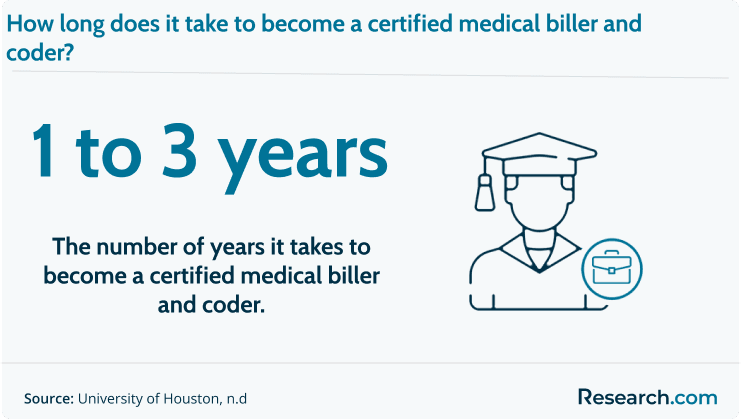
The training timeline depends on your background and program type. Certificate programs at vocational schools or community colleges can take four to twelve months. An associate degree in health information technology typically takes about two years. For people without healthcare experience, internships, practicum work, or entry-level administrative jobs may add time before they are competitive for full coding or billing roles. This is shorter than some clinical paths but still requires structured preparation, much like understanding how many years to be a dental hygienist helps students compare education timelines before committing.
If you already hold a healthcare credential and want leadership preparation, some students later explore options such as top 6 month master's degree online programs, but a graduate degree is not required for entry-level coding or billing work.
Most recognized medical coding and billing certifications
The best credential depends on whether you want billing, outpatient coding, inpatient coding, or broader health information work. The major certification organizations include AAPC, AHIMA, and NHA. If affordability is your main concern, compare exam preparation carefully and review options for the cheapest medical coding certification online before enrolling.
| Certification | Organization | Primary focus | Best for |
| CPC | AAPC | Outpatient and physician-office coding using CPT, ICD-10-CM, and HCPCS Level II | Students who want coding roles in provider offices, clinics, outpatient settings, and ambulatory care |
| CBCS | NHA | Billing, insurance claims, reimbursement, fraud prevention, and health insurance procedures | Candidates targeting billing departments, insurance companies, private practices, and revenue cycle support |
| CCA | AHIMA | Entry-level coding knowledge across healthcare settings | Beginners who want a broad coding credential before choosing a specialty |
| CCS | AHIMA | Hospital coding, including ICD-10-CM and ICD-10-PCS for diagnoses and procedures | Professionals who want inpatient or hospital-based coding roles |
| CPB | AAPC | Billing, payment processes, claims, and revenue cycle management | People who want a billing credential from AAPC rather than a coding credential |
Professionals working near pharmacy, medication records, or specialty reimbursement may also benefit from understanding pharmacy operations. Advanced options such as an online Doctor of Pharmacy program are not necessary for billing and coding jobs, but they may be relevant for people moving toward pharmacy leadership, clinical informatics, or specialized healthcare administration.
Medical coding and billing salary expectations
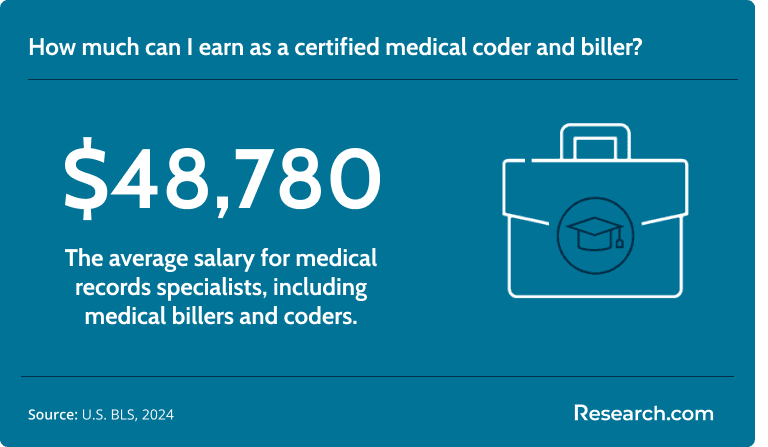
As of May 2023, the median annual wage for medical records specialists, a category that includes many certified medical coders and billers, was $48,780. Earnings vary by experience, certification, education, employer type, specialty, and location. The lowest 10 percent earned less than $35,080, while the highest 10 percent earned more than $77,810.
Certification can help a candidate qualify for interviews, but it does not guarantee a specific salary. Higher earnings are more likely when professionals combine certification with experience, specialty knowledge, audit skills, compliance expertise, or supervisory responsibilities. Coding managers, revenue cycle analysts, and specialists who understand payer rules may earn more than entry-level billers or records clerks.
CBCS certification requirements
The CBCS, or Certified Billing and Coding Specialist, is offered by the National Healthcareer Association (NHA). It is designed for people who want to work with billing processes, insurance claims, patient data, reimbursement, basic coding, and compliance-related documentation. CBCS-certified professionals may work in medical offices, insurance environments, billing departments, or healthcare administration teams.
To qualify for the CBCS exam, candidates must meet one of these requirements:
- Complete a medical billing and coding training program through an accredited institution.
- Have at least one year of supervised medical billing and coding work experience within the past three years.
- Hold a high school diploma or GED and have relevant on-the-job training in medical billing or coding.
Who should consider CBCS?
- Students who want a billing-heavy role rather than a pure coding role.
- Career changers interested in claims, insurance coordination, and reimbursement workflows.
- Administrative healthcare workers who already handle patient accounts or payer communication.
- People seeking entry-level revenue cycle positions where billing knowledge is more important than advanced code assignment.
CPC certification requirements
The CPC, or Certified Professional Coder, is offered by AAPC (American Academy of Professional Coders). It is a major credential for professionals who code provider services using CPT, ICD-10-CM, and HCPCS Level II. CPC-certified professionals commonly work in physician offices, outpatient clinics, ambulatory care centers, and healthcare organizations where accurate coding supports reimbursement, reporting, and compliance.
To pursue the CPC credential, candidates must:
- Have a high school diploma or equivalent, such as a GED.
- Pass the CPC exam, which includes 100 multiple-choice questions covering coding guidelines, regulations, medical terminology, and related topics.
- Gain at least two years of professional coding experience or complete an AAPC-approved coding course. Candidates who pass the exam without the required experience receive the CPC-A, or Apprentice, designation and can remove it after submitting proof of experience.
Who should consider CPC?
- Students who want to become medical coders rather than billing specialists.
- People targeting physician-office, outpatient, clinic, or ambulatory care coding jobs.
- Healthcare workers who already understand provider documentation and want a coding credential.
- Candidates whose local job postings frequently list CPC as preferred or required.
Jobs you can pursue with billing and coding training
Medical billing and coding training can lead to several administrative, records, and health information roles. Not all of these jobs require the same certification, and some may require additional training or employer-specific experience. Use job descriptions, not just job titles, to decide which credential fits.
| Role | What the work involves | Average salary listed |
| Medical Records Specialist | Organizes, maintains, checks, and protects patient health records while supporting regulatory and documentation requirements. | $48,780 per year |
| Health Information Technologist and Medical Registrar | Works with healthcare data systems, registries, electronic health records, reporting accuracy, and compliance-related information. | $62,990 per year |
| Medical Assistant | Handles administrative and clinical support tasks such as scheduling, recording patient histories, and assisting with procedures. Students seeking a low-cost entry route may compare the cheapest online medical assistant program options. | $42,000 per year |
| Medical Transcriptionist | Converts provider audio notes into written medical reports and must understand terminology, grammar, and documentation standards. | $37,060 per year |
| Pharmacy Technician | Supports pharmacists with prescriptions, medication preparation, inventory, customer service, insurance verification, and claim-related tasks. | $40,300 per year |
| Information Clerk | Performs clerical and front-office duties, maintains paperwork, answers questions, and supports administrative operations. | $40,540 per year |
These jobs show why billing and coding skills can be useful across healthcare administration. However, the best role for you depends on whether you prefer documentation review, patient accounts, insurance communication, office support, or data management.
How allied healthcare cross-training can help your coding career
Clinical awareness can make coders and billers more effective because documentation, procedures, diagnoses, and payer rules are easier to understand when you know how care is delivered. Cross-training is not required for CBCS or CPC, but exposure to allied health fields can help professionals communicate better with clinical teams and interpret records more confidently. For example, people interested in diagnostic imaging environments may explore sonography programs online to understand a different side of healthcare delivery.
How to choose an accredited online medical billing and coding program
An online training program should prepare you for the certification you actually plan to take. Do not assume that every program prepares students equally for CPC, CBCS, CPB, CCA, or CCS. Before enrolling, compare curriculum, instructor qualifications, exam alignment, career support, software practice, and total cost.
| What to check | Why it matters | Question to ask |
| Accreditation or institutional recognition | Accreditation affects credibility, transfer options, and sometimes employer confidence. | Is the school accredited, and by which agency? |
| Certification alignment | A billing-focused course may not prepare you well for a coding-heavy exam. | Does the curriculum specifically prepare students for CBCS, CPC, CPB, CCA, or another exam? |
| Code set coverage | Coders need current training in relevant code systems and guidelines. | How are CPT, ICD-10-CM, HCPCS Level II, and payer rules taught? |
| Hands-on practice | Employers value candidates who can work through realistic documentation and claims scenarios. | Does the program include case studies, coding exercises, claims simulations, or EHR-related practice? |
| Exam and membership costs | Tuition may not include exam fees, books, memberships, or retake costs. | What is included in tuition, and what will I pay separately? |
| Career services | Entry-level candidates often need help translating training into a first job. | Does the school provide resume help, externship support, job boards, or employer connections? |
To compare structured options, review accredited medical billing and coding training online and verify details directly with each school before enrolling.
Do hospitals prefer CPC or CBCS certification when hiring?
For coding jobs, hospitals and larger healthcare employers often give more weight to CPC than CBCS because CPC is specifically built around coding systems used in provider documentation and reimbursement. CPC can be especially useful for outpatient, clinic, ambulatory, and physician-based coding positions.
For billing, claims, patient accounts, or revenue cycle support roles, CBCS may still be relevant. A hospital may hire CBCS-certified candidates for billing departments, insurance follow-up, or administrative reimbursement work, but CBCS is usually not as strong as CPC for jobs that require detailed code assignment.
One important caution: hospital inpatient coding can involve different expectations than outpatient coding. Some employers may prefer other credentials for inpatient records work. Always compare the exact wording of job postings before choosing an exam.
How networking and mentorship can speed up career growth
Certification helps you meet baseline requirements, but relationships often help you learn what employers actually need. Local professional groups, online coding forums, AAPC chapters, alumni communities, and workplace mentors can help you understand job openings, payer trends, audit expectations, and career paths that are not obvious from course materials.
Networking is especially useful if you want to move beyond entry-level billing or coding into compliance, auditing, revenue cycle leadership, or administration. Professionals aiming for higher-level operations roles can also review healthcare administration jobs with the highest salaries to understand which roles require additional business, leadership, or data skills.
How additional degrees may support billing and coding advancement
A degree is not always required for entry-level billing or coding work, but additional education can matter if you want to move into management, compliance, analytics, informatics, or specialized healthcare operations. The right degree depends on your target role. Health information, healthcare administration, public health, business, and data-focused programs are usually more directly relevant than unrelated majors.
Some professionals work in niche settings such as sports medicine clinics, rehabilitation centers, athletic organizations, or event health operations. In those cases, a program like a cheap sports management bachelor's degree online may provide organizational and industry context, although it is not a direct substitute for coding or billing certification.
How business education can strengthen a medical billing and coding career
Billing and coding professionals who understand finance, operations, budgeting, process improvement, and leadership may be better prepared for revenue cycle management roles. Business training can be useful for people who want to supervise billing teams, manage denials, improve workflows, or participate in strategic healthcare operations.
For professionals who want a broader business foundation, an accelerated online degree in business may help build skills in management, accounting, project coordination, and decision-making. It should be viewed as an advancement tool, not as a replacement for billing and coding competence.
CPC continuing education requirements
CPC certification requires ongoing education so coders stay current with coding changes, regulations, documentation expectations, and compliance requirements. The key requirements include:
- Earn 36 CEUs every two years. CPC-certified professionals must complete 36 continuing education units every two years to keep the credential active.
- Use AAPC-approved learning options. CEUs may come from approved courses, webinars, workshops, conferences, and other recognized training activities.
- Attend local AAPC chapter activities. Chapter meetings can provide CEUs, networking, and practical updates from working professionals.
- Pursue specialty learning or employer training. Additional certifications, risk adjustment training, compliance education, inpatient coding topics, or approved employer education may count toward CEUs. These activities can also help professionals stay aligned with medical coder requirements.
- Submit CEUs on time. Missing continuing education requirements can lead to certification suspension or revocation, which may affect job eligibility.
Is medical coding still a good career choice in 2026?
Medical coding can still be a practical career choice for people who want healthcare work without a direct patient-care role, but it is not an automatic shortcut to remote employment or high pay. The field rewards accuracy, persistence, certification, and experience. Entry-level candidates may need to start in billing, records, front-office, or trainee roles before moving into full coding positions.
The U.S. Bureau of Labor Statistics projects that employment for medical records specialists, including medical coders, will grow by 9% from 2023 to 2033. About 15,000 job openings are expected each year, on average, over the next decade. Employment is projected to move from 191,500 medical records specialists in 2023 to 208,200.
Medical coding may be a good fit if you enjoy detailed rules, healthcare documentation, independent work, and continuous learning. It may be a poor fit if you dislike reading complex records, adapting to changing guidelines, meeting accuracy standards, or handling productivity expectations.
Some professionals use coding and billing experience as a foundation for broader healthcare careers. For example, licensed nurses may consider ADN to MSN bridge programs if they want to move into advanced nursing roles. People with wellness or movement science backgrounds may also compare exercise science degree jobs that pay well when deciding whether coding is the right healthcare path.
The chart below shows employment projections data for medical records specialists in the U.S.:
Technology and compliance trends shaping billing and coding careers
Technology is changing how billing and coding teams work, but it has not removed the need for trained professionals. Automation, electronic health records, coding assistance tools, payer edits, and analytics can improve speed, but human review is still important for documentation accuracy, compliance, claim correction, and judgment-based decisions.
To remain competitive, professionals should keep learning in these areas:
- Coding guideline updates: Code sets and payer expectations change, so outdated training can quickly become a problem.
- Compliance and audits: Employers value workers who understand accuracy, documentation support, fraud prevention, and risk management.
- Revenue cycle analytics: Denial trends, claim delays, and reimbursement patterns are increasingly important in healthcare operations.
- Healthcare software: Comfort with electronic records, billing platforms, and digital workflows can improve employability.
- Specialized healthcare environments: Knowledge of pharmacy, public health, outpatient care, or specialty clinics may help professionals move into targeted roles. For example, a pharmacist school online pathway may be relevant for professionals moving far beyond coding into pharmacy-focused healthcare leadership.
How a public health degree can complement medical coding and billing
Public health education can broaden a billing or coding professional’s understanding of healthcare systems, population health, policy, reporting, and prevention-focused care. It is most useful for people who want to move into health data, program administration, compliance, quality improvement, or healthcare operations rather than remain in a strictly entry-level billing role.
If your long-term goal includes healthcare policy, population health reporting, or administrative leadership, you may compare options such as the best online public health bachelor's degree. For a first coding or billing job, however, certification and practical experience usually matter more than a public health degree.
Common mistakes to avoid when choosing CBCS, CPC, or a training program
| Mistake | Why it can hurt you | Better approach |
| Choosing a certification before reviewing job postings | You may earn a credential that local or remote employers do not request. | Collect job postings first, then choose the credential that appears most often for your target role. |
| Assuming billing and coding are the same career | You may prepare for claims work when you really want coding, or the reverse. | Compare daily tasks, not just job titles. |
| Focusing only on tuition | Books, exam fees, memberships, software, and retakes may increase total cost. | Ask for the full cost of attendance before enrolling. |
| Ignoring accreditation and exam alignment | A weak program may not prepare you for the certification exam or employer expectations. | Verify school accreditation, curriculum details, and certification pass preparation. |
| Expecting immediate remote work | Many remote coding jobs prefer experience, strong productivity, and proven accuracy. | Be open to entry-level office, billing, records, or hybrid roles while gaining experience. |
| Letting certification lapse | Expired credentials can weaken your resume and limit job options. | Track CEUs early and keep records of completed education. |
Practical steps for choosing the right path
- Define your target job first. Decide whether you want coding, billing, claims, records, revenue cycle, or healthcare administration.
- Review real job postings. Look for required credentials, software, experience, and keywords such as CPC, CBCS, CPB, CCA, CCS, CPT, ICD-10-CM, HCPCS Level II, claims, denials, or reimbursement.
- Choose the exam that matches those postings. CPC is usually stronger for coding roles; CBCS is usually more aligned with billing and claims roles.
- Compare training programs carefully. Check accreditation, curriculum, instructor experience, exam preparation, hands-on practice, and total cost.
- Build experience while studying. Front desk, patient registration, insurance verification, records, or billing assistant jobs can help you enter the field.
- Plan for continuing education. Coding and billing rules change, so long-term success depends on staying current.
- Reassess after your first job. Once you understand the field, you can decide whether to add another credential, pursue a degree, specialize, or move toward management.
Resources
- American Academy of Professional Coders (AAPC). Certified professional coder exam. AAPC.
- University of Houston. Online Medical Billing and Coding Training. UH.
- U.S. Bureau of Labor Statistics. Occupational Outlook Handbook: Medical Records Specialists. BLS.
Key Insights
- CPC is usually the better first choice for people who want medical coding jobs, especially in physician-office, outpatient, clinic, or ambulatory care settings.
- CBCS is more appropriate for candidates who want billing, claims processing, reimbursement, insurance follow-up, or entry-level revenue cycle support roles.
- The median annual wage for medical records specialists was $48,780 as of May 2023, but salary depends heavily on experience, employer, specialty, location, and role level.
- Medical records specialist employment is projected to grow by 9% from 2023 to 2033, with about 15,000 openings expected each year, on average, over the decade.
- Do not choose a certification based only on popularity. Use current job postings to determine whether employers in your target market ask for CPC, CBCS, CPB, CCA, CCS, or another credential.
- Training program quality matters. Check accreditation, exam alignment, hands-on practice, total cost, and career support before enrolling.
- Technology is changing billing and coding work, but accuracy, compliance knowledge, documentation judgment, and payer-rule understanding remain valuable human skills.
Other Things You Should Know About Medical Coding & Billing Exams: CBCS vs. CPC Certification
A passing score is set by AAPC after exam equating, and the CPC exam is reported on a 0–100 scale. Candidates are typically required to answer 70% of the scored questions correctly to earn certification, though AAPC may adjust the final cut score.
To be eligible for the CBCS exam in 2027, candidates should have completed a healthcare training program. For the CPC exam, candidates typically need at least two years of medical coding experience or study alongside specific coding coursework from an accredited institution.