# 1 position
Compu-Med Vocational Careers Corp - Dental Assisting/Assistant.
certificate or diploma

Audited and Verified:
Our Editorial and Data Verification Process
Research.com uses government datasets, official education statistics and primary institutional information to support its career and degree guides. Our review process checks factual accuracy, occupational definitions, source dates and the requirements associated with the credentials discussed.
How This Article Was Fact-Checked
Our editorial team verifies salary estimates, employment projections, education requirements and program information against original data providers and official organizations. Salary figures are checked against the relevant occupational definitions and reporting periods. Information about licensure, accreditation and required in-person training is reviewed separately.
Fact-checked and verified on:

Co-Founder and Chief Data Scientist

Reviewed by Karolina Broda
Fact-Checker and Data Verification
Choosing the cheapest dental assistant program can backfire if it leaves you without the practical training or Florida credentials your intended job requires. The U.S. Bureau of Labor Statistics projects 7.4% national growth in dental assistant employment from 2025 to 2035, making training choices worth examining carefully. This guide is for Hialeah residents comparing cost, time, hands-on experience, and career entry. It also features a Most Affordable Dental Assistant Trade Schools in Hialeah for 2027 ranking, created by the Research.com team of data scientists to help students identify programs worth considering.
Expect a short occupational program built around chairside procedures, infection control, patient care, records, and supervised practice - not just lectures. A certificate or diploma can suit someone seeking relatively quick entry. An associate-degree pathway generally takes longer and may include broader coursework; it is worth the extra time only if its curriculum, credit value, and cost support your goals. Programs with similar credential names may offer substantially different clinical experience.
In the Hialeah area, compare published offerings at Compu-Med Vocational Careers Corp and Florida National University-Main Campus, but confirm the specific dental-assisting program, schedule, credential, and current approval status with each school before applying. Also consider whether a nearby dental practice will hire and train an entry-level assistant. Employer training can reduce upfront tuition, but you must still verify how it addresses any Florida requirements for the duties you hope to perform (Florida Board of Dentistry).
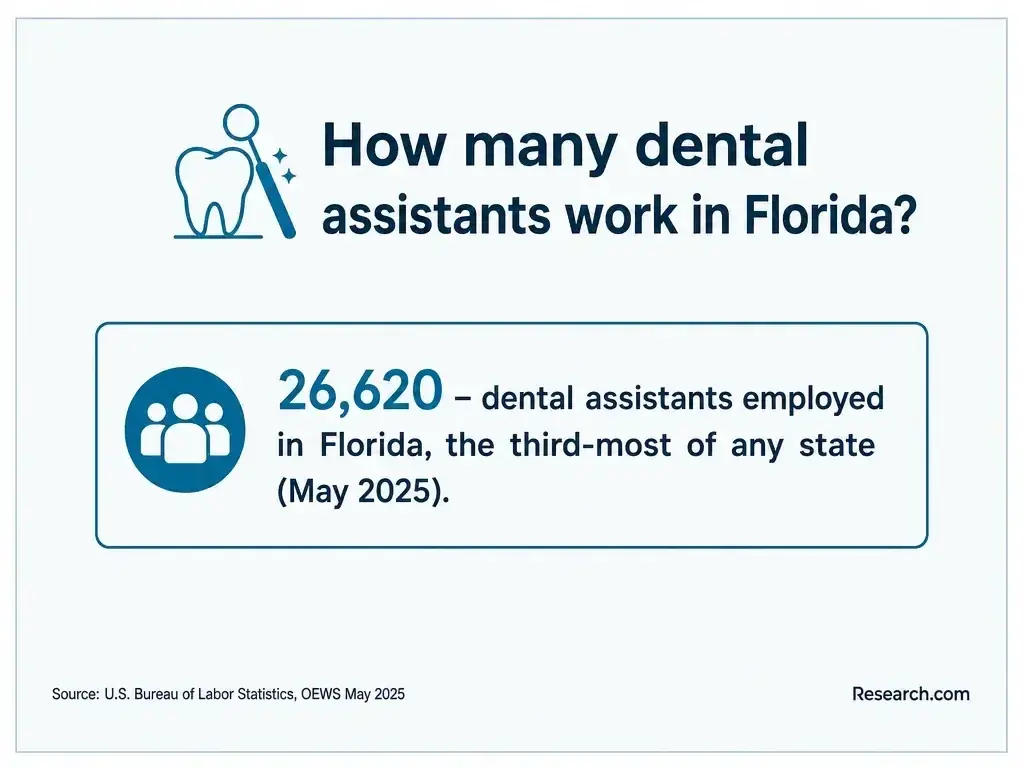
Dental assistants primarily work in dentists' offices, supporting examinations and procedures, preparing instruments and treatment rooms, and helping patients understand appointments and care instructions (U.S. Bureau of Labor Statistics). Hialeah residents can look beyond city boundaries to practices across the Miami-area labor market, including general dentistry and specialty offices. A wider search may improve your options, but commuting time and transportation costs belong in your training and job budget.
Match the program to the work you want. A practice seeking assistance with radiographs or expanded functions may need evidence of training or certification beyond a basic completion certificate. Ask prospective employers which duties new hires actually perform and which Florida credentials they require before paying for a program advertised as "job-ready" (Florida Board of Dentistry; Florida Department of Health).
A verified Hialeah-specific dental assistant median is not available in the figures used here. The appropriate national benchmark is $48,070 in May 2025 for dental assistants, according to the U.S. Bureau of Labor Statistics. That median spans workers with different experience, schedules, and duties; it should not be used as an expected first-job offer in Hialeah.
When judging whether a program is affordable, compare actual entry-level offers from Miami-area practices with your expected take-home pay, training debt, and commute. Ask whether an employer pays more for documented radiography or expanded-functions skills, and whether it will fund additional training. Do not assume that a more expensive credential automatically produces a higher wage.
Dental-assisting programs commonly take about one year, while associate-degree routes generally take longer; actual time depends on the school's schedule, required clinical work, and whether you attend full-time (U.S. Bureau of Labor Statistics). Florida does not impose one universal clock-hour total for every basic dental assistant job. Requirements tied to particular duties, including expanded functions and radiography, are a separate question to check with the Florida Board of Dentistry and Florida Department of Health.
Get the program's published clock hours, lab hours, clinical or externship hours, and calendar length in writing. An accelerated schedule may shorten time without earnings but leave less room for paid work; a part-time schedule may protect income while extending the completion date. The phrase best 6-month online associate degree programs should not be treated as a dental-assisting timeline: a fast online credential cannot replace required chairside practice.
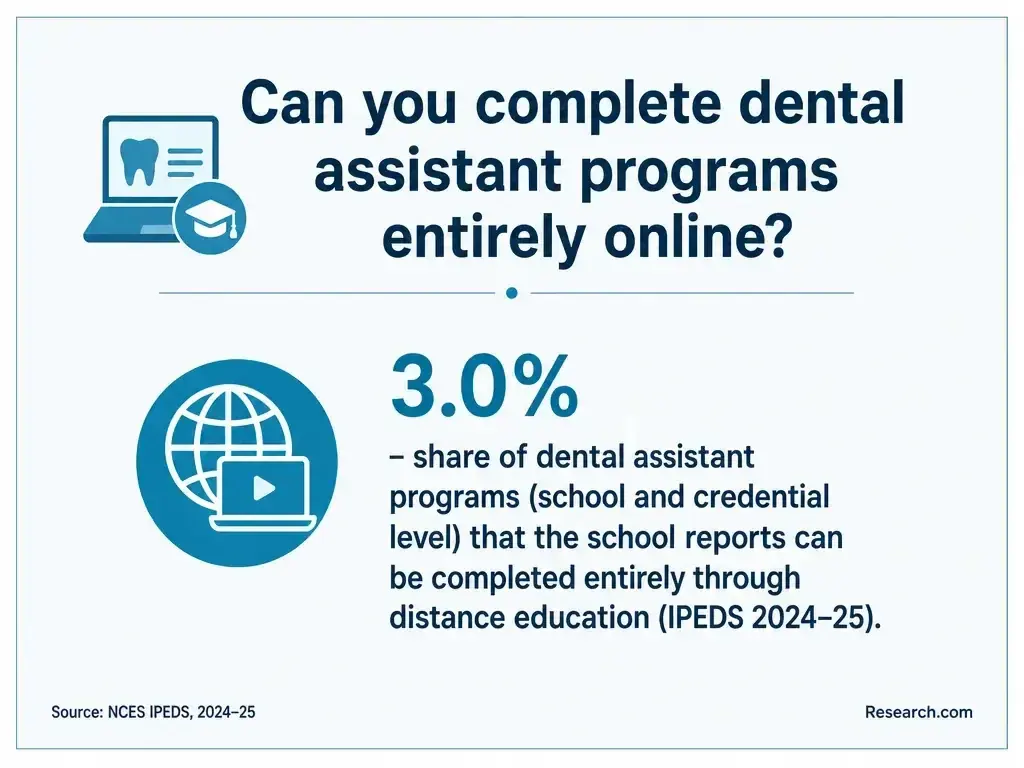
Online coursework can cover subjects such as terminology, records, and infection-control principles. It cannot, by itself, demonstrate safe instrument handling, chairside assistance, or supervised patient care. A hybrid program can be a practical choice for someone working in Hialeah if its in-person labs and clinical placement are accessible and its schedule is clear. An on-campus program may offer more structured practice but require more frequent travel.
Ask exactly where and when hands-on instruction occurs, who arranges a clinical placement, and whether the training supports the Florida duties you intend to perform. Marketing an online course as convenient - or comparing it with easy college classes to take online - does not establish occupational eligibility. Verify the practical components before enrolling (Florida Board of Dentistry).
There is no defensible single Hialeah program average without comparable, current prices for the same credential and included expenses. Request an itemized, dated cost-of-attendance estimate from each provider instead of relying on an advertised tuition figure. The categories below show what to compare; a blank or "included" charge should be confirmed in writing.
| Cost category | Why it changes the comparison |
| Tuition and mandatory fees | Establishes the billed school cost and any payment-plan obligations. |
| Books, supplies, uniforms, and protective equipment | May be included at one school and purchased separately at another. |
| Clinical placement and transportation | Travel beyond Hialeah can add recurring costs and affect work hours. |
| Exams and application requirements | Ask which certification, radiography, screening, or health-related charges apply to your intended route. |
| Lost earnings and financing | Schedule changes and borrowing can outweigh a small tuition difference. |
To assess return on investment, consider the probability of completing the program, grants or employer support, debt, income you give up while training, your current earnings, and plausible earnings afterward over a realistic time horizon - not just a headline wage. Federal aid depends on eligibility of both the student and program; check Federal Student Aid and the school's financial-aid office. Ask Florida's workforce system about training assistance before borrowing (Federal Student Aid; CareerSource Florida).
The school may award a certificate, diploma, or associate degree; the exact credential must appear in its catalog. None should be confused with an occupational license or the Dental Assisting National Board's optional professional certifications. Institutional accreditation concerns the school; Commission on Dental Accreditation recognition concerns a specific dental program. Florida school authorization, where applicable, is another distinct check (Commission on Dental Accreditation; Florida Commission for Independent Education).
Before choosing, ask whether completed coursework can transfer, whether prior learning earns credit, and whether the credential documents the training needed for your intended Florida duties. Comparisons of top non profit accredited colleges address institutional recognition, not whether a particular dental-assisting program prepares you for expanded functions or radiography. A school's ownership type alone does not settle that question.
Requirements vary by provider. Ask each school whether it requires a high school diploma or equivalent, an application or assessment, immunizations, a background check, or other documentation before clinical placement. Check whether those requirements bring additional charges or could delay your start. Do not assume admission means you are cleared for every clinical site.
If a practice offers direct-entry training, ask who supervises you, what duties you may perform while learning, and how the practice documents training for any expanded functions or radiography you eventually seek. This route may suit someone who needs income immediately, but it is not equivalent to a school program unless the resulting skills and eligibility meet the job's requirements (Florida Board of Dentistry).
A useful curriculum connects classroom knowledge to repeated practice: infection prevention, instrument processing, dental terminology, chairside setup, patient communication, recordkeeping, and radiography instruction where offered. The occupation requires close coordination with a dentist and careful attention to safety and patient comfort (U.S. Bureau of Labor Statistics).
Look past the course titles. Ask for the number of supervised lab and clinical hours, the procedures students practice, the equipment available, and how instructors assess competency. If a program advertises expanded-functions or radiography preparation, request the precise Florida training pathway it supports rather than assuming that exposure to a topic establishes permission to perform the duty (Florida Board of Dentistry; Florida Department of Health).
Florida does not require a single general dental assistant license for every entry-level assisting role. It does regulate particular duties. Expanded functions require appropriate formal training under Florida rules, and dental radiography has its own certification requirements administered through the Florida Department of Health. Verify the current requirements for the exact tasks in a job description before enrolling or accepting duties (Florida Board of Dentistry; Florida Department of Health).
National certification through the Dental Assisting National Board is distinct from Florida permission to perform regulated functions. Likewise, school authorization and institutional accreditation do not replace required duty-specific training or certification. Ask a program which requirements it satisfies, which remain after graduation, and what documentation it gives graduates (Dental Assisting National Board; Florida Board of Dentistry).
Start with the duties you want to perform, then compare programs against that goal. A low-price program may be the right investment for basic assisting; paying more may be justified if the additional supervised practice and documented Florida eligibility meet a real employer requirement. Rankings help identify options, but they do not substitute for checking the current program.
Use these questions with admissions staff - and request answers in writing when cost or eligibility is involved:
Be wary of guaranteed jobs, vague claims that a program is "fully licensed," or promises that entirely online study qualifies you for hands-on duties. Unrelated education questions, such as do all phd programs require a dissertation, cannot answer the practical question here: whether this specific training makes you ready and eligible for your intended dental-assisting work.
Many people begin with basic chairside support, then build documented skills for expanded functions or radiography as their role requires. With experience, some move toward specialty practices, lead-assistant responsibilities, scheduling, or practice administration. These are possible paths, not automatic promotions; duties and pay depend on the employer and on Florida's rules for regulated functions (Florida Board of Dentistry; U.S. Bureau of Labor Statistics).
If your main goal is maximum earnings rather than dental patient care, compare occupations before enrolling. A guide to what trade school jobs pay the most can broaden that comparison, but salary alone cannot tell you whether another occupation's training time, physical demands, or entry requirements fit your circumstances.
The U.S. Bureau of Labor Statistics projects 7.4% national employment growth for dental assistants from 2025 to 2035. That indicates a growing occupation nationally, not a forecast of Hialeah vacancies or a guarantee of employment after training. Your practical market includes practices across the wider Miami area, so placement-site access and a feasible commute may matter as much as a school's Hialeah address.
Before committing, review current local postings for the exact credentials, experience, schedule, and bilingual communication skills employers request. Compare those requirements with the program's documented training. If many suitable openings require duties the program does not prepare you to perform, its low price may offer poor value for your intended job.
Investing in training is a consequential decision, especially when the lowest advertised tuition may not be the lowest cost of becoming job-ready. Research.com created this ranking to help readers compare dental assistant programs with other options in the same occupation and location. Its team reviews multiple education and occupational sources for credibility and accuracy; only programs with completions reported to IPEDS are eligible for the ranking.
Most affordable rankings score costs and debt: tuition, cost of attendance, median student debt, and federal loan default rate. Indicator weights use an entropy-based method, which gives more weight to measures that differ more across programs. Accreditation and other quality measures are not part of the affordability score. Research.com's separate best-program methodology considers outcomes, earnings, costs, accreditation or relevant industry recognition, and student support. See Research.com's methodology for more detail. A provider's absence from this ranking does not establish that it lacks approval or quality; IPEDS does not cover every trade-training route.
The following sources inform the ranking and its checks. Some cover broader trade education rather than dental assisting specifically, so readers should not mistake inclusion in this source list for a dental-program endorsement.
Use the ranking to narrow a shortlist, then verify each program's current price, clinical training, Florida expanded-functions preparation, and radiography pathway directly. An affordability score cannot answer those job-readiness questions for you.
# 1 position
# 2 position

Not necessarily. Compare total cost, supervised practice, completion prospects, and preparation for the Florida duties you want to perform. A low tuition figure can exclude supplies, exams, or clinical travel.
Basic assisting may be available through employer training. Confirm the duties you will perform: Florida has additional requirements for expanded functions and dental radiography (Florida Board of Dentistry; Florida Department of Health).
Some theory can be taught online, but chairside skills require in-person practice. Ask where supervised labs and clinical training occur and whether the program supports your intended Florida duties.
No. A completion credential, national professional certification, and Florida duty-specific requirements are different. Check each separately with the school, Dental Assisting National Board, and Florida regulators.
Request the itemized total price, refund terms, schedule, hands-on hours, clinical placement policy, credential awarded, and written explanation of the Florida duties for which the program provides qualifying training.