# 1 position

Audited and Verified:
Our Editorial and Data Verification Process
Research.com uses government datasets, official education statistics and primary institutional information to support its career and degree guides. Our review process checks factual accuracy, occupational definitions, source dates and the requirements associated with the credentials discussed.
How This Article Was Fact-Checked
Our editorial team verifies salary estimates, employment projections, education requirements and program information against original data providers and official organizations. Salary figures are checked against the relevant occupational definitions and reporting periods. Information about licensure, accreditation and required in-person training is reviewed separately.
Fact-checked and verified on:

Co-Founder and Chief Data Scientist

Reviewed by Karolina Broda
Fact-Checker and Data Verification
Choosing affordable dental assistant training in Alameda means looking beyond the advertised tuition: a low-cost program may still require separate clinical training, coursework, or fees before you can perform the duties you want. The U.S. Bureau of Labor Statistics projects 7.4% national growth in dental assistant employment from 2025 to 2035. For career starters and working adults, this guide explains California's training routes, costs, credentials, and job prospects. It also accompanies the Most Affordable Dental Assistant Trade Schools in Alameda for 2027 ranking, created by the Research.com team of data scientists to help students identify programs worth considering.
Expect a mix of classroom instruction and supervised practice in infection control, patient preparation, chairside assistance, instruments, records, and office workflow. Dental radiography and expanded duties require particular attention: a school's certificate alone does not authorize every task in a California dental office. Ask for a written list of practical competencies, clinical placements, and the California requirements the curriculum addresses (Dental Board of California; U.S. Bureau of Labor Statistics).
Training routes differ in what they provide. A short course may suit someone seeking basic preparation before employer training; a longer certificate or diploma may provide more structured lab and clinical experience; an associate degree takes a broader academic route but is not inherently necessary for dental assistant entry. Readers comparing best 6 month associate online programs should not assume a fast online credential replaces supervised dental-assisting practice.
For a City of Alameda resident, a program elsewhere in Alameda County may be practical only if its lab and clinical schedule works with the commute. Check the actual training address and placement locations before treating a nearby-sounding program as accessible.
Dental offices are the principal workplace for dental assistants, with duties divided among chairside care, sterilization, records, and scheduling according to the practice and the worker's qualifications (U.S. Bureau of Labor Statistics). Alameda residents can search across the wider Alameda County and Oakland-area labor market rather than limiting themselves to offices on the island. That wider search may improve the range of openings, but the commute and required hours should be part of any job comparison.
General practices can offer broad exposure; specialty practices may emphasize a narrower workflow. Before accepting a position, ask which procedures you will perform, who provides and pays for required training, and whether the office will supervise skills you have not yet learned. An employer's willingness to train is useful, but it does not waive California's rules for regulated duties (Dental Board of California).
A verified, directly comparable City of Alameda wage figure is not available here. As a national benchmark, the median annual wage for dental assistants was $48,070 in May 2025 (U.S. Bureau of Labor Statistics, Occupational Outlook Handbook). That is the midpoint for employed assistants across experience levels and locations - not an entry-level offer or a forecast for someone finishing training in Alameda.
Compare actual local offers by hourly pay, paid hours, benefits, commuting costs, and whether the employer pays for additional coursework. A higher advertised wage can be less attractive if it requires substantial unpaid travel or training. For a training investment, compare likely additional earnings against your current pay, total training expense, possible debt, and time away from work rather than dividing tuition by the national median.
There is no single Alameda program length. Short entry courses, structured certificate or diploma programs, and associate-degree pathways have different schedules and amounts of supervised practice. Employer training can begin alongside paid work, but the time needed to qualify for a particular California duty or RDA route is a separate question. The Dental Board of California sets requirements for regulated functions and registration; do not infer eligibility from a school's advertised completion date.
Ask each provider for its total clock or contact hours, lab hours, clinical hours, placement schedule, and expected time to completion for part-time students. If you already work in a dental office, also ask whether prior learning or experience changes the school's requirements - and confirm separately whether that experience counts toward any Dental Board eligibility route.
Online instruction can cover terminology, anatomy, infection-control principles, and office procedures. It cannot, by itself, demonstrate chairside technique, instrument handling, radiography skills, or patient-facing clinical competency. A hybrid program is useful only when its in-person labs and supervised experience are accessible from Alameda and aligned with the intended California duties (Dental Board of California).
For readers researching best affordable online universities that accept fafsa, federal-aid eligibility and online convenience are separate from dental-assisting readiness. Verify aid eligibility for the specific program, then obtain its lab and clinical schedule in writing. Do not enroll in an entirely remote course on the assumption that its certificate authorizes hands-on procedures.
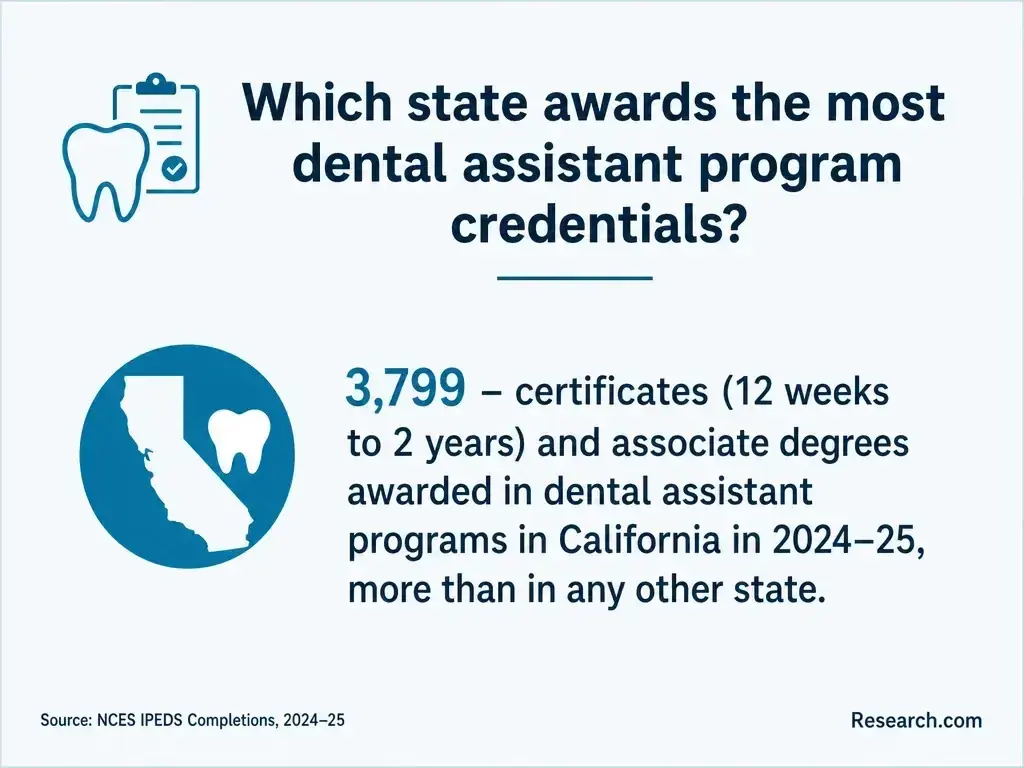
There is no defensible single Alameda average without comparable, current prices for the specific programs under consideration. Published tuition may exclude registration and lab fees, textbooks, scrubs and protective equipment, vaccinations or background checks where required by a placement, transportation, and any applicable examination or registration fees. Request a current itemized cost sheet rather than treating the lowest advertised tuition as the total price.
Funding depends on the provider and program. Ask its financial-aid office whether the specific credential qualifies for federal aid, California assistance, scholarships, or workforce funding; ask an employer whether paid training or reimbursement is available. Federal Student Aid notes that eligibility attaches to qualifying students and programs, not simply to a school's marketing claims. Include lost wages during training in your comparison, particularly if an accelerated schedule limits your work hours.
The award depends on the provider: it may be a course-completion certificate, an occupational certificate or diploma, or an associate degree. These are educational awards, not interchangeable permissions to perform regulated procedures. California RDA registration is a separate state credential, while Dental Assisting National Board certification is a separate professional certification with its own eligibility rules (Dental Board of California; Dental Assisting National Board).
Institutional accreditation, school authorization, CODA programmatic accreditation, and Dental Board approval also answer different questions. Ask the school to identify the exact credential, its current authorization and accreditation status, and which California RDA eligibility route - if any - it supports. A list of easiest bachelor's degree options does not answer those dental-assisting questions; choose the credential that matches the job duties you want.
Admission rules vary by provider. A school may ask for proof of prior schooling, an application, and readiness for clinical placement; a placement may separately require health documentation or a background check. Those school conditions are distinct from California's rules for working as an unlicensed assistant, performing particular functions, or applying for RDA registration (Dental Board of California).
Before paying an enrollment deposit, obtain the admission checklist and ask whether any requirement could delay your first lab or placement. If you plan to train while employed, confirm the attendance policy and whether missed clinical hours must be made up. College of Alameda is one local institution a reader may wish to check, but verify its current offerings directly rather than assuming it has an active dental-assisting program or a particular admission route.
Useful training connects dental anatomy and terminology to the actual sequence of a patient visit: preparing the room, maintaining infection control, assisting the dentist, processing instruments, documenting care, and communicating with patients. Radiography instruction and practice matter if you want duties involving dental X-rays; completion of general chairside coursework does not automatically establish California authorization for radiographic procedures (Dental Board of California; U.S. Bureau of Labor Statistics).
Compare programs by observed practice, not just course titles. Ask to see the skill checklist, how performance is assessed, and whether students practice in a lab before entering a clinical setting. Experience with digital records and imaging workflows can be useful, but software exposure should not crowd out supervised patient-safety skills.
Not for every entry-level dental assistant role. California distinguishes unlicensed dental assistants from registered dental assistants and regulates which duties each may perform. An unlicensed assistant can enter through employer training for permitted work, but required instruction and any authorization for additional duties must still be met. RDA registration has separate education or experience, coursework, examination, and application requirements; finishing a trade-school course does not automatically grant it (Dental Board of California).
Check the Dental Board of California's current duty charts and RDA application pathways against the job you want. Then ask a prospective school which required courses it provides and what graduates must complete elsewhere. DANB certification may demonstrate knowledge to an employer, but it is not a substitute for California registration or state-specific permission to perform a regulated duty (Dental Board of California; Dental Assisting National Board).
Start with your target job: basic chairside assistant now, or a pathway toward California RDA registration. An affordable program is worth considering when its full cost, supervised practice, schedule, and regulatory alignment fit that goal. A short course may be enough to support entry into an employer-training position; it may be poor value if you expect it to cover requirements it does not provide.
Use these checks before committing money or time:
Do not let a low ranking price or a broad education search substitute for these checks. Even resources about what schools offer dual degree programs address a different decision; for dental assisting, the decisive question is whether the training prepares you for the intended California duties at a manageable total cost.
Entry-level assistants may build experience in chairside support, sterilization, scheduling, and patient communication. With the required additional training and California eligibility, some pursue RDA registration or duties requiring further authorization; experienced staff may move into lead-assistant or practice-coordination responsibilities. Those steps depend on the employer, documented skills, and applicable Dental Board rules - not on a certificate title alone (Dental Board of California; U.S. Bureau of Labor Statistics).
If your goal is a different clinical occupation, check that occupation's separate training and licensing requirements rather than assuming dental-assisting credits transfer. Likewise, a search for the cheapest master's degree online is not a substitute for choosing an entry-to-work dental-assisting pathway.
The U.S. Bureau of Labor Statistics projects 7.4% growth in dental assistant employment nationally from 2025 to 2035. This supports considering the occupation, but it is not an Alameda-specific projection and does not guarantee an opening after graduation. For a local decision, compare current postings across Alameda County with the duties you will be qualified to perform, and note whether employers offer training or ask for RDA registration.
Pay particular attention to recurring requirements for radiography, infection control, and chairside experience. If many appealing openings require skills your proposed program omits, its lower price may create a longer - and potentially more expensive - route into the work you actually want.
Investing in occupational training is a consequential decision. Research.com's team built the accompanying ranking to help readers compare affordable dental assistant programs against relevant local options, using reported data and checking sources for credibility and accuracy. Only programs with completions reported to the Integrated Postsecondary Education Data System (IPEDS) are eligible; an unlisted employer training route or school should not be assumed to be unsuitable.
The most affordable ranking scores tuition, cost of attendance, median student debt, and federal loan default rate. It distributes weights through an entropy-based method, under which indicators that vary more among eligible programs receive more weight. Unlike Research.com's separate best-program rankings, this affordability score does not include accreditation or other quality indicators. Readers should therefore use the ranking to narrow a cost-conscious search, then verify training, regulatory eligibility, and outcomes independently. More detail is available in Research.com's ranking methodology.
The team used the following sources in creating or checking the ranking. Some provide occupation-specific context rather than a dental-assisting affordability score:
# 1 position
# 2 position
For some permitted entry-level duties, California employers can train unlicensed dental assistants. You must still meet applicable training and duty requirements; RDA registration is a separate pathway (Dental Board of California).
Not by itself. Check the required in-person skills, training for specific duties, and any RDA eligibility requirements with the Dental Board of California before enrolling.
No. A certificate documents completion of a school program; RDA is a California registration with its own eligibility and application requirements (Dental Board of California).
Only if its full cost and practical training fit your goal. Compare fees, clinical access, commuting, lost work time, and any additional courses needed for the duties you want.
It may be if structured labs or clinical experience help you qualify for your intended role. Compare the program's out-of-pocket cost and time away from work with the employer's paid training and the limits of each route.