# 1 position

Audited and Verified:
Our Editorial and Data Verification Process
Research.com uses government datasets, official education statistics and primary institutional information to support its career and degree guides. Our review process checks factual accuracy, occupational definitions, source dates and the requirements associated with the credentials discussed.
How This Article Was Fact-Checked
Our editorial team verifies salary estimates, employment projections, education requirements and program information against original data providers and official organizations. Salary figures are checked against the relevant occupational definitions and reporting periods. Information about licensure, accreditation and required in-person training is reviewed separately.
Fact-checked and verified on:

Co-Founder and Chief Data Scientist

Reviewed by Karolina Broda
Fact-Checker and Data Verification
Choosing dental assistant training near Los Altos Hills means comparing more than tuition: the credential must fit the work you want to do under California rules. The U.S. Bureau of Labor Statistics projects 7.4% national growth in dental assistant employment from 2025 to 2035, making training choices timely without guaranteeing local jobs. This guide explains nearby pathways, costs, practical training, and career entry. It will also feature the Best Dental Assistant Trade Schools in Los Altos Hills for 2027 ranking, created by the Research.com team of data scientists to help students identify programs worth considering.
Expect a mix of classroom instruction, simulation, and supervised practice: infection control, chairside instrument transfer, dental materials, patient preparation, records, and radiography where the program provides qualifying training. An externship or clinical placement can show how a real office manages appointments, sterilization, and patient communication. Ask how many hours take place in a lab and how many with patients; similarly named certificates need not provide similar hands-on experience.
Los Altos Hills students will generally need to consider training and clinical sites across the surrounding Santa Clara County area, not just within town limits. Foothill College is a nearby option to investigate. A public-college program may suit someone seeking structured practice and a defined credential, while direct dental-office training may suit someone who needs to start earning sooner. Neither route should be assumed to confer Registered Dental Assistant (RDA) eligibility without checking its specific requirements with the Dental Board of California.
Dental assistants work primarily in dental offices, according to the U.S. Bureau of Labor Statistics. Around Los Altos Hills, a practical job search can include practices in nearby communities as well as the town itself: general dentistry offers broad chairside exposure, while orthodontic, pediatric, oral-surgery, and other specialty offices may require different routines. A specialty title does not expand the duties California permits you to perform.
Ask prospective clinical sites whether placements involve supervised patient care or mainly observation, and whether the office considers trainees for openings. That distinction matters more than a program's general promise of "job placement."
The U.S. Bureau of Labor Statistics reports a May 2025 national median annual wage of $48,070 for dental assistants. That is the midpoint for employed workers nationwide - not a local wage quote or a likely first-year salary. Pay for a Los Altos Hills resident will depend on the hiring office, duties permitted under California law, experience, and hours worked.
For a useful personal estimate, compare actual offers from offices you could commute to and ask whether advertised pay assumes RDA status, radiography duties, specialty experience, or benefits. Then compare expected take-home earnings with your current pay and the full cost and time of training; a higher wage does not by itself make an expensive program a good investment.
There is no single California clock-hour requirement that describes every dental assistant entry route. A structured certificate, a longer program that awards an associate degree, and dental-office training can have different calendars and clinical requirements. The relevant measure is when you will finish the instruction and supervised practice needed for the duties or RDA pathway you intend to pursue - not merely the date your online coursework ends.
Request the current calendar from Foothill College or any provider under consideration, including prerequisites, lab days, externship scheduling, and the date a credential is awarded. If an associate-degree timetable appeals to you, lists of best accelerated online associate degrees are not evidence that dental clinical training or California requirements can be accelerated or completed remotely.
Online instruction can cover terminology, records, and some infection-control theory. Instrument handling, radiography practice, chairside skills, and patient-facing clinical experience require suitable in-person facilities or supervised worksites. A hybrid program can reduce classroom commuting, but only if its required labs and clinical placements are realistically reachable from Los Altos Hills.
Before enrolling, obtain a written schedule showing where every practical component occurs and who arranges the placement. General directories of best nationally accredited online universities cannot establish that a dental assistant program supplies hands-on training or meets California RDA requirements. Institutional accreditation, programmatic accreditation, and state recognition answer different questions.
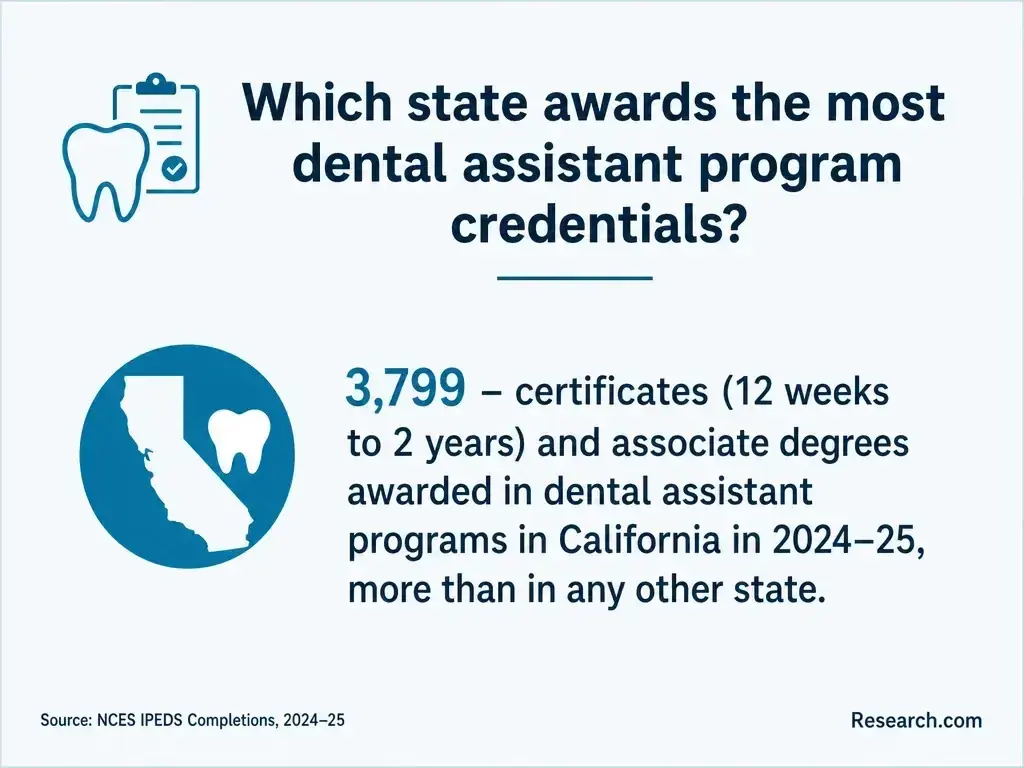
A defensible Los Altos Hills average is not available from a single comparable set of local program prices. Published tuition alone can obscure mandatory fees, supplies, uniforms, textbooks, immunization or screening requirements when applicable, examination and application charges, and travel to labs or clinical sites. A lower-priced program may cost more overall if its schedule requires substantial unpaid time away from work.
Ask each provider for an itemized, job-ready cost and a refund policy, then subtract only aid you are actually eligible to receive. Foothill College can explain its current tuition classification and aid options; eligible students can also check federal student aid and California assistance, while employer training may offset costs through wages. An affordable online associate's degree comparison is a useful reminder to examine total price, but it cannot replace a dental-program quote with clinical travel included.
The award depends on the provider: it may be a certificate, an associate degree where offered, or an employer's record of completed training. None is automatically a California RDA registration. Likewise, a program's institutional accreditation, a dental-assisting program's CODA accreditation, and a voluntary DANB certification are distinct from state authorization to perform particular duties, according to CODA, DANB, and the Dental Board of California.
Ask for the exact name of the award and written documentation of how the curriculum fits your intended California pathway. Broad searches for an online degree low cost will not answer whether a dental assistant credential includes qualifying practical work or supports registration.
Requirements vary by provider and placement site. Check the current program application for prior-schooling expectations, prerequisite courses, English-language or communication requirements, and deadlines; ask separately about clinical-site health documentation, background screening, and reliable transportation if applicable. Employer-sponsored entry can instead depend heavily on an office's willingness to train and supervise a new assistant.
Do not mistake admission for occupational eligibility. A school can accept you into a program without guaranteeing an externship at a convenient site, RDA qualification, or employment. Get those distinctions in writing before committing to a schedule or nonrefundable expense.
Core training connects safe patient care with efficient chairside work: preparing treatment areas, processing instruments, identifying dental anatomy, managing materials, documenting care, and communicating with patients and the dental team. Programs may also teach radiography and expanded procedures, but students must verify which instruction qualifies them for those tasks under California rules, according to the Dental Board of California.
Compare the practice behind a course title. A lab demonstration, repeated supervised skill checks, and an active clinical placement develop different levels of readiness. Digital records and imaging also make accurate data entry and privacy-conscious communication important workplace skills; neither substitutes for safe hands-on technique.
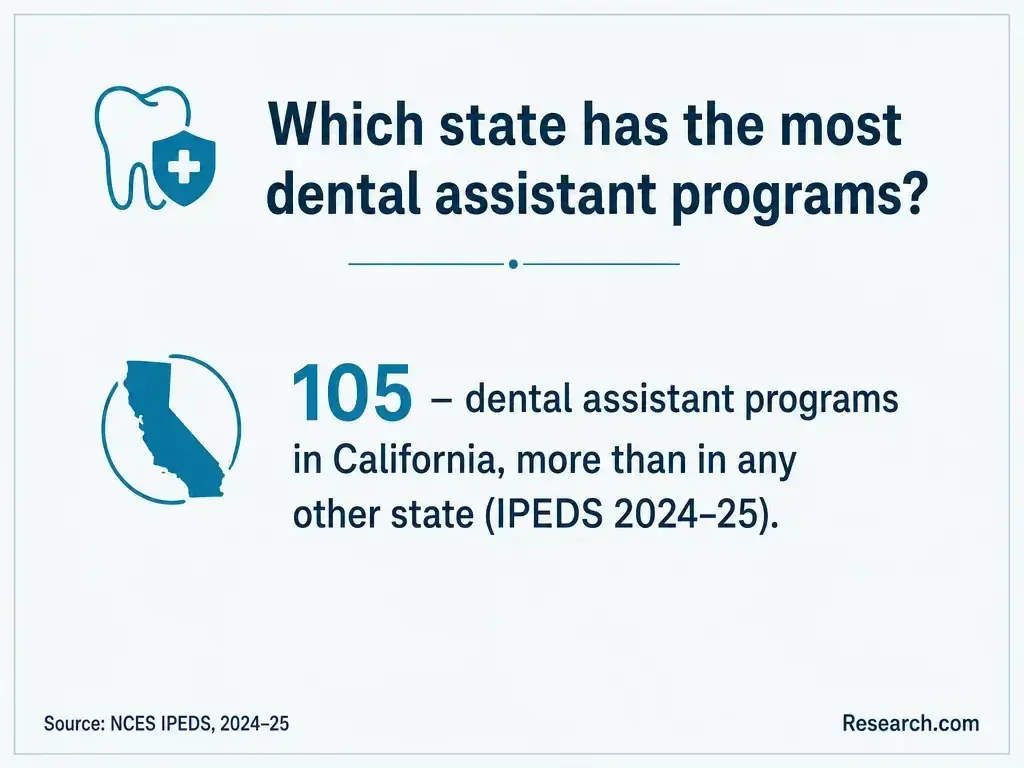
Not for every entry-level dental assistant role. California distinguishes unlicensed dental assisting from Registered Dental Assistant status and limits which duties an assistant may perform. Certain duties require specified training or qualifications; becoming an RDA involves meeting the Dental Board of California's applicable eligibility, coursework, and examination requirements. A school certificate alone is not a state registration.
Decide first which duties you want to perform. Then compare the program's documented courses and clinical experience against the Dental Board's current rules, including any radiography requirements. DANB certification is a separate professional credential, not a replacement for California authorization. Confirm current requirements with the Board before choosing a program based on an advertisement that says "certification eligible."
Start with your target job: entry-level chairside assistant, or a route intended to support RDA registration. Then compare nearby programs and office-based training on documented eligibility, supervised practice, total cost, schedule, and outcomes. A ranking can help create a shortlist, but it cannot tell you whether an externship fits your commute or whether an office will pay you while you learn.
Use these checks when speaking with admissions staff and prospective employers:
A common mistake is treating an impressive institutional label or an unrelated search ranking - such as easiest phd degree - as evidence of dental-assisting readiness. Choose the route that supports your intended duties at a cost and completion risk you can manage, not the route with the most appealing headline.
An entry-level assistant may build chairside and office experience, pursue California RDA registration if eligible, or move into a dental specialty practice. Experienced assistants may also take on scheduling, inventory, patient coordination, or team-training responsibilities. These are possible directions, not automatic promotions attached to a certificate.
If your goal is rapid entry, supervised office training may be worth comparing with a formal program. If you want a structured route toward additional permitted duties, verify the program's RDA alignment before enrolling. In either case, ask local employers which credentials they recognize and which duties they expect a new hire to perform on day one.
The U.S. Bureau of Labor Statistics projects 7.4% growth nationally from 2025 to 2035 for dental assistants. That indicates growth across the occupation, not a forecast of openings within Los Altos Hills or a guarantee that a particular graduate will find work. Because students can train and seek jobs across nearby communities, the practical market is broader than the town boundary.
Before paying for training, review current openings within a commute you would accept. Separate postings open to trainees from those requiring RDA status or prior experience. That comparison tests whether a shorter entry route is realistic for you - or whether more structured, qualifying practical training is the better investment.
Investing in education is a consequential decision. Research.com created its ranking to help readers compare dental assistant programs with other programs serving the same occupation and location, rather than with unrelated schools nationwide. The team checks multiple education and occupational sources to improve the ranking's credibility and accuracy. Only programs with completions reported to IPEDS are eligible; an unlisted employer-training route or career school is not necessarily a poor option.
Best-program rankings assess student outcomes; earnings and return on investment; costs and debt; and quality and recognition. Occupation-relevant programmatic accreditation or industry recognition receives 20% of the score, institutional accreditation 10%, and student support services 10%. The remaining 60% covers outcomes, earnings, and costs, with weights distributed by an entropy-based method that gives more weight to indicators that differ more across programs. Most-affordable rankings instead score only tuition, attendance cost, student debt, and federal loan default rate, using entropy-based weights; accreditation and other quality indicators are not part of that affordability score.
The ranking draws on the following sources. Some cover dental assisting directly; others provide broader education, accreditation, or workforce context rather than proof that a particular program meets California's registration requirements.
Use the ranking to narrow your search, then confirm each program's current clinical arrangements, full price, and California credential pathway directly. More detail about the ranking approach appears on Research.com's methodology page.
# 1 position
# 2 position
Foothill College is a nearby provider to investigate. Confirm its current dental-assisting offerings, application dates, credential, and clinical-site arrangements directly before making plans.
Some entry-level California dental assisting work can be learned under an employer's supervision. Permitted duties are limited, and additional training or registration may be necessary for the work you ultimately want to do, according to the Dental Board of California.
Do not assume so. Check the Dental Board of California's current RDA pathways and confirm how the program provides required hands-on instruction, qualifying coursework, and examination preparation.
It can be if its training supports your target duties and the likely earnings improvement justifies tuition, travel, lost work time, debt, and completion risk. Compare that investment with a realistic employer-training option.
No. CODA accredits eligible dental programs; California RDA registration is a separate process governed by the Dental Board of California. Check both the program's current status and your individual eligibility.