# 1 position
Pima Medical Institute-Albuquerque - Dental Assisting/Assistant.
certificate or diploma

Audited and Verified:
Our Editorial and Data Verification Process
Research.com uses government datasets, official education statistics and primary institutional information to support its career and degree guides. Our review process checks factual accuracy, occupational definitions, source dates and the requirements associated with the credentials discussed.
How This Article Was Fact-Checked
Our editorial team verifies salary estimates, employment projections, education requirements and program information against original data providers and official organizations. Salary figures are checked against the relevant occupational definitions and reporting periods. Information about licensure, accreditation and required in-person training is reviewed separately.
Fact-checked and verified on:

Co-Founder and Chief Data Scientist

Reviewed by Karolina Broda
Fact-Checker and Data Verification
Choosing dental assistant training in New Mexico means comparing more than tuition: you need clinical practice, a useful credential, and a path to the duties you want to perform. The U.S. Bureau of Labor Statistics projects 7.4% national employment growth for dental assistants from 2025 to 2035. This guide explains training routes, costs, state rules, and career prospects. It also features the Best Dental Assistant Trade Schools in New Mexico for 2027 ranking, created by the Research.com team of data scientists to help students identify programs worth considering.
A dental assistant training program prepares students to support dentists with patient preparation, instrument handling, infection control, dental imaging, records, and office workflow. Expect in-person practice: recognizing instruments in a video is not the same as using them safely during a procedure. Programs differ in whether practice takes place in a simulated dental lab, an affiliated office, or both.
The practical choice is often between a structured certificate or diploma and training provided by a hiring dental practice. A school program may suit someone who wants organized instruction and a supervised placement before seeking work. Employer training may suit someone who has an offer and can learn while earning, but the applicant should ask who supervises training and whether it covers any separately regulated duties. Neither a similarly named credential nor time spent in an office establishes eligibility for every dental assisting function.
Most dental assistants work in dentists' offices, according to the U.S. Bureau of Labor Statistics. In New Mexico, that can mean a general practice or a specialty office such as orthodontics or oral surgery. The setting changes the skills an employer may emphasize: a specialty office may prioritize procedure-specific instruments, while a smaller general practice may expect both chairside and front-desk work.
Location matters when comparing training. An Albuquerque-area student may have more offices to approach for placements, while someone farther from a training site should confirm the placement location and travel schedule before enrolling. A convenient classroom is less valuable if required clinical attendance entails an unaffordable commute.
The national median annual wage for dental assistants was $48,070 in May 2025 (U.S. Bureau of Labor Statistics, Occupational Outlook Handbook). That figure describes workers across experience levels and locations; it is not an offer a newly trained applicant should expect in New Mexico. To evaluate a local program, compare current job postings and the latest Bureau of Labor Statistics state or metro occupational wage estimates for dental assistants with the program's full cost.
Pay can also depend on the duties an employer needs, schedule, and experience. Ask prospective employers whether they pay for required training or examinations before taking on debt for an added credential. Readers comparing this occupation with others can use what is the highest paying trade school job as a starting point, but should compare local entry requirements as well as wages.
Completion time depends on the credential, course schedule, and clinical-placement requirements. A focused certificate can be shorter than a broader diploma or an associate-degree program; part-time attendance usually extends the calendar time. Employer training follows the practice's supervision and workload rather than a school term. There is no single statewide program length or clock-hour total that applies to every dental assisting route.
Request each provider's published total contact hours, separate lab and clinical hours, expected placement schedule, and typical time to completion. If rapid entry matters, compare the date you could begin supervised work - not just the final classroom date. A shorter program is a poor shortcut if it omits practice or preparation needed for your intended duties.
Online coursework can be useful for dental terminology, anatomy, records, and some infection-control theory. Chairside procedures, instrument handling, imaging practice, and supervised clinical work require suitable equipment and in-person oversight. A hybrid program can reduce classroom travel, but it does not remove the need to reach its lab and placement sites.
Before paying for an online or hybrid option, get its in-person requirements and placement arrangements in writing, especially if you live far from the provider. Ask whether it arranges a placement near you and who approves the site. Do not assume an entirely online course qualifies you for certification or for a duty regulated by the New Mexico Dental Health Care Board; check the applicable requirements with the board and credentialing organization.
There is no reliable single average price that captures New Mexico's public-college, private career-school, and employer-training routes. Published tuition is only the starting figure. Ask each provider for an itemized, current estimate covering mandatory fees, textbooks, supplies, protective equipment, uniforms, any required health checks, travel to clinical sites, and examination or application charges. Also account for earnings you would forgo while attending.
A lower-priced program is not automatically the better investment. Compare its completion likelihood, clinical access, aid eligibility, expected debt, and time until you can seek paid work. Confirm federal-aid eligibility through the school and Federal Student Aid; ask the school and New Mexico workforce agencies about current grant options. Employer-sponsored training may reduce upfront spending or provide wages, but confirm which costs and duties the employer actually covers.
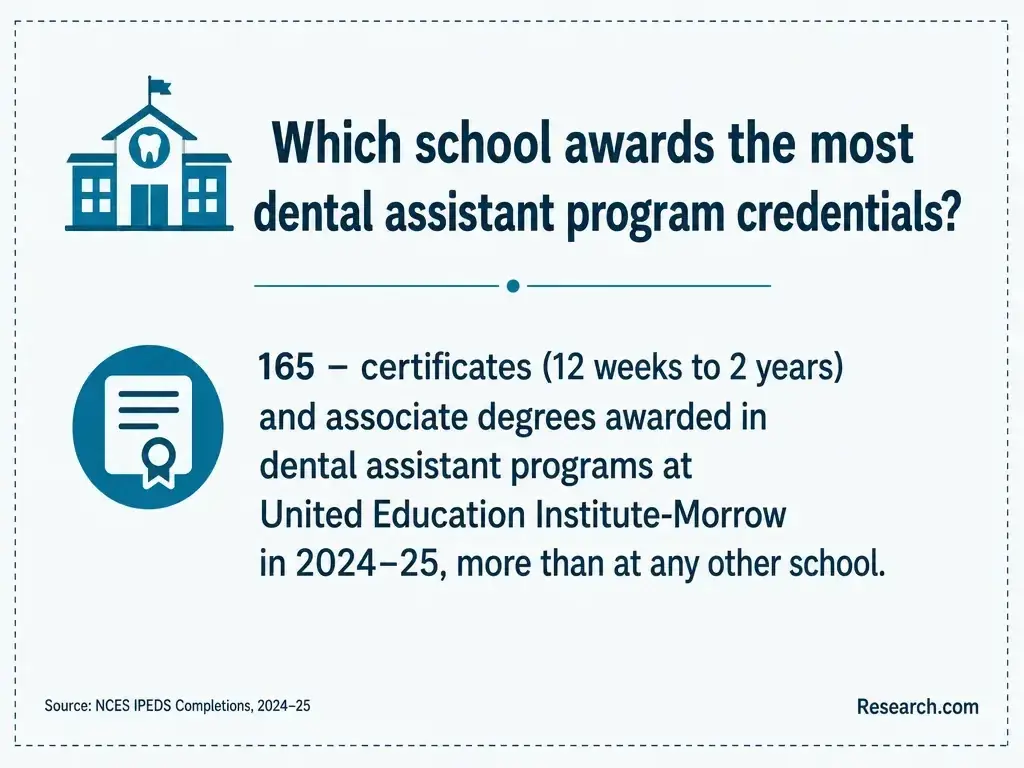
A school may award a certificate, diploma, or, for a longer academic program, an associate degree. These are educational credentials. Institutional accreditation addresses the school; CODA programmatic accreditation addresses an eligible dental assisting program. Neither automatically grants a professional certification or permission to perform every regulated duty (Commission on Dental Accreditation; New Mexico Dental Health Care Board).
The Dental Assisting National Board's Certified Dental Assistant credential is a separate professional certification with its own eligibility and examination rules. Before choosing a program, ask whether its particular curriculum and accreditation status support your intended certification route. If you may later change programs, ask whether completed coursework will transfer; do not assume another provider will accept it (Dental Assisting National Board).
Admissions requirements vary by provider. Ask whether applicants need a high school diploma or equivalent, placement testing, prerequisite coursework, or documentation for clinical participation. A school may also have deadlines or conditions set by its placement partners. Meeting school admissions requirements does not establish eligibility for certification or a board-regulated function.
Before applying, obtain the program's admissions checklist and clinical-placement conditions, then ask when each requirement must be completed and whether related costs are refundable. This matters particularly if you must arrange transportation, reduce work hours, or travel to a placement outside your home community.
Core instruction commonly combines dental anatomy and terminology with chairside assisting, instrument transfer, sterilization, infection prevention, patient communication, records, and dental-office workflow. Imaging instruction and practice can be especially important for students seeking radiography duties. The U.S. Bureau of Labor Statistics identifies both clinical support and administrative tasks in the occupation; check how a particular curriculum divides time between them.
Ask to see the skills checklist used in lab and clinical evaluation. A useful answer identifies which procedures students practice, what they must demonstrate independently under supervision, and how instructors address errors. That evidence is more informative than a course title such as "clinical skills."
Do not treat "dental assistant" as a single license covering every task. New Mexico permits dental assisting work within its dental-practice rules, while particular functions can carry separate training, certification, or supervision conditions. Check the New Mexico Dental Health Care Board's current rules for the exact duty you want - including radiography or other expanded functions - before enrolling. School graduation alone should not be taken as board authorization (New Mexico Dental Health Care Board).
National certification is also distinct from state permission to perform a regulated function. The Dental Assisting National Board sets eligibility and examination rules for its credentials; employers may value them, but applicants should verify both the employer's expectations and New Mexico's requirements for the intended work (Dental Assisting National Board; New Mexico Dental Health Care Board).
Start with the job you want, then test each program against it. If comparing Pima Medical Institute-Albuquerque, Central New Mexico Community College, Carrington College-Albuquerque, Santa Fe Community College, or New Mexico State University-Dona Ana, confirm that the specific dental assisting program is currently offered, where its clinical training occurs, what credential it awards, and its present cost. A school's inclusion in a ranking cannot answer those enrollment-year questions.
Use the same questions with every provider so a faster or cheaper option is not mistaken for an equivalent one:
Check institutional accreditation separately from CODA program accreditation and state requirements. Red flags include an unexplained "fully online" clinical curriculum, an advertised certification with no stated eligibility route, or a price that excludes required placement and examination costs. Compare the net investment over a realistic period, including lost earnings and the possibility of not completing - not just tuition or an occupational median wage.
Initial roles commonly involve chairside support or a combination of clinical and administrative duties. With experience and any applicable additional training or authorization, an assistant may pursue more specialized procedures, coordinate a practice's workflow, or move toward office supervision. These steps are possibilities, not automatic promotions or duties conferred by an entry-level certificate (U.S. Bureau of Labor Statistics; New Mexico Dental Health Care Board).
Students who prefer supervised patient care and a relatively direct route into a dental office may find the training worthwhile. Someone primarily seeking remote work, or unwilling to attend labs and clinical sites, should reconsider this particular occupation before committing funds. Ask local employers which skills they actually expect from new assistants and which they teach after hire.
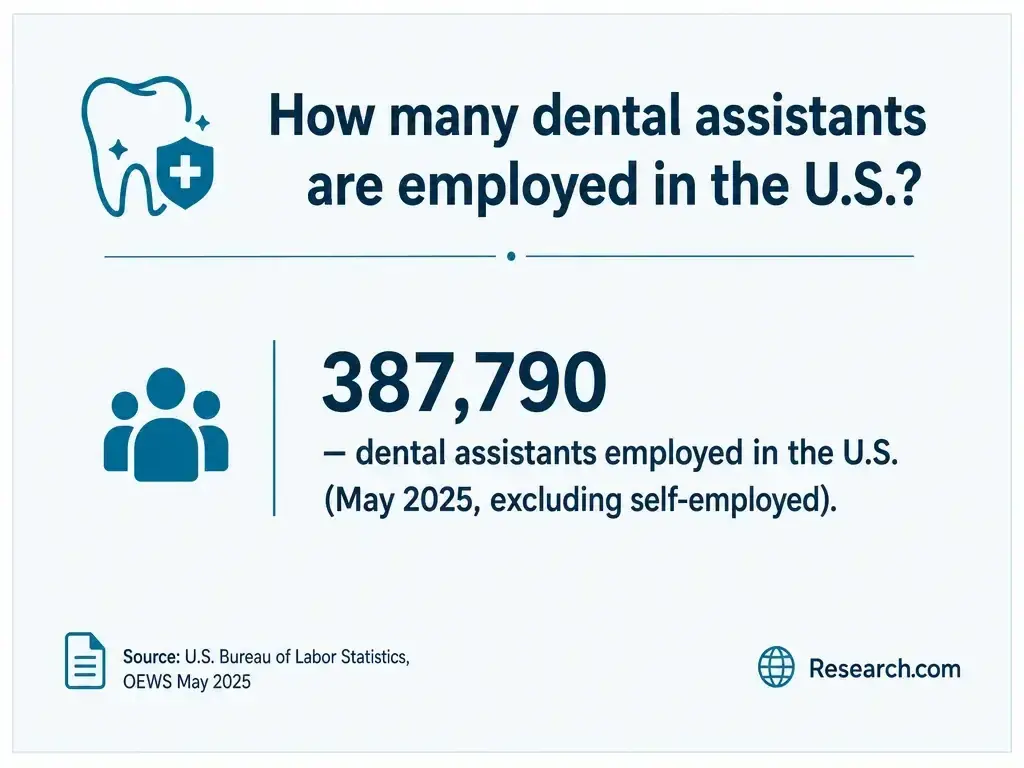
National employment of dental assistants is projected to grow 7.4% from 2025 to 2035 (U.S. Bureau of Labor Statistics, Employment Projections). That indicates opportunity across the occupation, not a guarantee of a vacancy in a particular New Mexico community. Dental assistants' work remains tied to patient visits and in-person procedures, making access to local practices more consequential than the availability of online coursework.
Before selecting a campus or clinical site, examine current openings within a workable commute and note which request experience, imaging-related qualifications, or a particular schedule. Repeat the search near graduation: national projections are useful for context, while local employer requirements determine whether your training fits the jobs you can reach.
Education is a substantial investment, so the Research.com team built this ranking to help readers compare dental assisting programs with other options in the same occupation and location. Only programs with completions reported to the Integrated Postsecondary Education Data System (IPEDS) are included. That makes the ranking a comparison of eligible programs, not an inventory of every employer-training or non-IPEDS option.
Best-program scores consider student completion and full-time and part-time retention; earnings one year after completion and earnings relative to annual attendance cost; tuition, attendance cost, debt - including debt held by students who withdrew - and federal loan default rates; and accreditation, relevant recognition, and student support. Relevant programmatic accreditation or industry recognition receives 20% of the score, institutional accreditation 10%, and student support 10%. The remaining 60% covers outcomes, earnings, and costs, with entropy-based weighting that gives more weight to indicators that vary more across programs. Most-affordable rankings instead score only tuition, attendance cost, median debt, and loan default rates using entropy-based weights; accreditation and other quality indicators are not part of that score.
The team uses the following sources to check institutional, program, outcome, and occupational information. Inclusion of a source does not mean every organization listed accredits dental assisting programs.
Readers can use the ranking to narrow a shortlist, then verify current program details directly; reported outcomes may cover a different period from current tuition or requirements. See the Research.com methodology for more about how the ranking was created.
# 1 position
# 2 position
# 3 position
# 4 position

# 5 position
# 6 position
# 7 position
# 8 position
# 9 position
Employer-supervised training may be an option for some dental assisting work. Ask the employer what it teaches and check New Mexico Dental Health Care Board rules before assuming that route covers radiography or another regulated function.
No. A school awards its educational credential; the Dental Assisting National Board sets separate eligibility and examination requirements for its professional certifications.
Theory may be delivered online, but practical skills require in-person training and supervision. Verify a program's lab and clinical arrangements before enrolling.
Only if its supervised practice, total cost, schedule, and preparation for your intended duties meet your needs. Compare those details with employer training and longer school options.
No. Institutional and programmatic accreditation address education quality; New Mexico's rules govern regulated functions. Verify the specific duty with the state board.