# 1 position
Seattle Central College - Dental Assisting/Assistant.
certificate or diploma

Audited and Verified:
Our Editorial and Data Verification Process
Research.com uses government datasets, official education statistics and primary institutional information to support its career and degree guides. Our review process checks factual accuracy, occupational definitions, source dates and the requirements associated with the credentials discussed.
How This Article Was Fact-Checked
Our editorial team verifies salary estimates, employment projections, education requirements and program information against original data providers and official organizations. Salary figures are checked against the relevant occupational definitions and reporting periods. Information about licensure, accreditation and required in-person training is reviewed separately.
Fact-checked and verified on:

Co-Founder and Chief Data Scientist

Reviewed by Karolina Broda
Fact-Checker and Data Verification
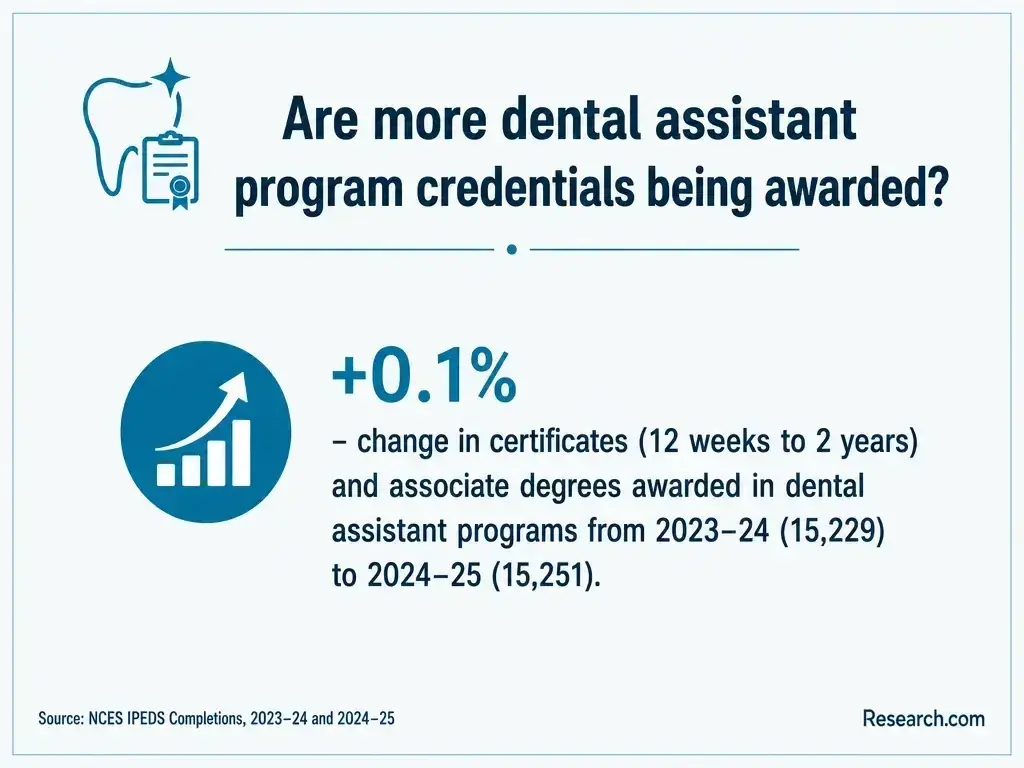
The cheapest dental assistant program is not necessarily the least expensive route into a Seattle dental office: fees, travel to clinical sites, and Washington credential requirements can change the calculation. The Research.com team of data scientists created the Most Affordable Dental Assistant Trade Schools in Seattle for 2027 ranking to help students identify programs worth considering. With the U.S. Bureau of Labor Statistics projecting 7.4% growth in dental assistant employment from 2025 to 2035, this guide helps prospective students and career changers compare costs, hands-on training, credentials, and realistic alternatives.
A dental assistant training program prepares students to support dentists with patient care, infection control, instruments, records, and office workflow. For a Seattle applicant, the key distinction is between a school-based certificate or diploma, an associate degree that includes additional coursework, and supervised training arranged by an employer. These routes can differ substantially in price and practical experience even when they lead toward the same entry-level occupation.
Expect in-person practice in a simulation lab, dental clinic, or office before treating an online curriculum as job preparation. Ask each provider how students practice chairside assistance and radiography, who arranges clinical placement, and whether that placement is reachable from home. An accelerated associate program may suit someone seeking the broader credential, but compare its schedule and total cost with a shorter occupational certificate; best accelerated associate degree options are not substitutes for verified dental clinical training.
Most dental assistants work in dentists' offices, according to the U.S. Bureau of Labor Statistics. In the Seattle area, that makes general and specialty practices the most relevant places to ask about clinical placements and entry-level openings. Roles may combine chairside work with sterilization, scheduling, or insurance tasks; a specialty office may require additional training after entry.
Dental assisting is a patient-facing route into healthcare, not automatically one of the best paying trade school jobs. If earnings are the deciding factor, compare the training cost and entry requirements of other occupations rather than assuming a dental assistant credential leads to a different licensed dental role.
The U.S. Bureau of Labor Statistics reports a $48,070 national median annual wage for dental assistants in May 2025. A median describes workers across experience levels, not the pay a newly trained assistant should expect. Ask Seattle-area employers for current entry-level pay ranges and whether the quoted rate assumes radiography skills, specialty experience, or weekend availability.
For a return-on-investment comparison, weigh likely additional earnings against the full cost of training and income forgone during it. Include financial aid, expected debt, the chance of completing the program, and how long you expect to work in the occupation; a shorter program is not automatically the better investment if it lacks the practical training an employer needs.
Program length depends on the credential, attendance schedule, and clinical-placement requirements. A focused certificate may take less time than an associate degree, while employer-based training can let a new hire earn wages as skills develop. Neither the credential name nor a school's advertised calendar alone establishes when you can begin work.
Ask for the current catalog's total clock or credit hours, lab hours, required clinical hours, and typical time to placement and completion. Washington does not impose one universal school-program length for its basic dental assistant credential; verify any additional education or experience requirements for expanded duties with the Washington State Department of Health.
Online instruction can cover terminology, infection-control principles, dental anatomy, and administrative work. It cannot replace observed chairside practice, instrument handling, radiography practice, or a required clinical placement. A hybrid program makes sense when its campus sessions and clinical site fit your work schedule; an on-campus option may be simpler if you need regular access to equipment and instructors.
Before paying for a remote course, get written answers about where practical training happens and who secures the site. Lists of free to apply accredited online colleges can help you consider application costs, but an institution's accreditation or online availability does not establish that a dental assisting course provides Washington-relevant hands-on preparation.
There is no single reliable "average Seattle price" that covers public-college programs, private career schools, and employer training on identical terms. Published tuition may omit fees and clinical expenses, while an employer route may pay wages but offer a different schedule or training structure. Request a current, itemized estimate from each provider before comparing prices.
The following cost categories help explain why the lowest advertised tuition may not produce the lowest cost to become job-ready.
| Cost or offset | What to verify |
| School charges | Tuition, mandatory fees, textbooks, supplies, and any equipment or uniform costs. |
| Career-entry charges | Applicable examination, certification, Washington credential-application, and screening costs. |
| Time and travel | Commutes to labs and clinical sites, schedule-related childcare, and wages forgone during training. |
| Possible offsets | Grants, scholarships, eligible federal or Washington aid, workforce assistance, or wages during employer training. |
Federal aid depends on both student and program eligibility, not merely whether a school advertises accreditation (Federal Student Aid). Washington College Grant and other state assistance also have eligibility rules (Washington Student Achievement Council). Ask the financial aid office for your net cost after confirmed aid, not a best-case estimate.
A school may award a certificate, diploma, or associate degree; Washington's dental assistant credential is issued separately by the state. The Dental Assisting National Board's Certified Dental Assistant credential is another distinct, voluntary national certification with its own eligibility and examination rules. A similarly named school certificate does not automatically confer either credential (Washington State Department of Health; Dental Assisting National Board).
Choose based on the credential your intended dental-office role actually calls for. An associate degree may appeal if you value additional coursework, but do not pay for that credential solely because it sounds more advanced. Likewise, easiest online bachelor's degree programs are not a dental assistant entry credential and cannot replace the practical preparation this work requires.
Admissions criteria vary by provider. A school may request an application, prior education records, or a placement assessment; clinical sites may have separate health, safety, or screening requirements. An employer-training route instead depends on the office's hiring standards and willingness to supervise a new assistant. Get the actual entry and clinical-placement requirements in writing before accepting an offer.
Ask whether any prior coursework or dental-office experience earns credit or advanced standing, and whether that credit reduces both the bill and time to completion. Do not assume prior learning waives clinical competencies or changes Washington credential requirements; confirm each decision with the program and the Washington State Department of Health.
Useful training connects infection prevention, dental anatomy, patient communication, charting, instrument processing, and chairside procedures to repeated practice. Radiography instruction deserves particular scrutiny: ask what equipment students use, how competency is assessed, and which duties graduates are prepared to perform under Washington rules. Office software and scheduling matter, but they should not crowd out supervised patient-care skills (U.S. Bureau of Labor Statistics; Washington State Department of Health).
Yes: Washington dental assistants must hold the applicable state credential to practice dental assisting. Basic dental assistant registration is different from the state's expanded function dental auxiliary credential, which has additional requirements and permits different duties. A school award, institutional accreditation, CODA program accreditation, and DANB certification each answer a different question; none should be treated as automatic Washington authorization (Washington State Department of Health; Commission on Dental Accreditation; Dental Assisting National Board).
Before enrolling, check the Washington State Department of Health's current credential and scope-of-practice information for the tasks you want to perform. Then ask the program to identify precisely which requirements its training addresses and which applications or examinations remain your responsibility.
Start with the work you want to do, then compare Seattle-area options on eligibility, practical training, net cost, and schedule. Seattle Central College and Pima Medical Institute-Seattle are institutions a local applicant may encounter, but confirm directly whether the relevant dental assisting program is currently offered at the campus, its current terms, and its clinical arrangements. Do not infer a program's availability or quality from an institution's name or a ranking position.
Use this sequence to avoid the most expensive enrollment mistakes:
A red flag is a promise of automatic certification, state eligibility, or a particular salary without identifying the applicable requirement or evidence. The best-value option is the one you can complete and use for your intended role at a manageable net cost - not necessarily the one with the smallest tuition figure.
Entry-level dental assisting can lead to greater responsibility in chairside work, practice operations, or a dental specialty as experience develops. Some assistants pursue DANB certification or training for expanded functions, but those steps have distinct eligibility rules and are not automatic promotions. Dental assisting also provides exposure to a dental workplace without qualifying someone for a different licensed occupation (Dental Assisting National Board; Washington State Department of Health).
If your main goal is a substantially different earnings trajectory, compare the actual occupation and its required training rather than relying on lists of most profitable majors as a proxy for dental assistant pay. For this decision, the relevant question is whether the credential, time, and cost match the work you want to perform.
The U.S. Bureau of Labor Statistics projects 7.4% national growth in dental assistant employment from 2025 to 2035. That suggests continuing opportunities, but it is not a Seattle-specific hiring forecast or a guarantee of placement. A local applicant should check current openings across general and specialty practices and compare advertised skills with each program's clinical training before committing to tuition.
Education is a consequential investment, so Research.com designed this ranking to help readers compare dental assistant programs against relevant local options rather than against unrelated trades. Only programs reporting completions to the Integrated Postsecondary Education Data System (IPEDS) are eligible. That means the ranking may not capture every employer-training route or provider; absence from the list is not a quality judgment.
The most affordable ranking scores tuition, cost of attendance, median student debt, and federal loan default rate. Indicator weights are assigned using an entropy-based method, which gives more weight to measures that differ more across eligible programs. Accreditation and other quality measures are not part of this affordability score. Research.com's separate best-programs methodology also evaluates outcomes, earnings, support, accreditation, and occupation-specific recognition; readers should not mistake an affordability rank for that broader assessment.
The Research.com team draws on the following sources to check costs, outcomes, institutional information, and occupation-specific context. Not every source publishes data for every program.
Use the ranking to narrow a shortlist, then verify each program's current price, practical training, and fit with Washington requirements. More detail on the ranking approach appears in Research.com's methodology.
# 1 position
# 2 position
Compare the net cost of available school programs with paid employer training. Include fees, supplies, clinical travel, lost wages, and Washington credential costs; the cheapest advertised tuition may not be the cheapest path to work.
Online coursework can cover theory, but chairside and other practical skills need in-person training or supervised practice. Verify a program's clinical arrangements and Washington relevance before enrolling.
A school certificate alone is not the state credential. Check the Washington State Department of Health's current registration requirements and the duties you intend to perform.
Do not assume every basic dental assistant role requires a CODA-accredited program. CODA status can matter for particular advanced pathways or certification eligibility, so check the requirements for your specific goal with the relevant regulator or certifying organization.
No. Compare its total cost and completion time with the amount of supervised practice, clinical support, and preparation it provides for the job you want.