# 1 position
Trinidad State College - Dental Assisting/Assistant.
certificate or diploma

Audited and Verified:
Our Editorial and Data Verification Process
Research.com uses government datasets, official education statistics and primary institutional information to support its career and degree guides. Our review process checks factual accuracy, occupational definitions, source dates and the requirements associated with the credentials discussed.
How This Article Was Fact-Checked
Our editorial team verifies salary estimates, employment projections, education requirements and program information against original data providers and official organizations. Salary figures are checked against the relevant occupational definitions and reporting periods. Information about licensure, accreditation and required in-person training is reviewed separately.
Fact-checked and verified on:

Co-Founder and Chief Data Scientist

Reviewed by Karolina Broda
Fact-Checker and Data Verification
The cheapest dental assistant program is not necessarily the least expensive way to become job-ready. Fees, clinical access, commuting, and radiography training can change the total. This guide will help Colorado students and career changers compare those trade-offs, credentials, and employment options. It will also feature the Most Affordable Dental Assistant Trade Schools in Colorado for 2027 ranking, created by the Research.com team of data scientists to help students make an informed choice about programs worth considering. Nationally, dental assistant employment is projected to grow 7.4% from 2025 to 2035 (U.S. Bureau of Labor Statistics).
Expect instruction in chairside assistance, infection control, patient communication, instruments, dental materials, and office procedures, followed by supervised practice where the program provides it. Dental assisting is a hands-on occupation: a course that teaches terminology but offers no meaningful opportunity to practice clinical tasks is not equivalent to a program with labs and an arranged externship (U.S. Bureau of Labor Statistics).
There is more than one route into the occupation. This comparison identifies the credential and practical experience to check before committing:
| Pathway | Typical credential or outcome | Best fit and main trade-off |
| Community college or public technical program | Certificate; some colleges may offer an associate degree | Useful when structured labs and a recognized college credential matter; check course sequencing and commuting. |
| Private career-school program | Certificate or diploma | May suit someone seeking a concentrated schedule; compare the full price and clinical arrangements. |
| Dental-office training | Employer-verified skills; possibly no school credential | Can reduce upfront school costs and allow earnings while learning, but training breadth and access to particular duties depend on the employer and applicable rules. |
In Colorado, a student considering Trinidad State College, Red Rocks Community College, Pikes Peak State College, Front Range Community College, or Concorde Career College-Aurora should confirm the specific current offering, campus, schedule, and externship site before comparing prices. A nearby program with dependable clinical placement may cost less overall than a lower-tuition option requiring repeated long trips.
Dental offices are the principal workplace; opportunities can also arise in specialty practices, such as orthodontics or oral surgery, and in community dental settings (U.S. Bureau of Labor Statistics). Ask a prospective program where its students complete clinical experience: a placement in the type of practice you hope to join can help you assess the work and build relevant skills.
Location affects the practical choice. Someone outside the Front Range should compare local office-training opportunities with the cost of traveling to campus and externship sites. A training provider's address alone does not tell you where hands-on work occurs - or whether that placement fits your transportation and work schedule.
A Colorado applicant should use pay in local job postings to budget for entry-level work, rather than assume a national median is an offer. The U.S. Bureau of Labor Statistics reports a $48,070 national median annual wage for dental assistants in May 2025. A median describes workers across experience levels and locations, not the likely first wage of someone finishing training.
Compare postings for the duties you will actually be prepared to perform, including whether radiography or expanded functions are expected. When weighing a program's cost against possible earnings, account for current income, time away from work, aid, debt, the chance of completing, and how long you expect to work in the field. A higher-priced program is not automatically a worse investment if it provides practical training you cannot otherwise access; neither is a faster program automatically better.
Dental assistant certificates and diplomas are generally shorter than associate degree programs, while office-based training follows an employer's schedule rather than a common school calendar (U.S. Bureau of Labor Statistics). Colorado does not impose one statewide clock-hour requirement for every person entering dental assisting; the hours that matter depend on the program and the duties involved (Colorado Dental Board).
Ask for the current calendar, required lab hours, externship hours, and whether the externship is arranged before or after classroom completion. If you are comparing 12 month certificate programs that pay well, compare actual time to job readiness - not just the advertised classroom duration. Part-time attendance may preserve income but extend the time before you can seek work requiring the new skills.
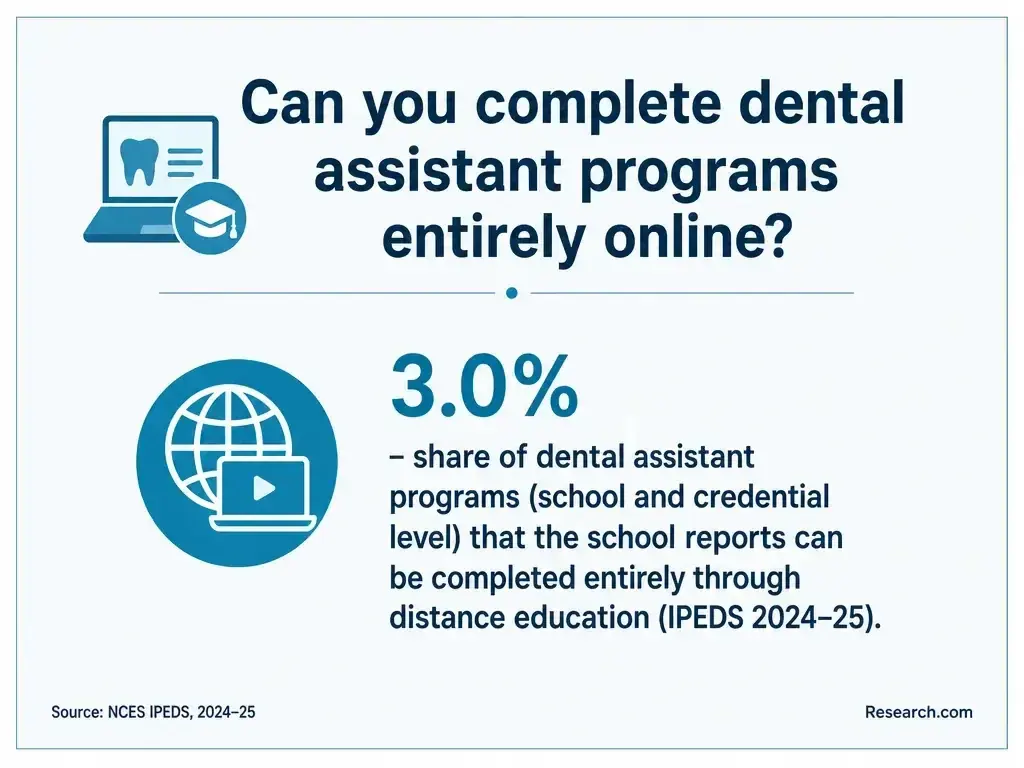
Online study can cover subjects such as dental terminology, anatomy, scheduling, and some safety concepts. Instrument handling, chairside teamwork, infection-control technique, and supervised clinical work require in-person practice. A hybrid program can be practical if its lab and externship locations are accessible; an entirely online course should not be assumed to prepare you for every dental-office task or satisfy Colorado radiography rules (Colorado Dental Board; U.S. Bureau of Labor Statistics).
Request a schedule that separates online coursework from required campus days and clinical shifts. For a rural student, the decisive question is often not whether lectures are online, but whether the provider can arrange appropriate hands-on experience within a reasonable commute. Treat a claim that "online" means "no travel" as a red flag until the provider explains every practical requirement.
There is no single reliable statewide price that captures public programs, private career schools, and employer training on the same basis. Published tuition can omit costs that are necessary to finish and seek work. For a meaningful comparison, request an itemized, current estimate from each provider rather than relying on an advertised starting price.
These cost categories show what to include in a personal total; some will not apply to every program:
| Cost or offset | Why it changes the comparison |
| Tuition and mandatory fees | Check the full program price, resident eligibility where applicable, and whether fees are included. |
| Books, supplies, uniforms, and protective equipment | Ask what the school supplies and what you must purchase separately. |
| Exams, checks, and required documentation | Certification exams or placement-related requirements may add costs. |
| Travel and lost earnings | Campus and clinical schedules can make a seemingly cheaper option more expensive. |
| Grants, eligible aid, or paid office training | Funding or wages can reduce what you must pay or borrow. |
Federal aid eligibility depends on both the institution and the particular program; it should not be inferred from the word "accredited" alone (Federal Student Aid). Ask the provider to identify eligible aid and check Colorado workforce-training assistance through the appropriate workforce center. If you are also scanning cheapest online bachelor degree comparisons, keep their prices separate: they do not measure the cost of becoming a dental assistant.
Depending on the provider, completion may lead to a certificate, diploma, or - in a program that actually awards one - an associate degree. Training in a dental office may instead produce documented work experience without a school credential. Ask for the exact credential name and a written list of the clinical competencies completed; similarly named certificates need not include the same practical training.
School completion, national certification, and permission to perform particular tasks are different things. The Dental Assisting National Board (DANB) sets requirements for its certifications, while the Colorado Dental Board governs duties under state rules. If certification is your goal, ask the school which DANB eligibility route its program supports and verify that answer with DANB before enrolling. A school's institutional accreditation, authorization to operate, and Commission on Dental Accreditation (CODA) programmatic accreditation are also distinct checks - not interchangeable promises of certification or employment.
Requirements vary by provider and by clinical site. Confirm the education prerequisite, application dates, any required immunization or health documentation, background-check policy, and whether you must secure your own externship. Do not assume that being admitted also guarantees a clinical placement.
If a program advertises credit for prior learning or a way to apply previous dental-office experience, request its written policy and ask which specific courses or lab requirements can be waived. That matters most for career changers who already have relevant experience: reducing classroom repetition is valuable only if they still receive the practical preparation needed for their intended duties. Searches for which is the easiest degree to get will not answer these occupation-specific entry questions.
A useful curriculum connects knowledge to work at the chair: preparing treatment rooms, passing instruments, supporting patients, processing materials, maintaining records, and applying infection-control procedures. Radiography instruction and practice should be examined separately because imaging duties are subject to Colorado-specific rules (Colorado Dental Board; U.S. Bureau of Labor Statistics).
Ask to see the skills checklist and find out who observes students performing each task, how often they practice, and what happens if they cannot complete an externship. Those answers are more informative than a course title alone. If you want a specialty-office role, ask whether the program offers relevant exposure without assuming that a general dental assisting credential teaches every specialty procedure.
Colorado does not issue a general occupational license to dental assistants. That does not mean every task is open to an untrained new hire. Rules for taking dental radiographs and for delegated or expanded duties must be checked against current Colorado Dental Board requirements and the supervising dentist's responsibilities. Ask an employer which duties a new assistant will perform before choosing training solely on price (Colorado Dental Board).
DANB certification is a separate professional credential, not a Colorado dental assistant license. CODA accreditation describes a program, while institutional accreditation and state school authorization address different aspects of the provider; none replaces a duty-specific state requirement (DANB; CODA; Colorado Dental Board). A provider should be able to explain exactly how its instruction supports the tasks you intend to do.
Start with the work you want - general chairside assistance, radiography-related duties, or a specialty-practice setting - then compare programs against that goal. An affordability ranking is a shortlist, not a substitute for checking training and fit. These questions expose the differences most likely to affect your decision:
Verify institutional accreditation with the accreditor, CODA programmatic status with CODA if claimed, and school authorization with the relevant Colorado regulator; then confirm certification criteria with DANB. Avoid treating a school's ranking position, a promised salary, or a short advertised duration as proof of job readiness. Comparing training for an unrelated no dissertation doctorate will not resolve whether a dental program includes the clinical work you need.
A common starting point is general chairside work. With employer support, relevant training, and experience, an assistant may take on permitted additional duties, work in a specialty practice, help coordinate patients and schedules, or move toward a lead-assistant role. The available tasks depend on Colorado rules and the dental practice; a new certificate alone does not confer an advanced role (Colorado Dental Board; U.S. Bureau of Labor Statistics).
Choose optional certification or further occupational training for a defined purpose: an employer requirement, a skill you want to document, or a role you can realistically pursue. Before paying for an add-on, ask local employers whether they recognize it. Comparisons involving short phd programs online do not describe progression within dental assisting; practical experience and applicable duty requirements are the relevant measures here.
The latest national U.S. Bureau of Labor Statistics projection calls for 7.4% growth in dental assistant employment from 2025 to 2035. That signals continuing demand nationally, but it is not a Colorado placement rate or a forecast for any particular town. Use current Colorado job postings and official state labor-market information to check whether openings near you match the duties your chosen program teaches.
Look beyond the number of listings: note schedules, experience expectations, radiography requirements, and commuting distance. If nearby practices regularly seek skills your prospective program does not teach, ask how you would gain them before paying a deposit. A program is worth considering when its total cost, practical training, and likely local opportunities align with your own employment goal - not merely because the occupation is growing.
Investing in training is a consequential decision, so the Research.com team evaluates programs against others in the same occupation and location, rather than treating every trade-school option as interchangeable. Only programs with completions reported to IPEDS can enter the ranking. That makes the comparison useful for evaluating listed programs, but it does not mean an unlisted employer-training option is inferior or unavailable.
The most affordable ranking scores tuition, cost of attendance, median student debt, and federal loan default rate. It uses an entropy-based weighting method, which gives more weight to measures that vary more across programs. Accreditation and other quality indicators do not enter this affordability score. Research.com also produces separate best-program rankings that consider outcomes, earnings, costs, support, accreditation, and relevant recognition; those should not be confused with this cost-focused ranking.
The team uses the following sources to check program, cost, outcome, recognition, and training information. Some sources cover trades other than dental assisting and do not establish dental-program approval:
Use the ranking to narrow your search, then verify the current price, practical training, and credential with each provider. More detail on the approach appears in Research.com's methodology.
# 1 position
# 2 position

# 3 position

# 4 position
# 5 position
# 6 position

# 7 position
# 8 position
# 9 position
# 10 position
# 11 position
# 12 position
# 13 position
Compare itemized public- and private-school quotes with available paid office training. The lowest tuition may not be the lowest total cost once supplies, travel, and lost earnings are included.
Office-based training can be a route into some dental assistant work. Confirm what the employer will teach and what Colorado requires for any additional duties you hope to perform (Colorado Dental Board).
Online coursework can teach theory, but it does not replace supervised practice with instruments, patients, and infection-control procedures. Check every in-person lab and clinical requirement before enrolling.
Colorado does not require a general dental assistant license. DANB certification is separate, and particular duties - including radiography - have requirements that should be verified with the Colorado Dental Board and prospective employer.
Choose based on the actual curriculum, clinical experience, total cost, and time needed for your target job. An associate degree generally involves a longer course of study; the credential name alone does not establish better preparation.
Not necessarily. Ask whether both the institution and your specific program are eligible for federal aid, and request a written estimate of grants, borrowing, and remaining costs (Federal Student Aid).