# 1 position

Audited and Verified:
Our Editorial and Data Verification Process
Research.com uses government datasets, official education statistics and primary institutional information to support its career and degree guides. Our review process checks factual accuracy, occupational definitions, source dates and the requirements associated with the credentials discussed.
How This Article Was Fact-Checked
Our editorial team verifies salary estimates, employment projections, education requirements and program information against original data providers and official organizations. Salary figures are checked against the relevant occupational definitions and reporting periods. Information about licensure, accreditation and required in-person training is reviewed separately.
Fact-checked and verified on:

Co-Founder and Chief Data Scientist

Reviewed by Karolina Broda
Fact-Checker and Data Verification
Choosing an affordable dental assistant program means comparing more than tuition: hands-on training, the credential awarded, and the cost of getting to clinical sites can change which option is worth it. The U.S. Bureau of Labor Statistics projects 7.4% national employment growth for dental assistants from 2025 to 2035. For students and career changers, this guide explains Kansas training routes, costs, and entry requirements. It also features a Most Affordable Dental Assistant Trade Schools in Kansas for 2027 ranking, created by the Research.com team of data scientists to help students identify programs worth considering.
Expect instruction in chairside support, infection prevention, dental materials, patient records, and office workflow, followed by supervised practice. Programs differ substantially in how much time students spend in a simulation lab, assisting with patients, or at an outside dental practice. Ask for each program's current curriculum and required clinical hours rather than assuming similarly named certificates provide equivalent experience.
A public technical-college certificate or diploma can suit someone who wants structured practice before applying for jobs. An associate degree may add general coursework and take longer; it is not automatically necessary for entry-level assisting. Direct employer training can be a lower-upfront-cost alternative for a person who finds a dentist willing to train a new hire, but the duties taught and any certification preparation may be narrower. Salina Area Technical College and Flint Hills Technical College are examples of Kansas providers to investigate, not evidence that either offers the same curriculum, price, or current clinical placement.
Most dental assistants work in dental offices, supporting general dentists or specialty practices such as orthodontics and oral surgery; duties depend on the practice and what Kansas permits an assistant to do under a dentist's supervision (U.S. Bureau of Labor Statistics; Kansas Dental Board). Some roles emphasize scheduling, records, and patient communication, while others involve more chairside work.
Location changes the practical choice. A student outside a larger employment center should ask where clinical placements occur and whether the commute is manageable; the same question applies to eventual jobs. If a specialty practice is the goal, confirm that the program offers relevant exposure rather than assuming every placement includes it.
The U.S. Bureau of Labor Statistics reports a $48,070 national median annual wage for dental assistants in May 2025. That describes workers across experience levels and locations, not a Kansas graduate's likely first offer. Before borrowing, compare current entry-level postings in the Kansas area where you intend to work and ask employers whether certification, experience, or specialty duties affect pay.
Pay also needs to be weighed against training time. A shorter, less expensive route may produce a better financial result if it leads to the duties you want; a longer program may be worthwhile if its clinical experience improves your options. If earnings are the main reason for enrolling, compare what trade school jobs pay the most while accounting for each occupation's different entry requirements.
There is no single Kansas-wide program length or clock-hour requirement that applies to every dental assistant training route. A short course, a technical-college certificate or diploma, an associate degree, and employer-based training have different schedules and outcomes. Compare the published calendar and the hours spent in lab and supervised patient care; a fast program with little practical work may require more learning on the job.
Ask whether clinical hours take place during normal work hours and whether a part-time option extends the calendar. Someone balancing wages and training may prefer a longer schedule that preserves income, while a full-time option may fit someone able to enter the job market sooner. The best 6 month certifications that pay well online can provide a comparison of short training options, but an online timetable alone cannot replace dental assisting practice.
Online delivery can work for terminology, anatomy, records, and other classroom material. Instrument handling, infection-control procedures, chairside coordination, and patient-facing practice require in-person instruction or supervised work. A hybrid program is useful only if its required lab and clinical sites are accessible from where you live.
Before paying an online provider, get written answers about who arranges local clinical training, how it is assessed, and whether the completed training supports your intended certification route and Kansas duties. A course advertised as fully online should not be assumed to make a student ready for chairside work or eligible for a particular certification (Dental Assisting National Board; Kansas Dental Board).
A reliable statewide average for all Kansas dental assistant training routes is not available from a single comparable dataset. IPEDS and College Scorecard cover participating institutions but do not capture every private course or employer training arrangement (National Center for Education Statistics; U.S. Department of Education). An advertised tuition figure is therefore more useful as a starting point than as a benchmark.
Request an itemized, current quote that includes tuition, required fees, textbooks, instruments, protective equipment, uniforms, and any exam charges. Add commuting to labs and clinical sites, possible health-screening or background-check costs, and wages you would give up while attending. Then subtract aid you are actually eligible to receive - not aid merely advertised as available.
Check federal-aid eligibility with the school and Federal Student Aid, and ask its financial-aid office whether your particular program qualifies for the Kansas Promise Scholarship under current Kansas Board of Regents rules. Eligibility can depend on the program and the student; employer-paid training may be cheaper upfront but can offer a different scope of instruction. Advanced online credentials, including a cheapest online masters degree, are not a substitute for comparing these occupation-specific entry costs.
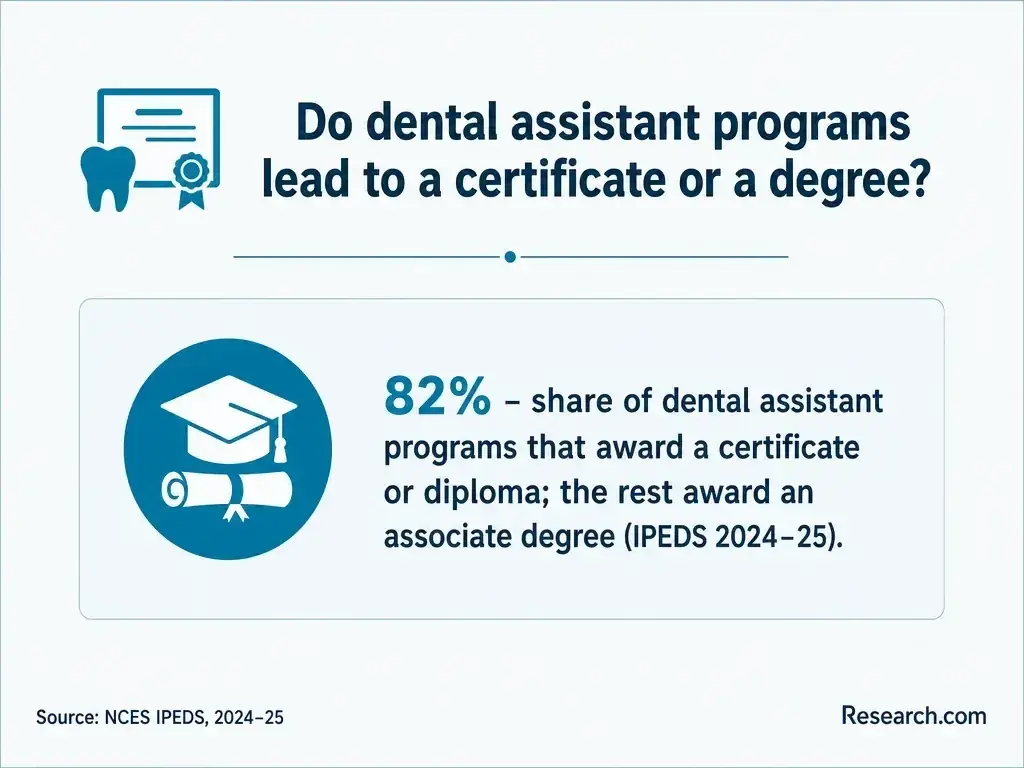
Depending on the provider, completion may lead to a school-issued certificate or diploma, or an associate degree. An employer may instead document workplace training without awarding an academic credential. Ask exactly what appears on the completion record and whether the program prepares students for any external examination.
School credentials and professional certification are different. The Dental Assisting National Board (DANB) awards the Certified Dental Assistant credential to applicants who meet its eligibility and examination requirements; finishing a course does not itself award CDA certification. Likewise, institutional accreditation addresses the school, while Commission on Dental Accreditation (CODA) accreditation addresses an eligible dental assisting program. Neither should be confused with permission to perform a particular duty under Kansas rules (DANB; CODA; Kansas Dental Board).
Requirements vary by provider. A school may request proof of prior schooling, placement information, immunization or health documentation, and materials needed for a clinical placement. An employer-training route instead depends on the hiring practice's requirements. Ask admissions which conditions apply before enrollment and which must be met before patient contact; a student who cannot complete a placement may be unable to finish an otherwise accessible course.
Prior training can matter, but do not assume transfer credit or advanced standing. If you have dental-office experience, request a written review of what the program will recognize and what hands-on competencies you must still demonstrate. Comparing unrelated shortcuts such as the easiest degree to get online will not answer whether a dental assisting program accepts your prior learning.
Core training generally covers dental terminology, anatomy, instrument identification, sterilization and infection prevention, dental materials, chairside procedures, patient communication, and recordkeeping (U.S. Bureau of Labor Statistics). Programs may also introduce radiography, but learning a topic in class is not the same as meeting every condition for performing that duty at work; verify current Kansas requirements with the Kansas Dental Board.
Practice is the differentiator. Ask to see the skills checklist and how instructors evaluate instrument transfer, operatory preparation, and safe workflow. If digital records or imaging equipment are important to nearby employers, ask whether students actually use them, not simply whether they appear in a course description.
Do not assume that every entry-level dental assistant needs an individual professional license or that every duty is open to an untrained new hire. Kansas regulates dental practice and the duties assistants may perform under a dentist's direction; requirements can differ by task (Kansas Dental Board). Before choosing a program, identify the duties you want - particularly any radiography or expanded functions - and confirm the current training, examination, supervision, or authorization rules directly with the Board.
DANB's CDA is a professional certification, not a Kansas occupational license. CODA program accreditation can matter to a DANB eligibility pathway, but it is not itself certification or state authorization (DANB; CODA). Ask a prospective school which specific eligibility pathway its graduates can document, rather than accepting a general claim that the program is "certification-ready."
Start with the job you want, then compare programs on the requirements for reaching it. An affordability ranking can identify options to investigate, but its cost-and-debt score does not establish clinical quality, certification eligibility, or personal return on investment.
Use these questions when speaking with admissions and, if possible, a clinical-placement coordinator:
A common mistake is choosing the cheapest or fastest advertised course without checking clinical access. Another is treating accreditation, certification, and state rules as interchangeable. For a realistic return-on-investment comparison, consider completion probability, existing earnings, expected entry pay, debt, training time, and how long you expect to work in the field - not tuition alone. A shortest online phd programs comparison, for example, answers a very different education question and should not distract from the practical requirements of dental assisting.
The direct path is an entry-level chairside or dental-office support role. With experience, an assistant may seek a specialty practice, take on coordination responsibilities, or pursue optional professional certification where eligible. Each step depends on employer needs and the duties Kansas permits; a specialty title does not by itself authorize additional procedures (Kansas Dental Board; DANB).
If you mainly want to earn while learning, ask local practices whether they hire and train beginners. If you want structured feedback and a documented credential before applying, a school program may fit better. Neither route guarantees a particular position, so compare the supervised skills you will gain and the evidence you can show an employer.
The U.S. Bureau of Labor Statistics projects 7.4% national employment growth for dental assistants from 2025 to 2035. This indicates an expanding national occupation, not a guaranteed opening in a particular Kansas town or for a newly trained applicant. Use current local postings to check which practices are hiring, what experience they request, and whether your prospective program teaches those skills.
Geographic flexibility may matter as much as the national projection. Someone tied to a small local job market should investigate clinical-placement connections and nearby employers before committing to tuition; someone able to commute can compare a wider range of opportunities.
Investing in education is an important decision. Research.com's team designed this ranking to help readers compare dental assistant programs with other programs serving the same occupation and location, using standardized data and reviewing relevant sources for credibility and accuracy. Only programs with completions reported to the Integrated Postsecondary Education Data System (IPEDS) are included; a provider's absence does not mean its training is unavailable or inadequate.
The most affordable ranking scores costs and debt only: tuition, cost of attendance, median student debt, and federal loan default rate. An entropy-based method gives more weight to measures that vary more across programs. Unlike Research.com's separate best-program rankings, affordability scores do not include accreditation, student outcomes, or other quality measures. Readers should therefore use the ranking as a cost-focused shortlist, then verify training quality and fit independently. More detail appears on the Research.com methodology page.
The following sources inform the ranking and its review of institutional data and occupation-relevant recognition. Inclusion as a source does not mean every organization accredits dental assisting programs.
# 1 position
# 2 position
# 3 position
# 4 position
Employer-based training may be an option for entry-level work. Confirm which duties the employer will teach and supervise, and check Kansas Dental Board rules for any task you hope to perform.
Online coursework can teach theory, but chairside skills require in-person practice. Ask how the provider arranges and evaluates that practice and whether local employers recognize its training.
No. Compare total job-ready cost with clinical experience, completion requirements, and the credential's fit for your goals. Low tuition can lose its advantage if essential practical training or travel is missing from the quote.
No. CDA is awarded by DANB to applicants who meet its eligibility and examination requirements; a school-issued credential is separate (Dental Assisting National Board).
Choose based on the duties, training depth, time, and cost you need. Ask employers whether the additional coursework would change your opportunities before paying for a longer route.