# 1 position

Audited and Verified:
Our Editorial and Data Verification Process
Research.com uses government datasets, official education statistics and primary institutional information to support its career and degree guides. Our review process checks factual accuracy, occupational definitions, source dates and the requirements associated with the credentials discussed.
How This Article Was Fact-Checked
Our editorial team verifies salary estimates, employment projections, education requirements and program information against original data providers and official organizations. Salary figures are checked against the relevant occupational definitions and reporting periods. Information about licensure, accreditation and required in-person training is reviewed separately.
Fact-checked and verified on:

Co-Founder and Chief Data Scientist

Reviewed by Karolina Broda
Fact-Checker and Data Verification
The cheapest dental assistant program may not be the cheapest route into a job if it leaves you paying separately for hands-on training or required permits. The Research.com team of data scientists created the Most Affordable Dental Assistant Trade Schools in Oklahoma for 2027 ranking to help students identify programs worth considering. With U.S. dental assistant employment projected to grow 7.4% from 2025 to 2035, this guide helps you compare costs, credentials, practical training, and Oklahoma's rules before enrolling (U.S. Bureau of Labor Statistics).
Expect instruction in dental terminology, infection control, instrument transfer, patient preparation, charting, and front-office workflows. A substantial practical component should let you rehearse these tasks in a lab and, where offered, perform appropriate work under supervision in a dental office. Ask how many hours are spent in each setting: two programs awarding a "dental assistant certificate" may offer very different amounts of chairside practice.
Oklahoma students can compare public technology-center and college training with private career-school programs and dentist-provided on-the-job training. Rose State College, Tulsa Technology Center, High Plains Technology Center, Community Care College, and Miller-Motte College-Tulsa are among the providers to investigate; confirm each provider's current dental assisting offering, campus, schedule, and credential directly. Employer training may reduce upfront school costs and let you earn while learning, but its breadth and access to formal credentials depend on the employer. Do not assume it is a registered apprenticeship.
The right route depends on your intended duties. A structured program is more attractive if you need supervised practice, a recognized credential, or a documented path toward expanded-duty training. An office willing to train a beginner may be a better financial fit if you can verify that it provides the skills and supervision needed for the role.
Most dental assistants work in dentists' offices, where the job combines chairside support, sterilization, patient communication, and sometimes scheduling or records work (U.S. Bureau of Labor Statistics). Depending on the practice and the duties you are qualified to perform, opportunities may include general dentistry, pediatric or specialty practices, and community dental clinics.
Location changes the practical value of a program. In Oklahoma City or Tulsa, you may be able to compare more nearby training sites and dental offices; in a rural area, commuting to a lab, placement site, or potential employer can materially raise your total cost. Before paying a deposit, ask where clinical experiences occur and whether you must arrange your own transportation.
There is no sound basis for treating a national wage as a promised Oklahoma offer. The U.S. median for dental assistants was $48,070 annually in May 2025 (U.S. Bureau of Labor Statistics). Half of employed assistants nationally earned above that figure and half below it; it includes experienced workers as well as newer entrants. For an Oklahoma decision, compare current local job postings by location, experience requirement, duties, and permit preferences with your present earnings.
Return on investment is more than a comparison between tuition and a median wage. Account for aid, borrowing, your likelihood of finishing, time away from paid work, and how long you expect to use the credential. Broad comparisons such as which major makes the most money cannot substitute for an entry-level dental assistant offer in the area where you intend to work.
Length depends on the provider's calendar, whether attendance is full-time or part-time, and whether supervised office experience is included. A short course may get you into an entry-level office role sooner; a longer certificate or diploma may provide more lab time and a broader curriculum. Ask for the published total clock or contact hours, lab hours, and any required externship hours rather than relying on a program's advertised number of months.
Do not mistake an advertisement for best online associate degrees in 6 months for evidence that dental assisting competencies can be learned entirely online or on the same timetable. If speed is your priority, compare the date you could actually start supervised work - not just the date classes end.
Online delivery can suit dental terminology, records, and some infection-control theory. It cannot replace practice handling instruments, positioning equipment, communicating chairside, or following safety procedures under observation. A hybrid program is a credible option only if its scheduled labs and any office placement are accessible to you and cover the competencies you need.
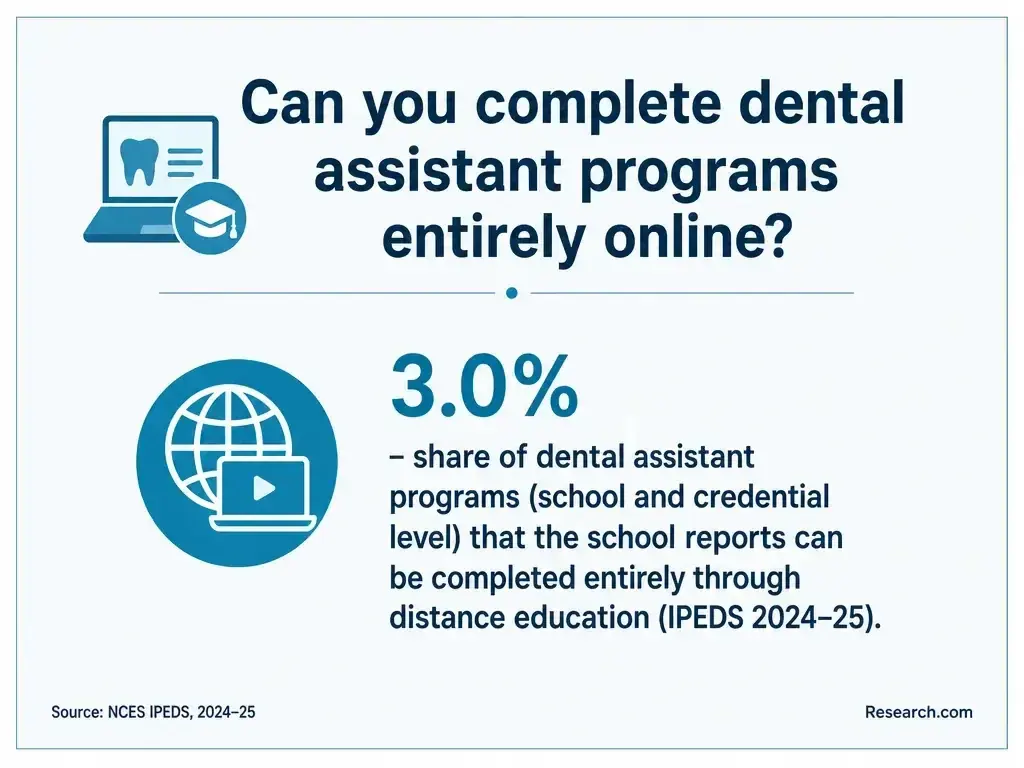
Before choosing an online program, ask who arranges local hands-on practice, how performance is assessed, and whether the training supports the particular Oklahoma permit or certification route you want. "Online schools FAFSA approved" is not a substitute for checking the specific program: online schools FAFSA approved may still offer individual courses that are ineligible for federal aid. Confirm eligibility with the school's financial aid office and Federal Student Aid.
There is no single reliable statewide average that covers public, private, short-course, and employer-trained pathways on the same basis. Published tuition figures may omit expenses that determine which option is actually affordable. Request a written, itemized estimate from each provider for the same intended credential and duties.
The following costs belong in that comparison, even when a school advertises a low tuition price:
Subtract grants, scholarships, or employer contributions only if you are eligible and the funding is confirmed. Ask whether a program qualifies for federal aid and whether Oklahoma Works can assess you for available workforce-training assistance (Federal Student Aid; Oklahoma Works). Paid office training may lower your cash expense but could provide less portable documentation; compare both its earnings and its training plan.
The award might be a certificate, diploma, or, at a college, an associate degree; employer training may award no school credential. Those labels describe what the provider grants, not permission to perform every dental assisting duty. Ask for the exact credential name and a list of competencies documented on completion.
Institutional accreditation concerns the school; CODA programmatic accreditation concerns a particular dental program; state authorization concerns permission to operate. None is interchangeable with professional certification or an Oklahoma expanded-duty permit. If you want Dental Assisting National Board certification, check its current eligibility routes and whether the program supports the one you plan to use (Commission on Dental Accreditation; Dental Assisting National Board; Oklahoma Board of Dentistry). Also ask whether completed coursework can receive credit toward another credential; transfer is determined by the receiving provider, not guaranteed by a certificate title.
Requirements vary by provider and placement site. A program may ask for a high school diploma or equivalent, an application, and evidence that you can meet health or background-check requirements for clinical work. Ask whether those checks happen before admission or before placement, what they cost, and what happens if you cannot secure a placement.
For employer-based entry, ask the dentist what experience is expected, which tasks a beginner can perform under supervision, who teaches infection control, and whether the office will support later permit training. Admission to a school is separate from eligibility for a certification exam or state-regulated duty; obtain those answers before enrolling.
Core training should connect infection prevention and patient safety with everyday chairside work: preparing the operatory, maintaining instruments, assisting during procedures, recording information accurately, and communicating with patients and the dental team (U.S. Bureau of Labor Statistics; O*NET). Students may also study dental materials, imaging concepts, scheduling, and billing, but coverage and supervised practice vary.
Read the course outline against the duties in jobs you would actually accept. If a posting calls for radiography or another expanded duty, ask whether the program includes the relevant instruction and whether additional Oklahoma permit steps remain. Technology used for records and imaging makes computer confidence useful, but hands-on safety and communication still require direct assessment.
Do not assume every Oklahoma dental assistant needs the same credential. Entry-level assisting and particular expanded duties have different rules. The Oklahoma Board of Dentistry regulates permits for specified duties, including dental radiography and certain other expanded functions; the training and application requirements depend on the duty. Check the board's current requirements for the precise work you want to do before choosing a course (Oklahoma Board of Dentistry).
DANB certification is a professional credential, not an Oklahoma occupational license or an automatic replacement for a state permit (Dental Assisting National Board; Oklahoma Board of Dentistry). Ask a prospective school to identify, in writing, which board requirements its training addresses and which exams, applications, or supervised experience you must complete separately. Be wary of a claim that "certified upon graduation" means permission to perform every function.
Start with the dental duties and commute you can realistically accept, then compare programs on a like-for-like basis. A low price matters most when the training also supplies the practical experience and documentation you need. Use these questions with admissions staff and, where possible, a local dental employer:
Verify accreditation with the named accreditor, authorization with the appropriate regulator, and duty-specific rules with the Oklahoma Board of Dentistry. Do not rely on a ranking alone or mistake a school-wide approval for CODA accreditation of its dental assisting program. Searches for easiest masters answer a different question; the useful test here is whether this particular training gets you to your intended dental assistant role at a cost you can manage.
A common progression is supervised entry-level assisting, then broader chairside responsibilities as experience and any required permits allow. Assistants may focus on a specialty practice, take on scheduling or treatment-coordination work, or help train newer staff. More responsibility does not automatically bring a new state credential or a pay increase; compare actual Oklahoma job requirements and offers.
If you are still choosing among hands-on occupations, careers to purse with a vocational degree can provide a broader comparison. Within dental assisting, however, prioritize a pathway that develops the tasks employers request and documents the training needed for any regulated duties.
The U.S. Bureau of Labor Statistics projects 7.4% growth in dental assistant employment from 2025 to 2035. That national projection signals continuing demand, but it is not an Oklahoma placement rate or a guarantee of an opening near your home. An applicant in a smaller community may need to consider the number of reachable practices as carefully as the statewide market.
Use current local postings to test the outlook before enrolling: note how often employers request chairside experience, radiography eligibility, or a particular schedule. If most suitable openings require duties your chosen program does not prepare you for, a seemingly faster or cheaper course may cost you time later.
Investing in training is an important decision, so Research.com evaluates programs against others in the same occupation and location rather than against unrelated schools nationwide. Only programs with completions reported to IPEDS are eligible for this ranking. That makes the comparison more relevant, but it also means an employer training route or a program absent from IPEDS may not appear; absence is not a judgment of quality.
For the most affordable ranking, the Research.com team scores tuition, cost of attendance, median student debt, and federal loan default rate. Weights are assigned through an entropy-based method, which gives more weight to measures that distinguish programs. Accreditation and other quality indicators are not part of the affordability score. Readers should therefore use the ranking to build a shortlist, then verify clinical training, credential fit, and Oklahoma permit preparation independently.
Research.com's separate best programs rankings consider student outcomes; earnings and return on investment; costs and debt; and quality and recognition. Their weights assign 20% to occupation-relevant programmatic accreditation or industry recognition, 10% to institutional accreditation, 10% to student support, and the remaining 60% - distributed by an entropy-based method - to outcomes, earnings, and costs. The team checks multiple sources to improve the credibility and accuracy of these comparisons. Its ranking sources include:
For more detail on the approach, see Research.com's methodology. A low ranking cost is a useful starting point, not proof that a program covers every expense or qualifies you for a particular duty.
# 1 position
# 2 position
# 3 position
# 4 position
# 5 position

# 6 position
There is no universally cheapest route. Compare public and private program quotes with paid, dentist-provided training, then include supplies, travel, lost wages, and any later permit-related costs.
Employer-provided training can be a route into entry-level work. Confirm what the dentist will teach and supervise, and check Oklahoma Board of Dentistry requirements before performing a regulated expanded duty.
Some theory may be online, but chairside and safety skills require hands-on practice and assessment. Ask where a program's labs or supervised office training take place.
Not automatically. Check the Oklahoma Board of Dentistry's current radiography permit requirements and ask the provider which requirements its course satisfies.
No single program label describes every Oklahoma entry-level job. CODA accreditation can matter for a training or certification pathway, but you should check the specific employer duties, DANB eligibility route, and applicable state permits.