# 1 position
American Institute-West Hartford - Dental Assisting/Assistant.
certificate or diploma

Audited and Verified:
Our Editorial and Data Verification Process
Research.com uses government datasets, official education statistics and primary institutional information to support its career and degree guides. Our review process checks factual accuracy, occupational definitions, source dates and the requirements associated with the credentials discussed.
How This Article Was Fact-Checked
Our editorial team verifies salary estimates, employment projections, education requirements and program information against original data providers and official organizations. Salary figures are checked against the relevant occupational definitions and reporting periods. Information about licensure, accreditation and required in-person training is reviewed separately.
Fact-checked and verified on:

Co-Founder and Chief Data Scientist

Reviewed by Karolina Broda
Fact-Checker and Data Verification
Choosing dental assistant training means looking beyond a school's name: you need to know what you will practice in person, what you will pay, and which duties you can perform afterward. The U.S. Bureau of Labor Statistics projects 7.4% national employment growth for dental assistants from 2025 to 2035. For career starters and career changers, this guide explains Connecticut training routes, costs, credentials, and job prospects. It also accompanies the Best Dental Assistant Trade Schools in Connecticut for 2027 ranking, created by the Research.com team of data scientists to help students identify programs worth considering.
Expect instruction in chairside assistance, infection prevention, instrument handling, patient communication, and dental-office workflow. A strong program lets you practice these tasks in a lab and, where offered, a supervised dental-office placement. Classroom instruction alone cannot show whether you can maintain a sterile field, prepare a treatment room, or assist safely during a procedure.
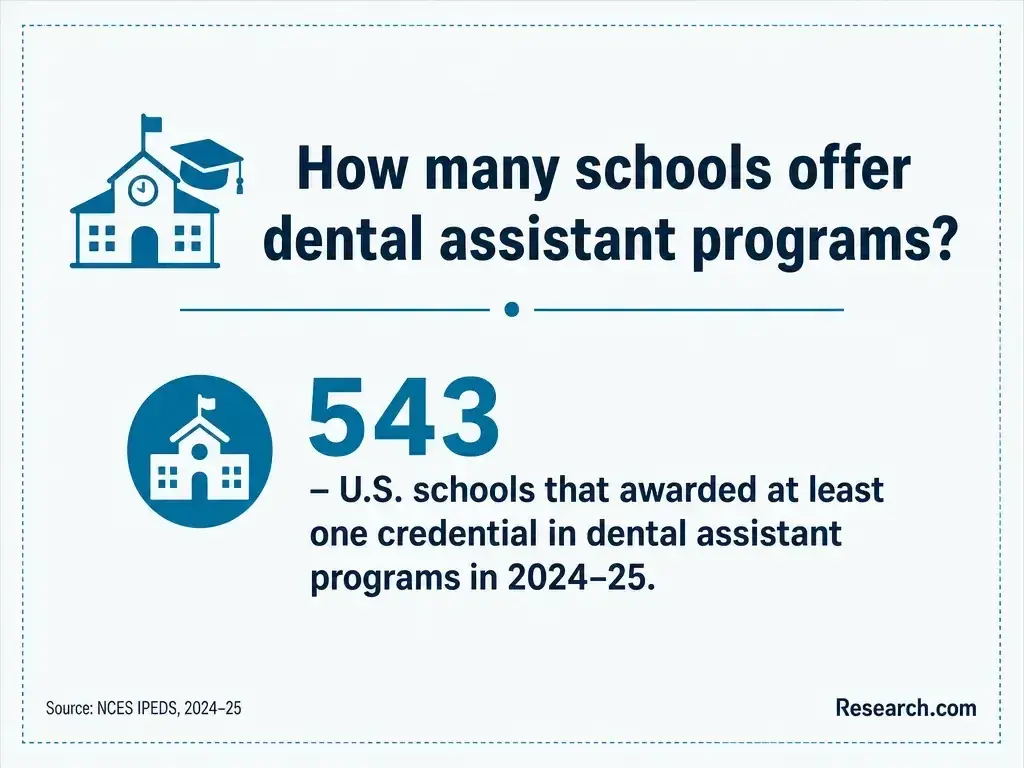
Connecticut students can compare programs at Connecticut State Community College and career-school options such as American Institute-West Hartford and Porter & Chester Institute. Confirm the current campus, program availability, schedule, and credential directly with the provider; offerings can change. Also ask local dental offices about structured, supervised entry-level training. That route may suit someone who needs earnings sooner, but its instruction and transferability can differ from a formal program.
The choice is not simply public versus private. A program with a workable clinic schedule and documented hands-on practice may be more useful than a faster option that leaves you finding clinical experience on your own.
Dental assistants primarily work in dental offices, supporting general dentists or specialists; some positions also involve reception, scheduling, and records, according to the U.S. Bureau of Labor Statistics. Ask placement staff whether their employer relationships cover the kind of practice you want: a general office, orthodontic practice, pediatric office, or oral-surgery practice may emphasize different routines.
Location affects the practicality of training as well as employment. A Connecticut program's classroom may be convenient while its assigned clinical site requires a longer commute. If you cannot travel reliably to that site, ask whether the school offers placements nearer home before enrolling.
The U.S. Bureau of Labor Statistics reports a $48,070 national median annual wage in May 2025 for dental assistants. A median describes workers across experience levels and locations; it is neither a Connecticut wage figure nor a likely first offer.
For a local pay decision, check the Bureau of Labor Statistics' Connecticut occupational wage estimates for dental assistants and compare current openings within your commuting area. When evaluating a training offer, compare expected entry-level pay - not the national median - with what you earn now, then account for time out of work and any debt. Specialty duties and experience may affect offers, but a program should not promise a particular wage.
There is no single statewide program length that fits every dental assisting route. A career-school certificate may use an accelerated schedule, while a public-college program may spread instruction across academic terms; supervised employer training depends on the office's plan and the duties being taught. Published calendar length can also conceal differences in lab time and clinical placement.
Request each program's current catalog showing total clock or credit hours, lab hours, placement hours, weekly attendance, and the earliest realistic completion date. Ask whether you must arrange your own clinical site and whether a missed placement delays graduation. Faster training is worthwhile only if it provides enough practice for the jobs you intend to seek.
Unlike an accelerated bachelor degree, an accelerated dental assisting certificate should be judged chiefly on whether its compressed schedule preserves supervised clinical practice.
Online delivery can make terminology, anatomy, records, and some infection-control coursework easier to fit around work. It cannot replace practicing instrument transfer, room preparation, chairside positioning, or other patient-facing skills with supervision. A hybrid program is useful when it specifies where and when those in-person components occur; an entirely remote course should not be assumed to meet an employer's expectations or any requirement tied to a particular duty.
The comparison below separates delivery convenience from practical preparation.
| Format | Potential advantage | What to verify |
| On-campus | Scheduled access to dental labs and instructors | Clinical placement, equipment access, and commute |
| Hybrid | Some theory completed remotely | Required lab dates, placement location, and supervision |
| Online-only coursework | Flexible study of nonclinical material | How practical skills are taught and assessed in person |
Do not confuse a search for the easiest associate's degree online with a test of dental assisting readiness: the deciding evidence here is supervised practice, not how much coursework is remote.
There is no dependable single average that covers Connecticut career schools, public-college programs, and employer training on the same basis. Published tuition may exclude mandatory fees and the cost of reaching a clinical site. Compare written, current price sheets for the specific programs on your shortlist rather than applying one statewide estimate.
For each option, build a job-ready budget that includes tuition, mandatory fees, books, scrubs or other required clothing, supplies, any required health checks, clinical transportation, and applicable certification-exam costs. Then subtract grants or employer-paid training you can actually access. Ask whether the program and institution qualify for federal aid; institutional accreditation by itself does not establish a student's or program's aid eligibility, according to Federal Student Aid.
A low sticker price is not necessarily a better investment if travel costs, lost wages, or the risk of not completing are higher. Conversely, a shorter program is not automatically cheaper if it requires leaving paid work. If you are comparing an online bachelor's degree cheapest search result with dental assisting, keep the budgets separate: they lead to different credentials and job-entry requirements.
Check the award on the program's current catalog: it may be a certificate or diploma, while a longer college pathway may award an associate degree. These are school-issued credentials. They are not the same as Certified Dental Assistant (CDA), a professional certification administered by the Dental Assisting National Board (DANB). DANB sets its own eligibility and examination rules, so ask a school to identify the specific certification pathway its graduates can pursue.
Commission on Dental Accreditation (CODA) accreditation applies to an eligible dental assisting program, not automatically to every program at an accredited institution. State authorization to operate a school, institutional accreditation, CODA program accreditation, professional certification, and permission to perform regulated duties answer different questions. Verify each claim with the relevant school, accreditor, certifier, or Connecticut regulator.
An online phd no dissertation listing offers no shortcut to a dental assisting credential; the relevant comparison is between programs that teach and assess the duties you will perform.
Requirements differ by provider. Ask whether admission requires a high school diploma or equivalent, an assessment, immunization documentation, a background check, or other steps before clinical placement. An employer-training position may instead prioritize availability, communication, and willingness to learn under supervision. Do not assume that admission to a program means you have cleared every condition for its clinical site.
Before paying a deposit, obtain the catalog and written placement requirements. If you have prior dental-office experience, ask whether documented skills can earn advanced standing or reduce repeated coursework; do not assume experience will waive a school requirement or a certifier's eligibility rule.
Common subjects include dental terminology and anatomy, infection control, instrument processing, chairside procedures, patient records, communication, and dental-office administration, consistent with the occupational duties described by the U.S. Bureau of Labor Statistics. Radiography instruction may be offered, but a course on the subject should not be taken as automatic authorization to perform radiographic duties in Connecticut.
Look for evidence of practice, not just a course title. Ask to see the skills checklist used in labs and clinical placements: who observes students, which procedures they perform, and how a student remediates an unsuccessful assessment. Digital records and imaging workflows make it especially useful to ask which equipment and software students actually use.
Connecticut does not issue a general occupational license simply to work as a dental assistant, according to the Connecticut Department of Public Health and DANB's state-requirements guidance. That does not mean every dental duty is open to an untrained new hire. The duties you may perform, supervision, and any radiography-related requirements need to be checked against current Connecticut rules before you select training for a particular job.
DANB certification is a separate professional credential, not a substitute for state rules. Ask a prospective employer which duties an entry-level assistant will perform, then ask the school and the Connecticut Department of Public Health what training or documentation those duties require. Do not rely on a school's broad claim that its certificate "qualifies you for everything."
Start with the job you want, then test each program against it. A ranking can narrow your choices, but the best investment for you must also fit your schedule, commute, budget, and need for supervised practice.
Use these checks when speaking with admissions and program staff; request written answers where costs or eligibility are concerned.
A warning sign is an admissions pitch that treats institutional accreditation, a school certificate, DANB certification, and authorization for a particular duty as interchangeable. Another is an "online" program that cannot identify where clinical skills are practiced. Verify before enrolling, especially if a refund deadline is near.
An entry-level assistant may begin with room preparation, infection-control tasks, records, and supervised chairside support, with responsibilities expanding through employer training and experience. Some assistants move toward specialty practices, office coordination, or lead-assistant roles. DANB certification may be useful for professional development or employer preferences, but it should not be described as a universal entry requirement.
If your goal is a different clinical occupation, do not assume dental assisting hours or a school certificate will transfer into its training or licensing pathway. Ask the receiving program about credit or advanced standing before paying for a credential primarily as a stepping-stone. Similarly, a phd in 1 year search does not describe a dental assistant advancement route; experience, demonstrated skills, and relevant credentials matter more for these roles.
The U.S. Bureau of Labor Statistics projects 7.4% growth nationally from 2025 to 2035 for dental assistants. That indicates continuing national demand, not a forecast for a particular Connecticut town or a guarantee of placement after training.
Use Connecticut Department of Labor projections and recent vacancies to judge the market where you can commute. Read postings for required experience, schedules, radiography-related duties, and preferred certifications. If nearby offices consistently ask for skills your shortlisted program does not teach or assess, that is a stronger reason to reconsider it than a national growth figure alone.
Education is a significant investment, so the Research.com team built this ranking to help readers compare dental assistant programs against other programs serving the same occupation and location. The team evaluates reported outcomes, costs, debt, and relevant quality indicators. Only programs with completions reported to the Integrated Postsecondary Education Data System (IPEDS) are eligible; an unlisted employer-training route or school should not be assumed to be poor quality.
For best-program rankings, student outcomes include completion and full-time and part-time retention. Earnings and return on investment include median earnings one year after completion and earnings relative to annual attendance cost. Cost measures include resident and nonresident tuition, attendance cost, median debt - including debt held by students who withdrew - and federal loan default rates. Quality measures include relevant programmatic accreditation or industry recognition, institutional accreditation, and student support. Programmatic accreditation or relevant recognition receives 20% of the score; institutional accreditation, 10%; and support services, 10%. Outcomes, earnings, and costs share the remaining 60%, with entropy-based weighting that gives more weight to indicators that differ more across programs. Most-affordable rankings instead score only tuition, attendance cost, median debt, and loan default rates using entropy-based weights; accreditation and other quality measures do not enter that score.
The team used the following data sources in creating the ranking. Some cover broad trade-school comparisons rather than dental assisting specifically; readers should weigh occupation-specific sources most heavily when checking clinical training and certification claims.
Use the ranking to make a shortlist, not as proof that every listed program provides the same clinical experience or qualifies you for a particular duty. Research.com explains its broader approach on its methodology page.
# 1 position
# 2 position

# 3 position

# 4 position

Some offices may train an entry-level hire under supervision. Compare that offer's training plan and duties with a school program; a job offer does not waive requirements that apply to particular tasks.
No. CODA accreditation is a program-quality and credential-pathway consideration, not a blanket requirement for every entry-level position. Check the job's duties and any certification route you intend to pursue.
You may be able to complete some theory online, but chairside and infection-control skills need practical assessment. Ask where required labs or clinical training happen before enrolling.
No. A school awards its own credential; DANB sets separate eligibility and examination requirements for its certifications.
Only if its schedule, supervised practice, total cost, and credential fit the job you want. Compare actual lab and clinical experience rather than calendar length alone.