# 1 position

Audited and Verified:
Our Editorial and Data Verification Process
Research.com uses government datasets, official education statistics and primary institutional information to support its career and degree guides. Our review process checks factual accuracy, occupational definitions, source dates and the requirements associated with the credentials discussed.
How This Article Was Fact-Checked
Our editorial team verifies salary estimates, employment projections, education requirements and program information against original data providers and official organizations. Salary figures are checked against the relevant occupational definitions and reporting periods. Information about licensure, accreditation and required in-person training is reviewed separately.
Fact-checked and verified on:

Co-Founder and Chief Data Scientist

Reviewed by Karolina Broda
Fact-Checker and Data Verification
Choosing dental assistant training in Grand Island means comparing more than tuition: a low-priced program may still require travel, supplies, and time away from work. The U.S. Bureau of Labor Statistics reports a May 2025 national median wage of $48,070 for dental assistants, making training cost worth examining carefully. This guide explains local training choices, Nebraska practice rules, and career prospects. It also accompanies the Most Affordable Dental Assistant Trade Schools in Grand Island for 2027 ranking, created by the Research.com team of data scientists to help students identify programs worth considering.
Dental assistant training prepares students to support dentists with patient preparation, instrument handling, infection control, records, and chairside procedures. The occupation involves close patient contact and supervised clinical work, not just classroom knowledge (U.S. Bureau of Labor Statistics). A Grand Island student should ask where skills are practiced: an advertised local or online program may place its lab or clinical site outside the city.
Central Community College is a public-college option to investigate, but applicants should confirm the current dental assisting offering, teaching site, credential, schedule, and clinical placement directly with the college. A career-school certificate may suit someone seeking a focused route; supervised employer training may suit someone who can secure a dental-office position and earn while learning. Those routes are not interchangeable if the student wants particular credentials or duties.
Dental offices are the principal workplace for dental assistants, including general and specialty practices; some positions involve scheduling and records as well as chairside care (U.S. Bureau of Labor Statistics). Ask prospective clinical sites whether training includes the mix of duties you want. In a smaller labor market, being willing to commute to another nearby practice may widen job and placement options, but adds transportation costs.
Patient-facing chairside work differs from more solitary occupations. If daily patient interaction is a concern, compare the actual duties before committing; a broader look at best careers for introverts can help clarify that preference, but it does not replace observing a dental office.
A reliable Grand Island-specific median is not established here. The national median for dental assistants was $48,070 in May 2025 (U.S. Bureau of Labor Statistics). That is the midpoint across experienced and newer workers nationwide, not a starting-pay quote for a local graduate.
For a useful local estimate, compare current Grand Island job postings by required experience, certification, duties, and hours. Ask employers about paid training and benefits as well as hourly pay; a position requiring additional permitted functions should not be treated as equivalent to an entry-level opening.
Length depends on the credential and schedule. A focused certificate or diploma generally has a different time commitment from an associate degree, while employer training proceeds alongside work. No single clock-hour minimum applies to every route into basic dental assisting; requirements for particular duties and credentials must be checked separately with the Nebraska Department of Health and Human Services and the credentialing body.
Request the program's current calendar and a breakdown of classroom, lab, and supervised clinical hours. A short advertised completion time matters less if clinical placements occur later, require daytime availability, or involve a commute from Grand Island.
Online coursework can cover terminology, anatomy, records, and infection-control concepts. Chairside techniques, instrument processing, and supervised patient-care experience require appropriate hands-on practice. A fully online description is therefore not evidence that a student will gain the practical experience or eligibility needed for a desired role (U.S. Bureau of Labor Statistics; Dental Assisting National Board).
For a Grand Island student, a hybrid program is useful only if its lab and clinical locations are reachable and its schedule works with employment. Ask who arranges clinical placements and what happens if no local site is available. Guides to top online programs for seniors may help readers think about remote-study preferences, but dental assisting still calls for a program-specific check of in-person requirements.
There is no verified Grand Island-wide average presented here, and averaging a small set of advertised prices could obscure major differences in what they include. Compare each option using a written, itemized cost to become job-ready: tuition, mandatory fees, books, uniforms, supplies, required health or background checks, exam costs, clinical travel, and earnings lost during training. Confirm whether an exam or clinical placement is included rather than assuming it is.
Federal aid eligibility depends on the institution and program, not simply on a school calling itself accredited (Federal Student Aid). Ask about grants, scholarships, and workforce assistance before borrowing. An employer-training position can offset costs through wages, though it may not provide the same credential or clinical breadth as a formal program.
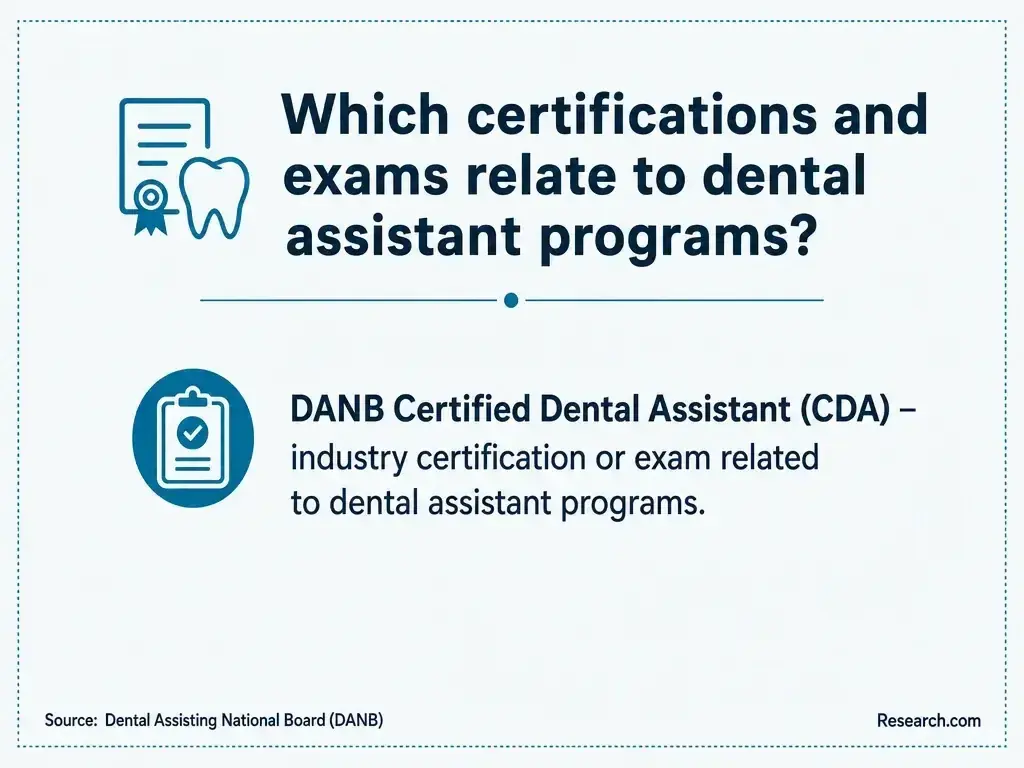
Depending on the program, the award may be a certificate, diploma, or associate degree; an employer may instead document workplace training. The school award is distinct from Certified Dental Assistant (CDA) certification issued by the Dental Assisting National Board. CODA program accreditation, institutional accreditation, Nebraska school authorization, and permission to perform regulated functions are also separate questions (Commission on Dental Accreditation; Dental Assisting National Board; Nebraska Department of Health and Human Services).
Ask for the exact award name and whether the curriculum and supervised experience meet the current eligibility route for any certification you intend to pursue. Do not infer eligibility from a credential's title alone.
Requirements vary by provider. Ask whether entry requires a secondary-school credential, placement assessment, immunization documentation, background check, or other conditions before clinical placement. Confirm deadlines and any added costs directly with the provider; admission to a program does not necessarily mean immediate access to a clinical site.
If you already have dental-office experience, ask whether the provider assesses prior learning or offers advanced standing. Get any resulting reduction in courses, time, and charges in writing rather than assuming experience automatically transfers.
Useful training connects dental anatomy and terminology to chairside assisting, instrument transfer, sterilization, infection prevention, patient communication, and recordkeeping (U.S. Bureau of Labor Statistics). Depending on the program and applicable rules, it may also address imaging or additional clinical functions. Check what students actually perform under supervision rather than relying on a course list that only says "introduction" or "overview."
Ask to see the current skills checklist and clinical-site expectations. That makes it easier to distinguish a program with repeated hands-on practice from one that primarily teaches concepts.
Do not assume one credential is required for every dental assisting task - or that a school certificate authorizes every task. Nebraska regulates dental practice and the functions assistants may perform; requirements can differ by duty (Nebraska Department of Health and Human Services). DANB certification is a separate professional credential, not a blanket substitute for Nebraska's rules (Dental Assisting National Board).
Before enrolling, identify the duties in the jobs you want, then check current Nebraska Department of Health and Human Services requirements for those duties. Ask the program to document which requirements its coursework and clinical training satisfy and which examinations or applications, if any, remain your responsibility.
Start with the role you want, then compare eligible programs on practical training, total cost, schedule, and the credential awarded - not ranking position alone. An inexpensive program is a weak investment if it lacks a workable clinical placement or does not support your intended duties. Institutional accreditation and CODA program accreditation answer different questions; verify each claim with the relevant accreditor (Commission on Dental Accreditation).
Use the same questions with every provider so an accelerated offer and a lower-priced, longer program can be compared fairly:
Estimate value over a realistic time horizon: include aid, debt, completion likelihood, wages you give up while training, and the earnings difference you reasonably expect - not a guaranteed salary. The top non profit accredited online universities are a separate comparison; their institutional status does not answer whether a dental assisting program provides local clinical access.
An entry-level assistant can build experience in general dentistry, then seek work in a specialty practice or take on more responsibility for office coordination and patient flow. Additional certification or training may support particular duties where Nebraska permits them; experience and an employer's needs still matter. Dental assisting training does not by itself qualify someone for a different licensed dental occupation (Nebraska Department of Health and Human Services).
Choose a program for the work it prepares you to perform now, not for an unrelated credential later. For example, cheap online doctoral programs are not an alternative route into chairside dental assisting.
U.S. dental assistant employment is projected to grow 7.4% from 2025 to 2035 (U.S. Bureau of Labor Statistics, Employment Projections). This national forecast signals continuing occupational demand, but it is not a count of Grand Island openings or a promise of local placement.
Check current local vacancies before selecting a schedule or specialty emphasis. Note whether employers will train new assistants, require experience, or seek particular functions; those distinctions are more useful for a first job decision than the national growth rate alone. An accelerated online bachelor's program addresses a different education goal and should not be used as a proxy for dental assisting job readiness.
Education is a significant investment, so Research.com designed this ranking to help readers compare the cost of dental assistant programs against other options in the same occupation and location. The team checks multiple education and industry sources to improve the ranking's credibility and accuracy. Only programs reporting completions to the Integrated Postsecondary Education Data System (IPEDS) are eligible; an unlisted employer-training or career-school option is not necessarily unavailable or poor quality.
The most affordable ranking scores tuition, cost of attendance, median student debt, and federal loan default rate. Weights are assigned through an entropy-based method, which gives more weight to measures that vary more across eligible programs. Accreditation and other quality indicators do not contribute to this affordability score. That differs from Research.com's best-program rankings, which consider outcomes, earnings and costs, accreditation or industry recognition, and student support. Readers should therefore use this ranking as a cost comparison, then verify clinical training and Nebraska requirements separately.
Research.com uses the following data sources to develop and check its trade-school rankings. Some cover colleges broadly, while occupation-specific sources help assess whether a credential has relevant recognition:
These sources have different coverage and purposes; none alone proves that a program meets every student's career goal. See Research.com's methodology for more about how the rankings are created.
# 1 position
# 2 position
Not necessarily. Compare mandatory costs, clinical travel, time away from work, credential eligibility, and whether you can complete the required hands-on training.
Employer training may be an option for some entry-level duties. Check Nebraska's rules for the duties you want and ask employers what training they provide.
Coursework may be online, but chairside skills need hands-on practice. Confirm where required labs and clinical experience occur before enrolling.
No. A school certificate and DANB certification are separate credentials with separate requirements (Dental Assisting National Board).
Check current guidance from the Nebraska Department of Health and Human Services for the specific duties you intend to perform.