# 1 position

Audited and Verified:
Our Editorial and Data Verification Process
Research.com uses government datasets, official education statistics and primary institutional information to support its career and degree guides. Our review process checks factual accuracy, occupational definitions, source dates and the requirements associated with the credentials discussed.
How This Article Was Fact-Checked
Our editorial team verifies salary estimates, employment projections, education requirements and program information against original data providers and official organizations. Salary figures are checked against the relevant occupational definitions and reporting periods. Information about licensure, accreditation and required in-person training is reviewed separately.
Fact-checked and verified on:

Co-Founder and Chief Data Scientist

Reviewed by Karolina Broda
Fact-Checker and Data Verification
In Salina, the cheapest dental assistant program is not necessarily the least expensive route into a job: supplies, clinical travel, and time away from work can change the calculation. The U.S. Bureau of Labor Statistics projects 7.4% national growth in dental assistant employment from 2025 to 2035. For prospective students and career changers, this guide compares training, costs, credentials, and Kansas requirements. It also features a Most Affordable Dental Assistant Trade Schools in Salina for 2027 ranking, created by the Research.com team of data scientists to help students make an informed choice about programs worth considering.
Dental assisting training prepares students to support dentists during procedures, maintain infection-control practices, prepare instruments, communicate with patients, and handle records. Classroom study alone is not enough to evaluate a program: ask where students practice chairside skills and whether they work with patients under supervision. The U.S. Bureau of Labor Statistics identifies both clinical and administrative duties as part of the occupation.
The practical choice is between structured school training and a possible employer-trained entry route. A certificate or diploma may suit someone seeking focused preparation; an associate degree can include more general coursework but takes a greater investment. A dental office willing to train a new hire may reduce upfront school costs, though the applicant should ask which duties they can learn on the job and whether the training supports later certification. Do not assume an employer-training position or registered apprenticeship is available locally without confirming an opening.
Before comparing a dental assistant program with accelerated programs online, identify the intended job. Speed and remote coursework do not replace supervised chairside practice.
General dental practices are the most direct employment target; specialty dental offices may also hire assistants, although their procedures and training expectations differ. The U.S. Bureau of Labor Statistics reports that most dental assistants nationally work in dentists' offices. In a smaller labor market such as Salina, a student should check current openings and clinical-placement locations before assuming a preferred specialty or schedule will be available nearby.
Ask a prospective program whether its externship sites are within a workable commute and whether placement includes the type of office where you hope to work. An externship is supervised experience, not a job offer.
The U.S. Bureau of Labor Statistics reports a $48,070 national median annual wage in May 2025 for dental assistants. That figure covers experienced and newly employed workers across the country; it is neither a Salina wage nor a forecast of a graduate's first offer. Use it as occupational context, then compare actual local job postings by required experience, hours, benefits, and duties.
For a personal return-on-investment estimate, compare plausible local take-home pay with what you earn now, then account for grants, borrowing costs, time away from work, and the chance of completing training. A short, affordable credential can make sense for someone seeking quick entry; it is less attractive if its schedule prevents paid work and its clinical placement requires substantial travel.
Program length depends on the credential, calendar, and amount of supervised practice. A focused certificate or diploma generally involves less coursework than an associate degree, while employer training can begin after hiring; none of these labels establishes a universal number of required clock hours. Request the current catalog's instructional and clinical hours, start and end dates, and attendance policy from each provider.
An accelerated schedule may get you into the job market sooner but can make it harder to keep a paycheck or arrange transportation to a clinic. If an associate degree is under consideration, a guide to the fastest way to get an associates degree can help frame the time trade-off; verify that any shorter schedule still provides the dental assisting practice you need.
Online coursework can accommodate subjects such as terminology and office procedures. Chairside technique, instrument handling, infection-control practice, and supervised patient care require a credible in-person arrangement. A hybrid program is useful only if its labs and clinical sites are reachable from Salina and its schedule fits your work obligations.
The comparison below focuses on what each format means for a student who must become competent in a dental office, rather than treating delivery format as a quality measure.
| Format | Potential advantage | Check before enrolling |
| On-campus | Scheduled access to equipment and instructors | Lab hours, clinic placement, and commuting costs |
| Hybrid | Some coursework completed remotely | Exact in-person dates and who arranges supervised practice |
| Online coursework | Flexible study for theory | Whether practical training exists at all; online lessons alone are not a substitute |
Resources on the best affordable online schools for job holders may help working students think about scheduling, but a dental assistant option must be judged separately on its local hands-on component.
A defensible Salina average cannot be stated without comparable, current prices for the available dental assisting programs. Ask Salina Area Technical College to confirm whether it offers the intended training in your entry term and to provide its current itemized cost; do not treat an institution-wide tuition figure as the price of a specific credential. Obtain the same written breakdown from any other training route you investigate.
To compare offers, add tuition and mandatory fees, books and consumables, uniforms or protective equipment, required health checks if applicable, certification exam charges, and travel to labs or clinical sites. Then subtract grants or employer contributions and consider wages forgone while studying. Federal Student Aid determines federal aid eligibility by the student and eligible program, not simply by the school's presence in a ranking. Kansas workforce assistance may also be worth checking through KANSASWORKS, subject to eligibility and available funding.
The award depends on the particular program: it may be a certificate, diploma, or associate degree. The school credential documents completion of that curriculum; it is not the same as the Dental Assisting National Board's Certified Dental Assistant (CDA) credential or permission to perform every dental-office duty in Kansas. DANB sets its own exam and eligibility pathways, while the Kansas Dental Board governs applicable state practice rules.
Check the exact award shown in the current program catalog and ask whether graduates meet a specific DANB eligibility pathway. If you are weighing transfer credit or a future associate degree, confirm in writing which courses transfer; an open enrollment university is not, by itself, evidence that dental assisting training will transfer or satisfy certification requirements.
Admissions requirements are program-specific. Ask about the minimum educational prerequisite, application deadlines, placement assessment, immunization or health documentation, background checks for clinical sites, and any supplies due before the first lab. A clinical site may impose conditions beyond those used for school admission; confirm both before making a nonrefundable payment.
Employer-trained entry has a different gatekeeper: an office must be willing to hire and supervise an inexperienced applicant. That can be a practical alternative for someone ready to learn at work, but it should not be confused with admission to a structured credential program or automatic eligibility for DANB certification.
Relevant training connects dental anatomy and terminology to chairside procedures, instrument transfer, sterilization, infection prevention, patient communication, records, and office workflow. The U.S. Bureau of Labor Statistics describes these as core areas of dental assistant work. Programs may also teach radiography, but students should verify both the practical instruction and Kansas rules for the duties they expect to perform.
Ask for a skills checklist, not just a course-title list. It should show which procedures are practiced in a lab, which are observed or performed under supervision, and how competence is assessed. That distinction matters when two programs award similarly named certificates but provide different opportunities to work with patients.
Do not assume there is a single dental assistant license that every new hire must hold, or that a school certificate authorizes every task. Kansas Dental Board rules determine which duties dental assistants may perform and under what conditions; verify the current requirements for duties such as radiography before choosing a curriculum. DANB's CDA is a professional certification with separate eligibility requirements, not a Kansas occupational license (Kansas Dental Board; Dental Assisting National Board).
Institutional accreditation concerns the school, CODA programmatic accreditation concerns a specific dental education program, and DANB certification concerns an individual. None automatically substitutes for the others or establishes permission to perform a regulated duty. Ask the program to identify its current accreditation status and the precise certification pathway it prepares students to pursue (Commission on Dental Accreditation; Dental Assisting National Board).
Start with the job you want, then test whether each option supplies the required practice, an appropriate credential, and a manageable total cost. The affordability ranking is a useful shortlist, but its score does not include clinical training or accreditation. For a Salina resident, a lower quoted price may lose its advantage if clinical travel or an incompatible schedule adds substantial expense.
Use these questions when speaking with admissions staff or an employer offering training. Request answers in writing where possible:
A common mistake is treating a general accreditation claim, an online schedule, or a low tuition quote as proof of job readiness. Even lists of top non profit accredited online universities cannot answer whether a particular dental assistant program offers accessible clinical practice. Choose the option whose documented training and cost fit your intended work.
The immediate path is an entry-level dental assistant role, potentially combining chairside and office responsibilities. With experience, an assistant may seek work in a specialty practice or take on more responsibility for scheduling, patient coordination, or training newer staff. DANB certification may support an individual's professional development, but employers' preferences and Kansas rules for particular duties still need checking (Dental Assisting National Board; Kansas Dental Board).
Dental assisting is not interchangeable with dental hygiene: it has a different scope of practice and training pathway. If independent clinical duties associated with another occupation are the goal, do not buy dental assistant training on the assumption that its credential automatically qualifies you for that job.
National dental assistant employment is projected to grow 7.4% from 2025 to 2035, according to U.S. Bureau of Labor Statistics Employment Projections. That suggests continuing demand across the occupation, not a guaranteed opening in Salina or at the moment a student finishes training.
Because a national projection cannot describe a small local hiring market, inspect current Salina-area postings before enrolling. Note whether offices request experience, radiography-related skills, certification, or a particular schedule, and compare those requirements with the program's actual training. If nearby openings are limited, decide in advance how far you could commute rather than relying on a national growth figure.
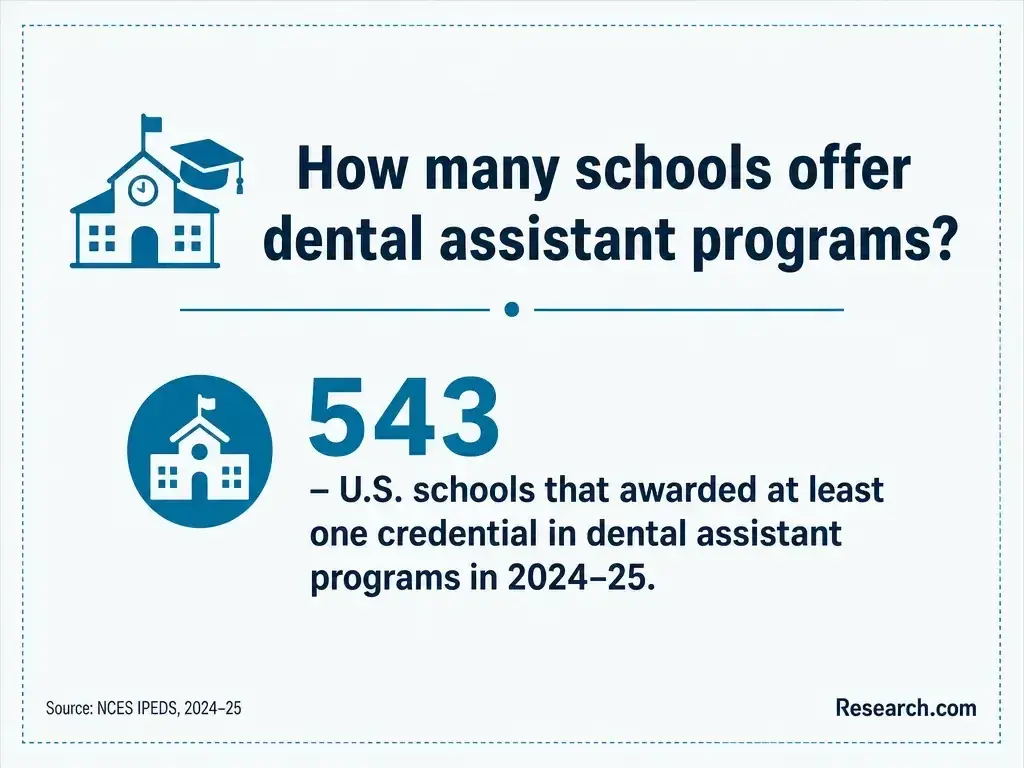
Investing in training is an important decision, especially when an advertised price does not capture the full cost of becoming job-ready. The Research.com team designed this ranking to compare dental assisting programs with other programs in the same occupation and location, using reported data rather than assuming every training provider offers equivalent value. Only programs with completions reported to IPEDS are included; an employer-training route or a program absent from IPEDS should not be interpreted as nonexistent or inferior.
The most affordable ranking scores costs and debt only: tuition, cost of attendance, median student debt, and federal loan default rate. Weights are assigned using an entropy-based method, under which indicators that vary more across programs receive more weight. Accreditation, hands-on training, and other quality measures are not part of this affordability score. For context, Research.com's separate best-programs methodology considers student outcomes, earnings and return on investment, costs and debt, and quality and recognition; it is not the scoring method used for this affordability ranking.
The team drew on the following data sources to check reported education data and relevant training context. Some are broader trade-education resources, not dental-assisting accreditors or evidence that a particular Salina program holds an approval:
This approach gives readers a consistent cost comparison, not a verdict on clinical quality or Kansas job eligibility. Confirm current prices, practical training, and credential eligibility directly before enrolling. More detail on the ranking process appears on the Research.com methodology page.
# 1 position
# 2 position
There is no verified cheapest option without current, itemized program prices. Compare total school and clinical costs with any available employer-paid training, including the wages you might give up while studying.
An employer willing to train a new hire may offer an entry route. Confirm what supervision and duties the position involves, and check Kansas requirements and any later DANB eligibility you intend to pursue (Kansas Dental Board; Dental Assisting National Board).
Online lessons can cover theory, but they do not provide in-person chairside practice. Ask how and where a program assesses practical skills before enrolling.
No. A school award and DANB's CDA certification are separate. Check DANB's current eligibility and examination requirements for your specific training route (Dental Assisting National Board).
No. The affordability score covers costs and debt, not clinical placement or fit with your intended duties. Verify those factors alongside the full price before committing.