# 1 position

Audited and Verified:
Our Editorial and Data Verification Process
Research.com uses government datasets, official education statistics and primary institutional information to support its career and degree guides. Our review process checks factual accuracy, occupational definitions, source dates and the requirements associated with the credentials discussed.
How This Article Was Fact-Checked
Our editorial team verifies salary estimates, employment projections, education requirements and program information against original data providers and official organizations. Salary figures are checked against the relevant occupational definitions and reporting periods. Information about licensure, accreditation and required in-person training is reviewed separately.
Fact-checked and verified on:

Co-Founder and Chief Data Scientist

Reviewed by Karolina Broda
Fact-Checker and Data Verification
Choosing dental assistant training near Jenkintown means deciding how much hands-on preparation you need - and whether the credential supports the duties you want to perform in Pennsylvania. The U.S. Bureau of Labor Statistics projects 7.4% national employment growth for dental assistants from 2025 to 2035, making this a timely career option to examine. This guide compares training routes, costs, credentials, and job prospects. It also features a Best Dental Assistant Trade Schools in Jenkintown for 2027 ranking created by the Research.com team of data scientists to help students identify programs worth considering.
Expect a mix of classroom instruction, simulated chairside practice, and - in programs that provide it - supervised experience in a dental office. Dental assistants prepare treatment areas and instruments, support dentists during procedures, help patients, and maintain records. The precise duties permitted depend on Pennsylvania rules and the worker's training (U.S. Bureau of Labor Statistics; Pennsylvania State Board of Dentistry).
For a Jenkintown resident, the practical question is not only where classes meet. Clinical placements and eventual jobs may be elsewhere in Montgomery County or the Philadelphia area, so commute time and transportation costs matter. Ask each provider where its labs and placements actually take place, who arranges them, and whether the schedule works alongside your job.
A certificate or diploma focused on entry-level assisting may be the most direct paid-training alternative to learning in an office. An associate-degree program generally takes longer and may appeal to someone who wants a broader academic credential, but its added cost is worthwhile only if the curriculum, clinical experience, and likely opportunities serve that person's goal. The U.S. Bureau of Labor Statistics recognizes both postsecondary training and on-the-job training as routes into dental assisting.
Dental offices are the principal workplace for dental assistants; duties may involve general dentistry or specialties such as orthodontics and oral surgery (U.S. Bureau of Labor Statistics). Around Jenkintown, searching beyond the borough expands the pool of potential clinical placements and employers, but it can also turn a seemingly convenient program into a substantial commute.
Compare job postings for the duties you want rather than treating every "dental assistant" opening as interchangeable. A specialty practice may want experience with particular procedures or imaging. Ask prospective placement offices whether they train beginners, whether placements can lead to employment, and which qualifications they expect before an assistant performs radiography or expanded functions.
There is no borough-specific wage in the national figure: the U.S. Bureau of Labor Statistics reports a $48,070 national median annual wage for dental assistants in May 2025. A median describes workers across experience levels and locations, not what a newly trained assistant in Jenkintown will be offered.
For a useful local estimate, compare current entry-level postings in the commuting area and ask employers about paid hours, benefits, and pay differences for additional permitted duties. When testing whether training will repay its cost, compare those likely offers with what you could earn while training, not solely with the national median.
The U.S. Bureau of Labor Statistics describes many postsecondary dental-assisting programs as taking about a year, while associate-degree programs generally take two years. An employer-trained entrant may begin working sooner, though time to perform duties independently varies with supervision, competence, and the duties involved. Part-time attendance can extend any school-based timeline.
Do not compare programs by calendar length alone. Request the published clock or credit hours, lab hours, supervised office hours, and placement schedule. There is no single program-hour figure that establishes eligibility for every dental-assisting duty in Pennsylvania; requirements depend on the function. A shorter program is a poor bargain if it leaves you to arrange essential practical training later (Pennsylvania State Board of Dentistry; U.S. Bureau of Labor Statistics).
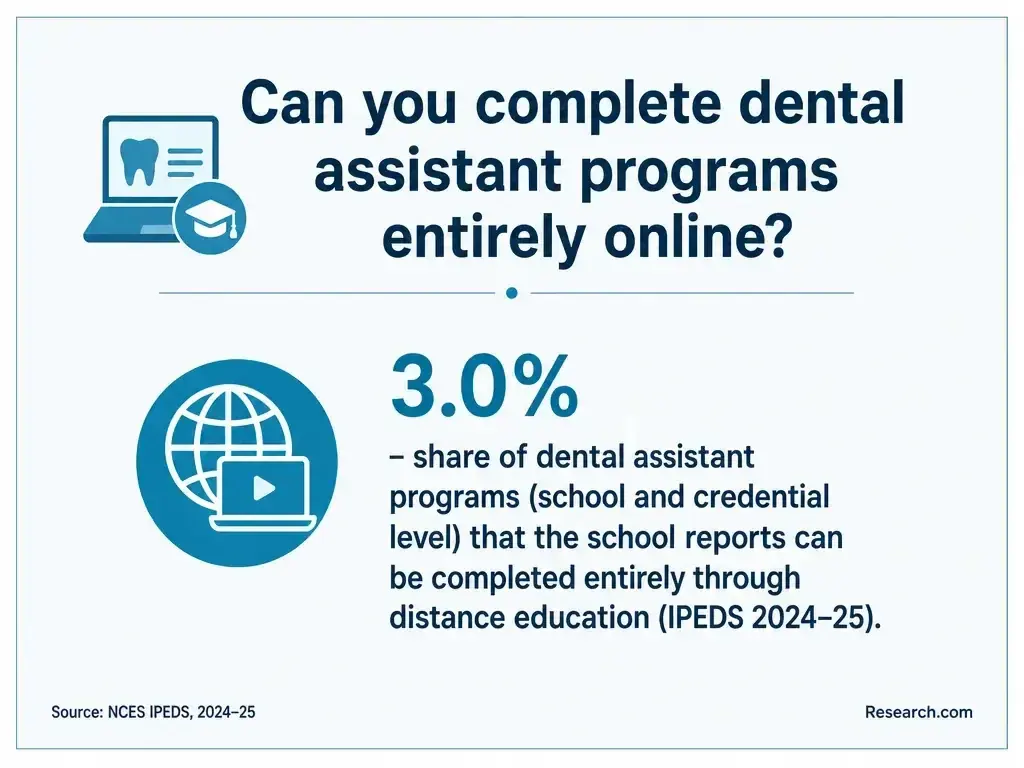
Online delivery can make terminology, records, and some infection-control coursework easier to fit around work. Instrument handling, chairside teamwork, patient positioning, and supervised clinical practice require in-person opportunities. An "online" label therefore says little about readiness until the provider explains where and when those competencies are assessed.
For someone commuting from Jenkintown, a hybrid program makes sense if required labs and office placements are accessible and scheduled predictably. Campus study may be preferable for a beginner who needs frequent guided practice. General guides to accelerated online degrees for working adults do not establish that a dental-assisting program includes the in-person training needed for the duties you intend to perform.
Before choosing either format, get written answers about lab attendance, clinical placement responsibility, and whether the resulting training supports your intended Pennsylvania duties. Do not assume that completing online coursework alone qualifies you for certification or regulated functions (Pennsylvania State Board of Dentistry; Dental Assisting National Board).
A reliable Jenkintown-wide average is not available here, and a tuition quote would not represent the full price of entry. Public and private providers can differ in charges and aid eligibility; either may be a good value depending on completion prospects and the training included. A directory of most affordable online schools for working students is not a substitute for a dental-assisting program's itemized price and clinical requirements.
Build a comparable, job-ready budget from each provider's written estimate:
Ask the financial-aid office whether the specific program qualifies for federal aid and which state or workforce-training assistance you can actually use. Employer-sponsored training may reduce upfront tuition and allow you to earn while learning, but compare its pay, supervision, and any work commitment with a school-based offer (Federal Student Aid; Pennsylvania Department of Labor & Industry).
The award depends on the provider: it may be a certificate, diploma, or associate degree. These are educational credentials, not automatic permission to perform every dental duty. CODA programmatic accreditation, institutional accreditation, Pennsylvania school authorization, DANB professional certification, and Pennsylvania authorization for particular duties answer different questions (Commission on Dental Accreditation; Dental Assisting National Board; Pennsylvania State Board of Dentistry).
For a first job, compare what an employer recognizes with the practical training behind the award. If you intend to pursue DANB's Certified Dental Assistant credential, check its current eligibility pathways and examination requirements against the exact program - not merely its name. If you want expanded functions in Pennsylvania, ask the state board whether the training meets its separate requirements. Lists of best accredited non-profit online schools cannot verify either form of dental-assisting eligibility.
Requirements vary by provider. Dental-assisting programs commonly ask for a high school diploma or equivalent; clinical participation may also involve health documentation, immunizations, or a background check. Confirm which items are admission conditions, which are placement conditions, and whether any must be paid for before enrollment (U.S. Bureau of Labor Statistics; individual program admissions policies).
Career changers should ask whether previous relevant coursework or documented workplace learning can reduce time or cost; do not assume transfer credit or advanced standing is offered. Older entrants comparing college degrees for seniors online should apply the same practical test to this trade pathway: can the schedule and required in-person training fit their circumstances? An office willing to train a beginner may offer a more workable entry route than a fixed daytime program.
Relevant instruction includes dental anatomy and terminology, infection prevention, instrument processing, chairside procedures, patient communication, and office records. Programs may also teach imaging concepts, but coursework alone does not establish permission to take dental X-rays in Pennsylvania (U.S. Bureau of Labor Statistics; Pennsylvania State Board of Dentistry).
Look past a topic list to how students demonstrate competence: supervised practice in preparing rooms, passing instruments, protecting patients and staff from contamination, and responding to a dentist's instructions matters in a working office. Ask how performance is assessed, how much practice occurs with equipment rather than only on a screen, and which tasks students may perform at their placement.
Pennsylvania does not treat every dental-assisting task as requiring the same credential. General assisting, dental radiography, and expanded-function work have different rules. In particular, the Pennsylvania State Board of Dentistry sets requirements for regulated functions; DANB certification is a professional credential and should not be mistaken for blanket state permission to perform them (Pennsylvania State Board of Dentistry; Dental Assisting National Board).
Decide which duties you want before choosing training. Ask the board and the program to identify the applicable education, examination, supervision, and state authorization requirements for those duties, then obtain confirmation that the program's current curriculum fits. A school's authorization to operate or an institution's accreditation does not replace those checks.
The best choice is the route that gets you competent and eligible for your intended duties at a cost and pace you can sustain. A ranking can identify programs for closer inspection; it cannot replace a comparison with nearby employer training or confirm an individual student's placement and aid package.
Use this sequence when speaking with admissions staff and prospective employers:
Be wary of a provider that promises certification from online study alone, cannot identify clinical arrangements, or quotes only tuition. Institutional type by itself does not determine return on investment: program duration, aid, debt, completion likelihood, earnings before and after training, and the time over which benefits accrue all matter. Material about accelerated master's programs online addresses a different investment and should not be used to judge this trade-school decision.
A common progression is supervised entry-level chairside work followed by greater responsibility as skills develop. Experience in a general office can help an assistant assess specialty practices, administrative duties, or supervisory opportunities. Additional training may support radiography or expanded functions, but Pennsylvania's rules - not experience or an optional credential alone - determine eligibility for regulated tasks (Pennsylvania State Board of Dentistry; U.S. Bureau of Labor Statistics).
Someone who wants to start earning quickly may favor an office that trains new assistants. Someone targeting specific advanced duties may benefit from a program deliberately aligned with those requirements. Either way, ask employers which skills lead to broader responsibilities and whether they help pay for further training.
The U.S. Bureau of Labor Statistics projects 7.4% national growth in dental-assistant employment from 2025 to 2035. That signals a growing occupation nationally, not a forecast of vacancies in Jenkintown or a guarantee of work after training.
Use the national projection alongside a local check: review current openings across a realistic commute, note which duties and credentials recur, and ask placement offices about beginner hiring. If most appealing openings require experience or regulated skills your chosen program does not provide, plan for a supervised first job or a different training route rather than assuming the growth figure will close that gap.
Investing in training is an important decision, especially when programs with similar names can differ in cost, clinical experience, and career preparation. Research.com compares programs against others in the same occupation and location so readers can assess realistic local options. Only programs with completions reported to IPEDS are eligible for the ranking; an unlisted employer-training route or other provider should not be assumed to be unavailable or low quality.
The best-programs ranking evaluates student outcomes, earnings and return on investment, costs and debt, and quality and recognition. Programmatic accreditation or relevant industry recognition accounts for 20% of the score, institutional accreditation for 10%, and student support for 10%. The remaining 60% covers completion and full- and part-time retention; earnings one year after completion and relative to annual attendance cost; tuition, attendance cost, debt - including debt among students who withdrew - and federal loan default rates. An entropy-based method distributes that remaining weight according to how much indicators differ across programs. Most-affordable-program rankings use only tuition, attendance cost, median debt, and default rates, with entropy-based weights; accreditation and other quality measures are not scored there.
To check the credibility and accuracy of the comparisons, the Research.com team uses the following education, accreditation, certification, and training data sources:
The ranking can narrow a shortlist, but its score cannot establish that a program meets every Pennsylvania duty or certification requirement. Confirm the current curriculum, practical placements, and regulatory eligibility directly before enrolling. See Research.com's methodology for more about how the ranking is created.
# 1 position
# 2 position
Yes. Some employers train beginners on the job. Compare the supervision and hands-on experience offered with a formal program, and verify separate Pennsylvania requirements before performing regulated duties (U.S. Bureau of Labor Statistics; Pennsylvania State Board of Dentistry).
It may support entry-level work, but its title alone does not establish competence, DANB certification eligibility, or permission for radiography or expanded functions. Check the curriculum against the job and duties you want.
Some coursework can be remote, but chairside skills and clinical practice require in-person training. Ask where those components occur and whether you must arrange your own placement.
Not necessarily. Compare total cost, foregone earnings, practical hours, completion prospects, and eligibility for your intended duties. A quick program that omits needed experience can cost more to remedy later.
No. Accreditation and state permission serve different purposes. Confirm the specific expanded-function requirements with the Pennsylvania State Board of Dentistry before enrolling.