# 1 position
Ross Medical Education Center-Morgantown - Dental Assisting/Assistant.
certificate or diploma

Audited and Verified:
Our Editorial and Data Verification Process
Research.com uses government datasets, official education statistics and primary institutional information to support its career and degree guides. Our review process checks factual accuracy, occupational definitions, source dates and the requirements associated with the credentials discussed.
How This Article Was Fact-Checked
Our editorial team verifies salary estimates, employment projections, education requirements and program information against original data providers and official organizations. Salary figures are checked against the relevant occupational definitions and reporting periods. Information about licensure, accreditation and required in-person training is reviewed separately.
Fact-checked and verified on:

Co-Founder and Chief Data Scientist

Reviewed by Karolina Broda
Fact-Checker and Data Verification
Choosing dental assistant training in Morgantown means looking beyond the certificate: will you practice chairside skills, meet West Virginia's rules for the duties you want, and finish without taking on more cost than the job can support? The U.S. Bureau of Labor Statistics reports a $48,070 national median annual wage for dental assistants in May 2025. This guide compares training routes, costs, credentials, and career prospects. It also features a Best Dental Assistant Trade Schools in Morgantown for 2027 ranking created by the Research.com team of data scientists to help students identify programs worth considering.
A dental assistant training program prepares students to support dentists during procedures, prepare rooms and instruments, follow infection-control protocols, communicate with patients, and maintain records. Some roles also involve dental imaging or other duties governed by West Virginia rules. Training is not interchangeable with permission to perform every task: the intended duties should determine which program is suitable (U.S. Bureau of Labor Statistics; West Virginia Board of Dentistry).
In Morgantown, compare a structured career-school program with training offered by a hiring dental practice. School-based training may provide scheduled labs and an arranged externship; employer training may let you earn while learning but can vary in scope and may not provide the credential or certification preparation you want. Ask Ross College-Morgantown and West Virginia Junior College-Morgantown whether they currently offer dental assisting, which credential is awarded, and where students complete supervised practice. Treat any answer about placement as a current program claim to verify, not a guaranteed job.
Most dental assistants work in dentists' offices; opportunities may also arise in specialty practices, including orthodontic and oral-surgery settings (U.S. Bureau of Labor Statistics). For a Morgantown student, the useful question is whether local clinical placements expose you to the type of practice where you want to work. A general-dentistry placement can build broad chairside routines, while a specialty placement may offer a narrower view of the occupation.
Ask whether placements require travel outside Morgantown, what hours practices expect, and whether you must arrange your own transportation. Those details affect both the real cost of training and whether a placement is workable alongside a job or caregiving responsibilities.
The national median annual wage for dental assistants was $48,070 in May 2025 (U.S. Bureau of Labor Statistics, Occupational Outlook Handbook). A median describes employed workers across experience levels and locations; it is not expected first-job pay in Morgantown. Before committing to tuition or debt, compare current local job postings for entry-level duties and schedules, and ask prospective employers what experience or credentials affect their offers.
Wages also need to be weighed against working hours, benefits, commuting, and any time spent gaining additional qualifications. A shorter, less costly route may offer better value for someone seeking an entry-level position, while a longer program may be worthwhile if its verified clinical training and credential match a specific career goal.
Completion time depends on the provider and format: a focused certificate or diploma can take less time than a broader associate-degree program, while part-time attendance extends the calendar even when required coursework is similar. Employer training follows the practice's schedule rather than a school term. Do not infer a program's length or required clock hours from its credential name; request the current catalog's total hours, lab hours, externship hours, and expected completion date from each provider.
For a working adult, the fastest calendar option is not necessarily the fastest route to a job. A compressed schedule that leaves little time for chairside practice - or requires an externship you cannot attend - can delay completion. Ask whether missed clinical hours must be made up and whether the school helps secure a placement.
Online coursework can be useful for dental terminology, records, and some infection-control theory. It cannot replace supervised practice with instruments, chairside workflows, and patients. A hybrid program is a practical option only if its in-person labs and any clinical placement are accessible from Morgantown and cover the competencies needed for the intended role.
When comparing online trade schools, obtain the dental-assisting program's actual lab and externship schedule, not just its advertised online format. Ask who arranges clinical sites and whether any required visits fall outside the area. Entirely remote coursework should not be assumed to satisfy certification pathways or West Virginia requirements for particular duties (Dental Assisting National Board; West Virginia Board of Dentistry).
There is no reliable single "average cost" for every Morgantown dental assistant route: published prices may cover different credentials, hours, and supplies. Compare written, current estimates for the total cost to become job-ready, rather than comparing tuition alone. The items below are the costs most likely to change the apparent price difference between programs:
Ask each school for an itemized estimate and a financial-aid offer before deciding how much to borrow. Federal aid eligibility depends on the institution and program, not simply on being a trade school (Federal Student Aid). Grants, eligible workforce funding, or paid employer training may reduce out-of-pocket cost, but compare the resulting debt, completion likelihood, and time away from paid work - not just the advertised tuition.
The credential depends on the route: a school may award a certificate, diploma, or associate degree, while an employer may document workplace training without awarding an academic credential. Ask each Morgantown provider for the exact award printed on its completion record. A credential title alone does not establish how much clinical training occurred or which duties a graduate may perform.
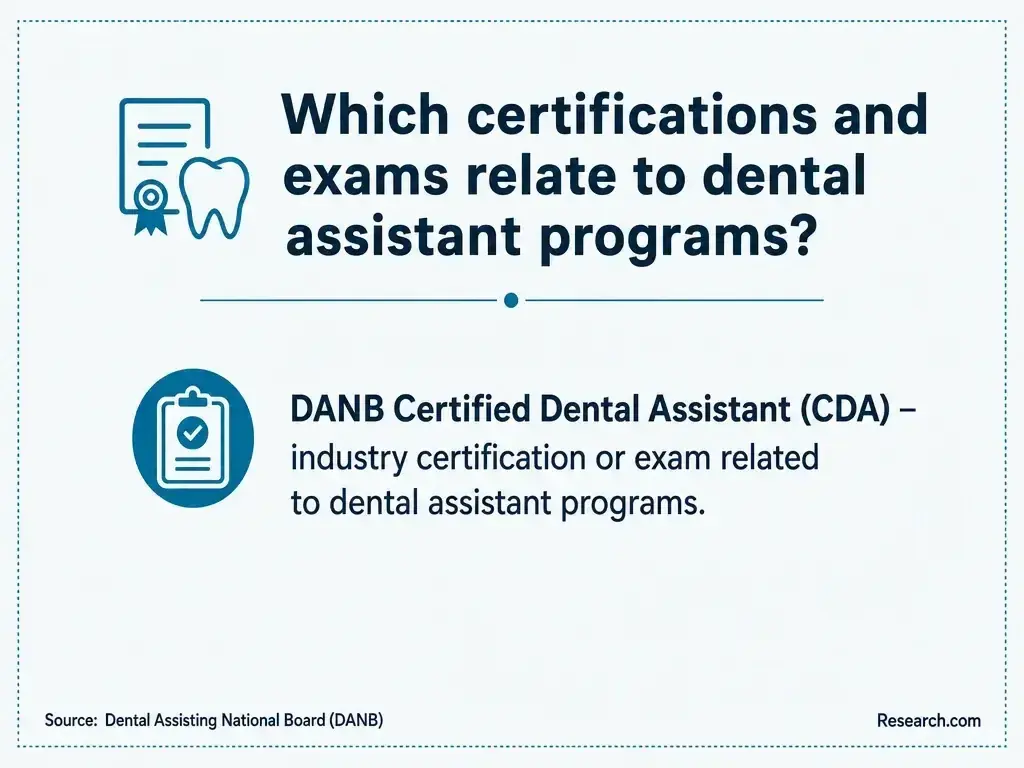
Institutional accreditation concerns the school; programmatic accreditation, when present, concerns a particular program. The Commission on Dental Accreditation maintains information on accredited dental-assisting programs. Professional certification through the Dental Assisting National Board is a separate process with its own eligibility and examination rules. State authorization, accreditation, certification, and permission to perform regulated duties are distinct checks - not substitutes for one another (Commission on Dental Accreditation; Dental Assisting National Board; West Virginia Board of Dentistry).
Entry requirements vary by provider. Request the current admissions checklist before paying a deposit; it may address prior schooling, an application or assessment, and requirements for participation in a clinical site. A practice offering on-the-job training may instead assess availability, communication skills, and willingness to learn its procedures. Do not assume that admission to a school automatically secures a clinical placement.
Compare requirements with your schedule as well as your qualifications. In particular, ask when externship hours occur, whether the clinical site sets additional screening requirements, and what happens if you cannot meet them. Those answers can reveal a barrier before you take on tuition or leave a current job.
Useful dental-assisting training connects classroom instruction to repeated practical work: preparing treatment areas, processing instruments, applying infection-control procedures, assisting chairside, documenting care, and communicating with patients and the dental team. Imaging instruction matters if the intended role includes radiography, but students must separately verify applicable West Virginia requirements (U.S. Bureau of Labor Statistics; West Virginia Board of Dentistry).
Ask to see how the program assesses these skills. A lab demonstration, supervised repetition, and feedback at a clinical site tell you more about job readiness than a course title alone. Training should also address current workplace use of digital records and imaging where those tools are part of the advertised curriculum; confirm which equipment students actually use rather than assuming every program provides the same exposure.
Do not treat "dental assistant" as a single, nationally licensed scope of practice. West Virginia determines which dental-assisting duties require particular training, examinations, credentials, or other authorization. The West Virginia Board of Dentistry is the primary source for requirements affecting work in Morgantown; the Dental Assisting National Board sets separate requirements for its professional certifications. Completing a program or earning a national certification does not automatically authorize every state-regulated duty (West Virginia Board of Dentistry; Dental Assisting National Board).
Before enrolling, identify the duties in jobs you want - especially radiography or expanded functions - then ask the school to show how its curriculum and supervised experience align with the current board rules. If you may work across a state line later, check that state's rules separately; West Virginia eligibility should not be assumed to transfer.
The best choice is the route that gets you ready for your intended work at a manageable total cost. A ranking can identify programs to investigate, but it cannot confirm that a particular externship schedule, financing plan, or set of duties fits you. Use this sequence when speaking with Ross College-Morgantown, West Virginia Junior College-Morgantown, or a practice offering training:
Red flags include a promise of certification without identifying the certifying body, an "online" program with no clear plan for practical training, or a quoted price that excludes mandatory supplies or clinical travel. Also ask about completion and placement measures - and how the school defines them - rather than accepting a guaranteed-outcome claim. If your immediate goal is to enter a practice and learn on the job, paid employer training may be a better fit than financing a longer school program; if you need structured instruction and documented clinical practice, a school-based route may offer more value.
Training can lead to general chairside assisting and, with the appropriate preparation and authorization, duties involving imaging or expanded functions. Experience may support a move into a specialty practice, patient coordination, or lead-assistant responsibilities. These are possible paths, not automatic promotions or permissions granted by a certificate (U.S. Bureau of Labor Statistics; West Virginia Board of Dentistry).
Choose initial training for the role you actually want next. Paying for a longer credential only makes sense if its additional supervised skills, employer recognition, and cost fit your plans. Conversely, starting through an employer can make sense if the practice will train you thoroughly and you can later obtain any additional qualifications your preferred duties require.
The U.S. Bureau of Labor Statistics projects 7.4% national employment growth for dental assistants from 2025 to 2035. That supports considering the occupation, but it does not predict the number of openings in Morgantown or guarantee a job after training. A smaller local search area can make the availability of nearby practices and workable clinical placements particularly important.
Check current postings for the duties employers request, then ask prospective training providers how they connect students with practices. Revisit those postings before paying a deposit: if they consistently require skills a program does not teach, its lower price or faster schedule may not make it the better investment.
Investing in training is an important decision. Research.com created its ranking to help readers compare dental assistant programs with other programs serving the same occupation and location - not with unrelated schools nationwide. The team checks multiple education and occupational sources to improve the ranking's quality, credibility, and accuracy. Only programs reporting completions to the Integrated Postsecondary Education Data System (IPEDS) are eligible; an omitted employer-training route or school should not be assumed to be poor quality.
Best-program rankings assess student outcomes; earnings and return on investment; costs and debt; and quality and recognition. Programmatic accreditation or relevant industry recognition carries 20% of the score, institutional accreditation 10%, and student support 10%. The remaining 60% covers outcomes, earnings, and costs, with weights distributed using an entropy-based method that gives more weight to indicators that differ more across programs. Measures include completion and full- and part-time retention; earnings one year after completion relative to attendance cost; tuition, attendance cost, debt - including for students who withdrew - and federal loan default rates.
Most-affordable-program rankings are different: they score tuition, attendance cost, median debt, and federal loan default rates using entropy-based weights, without adding accreditation or other quality indicators to that score. Neither ranking replaces a check of hands-on training or eligibility to perform particular duties in West Virginia.
The ranking draws on the following sources. Some, such as construction-training references, inform Research.com's broader trade-school methodology rather than dental-assisting requirements specifically:
Readers can use the ranking to narrow their shortlist, then verify each program's current price, clinical experience, and credential claims directly. More detail is available in Research.com's ranking methodology.
# 1 position
# 2 position
# 3 position
An employer-training route may be possible for some entry-level work. Confirm what the practice teaches and check West Virginia Board of Dentistry rules before assuming it covers radiography or other regulated duties.
Do not assume so. Theory can be taught remotely, but chairside skills require practical training; check the program's labs, clinical arrangements, and alignment with your intended duties.
No. A school awards its completion credential; professional certification has separate requirements set by the certifying organization, such as the Dental Assisting National Board.
Compare the full cost, clinical hours, schedule, credential, and preparation for the duties you want. Include travel and lost earnings, not just tuition.
No. Accreditation and West Virginia's duty-specific requirements serve different purposes. Verify both separately before enrolling.