# 1 position
Spartanburg Community College - Dental Assisting/Assistant.
certificate or diploma

Audited and Verified:
Our Editorial and Data Verification Process
Research.com uses government datasets, official education statistics and primary institutional information to support its career and degree guides. Our review process checks factual accuracy, occupational definitions, source dates and the requirements associated with the credentials discussed.
How This Article Was Fact-Checked
Our editorial team verifies salary estimates, employment projections, education requirements and program information against original data providers and official organizations. Salary figures are checked against the relevant occupational definitions and reporting periods. Information about licensure, accreditation and required in-person training is reviewed separately.
Fact-checked and verified on:

Co-Founder and Chief Data Scientist

Reviewed by Karolina Broda
Fact-Checker and Data Verification
The cheapest dental assistant program may not be the least expensive route to a job if it leaves you paying separately for clinical training or required certifications. The U.S. Bureau of Labor Statistics (BLS) projects 7.4% national employment growth for dental assistants from 2025 to 2035. For South Carolina students and career changers, this guide compares training routes, costs, practical experience, and state rules. It accompanies the Most Affordable Dental Assistant Trade Schools in South Carolina for 2027 ranking, created by the Research.com team of data scientists to help students identify programs worth considering.
Expect instruction in chairside assistance, infection prevention, patient communication, dental materials, records, and practice workflow, followed by supervised practice. A useful program lets you demonstrate those skills with equipment and patients - not just pass online quizzes. Ask which procedures students perform in a campus lab, which they observe or perform at a clinical site, and who arranges that placement.
The main routes differ in what you pay for and when you gain experience. This comparison helps match a route to your intended duties.
| Route | Training and credential | Best fit and main limitation |
| Technical-college certificate or diploma | Organized coursework and labs; may include a supervised clinical experience. Awards the college's stated credential. | Fits students seeking structured preparation; confirm clinical access and total fees. |
| Private career-school program | Often an accelerated certificate with labs; clinical arrangements vary. | Fits students needing a particular schedule, provided its higher or lower total cost and practical training justify the choice. |
| Direct entry with employer training | Practice-specific, supervised learning; may not award a school credential. | Fits applicants who find a willing employer and can start with permitted duties; training breadth and advancement options vary. |
| Registered apprenticeship, if available locally | Paid work with structured training under a registered sponsor. | Worth exploring for earn-while-learning access, but confirm that a dental-assisting opportunity actually exists nearby and covers intended duties. |
These routes are not interchangeable simply because they use the title "dental assistant." In particular, ask how each prepares you for radiography or expanded duties under current South Carolina rules. A program may also prepare students for a professional certification examination without making every graduate automatically eligible to take it.
Most dental assistants work in dentists' offices, according to BLS. In South Carolina, that makes the location of potential clinical placements and hiring practices especially important: a nearby practice may be a more useful training partner than a distant campus with a convenient class schedule. General and specialty practices can offer different exposure to procedures and equipment.
Ask a program where recent students completed clinical training and whether it can place you within a workable commute. In a rural area, limited placement choices may add transportation costs or delay completion; in a larger labor market, compare the types of practices available, not just the number of advertisements. The clinical experience and duties an employer expects can differ from what an entry-level classroom credential alone provides.
BLS reports a $48,070 U.S. median annual wage for dental assistants in May 2025. This is a national midpoint for employed assistants with varying experience - not a South Carolina starting salary or a promised return on tuition. For a local estimate, check the latest South Carolina occupational wage release and compare current job postings in the area where you intend to work. Distinguish advertised hourly pay from a full-time annual estimate, particularly if hours or benefits vary.
For an investment decision, compare a realistic first-job offer with what you could earn without enrolling. Factor in time out of work, any debt, and whether a program gives you access to duties local employers seek. A lower-priced program is not the better bargain if it requires substantial additional training before you can compete for those jobs.
Program length varies by route and schedule: an accelerated certificate may take months, while a more extensive college program can span multiple terms. Employer training progresses with the practice's needs rather than a school calendar. There is no single clock-hour total that describes every South Carolina dental assistant pathway; compare the actual instructional hours, lab hours, and clinical requirements published by each provider.
Ask for the calendar from first class through clinical placement and credential award. A short advertised course can take longer if the student must secure a clinical site independently or complete separate preparation for advanced duties. Part-time study can preserve earnings while extending the time before you can apply for positions requiring the completed training.
Online coursework can cover terminology, records, and some infection-control concepts. Chairside technique, instrument handling, radiography practice, and supervised patient care need appropriate equipment and in-person oversight. A hybrid program may reduce classroom commutes, but it does not eliminate travel to labs and clinical sites.
Before choosing a remote option, get the location and schedule of every in-person requirement in writing. Confirm who supplies the clinical placement and whether the training supports your intended South Carolina duties and any certification you plan to pursue. Resources about top accredited non-profit online universities can help readers evaluate online institutions generally, but an institution's accreditation does not establish that an online dental-assisting course provides the required hands-on training.
There is no single dependable statewide average that represents short courses, technical-college programs, private schools, and employer training on the same basis. Rather than apply an unrelated tuition average to your decision, request an itemized, program-specific cost estimate. Public-college resident and nonresident rates may differ; verify which rate you qualify for with the college.
The items below belong in a job-ready cost estimate, even if they appear on separate bills.
Federal aid eligibility depends on both the institution and the particular program, according to Federal Student Aid; do not assume that a short certificate qualifies. Compare the net cost after aid and likely borrowing, not a tuition-only headline. Someone considering top degree programs for seniors online should likewise keep that separate education decision from the costs and clinical requirements of dental-assisting training.
The award may be a certificate or diploma, depending on the provider. A school credential documents completion; it is not the same as Dental Assisting National Board (DANB) certification, CODA programmatic accreditation, or authorization to perform a particular duty under South Carolina rules. Ask for the exact credential name and the program's written explanation of which certification eligibility routes it supports.
Institutional accreditation concerns the school. CODA accreditation concerns a specific dental education program; it should be checked at the program level. State school authorization, where applicable, addresses permission to operate and is another distinct question. Even a recognized credential does not replace verification of the Board of Dentistry's rules for radiography or expanded functions. Lists of top schools with national accredited status cannot answer those dental-assisting program and duty-specific questions.
Schools set their own admissions criteria. Request the current requirements for prior education, applications, placement testing if used, immunizations or health documentation, and any background check required for a clinical site. An employer offering direct-entry training may use a different hiring process. Meeting school admissions requirements does not itself qualify a student for every clinical placement or dental-assisting duty.
If you have previous healthcare training or work experience, ask whether the provider awards prior-learning credit or advanced standing and whether that would change required labs or clinical practice. Get the answer before paying a deposit. Readers comparing one year master's programs online are considering a separate pathway; those admissions criteria do not predict entry requirements for a dental-assisting trade program.
Relevant instruction includes preparing treatment rooms, assisting during procedures, sterilization, infection control, dental materials, patient communication, and records. BLS describes these as common occupational tasks; the South Carolina Board of Dentistry determines which duties and conditions apply in the state. Radiography and expanded functions deserve particular scrutiny because a course description alone does not establish authority to perform them.
Ask to see a skills checklist and how instructors assess each competency. A program with repeated supervised practice may be more useful than one that covers the same topics only in lectures. Training should also address professional boundaries: assistants must know when a task requires the dentist's supervision or falls outside their permitted role.
Do not assume that every dental assistant position requires the same individual license or certification. South Carolina regulates dental-assisting duties through the South Carolina Board of Dentistry; the requirements relevant to an entry role may differ from those for radiography or expanded duties. Check the Board's current rules for the specific tasks you want to perform before selecting training. A school certificate is not itself permission to perform a regulated function.
DANB professional certification is separate from state regulation, and DANB sets its own examination eligibility requirements. Ask both the program and the Board which education, examination, or other conditions apply to your goal. If an admissions representative says a program "qualifies you for everything," request the applicable rule and eligibility route in writing rather than relying on the claim.
Start with the duties you want in your first job, then compare programs that can realistically prepare you for them. The affordability ranking is a useful shortlist, not a substitute for checking clinical access and regulatory fit. The following questions expose differences that a tuition comparison can miss:
Compare the answers with direct-entry employer training before committing. A paid position may reduce debt, while a structured program may provide broader practice or a clearer credential. Either can be the better investment depending on completion likelihood, aid, lost earnings, expected pay, and how long you expect to use the training. A search for the quickest cheapest masters degree addresses a different investment; speed and price alone are no better substitutes for occupational fit here.
An entry-level assistant may develop greater responsibility through experience, training for permitted expanded duties, or relevant certification. Other possible directions include specialty-practice assistance, patient coordination, or dental-office administration. Employers may value different combinations of clinical skill and experience; no initial certificate automatically confers an advanced role.
Choose training around the first role you actually want. If your goal is chairside work, prioritize supervised clinical practice. If you already work in a practice and want additional permitted duties, ask the Board and your employer what targeted preparation is needed before buying another broad entry-level program. Quickest cheapest masters degree comparisons are not a substitute for that occupation-specific decision.
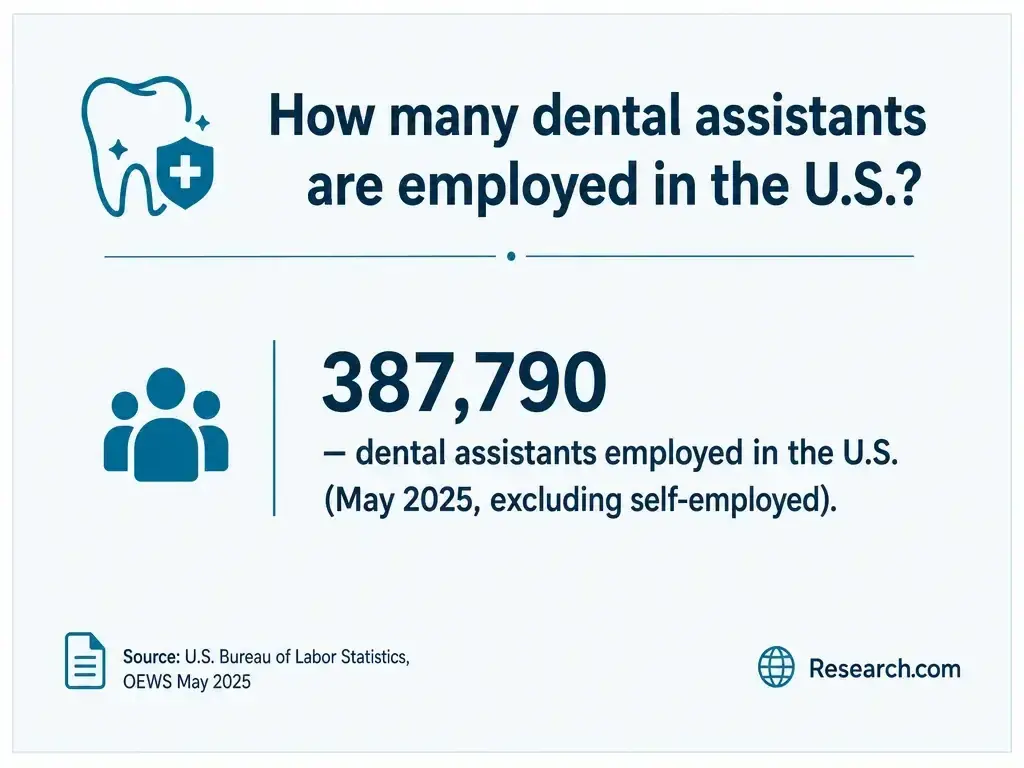
BLS projects 7.4% U.S. employment growth for dental assistants over 2025-2035. That national projection indicates demand for the occupation overall, but it is not a South Carolina forecast and cannot tell you how quickly you will find a job in your county. Use current state labor-market projections and local postings alongside it when deciding where to train and seek clinical experience.
Look beyond a posting count: note whether nearby employers request prior chairside experience, radiography preparation, particular schedules, or expanded-duty eligibility. Those details can make a longer program with relevant clinical practice worthwhile - or show that a local employer willing to train is the more economical starting point.
Education is a consequential investment, so Research.com evaluates programs against other dental assistant programs in the same location rather than against unrelated trades. The Most Affordable ranking uses tuition, cost of attendance, median student debt, and federal loan default rates. Its weights are assigned through an entropy-based method, which gives more weight to measures that vary more across included programs. Only programs with completions reported to IPEDS can enter the ranking; an omitted training provider is not necessarily unapproved or poor quality.
The team draws on education, accreditation, certification, and training sources to check the credibility and relevance of program information. Sources used to create the ranking include:
Affordability scores do not include accreditation or other quality indicators. Use the ranking to narrow a price-conscious shortlist, then verify clinical training, credential eligibility, and the full amount you would pay. For more detail on the ranking approach, see the Research.com methodology.
# 1 position
# 2 position
# 3 position

# 4 position
# 5 position
# 6 position

# 7 position

# 8 position

# 9 position
# 10 position
An employer willing to train may minimize upfront school costs, but availability and training breadth vary. Compare any paid training with a program's net price, clinical experience, and preparation for the duties you want.
Online coursework may cover theory, but chairside skills and clinical practice require in-person training. Confirm the location and supervision of those components before enrolling.
Not every entry route is identical. CODA accreditation applies to a program and may matter for particular credential routes; check DANB eligibility and South Carolina Board of Dentistry rules for your intended duties rather than assuming it is universally required or irrelevant.
Not automatically. Verify the Board of Dentistry's current radiography requirements and whether the specific course satisfies the applicable route before you pay for it.
Eligibility varies by school and program. Ask the financial-aid office to confirm eligibility for the exact certificate you intend to take and provide a written estimate of your remaining cost.