# 1 position


Audited and Verified:
Our Editorial and Data Verification Process
Research.com uses government datasets, official education statistics and primary institutional information to support its career and degree guides. Our review process checks factual accuracy, occupational definitions, source dates and the requirements associated with the credentials discussed.
How This Article Was Fact-Checked
Our editorial team verifies salary estimates, employment projections, education requirements and program information against original data providers and official organizations. Salary figures are checked against the relevant occupational definitions and reporting periods. Information about licensure, accreditation and required in-person training is reviewed separately.
Fact-checked and verified on:

Co-Founder and Chief Data Scientist

Reviewed by Karolina Broda
Fact-Checker and Data Verification
A low tuition price does not necessarily make a dental assistant program the cheapest route to a job: clinical travel, fees, and the training needed for specific duties can change the calculation. The U.S. Bureau of Labor Statistics projects 7.4% national growth in dental assistant employment from 2025 to 2035. For prospective students and career changers, this guide compares Florida training routes, costs, credentials, and work requirements. It also accompanies the Most Affordable Dental Assistant Trade Schools in Florida for 2027 ranking, created by the Research.com team of data scientists to help students identify programs worth considering.
Expect a short occupational program built around chairside practice, not just classroom study. Students commonly practice infection control, instrument preparation, patient communication, charting, and assisting during procedures in a lab before working with patients under supervision. Ask how many scheduled hours occur in a simulated lab and how many, if any, occur at a dental office; similarly named certificates can offer different amounts of practice.
Public technical or community college programs and private career-school programs may award certificates or diplomas. A longer community-college pathway may award an associate degree, but that extra time is not inherently necessary for entry-level assisting. A dental office may instead hire and train an entry-level assistant. That route can let someone earn while learning, though access to structured instruction and eligibility for radiography or expanded duties must be checked separately (Florida Board of Dentistry; U.S. Bureau of Labor Statistics).
Dental assistants primarily work in dentists' offices, including general and specialty practices; some work in public-health or other dental-care settings (U.S. Bureau of Labor Statistics). A student interested in orthodontics or oral surgery should ask whether a program arranges relevant clinical exposure rather than assuming a general placement covers that specialty.
Location affects the decision because an affordable campus is less useful if its clinic schedule requires an impractical commute. Compare the locations of classes, labs, and placements separately. If you hope to work outside Florida later, check the destination state's duty and radiography rules; training accepted for particular duties in one state does not automatically transfer to another.
Florida pay varies by employer, location, experience, and permitted duties. For a clearly defined benchmark, the national median annual wage for dental assistants was $48,070 in May 2025 (U.S. Bureau of Labor Statistics, Occupational Outlook Handbook). A median divides employed workers into two equal groups; it is not a typical offer to a newly trained Floridian. Ask local employers about entry-level hourly pay and paid benefits before estimating how quickly training costs could be recovered.
When comparing an offer with a program's price, include the time you will spend out of work or working fewer hours. Someone already employed in a dental office may get a different return from additional training than someone paying full tuition before securing a first position.
Certificate and diploma schedules can range from short, concentrated training to longer programs with substantial lab and clinical time; part-time study takes longer on the calendar. There is no single statewide clock-hour requirement for every entry-level dental assistant program. What matters is whether a program's documented instruction and supervised practice support the duties you intend to perform under Florida's rules (Florida Board of Dentistry).
Request a schedule showing total clock or credit hours, lab hours, clinical hours, and the earliest realistic completion date. If speed is your priority, compare that schedule - not just the advertised program length - with the time needed to arrange clinical placement and any additional duty-specific training. Readers weighing best accelerated programs should be especially cautious about treating a short calendar as evidence of equivalent hands-on preparation.
Online instruction can cover terminology, anatomy, office procedures, and some infection-control concepts. Instrument handling, chairside teamwork, radiography practice, and patient-facing clinical work require appropriate in-person training and supervision. A hybrid program can reduce trips for lectures, but it cannot eliminate travel to its labs or clinical site.
Before paying for an online course, get the location and schedule of every required in-person component in writing. Confirm separately whether the course meets Florida requirements for the radiography or expanded duties you want; an online completion certificate alone does not establish that eligibility (Florida Board of Dentistry). For students exploring cheapest online universities, dental assisting is a useful reminder that low-cost remote coursework and low-cost, job-ready clinical training are different purchases.
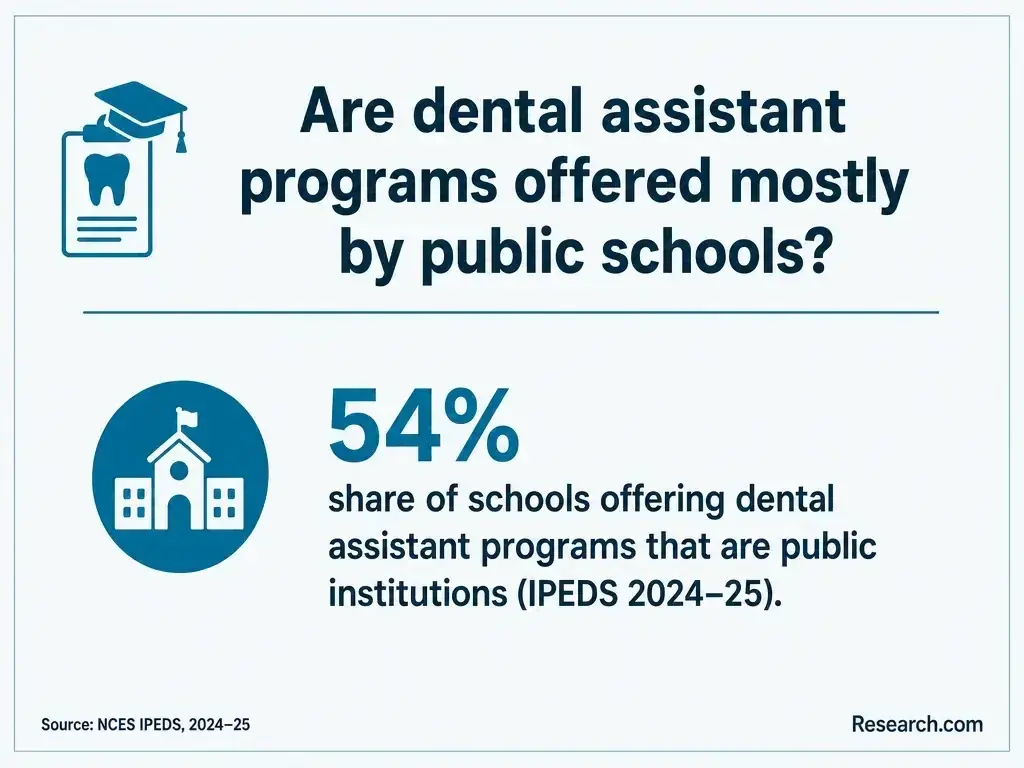
There is no single defensible statewide average that covers Florida's public programs, private schools, and employer training on the same basis. Published tuition may exclude expenses that determine what a student actually pays. Compare each option using a written, job-ready total, rather than treating an advertised price as the final cost.
Request an itemized estimate covering the following costs and any available offsets:
Public-program resident rates may differ from nonresident rates; verify residency rules and current charges with the provider. Federal aid depends on both the student and program being eligible, so check eligibility through Federal Student Aid rather than assuming every short course qualifies. Florida workforce offices may also identify training assistance for eligible job seekers (Federal Student Aid; CareerSource Florida). A paid office-training opportunity may have lower upfront cost, but compare its supervision and duty-specific training before calling it the better value.
The award might be a school certificate, diploma, or, in a longer academic pathway, an associate degree. These document completion; they are not themselves a Florida dental assistant license. The Dental Assisting National Board's Certified Dental Assistant credential is a separate, voluntary professional certification with its own eligibility and examination requirements (Dental Assisting National Board).
Institutional accreditation concerns the school; programmatic accreditation, such as Commission on Dental Accreditation accreditation, concerns a particular program. State authorization addresses permission to operate. None should be mistaken for automatic permission to perform every dental duty. Ask the school which credential it awards, whether its specific program has programmatic accreditation, and which Florida duty-specific training requirements its graduates meet (Commission on Dental Accreditation; Florida Board of Dentistry).
Entry requirements vary by provider. Schools may request a high school diploma or equivalent, an application, and evidence that a student can meet clinical-site health or background requirements. Confirm these with the program before paying an application fee; a school's admission standard is different from Florida's rules for performing particular duties.
Applicants already working in a dental office should ask whether documented experience can reduce coursework or support a duty-specific training route. Do not assume that experience automatically earns school credit or substitutes for a required course; obtain the school's credit decision and the applicable Florida Board of Dentistry guidance in writing.
Core training usually combines dental anatomy and terminology with infection prevention, sterilization, patient preparation, chairside assistance, records, and communication. Depending on the program, students may also learn dental materials, impressions, radiography, and practice administration. These subjects matter most when students can demonstrate them safely in a lab and, where available, a supervised clinical setting (U.S. Bureau of Labor Statistics).
Use the curriculum to test the program's fit: if your goal is a role involving radiographs, ask where you practice image-taking and how the training relates to Florida's radiography requirements. If you want a specialty office, ask whether the clinical placement exposes you to its workflow. A course title alone does not show that either experience is included.
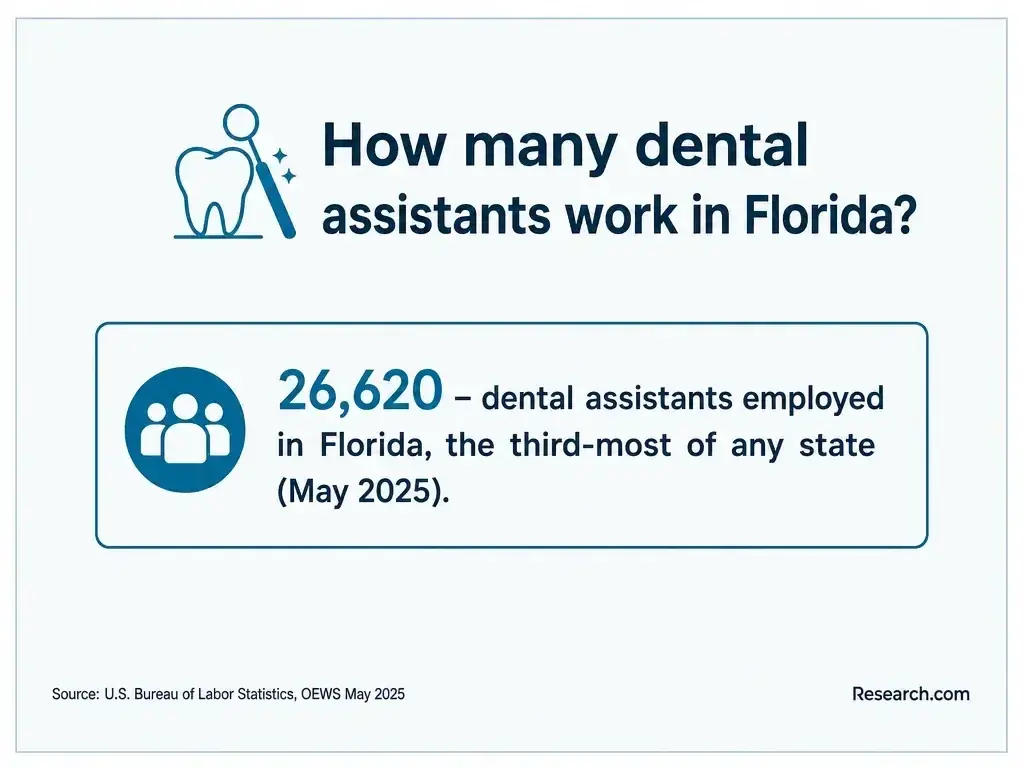
Florida does not issue a general license to work as a dental assistant. It does regulate which duties an assistant may perform and under what training and supervision conditions. Dental radiography and expanded functions have distinct requirements, so an assistant hired for basic duties should not assume they can immediately perform either (Florida Board of Dentistry).
Before enrolling, identify the tasks in the jobs you want, then ask the program to identify the Florida Board of Dentistry rule and training route it says applies to each regulated task. Verify the answer with the board. National certification through the Dental Assisting National Board may demonstrate additional preparation, but it is separate from Florida's duty-specific rules and is not a general state license (Dental Assisting National Board; Florida Board of Dentistry).
Start with the job, not the ranking position. The cheapest suitable option is the one that gets you the needed practical preparation and duty-specific eligibility at a manageable total cost. Compare the following in the same order for each shortlisted program:
A warning sign is a school promising that an entirely online certificate qualifies you for every dental duty, or quoting tuition without identifying clinical costs. Rankings can help locate affordable candidates, but they do not replace those checks. Career changers looking at degrees for older adults online should likewise check whether a remote option actually matches their desired occupation's hands-on requirements.
A common starting point is chairside assisting in a general practice. With employer experience and appropriate training for assigned duties, an assistant may move into a specialty practice, take on more permitted functions, or focus on scheduling and office coordination. Optional national certification can be useful where an employer values it; it does not change Florida's duty-specific rules by itself (Dental Assisting National Board; Florida Board of Dentistry).
Dental assisting is a good fit for someone who wants patient contact and practical work without assuming that a longer credential is required for entry. It is a weaker fit if the intended work is a different occupation with different training requirements. Readers comparing what careers can you go to trade school for should compare the actual daily tasks and entry rules, not just program length. Longer-term earnings comparisons, including four year degrees that pay well, describe a different educational investment - not a requirement for dental assistant entry.
The U.S. Bureau of Labor Statistics projects 7.4% growth nationally from 2025 to 2035 for dental assistants. This indicates continued demand across the occupation, but it does not predict openings for a particular Florida graduate or commute area. Use local postings to see which duties and schedules employers currently request, and ask prospective clinical sites whether they hire entry-level assistants.
When weighing return on investment, consider more than the projected growth rate: completion likelihood, aid and debt, wages you give up while training, plausible post-training pay, and how long you expect to work in the role all matter. For a formal comparison of options with different timing and costs, account for when those expenses and earnings occur rather than assuming the shortest or cheapest program wins.
Research.com created the ranking to help readers compare the cost of dental assistant training with other options available in Florida. Investing in education is an important decision, so the team draws on education, cost, debt, accreditation, and occupation-specific sources and checks the comparability of programs before ranking them.
Most affordable program rankings use tuition, cost of attendance, median student debt, and federal loan default rates. An entropy-based method assigns more weight to cost and debt indicators that differ more across programs. Accreditation and other quality indicators do not contribute to the affordability score; readers should evaluate those separately. Programs are compared with others in the same occupation and location, and only programs reporting completions to IPEDS are eligible. That limitation means a missing employer-training route or provider should not be assumed nonexistent or low quality.
The following sources informed the ranking and its occupation-specific checks:
The ranking narrows the search, but it cannot establish a student's final bill or eligibility to perform particular dental duties. Compare written program quotes and Florida Board of Dentistry requirements before enrolling. More detail on the ranking approach is available in Research.com's methodology.
# 1 position
# 2 position
# 3 position

# 4 position
Dental Assisting/Assistant
Delivery mode: On Campus (May Include Online Courses)
92.00
/ 100
Final score
Accreditation
Industry recognition: DANB-accepted for NELDA certification. Institutional accreditation from Southern Association of Colleges and Schools Commission on Colleges.
Miami Dade College earned a Research.com Affordability Score of 92.00/100, supported by $2,838 annual in-state tuition and $6,626 median student debt. The program is DANB-accepted for NELDA certification.
# 5 position

# 6 position

# 7 position

# 8 position
# 9 position

# 10 position
# 11 position

# 12 position

# 13 position

# 14 position
# 15 position

# 16 position
# 17 position

# 18 position

# 19 position
# 20 position

Compare the complete price of eligible public and private training with supervised employer training. An office job may reduce upfront tuition, but confirm how you would obtain training for any radiography or expanded duties you plan to perform.
Yes. Florida does not require a general dental assistant license, and employers may train assistants for appropriate entry-level tasks. Particular duties have separate rules, so verify those before accepting responsibilities (Florida Board of Dentistry).
Do not assume so. Online theory does not replace hands-on practice or establish eligibility for Florida-regulated duties. Ask where practical training happens and verify the program's duty-specific claims with the Florida Board of Dentistry.
There is no general Florida dental assistant license or blanket requirement for the Dental Assisting National Board's Certified Dental Assistant credential. Check the rules for your intended duties and any employer preferences separately (Florida Board of Dentistry; Dental Assisting National Board).
Not necessarily. Add fees, supplies, travel, lost earnings, and any extra training, then compare practical experience and completion prospects. A cheap program that does not prepare you for the duties you want may cost more to remedy later.